Keeping It Level
The shower bench vs shower chair for seniors debate isn’t really about the seat — it’s about whether you want a permanent solution or a flexible one. Measure your shower space before you buy anything. Make sure whatever you choose has adjustable legs and rubber feet. And understand that back support isn’t a luxury — for some seniors it’s a safety requirement.
My mamaw bought a shower bench for her small bathroom. It was beautiful. It was also enormous — way too wide for the shower she’d been using for thirty years. By the time she got around to returning it the window had closed.
Last I checked it’s holding a fern in her living room.
I’m a contractor. I’ve installed many shower seats in aging in place bathrooms. And I’ll tell you honestly — the mistake she made is the most common one I see when seniors or their families are shopping for a shower bench vs shower chair. Not the wrong style. Not the wrong material. The wrong size. Bought before anyone measured anything.
If you’re trying to decide between a shower bench vs shower chair for seniors — whether for an elderly parent or for yourself — this guide will help you make the right call the first time. Because a shower seat that doesn’t fit the space isn’t a safety upgrade. It’s an expensive flower stand.
For the complete bathroom safety picture beyond the seat itself my Senior Bathroom Safety Guide maps out every element from floor to fixtures.
The Question Everyone Asks vs the Question They Should Be Asking
Most people come to me asking which is better — a shower bench or a shower chair for seniors. That’s actually the second question.
The first question is whether you want a permanent modification or a flexible solution. The answer to that determines everything else — including which seat makes sense, what the installation involves, and whether you’re making a decision for right now or for the next twenty years.
When families are working through the shower bench vs shower chair decision for a senior parent that permanent vs flexible question is almost always what I’m really trying to answer. Get that right and the rest follows naturally.
Permanent vs Non-Permanent: The Real Shower Bench vs Shower Chair Decision
This is the framework I use every time I’m standing in a client’s bathroom working through the shower bench vs shower chair for seniors decision with them.
The Permanent Path
The permanent path means a built-in tiled bench or a fold-down wall-mounted seat. A built-in tiled bench is a full structural modification — framing, waterproofing, tile, grout, correct height relative to finished floor. It’s the most durable long-term option but it’s also the most expensive — a built-in tiled bench installation can run $1,500 to $3,000 or more depending on the scope of the work. A fold-down wall-mounted seat is significantly more affordable than a full built-in and still gives you a permanent solution — it mounts into wall blocking, folds flat when not in use, and doesn’t require tearing anything out to install if the blocking is already there. For a deeper look at built-in bench types, materials, and what makes one hold up over time my Shower Bench for Seniors Guide covers every option from tiled built-ins to freestanding teak. Both are right for someone whose mobility situation is stable and who wants something that stays put.
The Non-Permanent Path
The non-permanent path means a freestanding shower chair or a portable bench. These move, adjust, and can be replaced if needs change. A quality freestanding shower chair for seniors runs $40 to $150 — a fraction of what any permanent modification costs. If you want a full breakdown of what to look for before you buy — frame construction, foot type, weight capacity, and the features that actually matter — my Shower Chair for Seniors Guide covers it in detail. For elderly seniors on a fixed income a quality portable option isn’t a compromise. It’s often the smartest choice — especially when mobility needs are still changing and locking into a permanent installation might mean doing the work twice.
When the Portable Option is the Smarter Choice
I’ll be honest about something most guides skip. A lot of the seniors I work with in Eastern Kentucky are on fixed incomes. Home renovations aren’t cheap and pretending budget isn’t a factor doesn’t serve anyone. My job is to give you the safest option I can within what you can actually spend. A quality shower chair with rubber feet, adjustable legs, and the right weight capacity does exactly what a built-in bench does — it gives a senior a safe place to sit in the shower. The difference is in the installation cost, the permanence, and whether the solution fits where someone is in their life right now.
Neither path is wrong. They solve different problems for different seniors at different points in their lives — and at very different price points. The mistake is choosing based on anything other than what actually fits the situation and the budget in front of you.
For anyone who wants to understand the full cost picture of a permanent shower modification my Hidden Structural Costs in a Senior Bathroom Remodel covers what drives those numbers and why two bathrooms that look identical on paper can come in at very different prices.
Measure First. Everything Else Second.
Before you do anything else in the shower bench vs shower chair for seniors decision — measure your shower.
I cannot tell you how many times I’ve walked into a bathroom where someone bought a bench, got it home, and discovered it doesn’t fit. My mamaw is not alone. This happens constantly — and it happens because people shop before they measure.
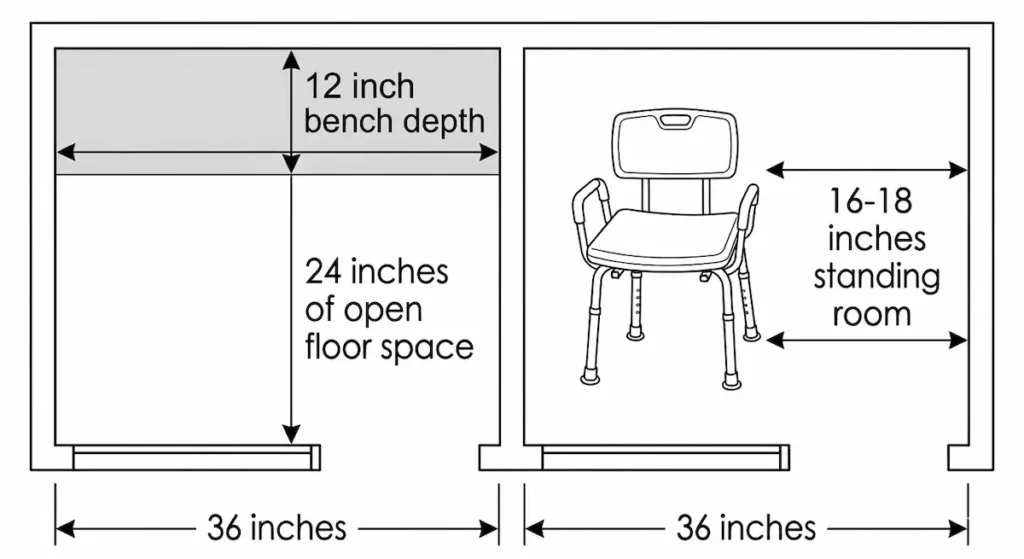
Here’s what you actually need to know before you buy anything:
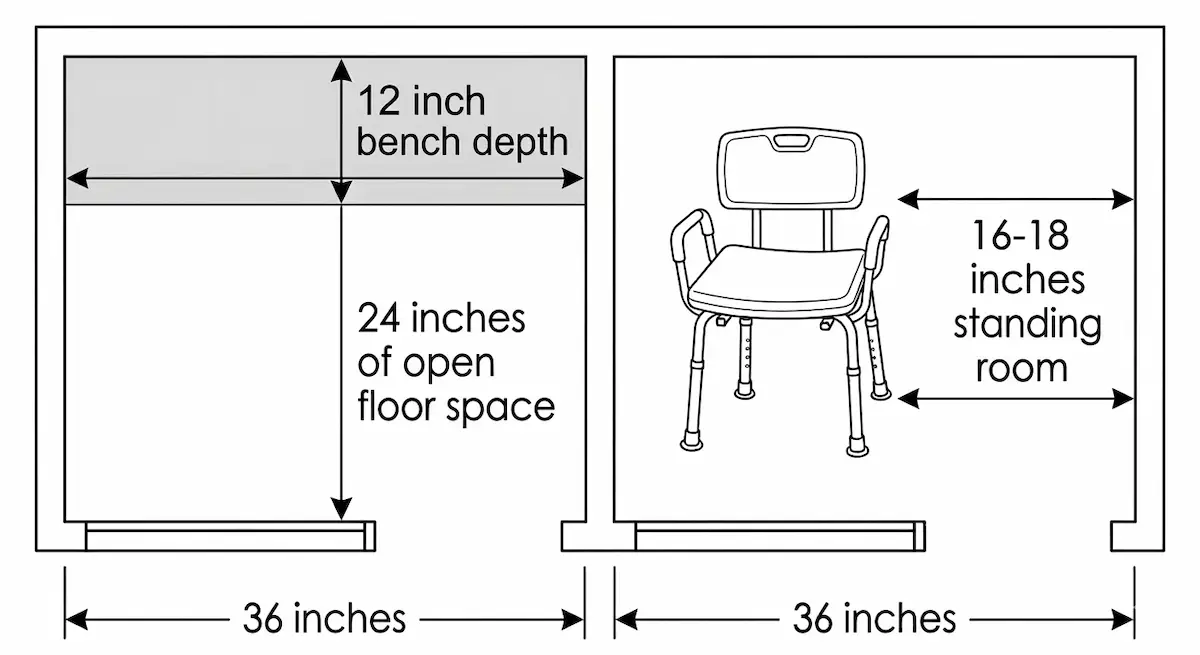
Shower width is your first number. A standard shower stall runs 36 inches wide. A larger walk-in might be 48 or 60 inches. Most freestanding shower chairs for seniors have a footprint of roughly 18 to 20 inches wide. A built-in bench typically runs 12 to 15 inches deep from the wall. Do the math before you buy — not after.
The 30-inch rule for built-in benches. If your shower is 30 inches wide a built-in bench is not your answer. A 12-inch deep bench in a 30-inch shower leaves 18 inches of standing room. That’s not enough space to stand, turn, or move without feeling cramped and that cramped feeling around a senior is exactly the kind of situation that leads to a fall. In a shower that narrow a freestanding chair that can be removed when not in use is the safer and more practical choice.
Fold-down bench width requirements. A fold-down wall-mounted seat is the middle ground in the shower bench vs shower chair for seniors decision — permanent mounting, non-permanent footprint. When it folds up it’s out of the way entirely. When it folds down it typically extends 15 to 17 inches from the wall. For a shower in the 36-inch range that leaves roughly 19 to 21 inches of standing room — workable for most seniors. Measure your specific shower and your specific seat before committing.
Door clearance. This one gets missed more than any other measurement. Make sure the shower door or curtain can open and close fully with the seat in its position. A chair placed too close to the entry point blocks the door and creates exactly the kind of awkward mid-step moment that causes falls in seniors.
Back Support: Preference or Safety Requirement?
Here’s a distinction most shower bench vs shower chair for seniors guides skip entirely.
Shower chairs typically have a back. Shower benches — both built-in and freestanding — typically don’t.
For some seniors that’s a preference. For others it’s a safety requirement.
If a senior has significant core weakness, balance issues, post-surgical fatigue, or any condition that makes sitting upright without support difficult — a chair with a back isn’t optional. It’s what keeps them from sliding or tipping during a task as simple as washing their feet. Reaching down, twisting slightly, shifting weight — all of those movements happen on a wet surface and a back gives the user something to brace against.
If a senior has reasonable core stability and primarily needs a seat for lower body washing, shaving, or general fatigue during a long shower — a backless bench is completely appropriate and gives more freedom of movement.
Ask the honest question before you buy. If there’s any doubt about core stability go with the back. It costs nothing extra on a freestanding shower chair for seniors and it eliminates a real risk.
Armrests
Armrests follow the same logic — with one exception. Standard shower chairs come with them. Most benches don’t. Armrests matter most during the sit-to-stand transition — they give the user something to push off from when their legs need the assist. However if grab bars are correctly installed within reach of the seated position you could argue the bar serves the same mechanical purpose as an armrest. A properly placed horizontal grab bar at the right height gives a senior the same push-off point during the sit-to-stand movement. If the full system is in place — seat, correctly positioned grab bar, handheld showerhead — the absence of armrests on a bench becomes much less of a safety concern. If the grab bars aren’t there yet armrests belong on the list of requirements not preferences until they are.
What to Look for Regardless of Which You Choose
Whether you go permanent or non-permanent, built-in or portable there are three things that apply to every shower bench vs shower chair for seniors decision. These aren’t optional.
Adjustable height.
On any freestanding option — chair or portable bench — adjustable legs are non-negotiable. Fixed height seats assume every senior is the same height. The target range for shower seat height is 17 to 19 inches above the finished floor — a range established by the ADA’s official accessibility guidelines based on how human bodies actually perform the sit-to-stand movement — but where within that range depends on the specific person using it every day. A 5’2″ senior and a 6’1″ senior do not need the same seat height. For a deeper look at exactly how to find the right height for a specific user my Shower Bench Height Guide covers the measurement process in detail.
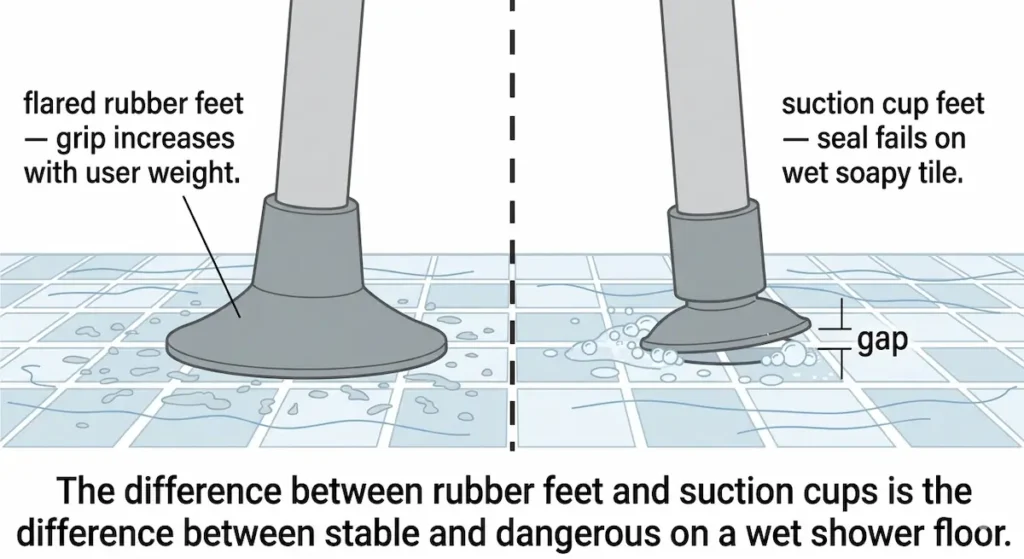
Rubber feet. Not suction cups.
I’ll say this as plainly as I can — do not buy a shower bench or shower chair for seniors that uses suction cups for stability. Soap scum, textured tile, grout lines — any of these will break that suction without warning. The seat shifts. The senior shifts with it. That’s a fall. Quality seats use large, flared rubber feet that grip through weight. The wider the foot the more stable the seat. Turn it over before you buy it and look at the feet. Hard plastic feet are almost as bad as suction cups on a wet surface. Soft rubber that gives slightly when you press your thumbnail into it — that’s what you want.
Weight capacity.
The minimum I recommend for any shower bench or shower chair for seniors is 250 lbs. If the user is close to or over 225 lbs move up to a bariatric rated option — 400 to 500 lbs capacity. A seat frame that flexes under load doesn’t just feel unstable. Over time it fatigues at the joints and fails. Buy the capacity you actually need not the minimum the label allows.
The Fold-Down: The Option Nobody Talks About Enough
When families are working through the shower bench vs shower chair for seniors decision the fold-down wall-mounted seat is the option that gets overlooked most often — and it genuinely solves the problem both paths create.
The permanent path gives you a solid stable seat that’s always there — but it’s always there even when you don’t want it. The non-permanent path gives you flexibility — but a freestanding chair sitting in the corner of a shower that isn’t being used takes up floor space and has to be moved for cleaning.
A fold-down seat mounts to the wall, folds down when a senior needs it, folds flat when they don’t. In a household where one person needs a seat, and another prefers to stand it’s the cleanest solution. In a smaller shower where floor space is genuinely limited it keeps the standing room open.
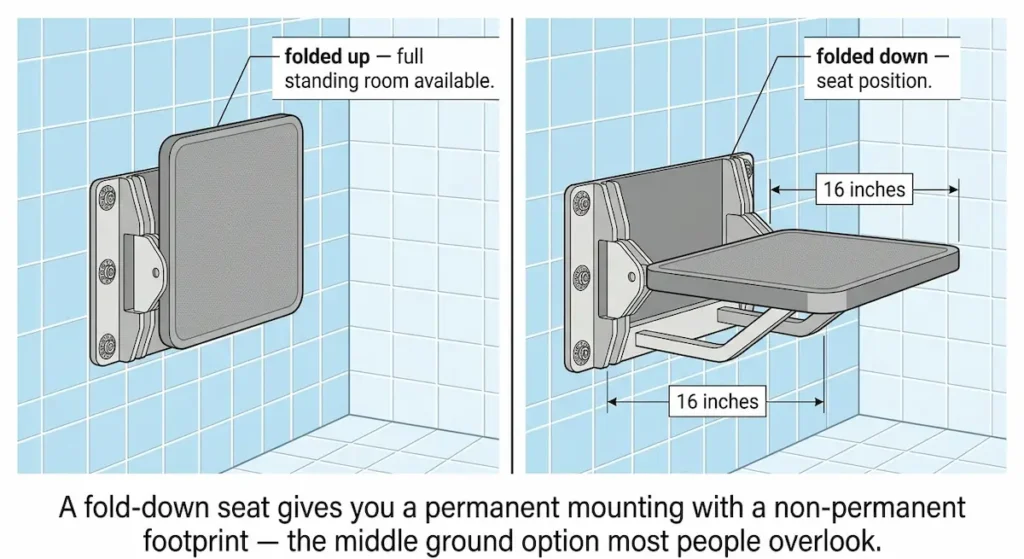
The catch — and it’s an important one — is that a fold-down seat is not a DIY project on a tiled wall. It mounts directly into wall blocking. If that blocking isn’t there before the tile goes up you’re either opening the wall to add it or you’re using anchors that aren’t rated for the lateral and downward force a fold-down seat puts on the wall when a senior sits down and stands up repeatedly over years. I don’t recommend anchors for this application. It has to go into wood.
If you’re doing a renovation and a fold-down seat is part of the shower bench vs shower chair for seniors plan — tell your contractor before the walls close. Blocking costs almost nothing to add during rough-in. Adding it after the tile is up is a different conversation entirely.
The Honest Contractor Verdict: Shower Bench vs Shower Chair
At the end of the day the shower bench vs shower chair for seniors decision is more personal than it is technical — but only after the structural questions are answered first.
Measure the space. Decide permanent or flexible. Assess whether back support is a preference or a requirement for the specific senior using this bathroom every day. Get those three things right and both options work. Get them wrong and neither option is safe regardless of what it cost.
If I’m standing in a bathroom with a client and they’re still genuinely undecided after we’ve worked through those questions my honest answer is usually this — start with a quality freestanding shower chair for seniors. It’s less expensive, it’s immediate, it doesn’t require opening a wall, and it gives you real-world information about what height, what position, and what features actually work for that specific person in that specific shower before you commit to anything permanent.
A built-in bench is the right long-term answer for a lot of seniors. But a chair tells you exactly what you need before the tile goes up.
A Shower Bench or Chair Is Only Part of the System
Whichever direction you go in the shower bench vs shower chair for seniors decision a seat alone is not a complete safety solution. It’s one piece of a system that has to work together.
A grab bar within reach of the seated position is not optional. The seat gives a senior somewhere to sit — the bar gives them the leverage to stand back up. Without it the seat creates a false sense of security at the most dangerous moment of the shower routine. My Grab Bar Placement Guide covers exactly where that bar needs to go relative to the seat and my Shower Zone Grab Bar Placement Guide goes deeper on the shower-specific placement decisions.
A handheld showerhead on a slide bar is equally important. A fixed showerhead is essentially useless from a seated position — the senior is either getting blasted in the face or barely getting wet from the knees down. A handheld wand on an adjustable slide bar puts the water where it needs to go from any seated height.
And shower controls need to be within reach from the seated position — roughly 18 to 24 inches from where the senior is sitting. If they have to lean forward or twist their torso to reach the handle they’re shifting their center of gravity off the seat’s base of support. That’s when people fall.
For the complete bathroom safety picture beyond the shower bench vs shower chair for seniors decision my Senior Bathroom Safety Guide maps out every element from floor to fixtures.
FAQ: Shower Bench vs Shower Chair for Seniors
Is a shower bench safer than a shower chair for elderly seniors?
Neither is inherently safer than the other — the right answer depends on the space and the user. A built-in bench or fold-down seat properly installed with correct blocking is extremely stable. A quality freestanding shower chair for seniors with rubber feet and correct height adjustment is equally stable. What makes either one unsafe is the wrong size for the space, the wrong height for the senior using it, or suction cup feet instead of rubber ones.
What features should I look for in a shower bench for elderly use?
For a freestanding bench — rubber feet not suction cups, adjustable legs, minimum 250 lb weight capacity, and a width that fits your shower with enough standing room remaining. For a built-in bench — correct slope toward the drain, proper waterproofing behind it, and height measured from the finished floor not the subfloor.
What should I look for in a shower chair for a senior with limited upper body strength?
Armrests are the most important feature for a senior with limited upper body strength — they provide the push-off point for the sit-to-stand transition. A back is equally important for core support during washing. Look for a chair with both, adjustable legs, wide rubber feet, and a cross-brace frame under the seat rather than legs that screw directly into plastic.
More Shower Bench vs Shower Chair FAQs
Can a shower chair fit in a 30×30 shower stall?
Yes — but measure first. Most standard shower chairs for seniors have a footprint of 18 to 20 inches wide. In a 30-inch stall that leaves 10 to 12 inches of standing room which is tight. Look for a compact shower stool — no back or arms — which typically has a smaller 13-inch footprint. Confirm the door or curtain can still open and close fully with the stool in place before you buy.
Does Medicare cover a shower bench or shower chair for seniors?
Original Medicare generally does not cover shower chairs or benches as they’re considered convenience items rather than durable medical equipment. Some Medicare Advantage plans have begun offering aging-in-place benefits that may cover them. Check your specific plan before purchasing.
What is the best shower seat for a caregiver-assisted shower?
A freestanding shower chair for seniors with open sides and armrests gives a caregiver the most access. Built-in benches and fold-down seats work well for independent users but the fixed position and enclosed walls of a built-in bench can make caregiver assistance more difficult. If caregiver-assisted bathing is a current or likely future reality a portable chair with open sides is the more practical long-term choice.
Field Tested Products
Moen Home Care Fold-Down Shower Seat My fold-down recommendation for aging in place installations. Available in teak and high-density plastic. Folds completely flat when not in use. The right answer for seniors who want a permanent solution without sacrificing floor space. Requires proper wall blocking — do not install into drywall or cement board alone. Weight rated to 500 lbs. Available at Home Depot and Amazon.
Drive Medical Premium Shower Chair with Back and Arms My standard freestanding shower chair for seniors recommendation. Tool-free assembly, cross-brace frame under the seat, adjustable legs, 350 lb weight capacity. The back and armrests make it appropriate for seniors with core weakness or limited upper body strength. Widely available at medical supply stores and Amazon.
Teak Shower Bench — Grade-A Teak For seniors who want a freestanding bench with a more finished look. Confirm it is Grade-A teak rated specifically for shower use — not patio furniture repurposed for a bathroom. Wide rubber feet, no assembly required. Requires monthly cleaning to prevent soap buildup. Available at Home Depot, Wayfair, and Amazon.
Not sure where a shower seat fits into your broader bathroom safety plan? My Free Home Safety Checklist walks you through the same room by room audit I use on job sites — so you can find the risks before they find you.