Keeping It Level
A shower chair isn’t a luxury item or a sign of giving up — it’s often the smarter choice over a built-in bench, especially in a smaller stall. The wrong chair is just as dangerous as no chair. Avoid suction cups, avoid steel frames, and make sure the controls are within reach before you ever sit down. If it has to mount to the wall it has to hit blocking — no exceptions.
I once visited a home to install grab bars and found the homeowner using a plastic lawn chair in her walk-in shower. She thought it was a clever money-saver, but when I looked at the floor, the chair’s thin legs had already started to “skate” across the wet tile. Even worse, the plastic was becoming brittle from the hot water. It wasn’t a safety tool; it was a disaster waiting to happen. If you are debating built-in shower benches for seniors, you’re looking at a permanent structural change. However, for many seniors researching options, a high-quality shower chair for seniors is the more practical, flexible, and affordable solution. If you’re still deciding between a bench and a chair my Shower Bench vs Shower Chair Guide can help you make that call before going deeper into chair-specific options.
Don’t let the simplicity fool you though—picking the wrong chair or placing it incorrectly can actually increase your risk of a fall.
Why a Chair Often Beats a Bench in Small Bathrooms
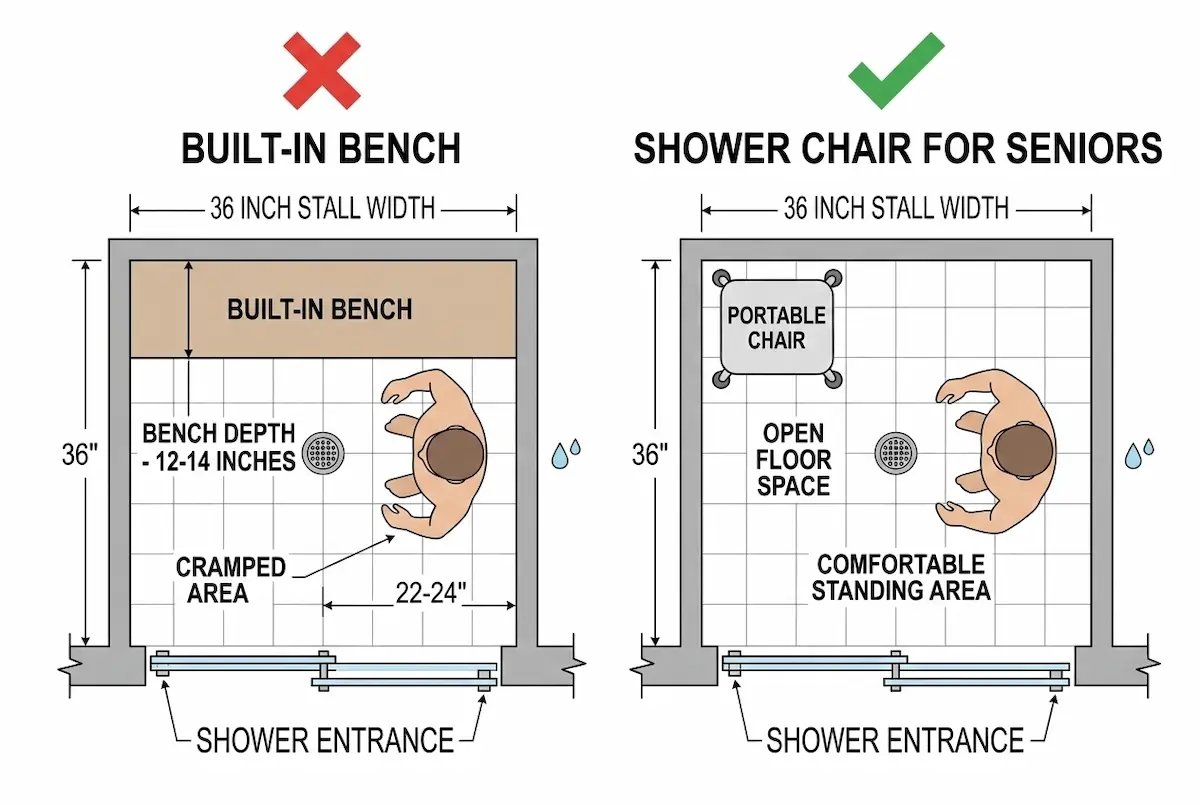
In my experience, homeowners often push for a built-in bench because of the luxury factor. But on a job site with a standard 36-inch shower stall, I might recommend a chair instead.
A built-in bench is a space-hog; it’s always there, even when you’re standing. A shower chair, however, allows for multi-user flexibility. If one person in the house needs to sit and another prefers to stand, a chair can be moved or removed. In a small bathroom, that extra 12 to 14 inches of “turning radius” is the difference between feeling cramped and feeling stable.
The Three Most Common Shower Chair Styles for Seniors
1. The Standard “Four-Leg” Medical Chair
This is the workhorse shower chair for seniors in aging-in-place installations. It features adjustable legs and usually comes with a backrest and armrests.
- Contractor Tip: Look for “cross-brace” framing under the seat. If the legs just screw into the plastic without a metal frame connecting them, the chair will eventually “wobble” as the plastic mounting points fatigue.
2. The Bath Transfer Bench (The “Bridge”)
If you are struggling to step over a 14-inch bathtub wall, this is your solution. It has two legs that sit inside the tub and two that sit on the bathroom floor.
- The Reality: It’s bulky. It requires you to use a shower curtain with a slit or a specialized “split” curtain to keep water off the floor. But from a safety perspective, it eliminates the single most dangerous movement in the bathroom: the one-legged balance act required to clear a tub wall.
3. Wall-Mounted Folding Seats
This is the “middle ground” between a chair and a bench. It mounts to the wall and folds up when not in use.
- The Structural Warning: I see these installed incorrectly more than any other fixture. You cannot mount these into drywall or just tile and cement board. They must be anchored into blocking inside the wall per ADA structural guidelines.
What to Look for in a Shower Chair for Seniors
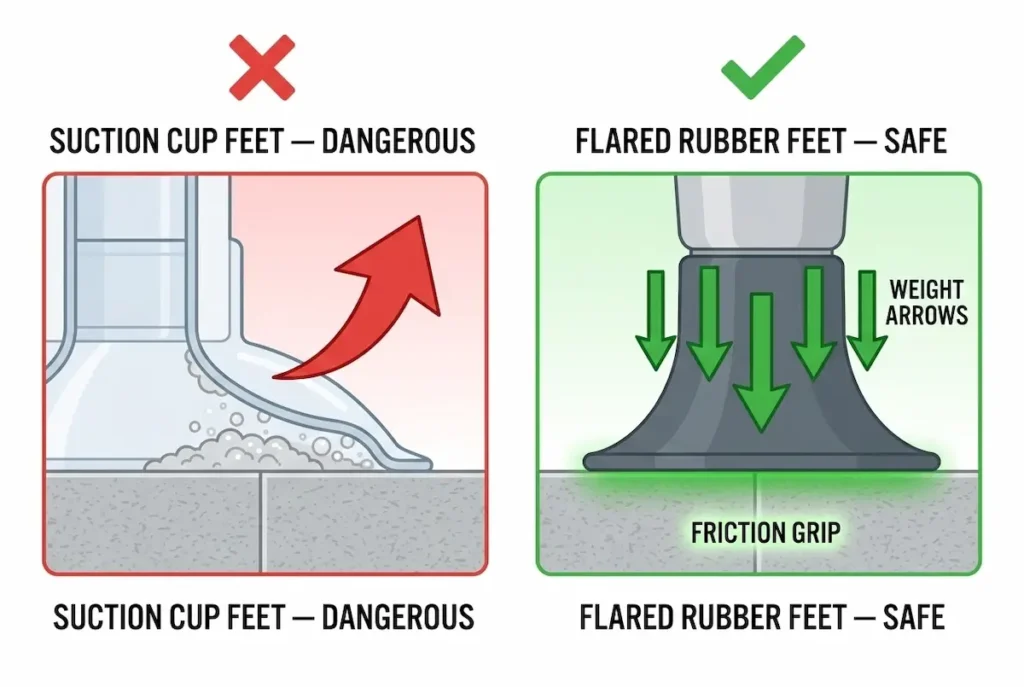
I need to be very clear here: Do not buy a shower chair that relies on suction cups for stability. Many “cheap” models use suction cups to try and keep the chair from sliding. In a real-world shower, soap scum and textured tile break that suction almost immediately. Once the suction fails, the chair can “jump” when you sit down.
- The Contractor’s Choice: Look for large, flared rubber feet. High-quality rubber feet act like tires; they use the weight of the user to “grip” the tile. The wider the foot, the more stable the chair.
The Aluminum vs. Steel Warning
Never buy a chair with a steel frame, even if it claims to be “rust-resistant.” In the constant humidity of a shower, steel will begin to oxidize within six months. This isn’t just a structural issue; the rust will bleed out of the legs and leave permanent, stubborn orange stains on your grout and acrylic tub that are nearly impossible to remove. Always verify the frame is 100% anodized aluminum.
Recommended Products (Field-Tested)
Based on what I’ve seen hold up over years of use, here are three models I frequently recommend to my clients:
- The Drive Medical Premium Series: This is my “standard” recommendation. It has a tool-free assembly and a very high weight capacity (350 lbs).
- The Medline Transfer Bench: For tub-to-shower transitions, this is the most stable “bridge” bench I’ve installed. It’s wider than most, which makes the slide-over much safer.
- The Moen Fold-Down Shower Seat: If you do have the wall blocking and want a permanent look, Moen’s teak or high-density plastic folding seats are the gold standard for durability.
Contractor Secrets: Placement and Maintenance
The “Reach Test” (Measurements Matter)
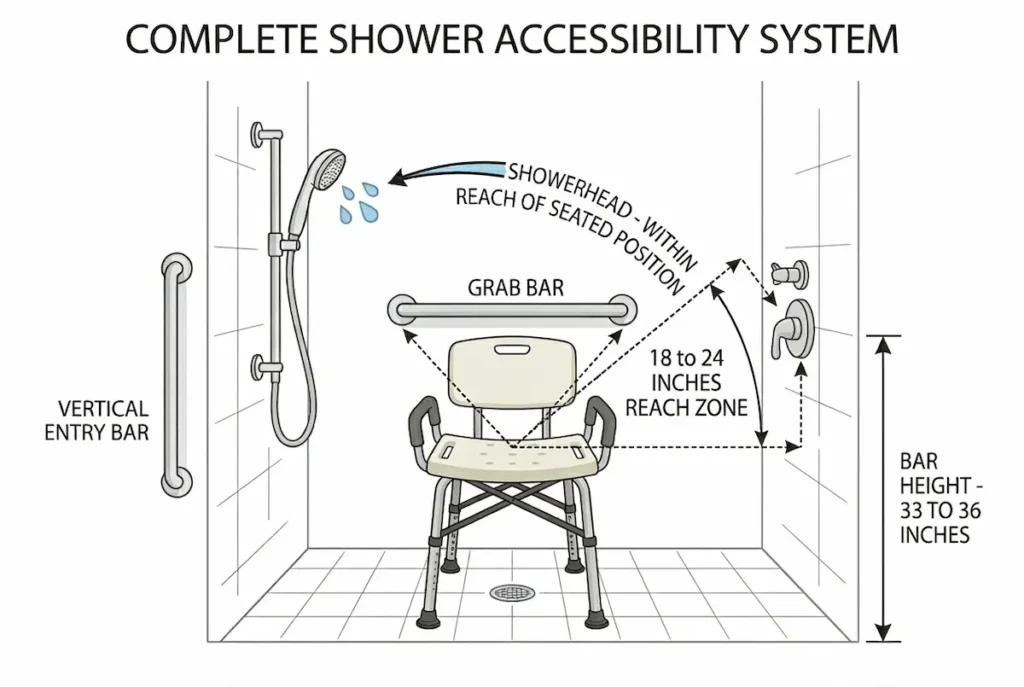
The most common mistake I see is people placing the chair too far from the controls. If you have to lean forward or twist your torso to reach the handle, you are significantly increasing your risk of a fall.
- The Fix: I typically aim for the shower controls to be within 18 to 24 inches of the seated position. This allows you to reach the water without shifting your center of gravity off the chair’s base of support.
The Sit-to-Stand Mechanic
Sitting down in a shower chair is only half the battle. The most dangerous moment is the “transition.” When you stand up from a seated position, your center of gravity moves forward and upward while your feet are on a wet surface.
- The System: This is why a shower chair for seniors without a grab bar is an incomplete safety system. You need a vertical or horizontal bar positioned so your arm can remain at a comfortable 90-degree angle while you “push” or “pull” yourself up. For a deeper look at the physics of sitting and standing safely, check out my Shower Bench Height Guide.
FAQ: Real Questions from the Job Site
How do I maintain a shower chair? Maintaining your shower chair for seniors starts with the rubber feet Shower chairs are notorious for growing mold under them. Once a month, tip the chair over and scrub the feet with a 10% bleach solution. Also, perform the “Rubber Test”: Press your thumbnail into the rubber foot. If it feels hard, “plastic-y,” or doesn’t bounce back, the material has dried out and lost its grip. Replace the chair immediately.
Can a shower chair fit in a small 30×30 stall? Yes, but you need a “compact” model. Measure the floor of your shower first. Most standard chairs have a “footprint” of about 18 to 20 inches wide. If your stall is tight, look for a “shower stool” (no back or arms), which usually has a smaller 13-inch footprint.
Do I need grab bars if I have a shower chair? Yes. A chair helps you while you are showering, but a grab bar helps you get to the chair. The moment you are standing up is when your blood pressure can shift and balance is most at risk. My Grab Bar Guide shows exactly where to place these relative to a chair.
Can I use a shower chair on a sloped floor? Most chairs have independently adjustable legs. Use this feature to “level” the chair so the seat is flat, even if the floor is pitching toward the drain. A tilted seat is an invitation for a slide-off.
What weight capacity should I look for? Most standard chairs are rated for 250 lbs. If the user is near or over that weight, you must buy a Bariatric Shower Chair. These are reinforced with double-cross braces and are usually rated for 500 lbs+.
What is the “Transfer Bench” curtain trick? Because a transfer bench straddles the tub wall, you can’t close the curtain. I recommend buying two cheap curtains and cutting a slit in one to fit around the bench, or purchasing a specialized “Hookless” curtain designed for transfer benches.
Final Thoughts on Choosing a Shower Chair for Seniors
A shower chair isn’t just a piece of furniture; it’s a medical safety device. Don’t settle for the cheapest option at the big-box store. Look for aluminum frames, large rubber feet, and a footprint that fits your space without blocking the door.
If you are evaluating your entire bathroom, I recommend using my Free Home Safety Checklist to see how a chair fits into your broader plan for bathroom safety.