Keeping It Level
Aging in Place grants and funding programs for modifications exist and are worth pursuing — but they are not a plan. They are a possibility. Most families renovating a bathroom for an elderly parent are paying out of pocket, and building your safety timeline around grant approval is a mistake. Programs have income limits, geographic restrictions, waitlists, and funding caps that run out. When the cap is real, prioritize needs over wants and fund the most expensive necessary modification with the grant money first — let the less expensive pieces come later. The timeline is always slower than you want it to be. And if you’re a contractor doing grant funded work, understand the price lock reality before you submit a single estimate. That said, if you qualify these programs are genuinely valuable and worth every phone call it takes to find out what’s available where you live.
- The Honest Reality About Aging in Place Grants & Funding
- Federal Programs for Aging in Place Grants
- Nonprofit Programs Worth Knowing
- How to Find What's Available Where You Live
- How to Prioritize When the Aging in Place Grants Won't Cover Everything
- Fund the Most Expensive Piece First
- What Grant Funded Work Actually Looks Like From the Contractor Side
- A Note on Tax Deductions and Insurance
- Common Mistakes for Aging in Place Grants
- FAQ: Aging in Place Grants and Funding
- More Aging in Place Grants FAQs
- Bottom Line
I got a call recently from a woman who needed a walk-in tub, widened doorways, and grab bars. She had already applied for a grant. She had already tried to get contractors out to the house. Every one of them was either not licensed and insured or couldn’t do the job. By the time she found me she had seven days to get her estimate submitted or the grant application was going to close.
Seven days.
We got it done. The estimate is in. Whether she gets approved we won’t know for another 6 months — and even then, it’s not guaranteed. The grant program has limited funds. Qualified applicants don’t always get approved. That’s the reality of grant funded aging in place work and it’s worth understanding before you count on anything.
Most people I work with never find a grant program at all. They pay for the renovation themselves because they need the bathroom fixed now, not in six months, and they can’t wait on a government timeline to find out if they qualified. The programs in this guide are real and genuinely helpful for the families who access them. But the honest contractor answer to the question of how most aging in place renovations get funded is — the family writes the check.
If you qualify for any of these programs apply as early as possible. Don’t wait until you’re seven days from a deadline.
For the complete picture of what a safe aging in place bathroom renovation involves beyond the funding side my Senior Bathroom Safety Guide maps out every element from floor to fixtures.
The Honest Reality About Aging in Place Grants & Funding
Before we go through the programs, a few things worth understanding about how grant funding for home modifications actually works.
Funding is limited and approval is not guaranteed. Most of these programs have more qualified applicants than available dollars. Meeting the eligibility requirements gets you in the door — it doesn’t guarantee you a check. Some programs have waitlists that run months or years. Apply early and have a backup plan.
The timeline is always slower than you want. Someone has to apply. The application has to be reviewed. Funds have to be allocated. Then and only then can work begin. It’s the government — the pace reflects that reality. Most grant funded projects I’ve been involved with have a timeline of six months or more from application to work starting. If a safety issue needs to be addressed now a grant program is not your answer.
Income and eligibility requirements are real. Most federal programs are specifically for low to very low income households. If you’re above the income threshold you won’t qualify regardless of how much you need the modification. Check the eligibility requirements before you invest significant time in an application.
Geographic restrictions apply. Some programs are specifically for rural areas. Others are administered at the state or county level and may not exist in every location. What’s available in Eastern Kentucky may not be available in suburban Ohio.
With those realities understood — here’s what’s actually out there.
Federal Programs for Aging in Place Grants
USDA Section 504 Home Repair Program
This is the program most directly relevant to rural families and the one I mention most often when someone asks about funding options in Eastern Kentucky.
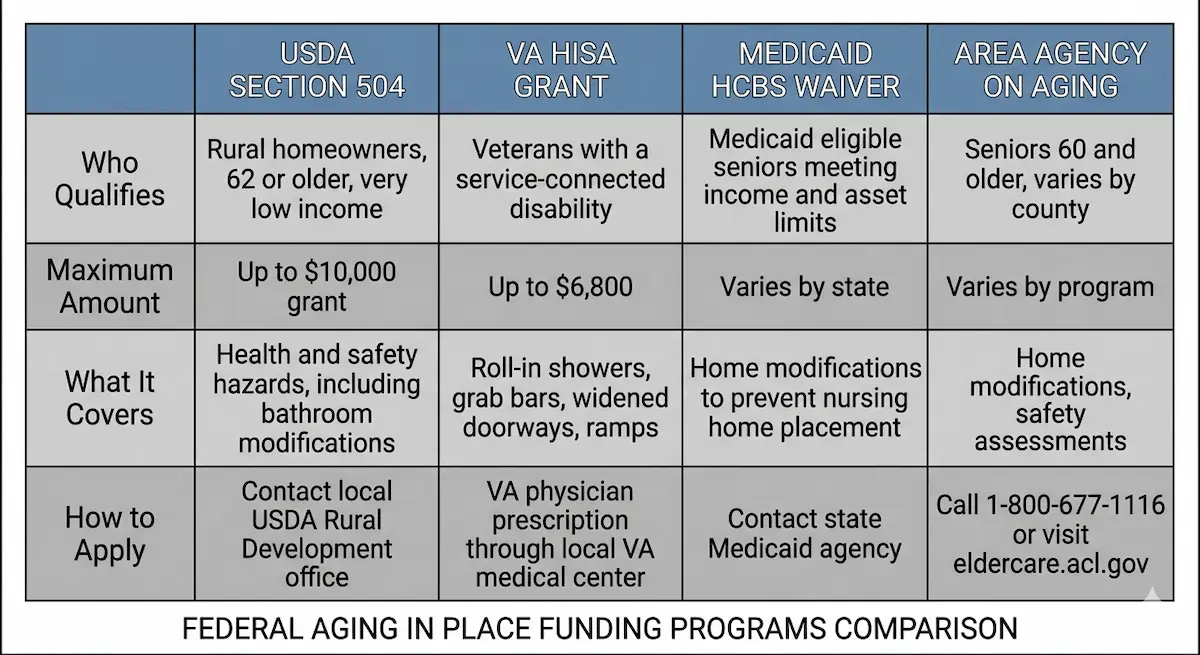
The Section 504 Home Repair program provides loans to very low-income homeowners to repair, improve, or modernize their homes, and grants to elderly very low-income homeowners to remove health and safety hazards. Rural Development For aging in place purposes the grant side is what matters most — grab bars, accessible showers, comfort height toilets, widened doorways all qualify as health and safety modifications.
To qualify for the grant portion you must be 62 or older, own and occupy the home as your primary residence, have household income below 50% of the area median income, and be unable to repay a loan. Neighbors Bank Grants have a lifetime limit of $10,000, except in presidentially declared disaster areas where the limit is $15,000. Loans and grants can be combined for up to $50,000 in assistance. Rural Development
The property has to be in a USDA eligible rural area — most of Eastern Kentucky qualifies but you can verify any specific address through the USDA eligibility tool on their website. Applications are accepted year-round but funding is limited so applying early matters. Contact your local USDA Rural Development office to start the process. The link to find your office is at rd.usda.gov.
If the property is a manufactured home there are additional structural considerations that affect what modifications are possible and what they’ll cost — my Mobile Home Bathroom Modifications for Seniors Guide covers the full picture before any grant funded work begins.
VA HISA Grant
If the person you’re renovating for is a veteran this is the first program worth looking into.
The VA Home Improvements and Structural Alterations grant provides up to $6,800 for veterans with a service-connected disability or a qualifying non-service-connected disability if they have a service-connected rating of at least 50%. For veterans with non-service-connected disabilities that don’t meet those criteria the grant provides up to $2,000. VA Claims Insider
The grant covers modifications like roll-in showers, grab bars, widened doorways, ramps, and plumbing or electrical upgrades needed for medical equipment. VA Claims Insider For aging in place bathroom renovations that coverage is a direct match.
The application requires a prescription from a VA physician documenting the specific modifications needed and the medical justification for them. A contractor bid for the cost of the work is also required. The application goes through the Prosthetic and Sensory Aids Service at your local VA medical center.
One practical note — the HISA grant can be used on a rented home with the landlord’s written permission, which makes it more flexible than some other programs.
VA SAH and SHA Grants
For veterans with more severe service-connected disabilities the VA also offers the Specially Adapted Housing grant and the Special Housing Adaptation grant. The SAH grant provides up to $126,526 for FY 2026 for veterans with qualifying severe service-connected disabilities. The SHA grant provides up to $25,350 for FY 2026. VA.gov These are significantly larger amounts, but the eligibility requirements are correspondingly more restrictive — they’re designed for veterans with major mobility limitations rather than the general aging in place population. If a veteran you’re working with has a significant service-connected disability, it’s worth having the VA evaluate which program they qualify for.
Medicaid Home and Community Based Services Waivers
This one is less straightforward than the others because it varies significantly by state — but it exists in every state and is worth knowing about.
Most states offer Medicaid programs that cover home modifications to enable elderly and disabled individuals to remain living at home. These programs are commonly referred to as Medicaid Waivers or HCBS Waivers and financial support for home modifications that enable aging in place is very often an included benefit. Paying for Senior Care
The goal of these programs is keeping elderly seniors out of nursing homes — which is less expensive for the state than institutional care. Home modifications that accomplish that goal are exactly what the programs are designed to fund.
In most states in 2026 the individual asset limit for HCBS Waivers is $2,000 and the individual income limit is $2,982 per month. Elder Care Resource Planning These are strict financial eligibility requirements. If the person you’re helping is already on Medicaid, they may already be in the system — contact your state Medicaid agency or your local Area Agency on Aging to find out what waiver programs exist in your state and whether home modifications are a covered benefit.
Unlike nursing home Medicaid, waivers are not an entitlement. Waiver programs have limited participant enrollment and sometimes waiting lists exist for services. Paying for Senior Care Apply early.
Title III of the Older Americans Act — Area Agencies on Aging
This is the funding stream most people have never heard of and the one that funds the most local level home modification help.
Title III of the Older Americans Act provides federal funding to states which then distribute it through a network of local Area Agencies on Aging. Those local agencies fund a range of services for elderly seniors including in some cases home modification assistance, grab bar installation programs, and safety assessment visits.
What’s available varies significantly by county. Some Area Agencies on Aging have robust home modification programs. Others have minimal funding for it. The only way to know what exists in your specific area is to call and ask.
The single best first phone call for any family trying to navigate aging in place funding is their local Area Agency on Aging. They know what programs exist locally, what the eligibility requirements are, and how to apply. You can find your local AAA at eldercare.acl.gov or by calling the Eldercare Locator at 1-800-677-1116.
Nonprofit Programs Worth Knowing
Rebuilding Together
Rebuilding Together is a national nonprofit that provides free home repairs and modifications for low income homeowners — including aging in place modifications like grab bars, ramps, and accessible bathroom upgrades. They work through local affiliates so availability varies by location. Check rebuildingtogether.org to find your local affiliate and what programs they offer.
Habitat for Humanity Aging in Place
Some Habitat for Humanity affiliates offer home repair and modification programs specifically for elderly homeowners aging in place. Like Rebuilding Together availability varies by local affiliate. Check with your local Habitat chapter to find out what they offer in your area.
Both of these programs fly under the radar for most families. They’re worth a phone call especially in areas where federal program funding is limited or waitlists are long.
How to Find What’s Available Where You Live
Beyond the federal programs listed above every state has its own layer of funding — state administered grant programs, low interest loan programs, community development block grants, and county level assistance programs that vary widely by location.
The honest answer is that no single article can map all of it because it changes by state, by county, and by year as funding gets allocated and programs open and close.
Your best starting points in order:
Your local Area Agency on Aging — call them first. They are specifically designed to connect elderly seniors and their families with available local resources and they know what exists in your county.
Your state housing finance agency — most states have one and many administer home modification grant or loan programs for low income or elderly homeowners.
Your local Community Action Agency — these federally funded nonprofits serve low income households and often have information about local grant programs that aren’t well publicized.
211 — dialing 211 connects you to a local resource helpline that can point you toward programs in your specific area.
How to Prioritize When the Aging in Place Grants Won’t Cover Everything
Most grant programs have a funding cap. That cap is real and it shapes every decision you make about what goes in the application.
The most important thing to understand before you apply is the difference between what you need and what you want. That distinction is not a criticism — it’s math. If the program caps at $10,000 and your full wish list comes to $18,000 you have to make choices. Making those choices strategically before you apply is significantly better than running out of money halfway through a renovation.
Start with what is genuinely required for safety and basic accessibility. A wheelchair user needs 36-inch doorways to get in and out of their home. They need to be able to access a bathroom. Whether that bathroom has a walk-in tub or a low-profile shower pan is a separate question — and nine times out of ten the accessible shower is significantly less expensive than the walk-in tub and does the same functional job. If the goal is safe accessible bathing and the budget is limited a low-profile shower pan with a 1-to-1.5-inch threshold achieves that goal at a fraction of the cost — my Non-Slip Shower Pans for Aging in Place Guide covers threshold heights and materials at every budget point.
Fund the Most Expensive Piece First
The same logic applies to grab bars and shower modifications together. If the grant cap covers a new accessible shower and grab bars installed correctly — great. If it covers the shower but not the bars, consider this — a new accessible shower without grab bars is still a significantly safer bathing situation than what existed before. And grab bars are among the least expensive modifications a contractor can make. It costs far less for a homeowner to pay out of pocket for grab bar installation at a later date than to pay out of pocket for a full shower renovation.
If you know grab bars are coming later tell the contractor who is doing the shower work before he closes anything up. Blocking costs almost nothing to add during a renovation. A wall with blocking already in it means grab bar installation later is a simple job. A wall without it means either opening the wall or working around the structural limitation. That one conversation before the walls close can save hundreds of dollars down the road. My Grab Bar Installation Guide covers exactly what that blocking needs to look like and why it has to go in before anything else closes up.
The practical framework for prioritizing an aging in place grants application is this — fund the most expensive necessary modification with the grant money and plan to fund the less expensive modifications yourself if needed. The grant pays for the shower. You pay for the grab bars. The grant pays for the doorway widening. You pay for the comfort height toilet. Think about which pieces of the renovation are financially out of reach without help and direct the grant money there first.
Not every combination works out cleanly. But thinking about it before you apply rather than after the money runs out is always the right move.
What Grant Funded Work Actually Looks Like From the Contractor Side
This section doesn’t exist in most grants guides because most grants guides are written for homeowners, not contractors. If you’re a contractor considering grant funded aging in place work there are things worth understanding before you submit your first estimate.
Make contact before you submit anything.
The first thing I do when I’m working with a new grant program is find a person to talk to. Not a website. A person. For the grant I’m currently working with I looked up the regional coordinator and called her directly. That one phone call told me everything I needed to know about what the estimate had to include, how the payment process worked, and what the rules were around price changes. Every grant program is administered by someone. Find that person before you submit anything.
The price lock reality.
This is the most important thing a contractor needs to understand about grant funded work and nobody talks about it.
When you submit an estimate for some grant funded work, the price in that estimate is the price the job gets done for. Not approximately. Not adjusted for market conditions. That number. If you estimate a walk-in tub at $5,500 and six months later when the grant is approved that tub costs $5,800 — you’re eating the $300. The grant was approved based on your estimate and that number doesn’t change.
I learned this directly from the regional coordinator on my current grant job. She told me upfront — the estimate price is the completion price. Build your estimate accordingly.
That doesn’t mean padding every line item dishonestly. It means thinking realistically about what materials will cost six months from now, not what they cost today. I add a modest buffer to items where prices are volatile — walk-in tubs, specialized fixtures, anything where I know the market moves. Standard framing lumber, fasteners, basic materials — those don’t need a buffer. Use your judgment and ask yourself a simple question before you submit: if someone called and asked me to justify every number on this estimate, could I do it? If yes, submit it. If no, adjust it.
Build in a contingency — and document it properly.
On my current grant estimate I included a $1,000 contingency line item. The regional coordinator confirmed this was acceptable and actually suggested it when I asked about unexpected conditions.
Here’s exactly how I structured it — and this matters. The contingency is clearly labeled in the estimate as a contingency. It is explicitly stated that this money will only be paid out if specific conditions are found — subfloor rot, rotted framing behind walls, structural issues that couldn’t be identified during a standard pre-renovation assessment. If those conditions are found, written consent will be obtained before any additional work proceeds, and before and after photos will be taken documenting the condition. If none of those conditions are found the contingency money stays with the program.
That transparency is intentional. Grant administrators understand that contractors can’t see through walls. They know subfloor rot exists in older homes. What they need to know is that you’re not going to find rot, charge for it, and pocket the money without documentation or approval. Show them your process. Be specific about what triggers the contingency and what doesn’t. They appreciate the professionalism and it protects you if something does come up.
Charge for everything that costs you money.
Grant funded or not, your estimate needs to cover your actual costs. A few things contractors consistently forget on grant estimates:
Travel. If the job is an hour from your shop that’s two hours of drive time per day. Over a two week job that adds up significantly. Charge for it.
Disposal. Demolition creates debris and debris costs money to dispose of. Figure out how many dump runs the job will require and put that in the estimate. Around here it costs $50 a load. Know your number before you submit.
Your time has value.
The timeline is not like a standard job.
Grant funded work moves on the program’s timeline not yours. Someone has to apply, the application has to be reviewed, funds have to be allocated, then work can begin. Expect six months or more from estimate submission to work starting in most cases. That affects how you schedule your pipeline and how you think about material pricing.
Licensed and insured is non-negotiable.
Every grant program I’m aware of requires contractors to be licensed and insured. That’s the baseline. The woman I’m currently working with had already had multiple contractors come out who either couldn’t prove licensing and insurance or couldn’t do the scope of work. Make sure your documentation is current and ready to submit if asked.
A Note on Tax Deductions and Insurance
Two funding adjacent options worth knowing about that aren’t grants but belong in this conversation.
Medical expense tax deduction. If a doctor prescribes a home modification as medically necessary — a roll-in shower for someone who cannot safely use a standard shower, grab bars for someone with documented fall risk — the cost may qualify as a deductible medical expense on federal taxes. The IRS allows deductions for medical expenses that exceed 7.5% of adjusted gross income. This isn’t a grant but it’s a legitimate way to reduce the out-of-pocket cost of modifications that a physician has documented as necessary. Consult a tax professional about your specific situation.
Long term care insurance. Some long-term care insurance policies include a home modification or alternative care benefit. The logic is the same as Medicaid waivers — it’s cheaper for the insurer to pay for a grab bar than a month in a memory care facility. If the person you’re helping has a long-term care policy, it’s worth calling the insurer specifically and asking whether home modifications are a covered benefit. Many policyholders don’t know this coverage exists.
Common Mistakes for Aging in Place Grants
Waiting too long to apply. Funding is limited and waitlists are real. If a grant program is on your radar apply now, not when the renovation is urgent. Being on a waitlist for six months is very different from needing a modification in six months and not having applied yet.
Counting on approval before planning the renovation. Grant approval is not guaranteed. Don’t tell an elderly parent their bathroom renovation is happening because you applied for a grant. Have a conversation about what happens if the grant doesn’t come through.
Contractors submitting estimates without understanding the price lock. Submit a number you can complete the job for regardless of what happens to material prices over the next six months. If you’re not sure how long approval will take ask before you submit.
Not asking about contingency options upfront. Before you submit any grant estimate ask the program administrator directly — what happens if we open a wall and find rot? Most programs have a process for this. Know what it is before you start.
Not reaching out to a contact first. Every program is administered by someone. A five-minute phone call before you submit an estimate can save you significant problems after.
FAQ: Aging in Place Grants and Funding
What grants are available for aging in place bathroom modifications? The main federal programs are the USDA Section 504 Home Repair grant for rural low-income elderly homeowners, the VA HISA grant for veterans, Medicaid HCBS waivers for Medicaid eligible seniors, and Title III funding distributed through local Area Agencies on Aging. Availability, eligibility requirements, and funding amounts vary by program and location. Your local Area Agency on Aging is the best single starting point for finding what’s available where you live.
Does Medicare cover aging in place home modifications? Generally, no. Original Medicare considers home modifications convenience items rather than covered medical equipment. Some Medicare Advantage plans have begun offering aging in place benefits that may cover modifications — check your specific plan. This is different from Medicaid which does cover modifications through HCBS waiver programs in most states.
How long does it take to get aging in place grants funding approved? It depends on the program but grant funded work is never fast. Someone has to apply, the application has to be reviewed, funds have to be allocated and then work can begin. Six months or more from application to work starting is realistic for most programs. Don’t plan a renovation around a grant timeline if the modification is urgently needed.
What does a contractor need to work on aging in place grant funded projects? At minimum — current licensing and insurance documentation. Most programs require both and won’t approve a contractor who can’t provide proof. Beyond that requirements vary by program. Call the program administrator before submitting any estimate to understand exactly what documentation is required and how the payment process works.
More Aging in Place Grants FAQs
What is the USDA Section 504 program and who qualifies? The Section 504 Home Repair program provides grants of up to $10,000 for rural homeowners who are 62 or older, own and occupy their home, have household income below 50% of the area median income, and cannot repay a loan. Grants are specifically for removing health and safety hazards — aging in place bathroom modifications qualify directly. Contact your local USDA Rural Development office to apply or verify your address eligibility at rd.usda.gov.
What is the VA HISA grant? The Home Improvements and Structural Alterations grant provides up to $6,800 for veterans with service-connected disabilities to make medically necessary home modifications including roll-in showers, grab bars, widened doorways, and ramps. Up to $2,000 is available for veterans with non-service connected disabilities under certain criteria. Application requires a VA physician prescription and goes through the Prosthetic and Sensory Aids Service at your local VA medical center.
What if I don’t qualify for any of these aging in place grants? The honest answer is that most aging in place renovations are funded out of pocket. If grant programs aren’t an option, the modifications are still worth doing — a grab bar costs less than an emergency room visit, and a low entry shower pan costs less than a nursing home. For families on a tight budget my Aging in Place Bathroom Safety Without a Full Remodel guide covers the high impact changes that don’t require a full renovation budget.
Bottom Line
Aging in place grants and funding programs for modifcations are real, they help real families, and they’re worth pursuing if you qualify. The USDA Section 504 program alone has funded safety modifications for thousands of rural elderly homeowners who couldn’t have afforded them otherwise. Veterans have access to meaningful funding through the VA that many never know to ask about.
But the cold reality of this work is that most families pay out of pocket. Programs have limited funding, approval isn’t guaranteed, and timelines don’t always match urgency. Apply for everything you qualify for and apply early — but don’t put a necessary safety modification on hold waiting for a grant check that may or may not arrive.
The bathroom still needs to be safe in the meantime.
For families in Eastern Kentucky specifically — a dedicated guide to the grants and funding programs available in our region is coming, including programs specific to rural Appalachian communities that don’t show up in national guides. If you’re in Eastern Kentucky and need help finding what’s available now your best first call is your local Area Agency on Aging.
For eligible low income rural homeowners, the USDA Section 504 program is the most direct federal resource available. You can find your local Rural Development office and verify your address eligibility at https://www.rd.usda.gov/programs-services/single-family-housing-programs/single-family-housing-repair-loans-grants.
Ready to evaluate your bathroom for the safety modifications that matter most? My Free Home Safety Checklist walks through the room-by-room framework so you can find the risks before they find you.