Keeping It Level
A pressure balancing valve handles pressure. An anti-scald thermostatic mixing valve handles temperature. For an elderly senior with neuropathy or slow reaction time, that distinction can mean the difference between a safe shower and a burn injury. Set it to 120 degrees, check it every three months, and never stand in the water stream when you turn the shower on. Everything else is details.
I’ve seen what happens when an anti-scald valve fails on a senior with neuropathy. A woman came into contact with water that was far too hot and couldn’t feel it until the damage was done. The valve wasn’t working properly, and nobody had checked it. That’s not a plumbing failure — that’s a maintenance failure. An anti-scald valve for seniors goes bad just like everything else. The difference between a safe bathroom and a dangerous one isn’t just whether the valve is installed. It’s whether anyone is paying attention to it.
For a complete picture of senior bathroom safety beyond water temperature, my Senior Bathroom Safety Guide covers every element from structural blocking to flooring to drainage in the order a contractor would actually build it.
Pressure Balancing Valve vs Anti-Scald Valve: Why the Distinction Matters for Elderly Seniors
Since 2000 the International Residential Code has required shower valves in new construction to include either a pressure balancing valve, a thermostatic mixing valve, or a combination of both. They have to have a maximum temperature limit stop set to 120°F. If your home was built after 2000 there’s a chance you already have some form of protection at the fixture level.
The problem is two things. First, older homes built before 2000 often have neither. Second, even in newer homes the limit stop has to be properly set at installation — and that doesn’t always happen. A valve that was never adjusted is a valve that isn’t protecting anyone.
When I’m retrofitting an anti-scald valve it’s almost always one of two situations. Either an older home with no protection at all, or a home where the existing valve has failed or was never properly calibrated. Either way the fix is the same.
Why a Pressure Balancing Valve Isn’t Enough
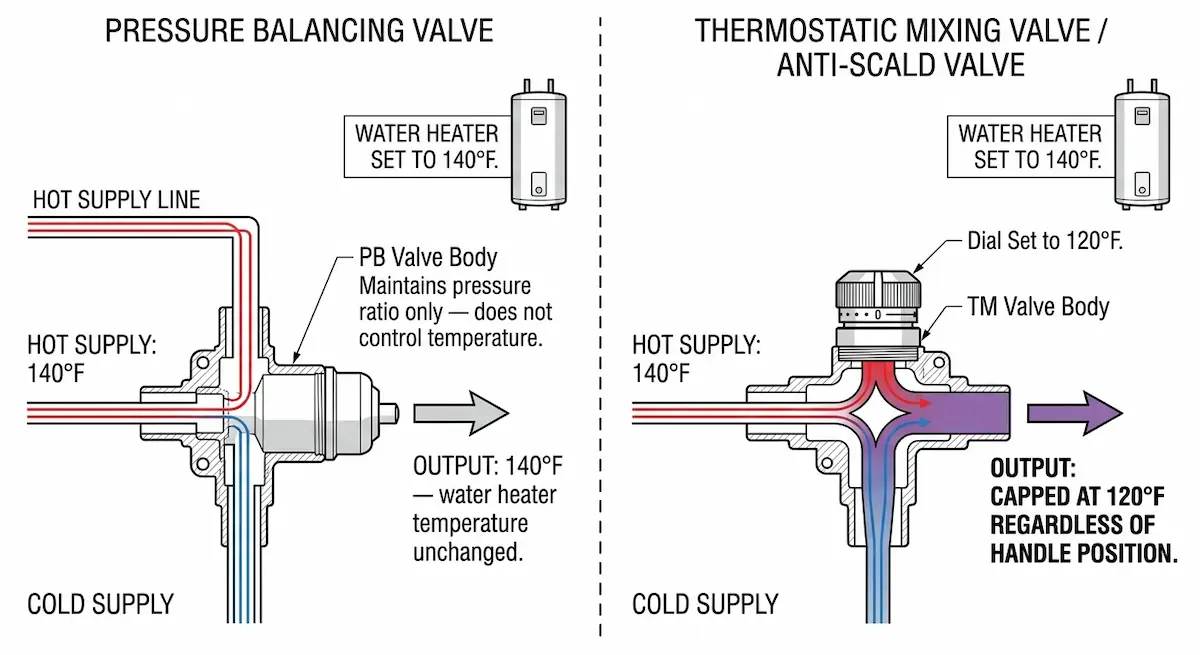
Here’s the distinction worth understanding. A pressure balancing valve does one thing — it maintains the ratio of hot to cold water when pressure fluctuates elsewhere in the house. Someone flushes a toilet, the cold pressure drops for a moment, the valve compensates so you don’t get a sudden blast of hot water. That’s useful and it’s why it became code minimum.
What it doesn’t do is control the actual temperature of the water coming out of your hot water heater. If your water heater is set to 140 degrees and someone turns the handle all the way to hot, the water coming out can still be dangerously hot. The pressure balancing valve has no control over that.
A thermostatic mixing valve — what most people call an anti-scald valve — premixes hot and cold water before it ever reaches the fixture and limits the output to whatever temperature you set it at. It doesn’t matter how the user adjusts the handle. It doesn’t matter what the hot water heater is set to. The water coming out will not exceed your preset temperature. That’s a mechanical fix, not a behavioral one.
The National Association of Home Builders recommends anti-scald valves in every aging in place bathroom — and from a contractor’s perspective, that recommendation doesn’t go far enough if it stops at a pressure balancing valve.
For an elderly senior aging in place — especially anyone with neuropathy, diabetic nerve damage, or any condition that reduces sensation — a behavioral fix isn’t enough. If someone can’t feel that the water is too hot until after the damage is done, telling them to be careful with the handle is not a safety plan. An anti-scald valve for seniors is.

The 120 Degree Standard
120 degrees Fahrenheit is the ADA standard and what I set every anti-scald valve for seniors installation to. It’s not arbitrary — at 120 degrees a full thickness burn takes several minutes of exposure to develop. At 140 degrees it takes seconds.
You could set it lower. Some contractors go to 110 or 115 for elderly clients with severe neuropathy. You could go slightly higher if the household has other users who want warmer water. But if I’m installing an anti-scald valve for a senior, it’s going to 120 and I’ll tell you why.
The setting process is straightforward. You turn the hot water all the way on at the fixture — fully open, maximum hot. Then you adjust the mixing valve until a thermometer at the fixture reads 120 degrees. That’s your set point. Everything downstream of that valve is now capped at 120 regardless of what happens at the handle.
A laser temp gun is faster than a standard thermometer but a regular kitchen thermometer works fine. You don’t need specialized equipment to set or check one of these valves.
One Rule That Has Nothing to Do with the Anti-Scald Valve for Seniors
Before we go further there’s a placement and habit rule that matters regardless of what valve you have installed. It applies to every elderly senior using a shower.
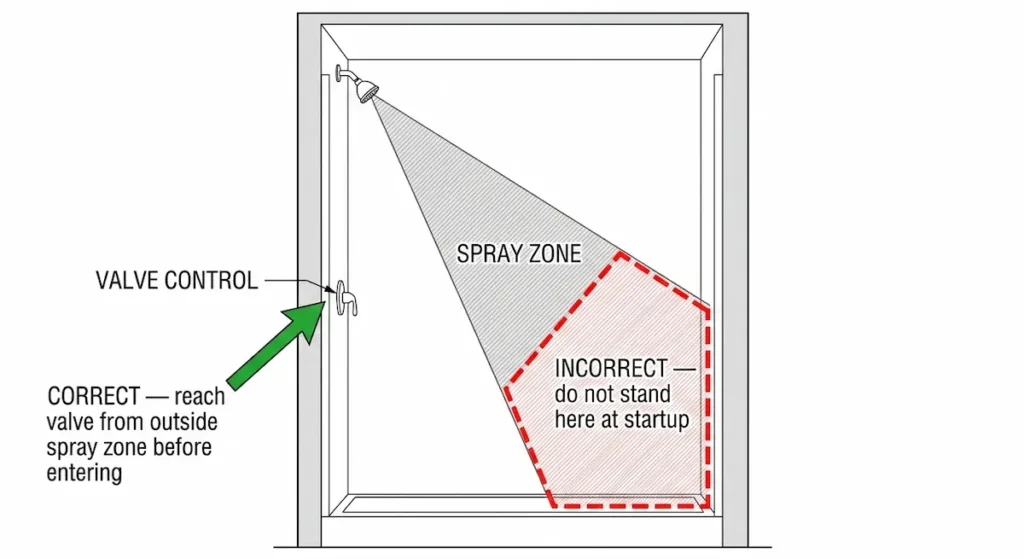
When you turn the shower on you should never be standing in the water stream. Ever.
This isn’t just for seniors — it’s a basic shower design and use principle that most people don’t think about until something goes wrong. When you build or modify a shower the controls should be positioned so the user can reach the handle from outside the spray zone. Reach behind or around the stream, turn it on, let it run for a moment, then step in.
If your current shower requires you to physically enter the spray zone to turn the water on, that’s a design problem worth fixing. Especially in an aging in place bathroom where a temperature spike or a pressure burst during that first second of flow is the most likely moment for a burn or a startle reaction that causes a fall.
When I spec a shower for aging in place the valve location is part of the conversation before anything goes on the wall. It should be part of yours too. For the complete picture of how shower controls relate to grab bar placement and bench position, my Shower Grab Bar Placement Guide covers how all three elements work together in a properly designed aging in place shower.
How an Anti-Scald Valve for Seniors is Installed
The good news for elderly homeowners or families on a budget is that a thermostatic mixing valve is one of the more approachable plumbing projects for someone with basic mechanical ability. You’re not rerouting supply lines or sweating copper in a tight space — you’re installing an inline valve between your existing hot and cold supply lines and the fixture.
The cold line connects to one side, the hot line to the other, and the premixed output goes to what was previously your hot supply at the fixture. Most valves have a gate style adjustment on top that you turn to dial in your temperature setting.
Connection options depending on your existing plumbing:
Push connect fittings like SharkBite — no tools beyond a pipe cutter, genuinely DIY friendly, what I recommend for homeowners attempting this themselves.
Sweat connections — soldering copper, requires a torch and experience, not a first timer job.
Union style — threaded connections, more forgiving than sweating, reasonable for a handy homeowner.
Crimp connections — require a specialized crimping tool that costs serious money, not realistic for a one time DIY job.
If you find cast iron supply lines when you open the wall — stop. That’s a whole home issue that goes well beyond an anti-scald valve installation. Cast iron supply lines rust from the inside and you’re drinking and bathing in that water. In my professional opinion they need to be replaced entirely and I will not budge on that. Drain pipes are a different story since you’re not consuming that water, but supply line cast iron needs to go. If your home has them, budget for a full supply line replacement with PEX and treat the anti-scald valve as part of that larger project.
Getting Into The Wall
For a shower installation the valve goes behind the wall — typically accessible from an adjacent room like a closet or hallway rather than through the shower tile itself. This is where planning ahead pays off significantly for any aging in place renovation.
Whenever the situation allows I strongly recommend installing an access panel at the valve location. It doesn’t have to be visible or unsightly — the last one I did was hidden inside a closet where nobody would ever notice it. But that panel means that when something needs attention down the road — and at some point something always does — a plumber can get directly to the plumbing without cutting a new hole through finished wall.
In my experience about 60 percent of homeowners go for the access panel when I explain the value. The other 40 percent just don’t want to look at it and that’s a completely valid choice. But the conversation should happen before the wall closes, not after.
For sink installations the valve goes right under the sink — no wall access required, no drywall work, straightforward retrofit. If you’re planning other upgrades alongside this work, my Aging in Place Bathroom Modifications Guide covers the plumbing and structural decisions — blocking, waterproofing, bench framing — that most contractors won’t raise unless you ask.
Whole Home vs Fixture Specific
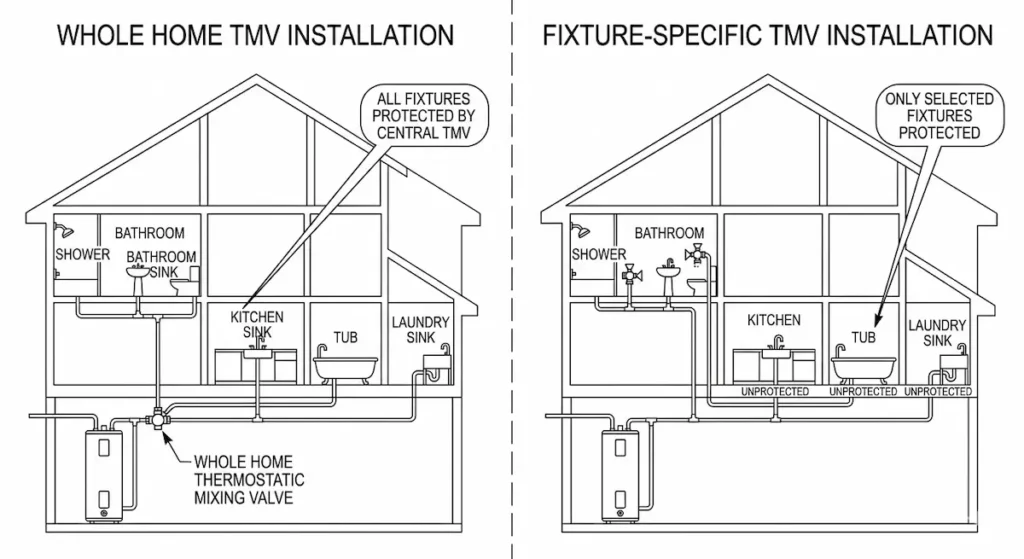
You have two approaches to anti-scald protection for seniors and the right one depends entirely on the household situation.
Fixture specific — a valve installed at the individual shower or sink. More targeted, less expensive, appropriate when only certain fixtures serve the elderly user or when other household members want different temperature preferences. A grandmother living in her own bathroom within a family home is a good candidate for fixture specific protection — her shower and her sink get the valve, the rest of the house stays at whatever temperature the family prefers.
Whole home — installed directly at the water heater, caps the temperature of every hot water outlet in the house simultaneously. More expensive upfront but simpler and more comprehensive. Makes the most sense when two elderly people share a home, when the entire household benefits from scald protection, or when a full aging in place renovation is already underway and the water heater is accessible.
I don’t have a blanket recommendation between the two. I present both options, explain the tradeoffs, and give my opinion based on the specific household. Every situation is different and the right answer for a couple in their 80s living alone is different from the right answer for a multigenerational household. If budget is the deciding factor, my Senior Bathroom Safety Without Remodeling Guide covers the highest-impact upgrades available without committing to a full renovation.
Cost Expectations for an Anti-Scald Valve for Seniors
Parts for an anti-scald valve for seniors typically run $60 to $70 for a quality unit. Brands I trust — Moen, SharkBite, and Bluefin make reliable product. In my experience most failures come from improper installation rather than the valve itself, so brand matters less than the installation being done correctly.
Labor is highly variable. A licensed plumber starting from scratch on a straightforward retrofit would likely start around $150 and go up from there depending on your location, how many valves are being installed, and whether wall access is involved. If the plumber has to cut into a wall ask two questions upfront — will he patch the drywall when he’s done, and if not, do you need to find a separate drywaller. Getting a clear answer before the work starts saves an unpleasant conversation after the pipe is run and there’s a hole in your wall. If the cost of a licensed plumber is a barrier, it’s worth knowing that several federal and state programs cover modifications — my Aging in Place Grants and Funding Guide covers what’s actually available and what the eligibility requirements look like.
Most newer homes and mobile homes built in recent years already have some form of anti-scald protection installed from the factory. I replaced one in a 2021 double wide that came with one already in place — if you’re doing a broader bathroom renovation in a manufactured home, my Mobile Home Bathroom Modifications for Seniors Guide covers the structural and plumbing realities that make those jobs different from standard construction. If your home is newer, it’s worth checking before you buy anything — you may already have it and just need to verify the temperature setting is correct.
Checking and Maintaining Your Anti-Scald Valve for Seniors
Installing an anti-scald valve for seniors is not the end of the conversation. These are mechanical devices and they fail over time — usually gradually rather than catastrophically. The water will slowly get hotter or slowly get cooler before it quits entirely, which is actually useful because it gives you a warning sign if you’re paying attention.
Check the output temperature every three months. Turn the hot all the way on at the fixture, let it run for a moment, and hold a thermometer under the stream. It should read at or below your set point. If it’s reading higher the valve needs adjustment or replacement. This is not a contractor call — it’s a homeowner task that takes two minutes and a thermometer.
Make it a habit the same way you check a smoke detector battery. Put it on the calendar. The elderly woman I mentioned at the beginning of this article didn’t have anyone checking hers. That’s the real lesson.
The Spectrum: From Basic to Premium
For context it’s worth understanding where anti-scald valves sit in the broader water temperature control landscape for aging in place bathrooms:
Pressure balancing valve — code minimum in most jurisdictions, handles pressure fluctuations only, does not cap temperature, already in most modern shower fixtures.
Thermostatic mixing valve — what this article is about, mechanical temperature cap, retrofit friendly, $60 to $70 in parts, appropriate for most aging in place situations involving elderly seniors.
Thermostatic shower system — premium fixture level product from manufacturers like Moen or Delta with thermostatic control built directly into the valve body, same core protection at a higher price point with more features, appropriate for a full remodel with budget.
For most aging in place situations a quality thermostatic mixing valve is the right answer. It delivers the mechanical temperature protection that matters without the cost of a full fixture replacement.
FAQ: Anti-Scald Valve for Seniors
What temperature should an anti-scald valve be set to for an elderly person? 120 degrees Fahrenheit is the ADA standard and what I set every aging in place installation to. You can go lower for an elderly senior with severe neuropathy. Verify the setting with a thermometer at the fixture with the hot fully open.
Can I install an anti-scald valve myself? Someone with basic plumbing experience and comfort with push connect fittings can handle a straightforward retrofit. If your plumbing requires sweating copper or you find unexpected issues behind the wall, call a licensed plumber.
How often should I check my anti-scald valve? Every three months. Turn the hot fully on, hold a thermometer under the stream, confirm it reads at or below your set temperature. Takes two minutes and a regular thermometer — no contractor needed.
Does my home already have one? Newer homes and mobile homes often come with anti-scald protection already installed. Check your existing fixtures before buying anything. If you’re not sure have a plumber take a look.
What’s the difference between a pressure balancing valve and an anti-scald valve? A pressure balancing valve maintains pressure ratios but doesn’t cap temperature. An anti-scald thermostatic mixing valve caps the output temperature mechanically regardless of what the user does at the fixture. For elderly seniors aging in place you want the thermostatic mixing valve.
Should I do fixture specific or whole home protection for an elderly person? Depends entirely on your household situation. Fixture specific makes sense when only certain areas serve the elderly user or when other household members want higher temperatures. Whole home makes sense when everyone benefits from the protection or when two elderly seniors share the home.
Bottom Line on Anti-Scald Valve for Seniors
A pressure balancing valve is not enough for an elderly senior aging in place — especially one with any condition that affects sensation or reaction time. A thermostatic mixing valve is a mechanical fix that works regardless of user behavior, costs under $100 in parts, and can be retrofitted to existing plumbing without a major renovation.
Install it, set it to 120 degrees, check it every three months, and make sure whoever is using that shower never stands in the water stream when they turn it on. Those four things cover the water temperature safety side of an aging in place bathroom completely.
For everything else in the bathroom — grab bars, flooring, thresholds, lighting — my Senior Bathroom Safety Guide maps the full renovation in the order a contractor would build it. And if you’re not sure where your bathroom stands right now, my Free Home Safety Checklist walks through every major risk zone room by room.