Keeping It Level
A bathroom exhaust fan for seniors does one job — move humid air out of the room before it damages your walls, grows mold, and turns your floor into a slip hazard. For a senior aging in place, all three of those outcomes are worse than they are for everyone else. Size it correctly at 1 CFM per square foot, vent it to the exterior, clean it monthly, and put a combination unit in if you’re doing any kind of upgrade. Everything else is details.
Most bathrooms have a bathroom exhaust fan. Many of those fans aren’t doing the job they’re supposed to do — either because they were undersized from the start, because nobody ever cleans them, or because whoever installed them never actually vented them outside. I’ve opened up enough ceilings to know that last one is more common than it should be.
A bathroom exhaust fan for seniors isn’t just an air quality issue. It’s a moisture issue, a mold issue, and a floor safety issue all wrapped up in one fixture. Getting it right is worth the conversation.
For the complete picture of senior bathroom safety, my Senior Bathroom Safety Guide covers every element from structural blocking to flooring to drainage in the order a contractor would actually build it.
What a Bathroom Exhaust Fan for Seniors Actually Does — and What Happens Without One
When you take a shower, you’re filling a small enclosed room with warm humid air. That air has to go somewhere. Without a working bathroom exhaust fan it goes into your walls, your ceiling, and behind your fixtures. Your sheetrock absorbs it. The corners get damp. The ceiling above the shower starts showing the first signs of what’s coming.
Mold is the end result most people know about, but the damage happens before you can see it. I’ve pulled mirrors off bathroom walls and found mold colonies behind them that the homeowner had no idea existed. Same with corners near the ceiling and along the base of walls near the shower. By the time mold is visible on a surface you can see, it’s been growing somewhere you can’t see for a while.
How fast mold develops depends on your climate, your temperature, and how much moisture the room holds. In a warm humid environment it can happen in weeks. In a drier climate it takes longer. The variable you control is how much moisture stays in the room after a shower — and that’s entirely a function of whether your bathroom exhaust fan is working.
For an elderly senior aging in place there are three specific reasons this matters beyond the general home maintenance concern.
Respiratory health.
Mold exposure is a serious health issue for anyone, and elderly adults are more vulnerable to respiratory problems than younger people. A bathroom with a chronic moisture problem and no functioning exhaust fan is a mold incubator that a senior is breathing in every single day.
Floor safety.
Steam and humidity don’t just go into the walls — they settle on the floor. A bathroom floor covered in moisture from an inadequate exhaust fan is a slip hazard. Wet tile and wet vinyl are the surfaces most falls happen on, and in a senior bathroom where fall prevention is the whole point of the renovation, keeping the floor dry is part of the same conversation as grab bars and non-slip flooring. My Non-Slip Bathroom Flooring for Seniors Guide covers the flooring side of that equation — but the best non-slip floor still gets more dangerous when it’s coated in steam that had nowhere to go.
Mold remediation cost.
A properly sized bathroom exhaust fan costs $30 to $150 depending on what you buy. Mold remediation in a bathroom that’s been accumulating moisture damage for years costs significantly more. I’ve seen jobs where the damage was extensive enough to require tearing out tile, replacing sheetrock, and treating the framing. The fan is always the cheaper choice.
Sizing Your Bathroom Exhaust Fan: CFM, Room Size, and Ceiling Height
CFM stands for cubic feet per minute — it’s the measure of how much air a fan moves. Every bathroom exhaust fan has a CFM rating on the box. The room you’re putting it in has a square footage. Matching those two numbers correctly is the entire sizing conversation.
The standard rule is 1 CFM per square foot of bathroom floor space.
- Small bathrooms under 50 square feet: minimum 50 CFM. This is where most fans start — 50 CFM is the floor, not a recommendation for a larger space.
- Medium bathrooms 50 to 100 square feet: 50 to 100 CFM matched to your actual square footage.
- Larger bathrooms over 100 square feet: start at your square footage CFM and add 50 CFM for each major fixture — toilet, shower, tub. A 120 square foot bathroom with a separate toilet, shower, and tub is not a 120 CFM situation.
Ceiling height matters and most people don’t account for it. The CFM calculation is based on floor square footage, but what the fan is actually moving is cubic feet of air — length times width times height. A bathroom with 10 foot ceilings has significantly more air volume than the same footprint with 8-foot ceilings. If your ceiling is above 8 feet, move up in CFM accordingly.
Oversized vs. undersized:
An oversized bathroom exhaust fan isn’t a problem. It’ll move more air than it needs to and that’s fine. An undersized fan is the issue — it’s running constantly but not moving enough air to do the job, which means the moisture is still sitting in the room. Most people assume a fan is a fan and buy the cheapest option available. A fan that’s inadequate for the room it’s in will still lead to moisture damage. The cheaper fan costs more in the long run when the mold bill arrives.

Ductwork: The Part That Actually Gets Skipped
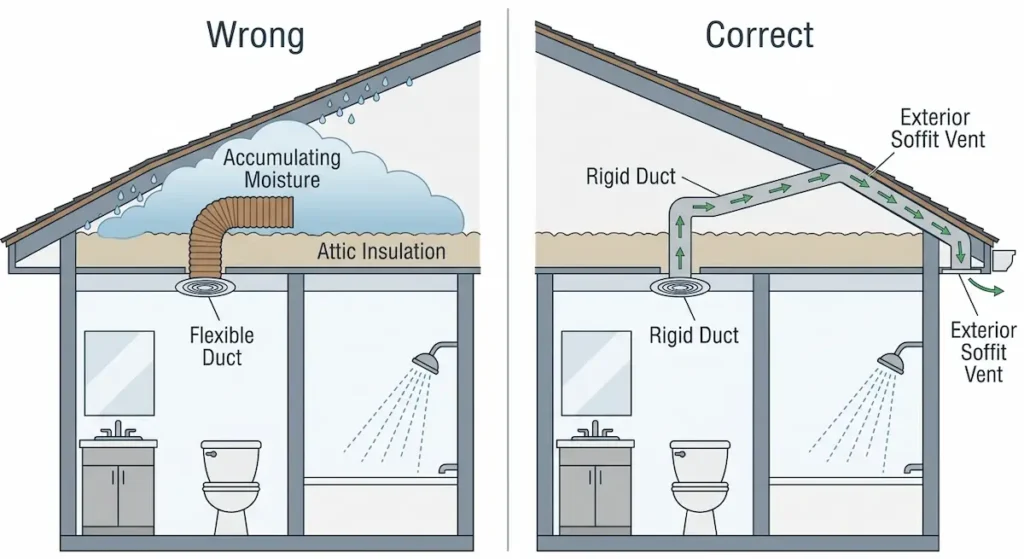
Here’s the most common bathroom exhaust fan failure I encounter on jobs — the fan is installed, it turns on, it sounds like it’s working, and it’s venting directly into the attic.
Code requires exterior venting. The exhaust has to go outside — through a soffit vent, through the roof, through an exterior wall. Not into the attic space where the insulation just absorbs all that moisture and you’ve moved your mold problem from the bathroom walls into the ceiling cavity.
I’ve pulled bathroom exhaust fans on remodels and found the duct just terminated in a pile of attic insulation. The fan ran fine for years and did absolutely nothing except deposit bathroom moisture directly into the structure of the house. The homeowner had no idea.
Beyond getting it outside, the path matters. The enemy of bathroom exhaust fan performance isn’t length — it’s turns. Every elbow in your ductwork creates a restriction. The air the fan is moving has to fight its way through every bend. A short run with three turns performs worse than a longer straight run. When I’m routing ductwork I’m always looking for the straightest path to the exterior. Flexible duct with unnecessary bends is one of the most common ways a properly sized fan ends up underperforming.
The Door Undercut: Make-Up Air
One thing almost nobody talks about — if your bathroom door is too tight to the floor, your fan is choking. A powerful fan can’t pull air out of a room it can’t pull air into. That gap at the bottom of the door is how make-up air gets in so the fan can actually push humid air out. You should have at least a half inch to three quarters of an inch clearance under the bathroom door. If you can’t slide a pencil under it, your fan is just spinning and making noise. This comes up more than you’d think on older homes where the floors have settled or new flooring was installed without accounting for door clearance.
Where to Position a Bathroom Exhaust Fan for Seniors
In most bathrooms I aim for a central location — positioned between the major fixtures rather than directly over one of them. The fan needs to serve the whole room, not just the shower corner.
That said, in a smaller bathroom the difference matters less. In a larger bathroom or a layout with a separate water closet or a significant distance between the shower and the vanity, placement is worth thinking through carefully.
The practical reason I default to center on most aging in place renovations is that I’m almost always installing a combination unit — fan plus light, or fan plus light plus night light — and a centered fixture looks intentional rather than like an afterthought.
Combination Units: What’s Actually Worth It for Seniors
A bathroom exhaust fan needs to be there. A light needs to be there. In most smaller bathrooms those being the same fixture just makes sense — it’s cleaner, and it’s one less hole in your ceiling.
When it comes to a bathroom exhaust fan for seniors specifically, the fan plus light plus night light combination is the one I recommend most consistently. I covered this in my Bathroom Lighting for Aging in Place Guide — a ring of passive night light around the fan housing that activates when the main light switches off. When you turn the bathroom light off, the night light comes on automatically. One fixture handling ventilation, primary lighting, and passive night lighting is a real value for an elderly senior’s bathroom.
The 3am trip to the bathroom is one of the highest fall-risk moments in an elderly person’s day. Anything that puts light on that path without requiring a switch to be found in the dark is worth the upgrade. For seniors aging in place, that combination fan is one of the most practical purchases in the whole renovation.
As for the rest of the bathroom exhaust fan for seniors combination options — heater, humidity sensor, Bluetooth speaker — I’ll put it this way. My own bathrooms have the fan, light, night light, and Bluetooth speaker combo installed. My bathroom is being properly vented, my son can see when he stumbles in at 2 am, and my daughter can listen to Taylor Swift at full volume while she gets ready. It works for everybody. Whether the heater or the humidity sensor makes sense for you depends on your situation, but the core combination of fan, light, and night light is what I’d spec for a bathroom exhaust fan for seniors, they’re reasonably priced and provide multiple functions.
A Note on Heater Combos
One specific caution on the bathroom exhaust fan for seniors heater combo — reduced heat sensitivity means someone can stand directly under an infrared heat lamp longer than they should without realizing it. If you go that route, pair it with a timer switch so it can’t be left running for hours by accident. Same principle as the fan timer, same $15 to $25 fix.
Sone Ratings: The Noise Factor Nobody Talks About
Most homeowners don’t know what a sone rating is. They just know that some fans are quiet and some sound like a small aircraft taking off. The sone rating on the box is the number that tells you which one you’re buying.
Lower sone number means quieter fan. A rating of 1.0 or below is essentially silent — you can barely tell it’s running. A rating of 3.0 or above is the one that makes people turn it off because they can’t hear the TV.
For a senior aging in place this matters for a simple reason: a loud bathroom exhaust fan is a fan that gets turned off. If the fan is annoying enough that the elderly person using the bathroom consistently avoids running it, it’s not doing its job. A quiet fan runs without being noticed, which means it actually runs.
One thing worth considering on the “fan that gets turned off” problem. The most important 15 minutes of venting happen after the person leaves the bathroom — not while they’re in it. People frequently flip the fan off the moment they walk out to save electricity or because they don’t like the noise, and that’s exactly when the moisture is still sitting in the room. If that sounds familiar, it might be worth swapping the standard toggle switch for a push-button countdown timer switch. Set it for 10, 20, or 30 minutes and it shuts itself off automatically — no one has to remember to come back and flip it off, and the bathroom actually dries out. It’s a $15 to $25 switch swap and it’s one of those small changes that makes a bigger difference than you’d expect.
Maintenance: Monthly, Two Minutes, No Tools
Pop the cover down. Wipe the dust off the grille and the fan blades. Push it back up. That’s the whole job and it should happen once a month.
Dust buildup on the fan restricts airflow. A restricted bathroom exhaust fan moves less air, which means the moisture problem it’s supposed to solve starts coming back. The fan also works harder against that restriction, which shortens its life.
The sign that a fan needs replacing rather than just cleaning is noise. A fan that was quiet and starts getting loud — or starts sounding labored or grinding — is telling you something is wrong mechanically. If the cleaning doesn’t fix it, the fan needs to come down. If your usually quiet fan suddenly sounds like Darth Vader trying to communicate with you, it’s probably time to replace it.
Skipping regular cleaning is also how fans fail prematurely. A bathroom exhaust fan that gets cleaned monthly will last significantly longer than one that gets ignored for years and then replaced when it finally quits.
FAQ: Bathroom Exhaust Fan for Seniors
What size bathroom exhaust fan does a senior bathroom need?
1 CFM per square foot is the baseline. Minimum 50 CFM for any bathroom. Add 50 CFM per fixture for bathrooms over 100 square feet. Increase CFM if your ceiling is above 8 feet. When in doubt, go bigger — an oversized fan isn’t a problem, an undersized one is.
Does it matter where the bathroom exhaust fan vents to?
Yes. It has to vent to the exterior — through a soffit, roof, or exterior wall. Venting into the attic is a code violation and moves your moisture problem from the bathroom into the ceiling structure. Minimize duct turns for best performance.
What’s a sone rating and what number should I look for in a bathroom exhaust fan for seniors?
Sones measure how loud the fan is. Lower number equals quieter fan. For an aging in place bathroom, I target 1.0 sones or below — quiet enough that it runs without being noticed or turned off.
Are combination bathroom exhaust fan and light units worth it for elderly seniors?
For most aging in place bathrooms, yes. Fan plus light plus night light in one fixture is cleaner, more functional, and one of the better value upgrades in an elderly senior’s bathroom. The passive night light feature — which activates when the main light turns off — directly addresses the fall risk of middle of the night bathroom trips.
How often should a bathroom exhaust fan be cleaned?
Monthly. Pop the cover down, wipe the dust off, push it back up. Dust buildup restricts airflow and shortens the fan’s life. A fan that gets cleaned regularly will perform better and last longer than one that doesn’t.
How do I know if my bathroom exhaust fan needs to be replaced?
Noise is the main indicator. A fan that was quiet and starts running loud or sounding labored usually has a mechanical issue that cleaning won’t fix. If a good cleaning doesn’t resolve it, it’s time to replace it.
The Bottom Line on Bathroom Exhaust Fan for Seniors
A bathroom exhaust fan for seniors is one of the least glamorous upgrades in an aging in place renovation and one of the most consequential if it’s wrong. Mold damage is expensive. Wet floors cause falls. Poor air quality affects the respiratory health of elderly seniors. All three of those outcomes are worse for an older adult aging in place than they are for a younger person, and all three are controlled by whether the exhaust fan is sized correctly, vented properly, and maintained.
Size it at 1 CFM per square foot, vent it to the exterior, keep the ductwork straight, and clean it monthly. If you’re doing any kind of upgrade, put a combination unit in — fan, light, and night light at minimum. And check your door. If your bathroom door is so tight to the floor that you can’t slide a pencil under it, your fan is just a noisemaker — you need that gap for make-up air, or the steam isn’t going anywhere.
For everything else in the senior bathroom — grab bars, flooring, water temperature, and lighting — my Senior Bathroom Safety Guide covers the full renovation in the order a contractor would build it. And if you want to assess your current bathroom before spending anything, my Free Home Safety Checklist walks through every major risk zone room by room.