Keeping It Level
Most bathrooms are built to minimum standards — is there a light in the room? Yes? Moving on. For aging in place that’s not good enough. Adequate lighting isn’t an aesthetic choice, it’s a safety system. The goal is even, overlapping coverage with no dark spots — especially in the shower. Everything else is secondary.
I just finished a bathroom remodel where we pulled out a leaking skylight and closed it off entirely. The homeowner had been fighting that leak for years, convinced natural light was worth the maintenance headache. It wasn’t. By the time we were done, a properly planned recessed lighting layout made the bathroom brighter at midnight than that skylight ever made it at noon — and it won’t leak in year three.
That’s the reality of bathroom lighting for aging in place. Natural light sounds appealing but it only works during the day, most bathroom windows stay covered for privacy anyway, and skylights in my experience will eventually leak. Every single one I’ve encountered has. I’ve fixed more than I can count. If you’re planning a remodel and a skylight is on the list, cross it off and put that money into a lighting plan that works at 3am.
For a complete picture of senior bathroom safety beyond lighting, my Senior Bathroom Safety Guide covers every element from structural blocking to drainage to flooring in the order a contractor would actually build it.
Why “A Light In The Room” Isn’t Enough for Senior Bathroom Safety
Most homes are built to minimum electrical standards. The builder’s question is simple — is there a functioning light fixture? Yes? Move on. For a 30-year-old that’s fine. For an elderly adult aging in place it’s a liability.
Research shows a 65-year-old needs roughly four times as much light as a 20-year-old to perceive the same level of detail. In a bathroom where clear water sits on grey tile, where the wet floor meets the dry floor without a color change, and where the difference between a shadow and a puddle can mean a fall — inadequate lighting isn’t just inconvenient. It’s dangerous. That’s why bathroom lighting for aging in place is so important.
The most common mistake I see in senior bathrooms isn’t the wrong type of fixture. It’s simply not enough of them. One ceiling light in the center of a bathroom creates bright spots directly underneath and dark zones everywhere else — behind the toilet, inside the shower, at floor level along the walls. Those dark zones are exactly where falls happen.
The Overlap Principle: How to Assess Your Bathroom Lighting for Aging in Place
When I walk in to assess bathroom lighting for aging in place renovations the first thing I’m looking for is coverage gaps. Where are the dull spots? Where does the light not reach? Is the shower its own dark zone when the curtain is closed?
The goal is overlapping light — fixtures positioned so their coverage areas intersect and there are no shadowy corners anywhere in the room. Recessed lights project in a cone shape downward. In a standard bathroom with 8 foot ceilings that cone covers a specific radius on the floor. At 10 foot ceilings the same fixture covers a wider area. When you place fixtures correctly those cones overlap and the entire floor plane is evenly lit.
For a standard bathroom I run a minimum of two recessed lights — one in the main area and one directly over the shower. In larger bathrooms or more complex layouts I’ll run three or more depending on ceiling height, the vanity lighting already in place, and the specific layout of the room. There’s no universal number — there’s a coverage standard, and you work backward from that.
The room layout and the vanity fixture both affect how many additional lights you need. If you already have a good vanity fixture covering that wall adequately, your main area light can focus coverage elsewhere. If your vanity light is weak or poorly positioned it becomes part of the problem rather than part of the solution.
The Shower Is the Most Overlooked Lighting Zone in an Elderly Bathroom
Ask a homeowner where the lighting problem is in their bathroom and they’ll almost never point at the shower. But the shower is consistently the most under lighted space in the room — and the highest risk zone for falls.
Here’s something most people don’t think about until it happens to them. You’re in a bathroom with the light on. You step into the shower and pull the curtain closed. Suddenly it’s significantly darker. That curtain just blocked the main ceiling fixture and now you’re standing on a wet slick surface with half the light you had ten seconds ago.
The fix is a dedicated fixture directly over the shower — not the bathroom ceiling light kind of reaching the shower area. A fixture inside the shower zone itself.

This has one non-negotiable technical requirement. Any fixture installed in or directly over a wet area must be wet-rated. Look for IP65 rated recessed fixtures for shower installations. A standard fixture in a wet zone is a safety and code issue — and it will fail faster than you’d expect in a constantly humid environment.
For wattage — in a bathroom you’re targeting 60 to 100 watt equivalent output. When buying LED fixtures the box will say “equivalent” because LEDs require significantly less actual wattage than the incandescent bulbs most people grew up with. A 10 watt LED can deliver 60 watt equivalent output. Buy by equivalent output and lumen rating, not by wattage.
The shower lighting question is also connected to your wall and ceiling material. If you’re installing a new shower surround as part of a senior bathroom renovation, my Shower Surrounds for Seniors Guide covers the material differences that affect how fixtures are mounted and sealed in a wet zone.
Color Temperature: Why Bulb Color Matters More Than Brightness in Bathroom Lighting for Aging in Place
Most homeowners assume a light is a light. They don’t know that bulbs have a color, and they don’t know that color makes a meaningful difference in an aging in place bathroom.
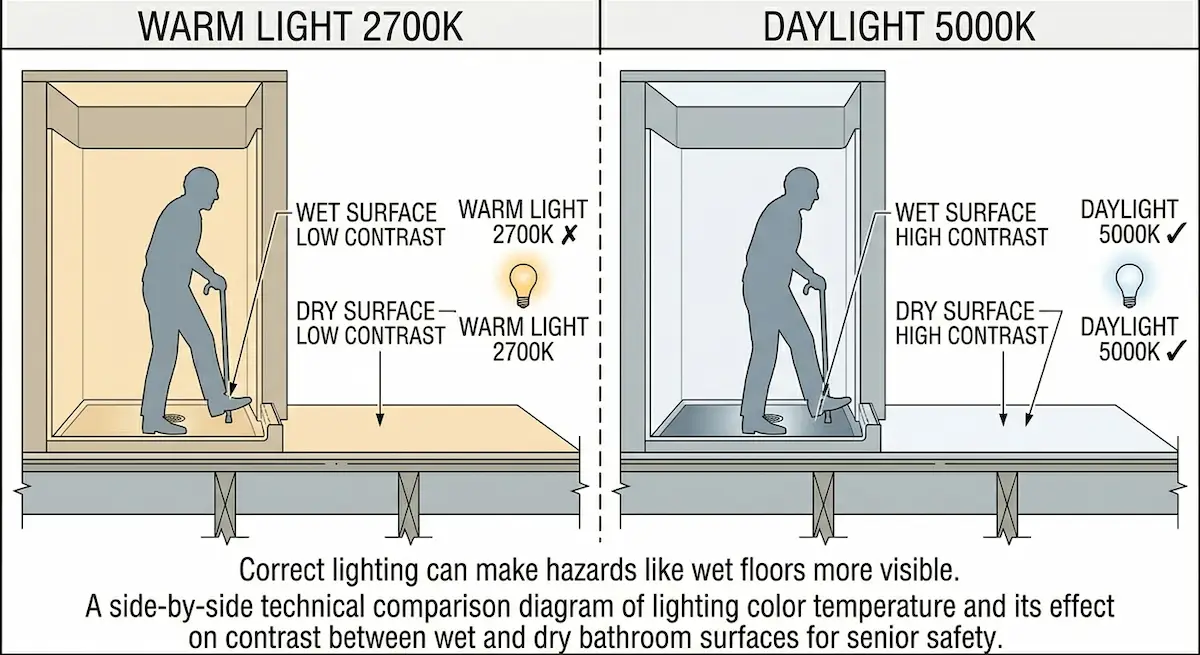
The warmth or coolness of a bulb is measured in Kelvin. Lower numbers — 2700K to 3000K — produce warm yellow light that feels comfortable but reduces contrast between surfaces. Higher numbers — 4000K to 5000K — produce cool daylight spectrum light that creates sharp contrast.
For senior bathroom lighting I spec 4000K to 5000K on every job. In a bathroom with warm yellow lighting a wet floor and a dry floor can look nearly identical. In a bathroom with daylight spectrum lighting the wet surface reflects differently, which is also why your flooring choice matters, and the contrast becomes visible to an aging eye. That contrast is what allows someone to actually see where the hazard is before they step on it.
Warm lighting looks better in a showroom. Daylight lighting is safer in an elderly bathroom. In most cases you can find fixtures that deliver the right color temperature in a style that still looks good — the aesthetic conversation is about fixture design and finish, not about choosing between safe and attractive.

The Cheapest High Impact Upgrade: Converting to Canless LED
If budget is the primary constraint the single highest impact lighting upgrade for an aging in place bathroom requires no new wiring, no new circuits, and no drywall work.
Most older bathrooms have recessed can lights with incandescent or fluorescent bulbs. A canless LED retrofit replaces the entire fixture at the existing wire location — you cut a new opening where the wire already is and snap in the LED unit. The wiring connection is already there. You’re not running anything new.
The difference in light output is significant and immediately visible. Incandescent bulbs waste a large portion of their energy as heat. An LED delivering the same equivalent output puts more of that energy into actual visible light. I’ve done this conversion in bathrooms that felt dim and dated and the change is dramatic.
This is also the conversation I have with elderly clients or their families who push back on lighting costs. Before we talk about anything else — when did you last change those bulbs and what type are they? Because if the answer is incandescent or fluorescent, the cheapest thing we can do right now will make more of a difference than you’d expect.
Night Lighting: The 3am Problem
The most dangerous moment in most seniors’ day isn’t the morning shower. It’s the 3am trip to the bathroom in the dark.
Motion activated night lighting is the cheapest safety upgrade in this entire guide and one of the most impactful for elderly adults aging in place. Options range from plug-in LED night lights to low voltage LED tape installed under the vanity toe kick that activates automatically on motion.
My current go-to recommendation for aging in place bathrooms on a budget is a bathroom exhaust fan with an integrated LED night light — a ring of light around the fan housing that activates automatically when the main light is switched off. Not motion activated — it simply responds to the main switch. When you turn the bathroom light off the night light comes on. When you turn it on the night light goes off. One fixture, three functions — exhaust, primary light, and passive night light — for the cost of a standard fan replacement. It’s one of the best value swaps I make on aging in place jobs.
The path from the bedroom to the bathroom matters just as much as the bathroom itself. A fall in a dark hallway on the way to the bathroom is still a fall. Motion activated baseboard lighting or plug-in sensors along that path is a $20 fix that covers the most dangerous part of the 3am trip — the first ten feet out of bed.
Switch and Outlet Heights: Planning for a Wheelchair
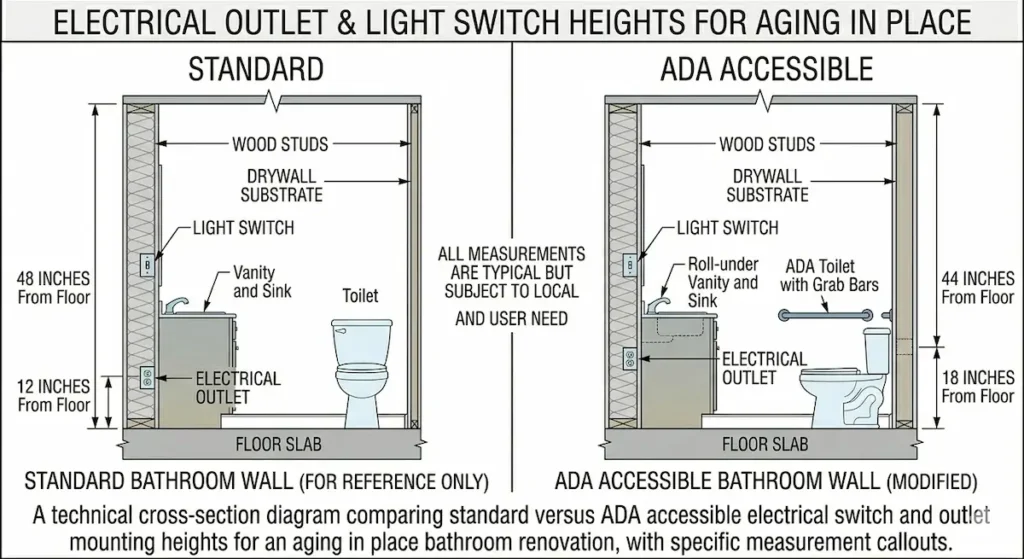
Most guides on bathroom lighting for aging in place never mention this. It belongs in the conversation because switches and outlets get placed during the same rough-in phase as your fixtures — and moving them after the walls are closed is expensive.
Standard switch height in most homes is around 48 inches from the floor. Standard outlet height is around 12 to 18 inches. Neither of those works well for a wheelchair user.
For a bathroom that needs to accommodate a wheelchair — whether that’s a current mobility situation, post-surgery recovery, or a progressive condition like MS where wheelchair use is a likely future reality — I target around 42 to 48 inches for switches and 18 to 24 inches for outlets. The ADA has specific recommendations worth referencing for your situation, but the practical goal is a height that works comfortably for both a seated user and a standing adult.
Here’s the part worth saying directly. If you know a wheelchair is in the future and you’re already opening walls for a remodel — MS progression, Parkinson’s, any condition with a clear trajectory — moving a switch location during rough-in costs nothing. Moving it after the tile is in costs significantly more. It’s a reality worth planning for honestly rather than hoping you won’t need it. If you’re already planning a wider doorway to accommodate a walker or wheelchair, my Widening Your Doorway for Aging in Place Guide covers what’s inside that wall and what to expect from the process.
Bathroom Lighting for Aging in Place Is Endless — Adequate Comes First
Bathroom lighting for aging in place is one of the most customizable elements of any renovation. Baseboard lighting, crown lighting, low voltage LED strips, color changing fixtures, smart lighting with motion sensors and timers, decorative sconces, backlit mirrors. The options are genuinely endless and the price range goes from a $15 plug-in night light to a fully automated custom system.
The principle that cuts through all of it is simple. Adequate is first. Aesthetics is second. Fortunately in most cases you can achieve both at the same time — the conversation with my senior clients is about fixture style and finish, not about choosing between safe and attractive.
Start with coverage. Make sure the shower has its own dedicated wet-rated fixture. That there are no dark zones at floor level. Make sure the color temperature gives you contrast on wet surfaces. Also, that night lighting covers the path from the bed to the toilet. Everything else is a customization on top of a safe foundation.
Custom Lighting Is a Different Conversation
One thing worth saying clearly — swapping out a basic exhaust fan for one of those combination units is a straightforward job for a qualified electrician or handyman. Custom lighting is not. Crown molding lighting, baseboard LED systems, and automated smart lighting setups involve different wiring, different planning, and in some cases permits. Just because one part of your lighting upgrade is simple doesn’t mean all of it is. If custom lighting is on your list have that conversation with your contractor before you start — not after someone has already cut into your ceiling.
For the full senior bathroom safety picture — flooring, grab bars, thresholds, drainage, and everything else that works alongside your lighting plan — my Senior Bathroom Safety Guide maps every element from floor to fixtures. If you’re working without a full remodel my Senior Bathroom Safety Without Remodeling Guide covers the upgrades that don’t require touching the tile — including the bathroom lighting for aging in place swaps that make the biggest difference for the least money.
FAQ: Bathroom Lighting for Aging in Place
How many lights does a senior bathroom need?
At minimum one in the main area and one dedicated wet-rated fixture in the shower zone. Most bathrooms benefit from two to three recessed fixtures depending on ceiling height, layout, and existing vanity lighting. The goal is even overlapping coverage with no dark zones — work backward from that rather than a fixed number.
What color temperature bulb is best for elderly bathroom safety?
4000K to 5000K daylight spectrum for bathroom lighting for aging in place. The higher contrast helps aging eyes distinguish between wet and dry surfaces and see edges and floor transitions clearly. Avoid warm yellow bulbs in wet areas even if they look better — contrast matters more than ambiance in a senior bathroom.
Do I need a special light fixture for the shower?
Yes. Any fixture inside or directly over a wet area must be wet-rated — look for IP65 rated recessed fixtures. A standard fixture in a shower zone is a safety and code issue and will fail faster than expected in constant humidity.
What’s the easiest bathroom lighting for aging in place upgrade that doesn’t require major work?
Converting existing recessed cans to canless LED retrofits. You’re replacing the fixture at an existing wire location — no new circuits, no drywall work, no electrician for a straightforward swap. The improvement in light output is significant and immediately visible.
Should light switches be at a different height in an aging in place bathroom?
If wheelchair accommodation is a current or future consideration, targeting 42 to 48 inches for switches and 18 to 24 inches for outlets is the practical range. The time to adjust this is during rough-in when walls are open — not after tile is in.
What about natural light and skylights in a senior bathroom?
Windows help during the day but most stay covered for privacy during actual bathroom use. Skylights in my experience will eventually leak — I’ve repaired more than I can count and I no longer recommend them. A well-planned artificial lighting system works at 3am and doesn’t require a roofing repair in year five.
The Bottom Line on Bathroom Lighting for Aging in Place
Lighting is the most underestimated safety upgrade in a senior bathroom and sometimes the cheapest to fix. You don’t need a full remodel to make a meaningful difference — sometimes it’s as simple as changing the bulbs. But if you are doing a remodel, plan the bathroom lighting for aging in place the same way you plan the grab bars and the flooring — with coverage and safety as the standard, not minimum code compliance.
One light in the room is not a lighting plan. Even, overlapping coverage with a dedicated shower fixture, daylight spectrum bulbs, and passive night lighting is. Start there and build up from what your budget allows.
If you want to walk through your current bathroom before starting any work, my Free Home Safety Checklist covers the most common lighting and safety hazards room by room.