Keeping It Level
Not every senior needs a specialized vanity — it depends entirely on their mobility, their bathroom layout, and where they’re headed physically. But if wheelchair access, seated use, or limited grip strength is part of the picture, the vanity is one of the most used fixtures in the bathroom and one of the most overlooked in an aging in place renovation. Get the height, the clearance, and the hardware right on a bathroom vanity for seniors and it works for everyone. Get it wrong and it’s a daily frustration at best and a fall risk at worst.
A lot of aging in place bathroom renovations start with grab bars, flooring, and shower access — and those are the right priorities. But the vanity is where most people start and end their day. It’s touched more times daily than almost any other fixture in the bathroom. For a senior aging in place, especially one with mobility limitations, arthritis, or a wheelchair, a vanity that doesn’t work for their body makes every single one of those interactions harder than it needs to be.
For the complete picture of senior bathroom safety, my Senior Bathroom Safety Guide covers every element from structural blocking to flooring to drainage in the order a contractor would actually build it.
Does Every Senior Need a Specialized Bathroom Vanity?
No — and that’s worth saying clearly before anything else. A standard vanity works fine for a lot of seniors depending on their mobility and what their actual needs are. The conversation about upgrading a bathroom vanity for seniors only becomes necessary when one of a few specific situations is present.
The first is wheelchair use — current or anticipated. A standard vanity cabinet doesn’t provide the knee clearance a wheelchair user needs to pull up close enough to use the sink comfortably. The second is the need to sit while getting ready — not necessarily in a wheelchair, but any situation where standing at the vanity for extended periods is difficult. The third is grip strength and dexterity issues — arthritis, Parkinson’s, stroke — where the hardware on a standard vanity becomes a daily obstacle.
If none of those apply, a standard vanity may be perfectly adequate, and the conversation is more about hardware and faucet upgrades than a full vanity replacement. Start with the person’s actual situation before you start pricing out new cabinetry.
One risk worth understanding even for seniors who don’t use a wheelchair — the vanity is where a lot of quiet slips happen that never get attributed to the vanity itself. Leaning forward to reach a faucet that’s too far away shifts your center of gravity forward over a wet floor. It doesn’t feel dangerous until it is. If a full accessible vanity replacement isn’t in the budget, the single most important change is making sure the faucet is reachable without a forward lean. Everything else builds from there.
Vanity Height: Standard vs. ADA vs. Comfort Height
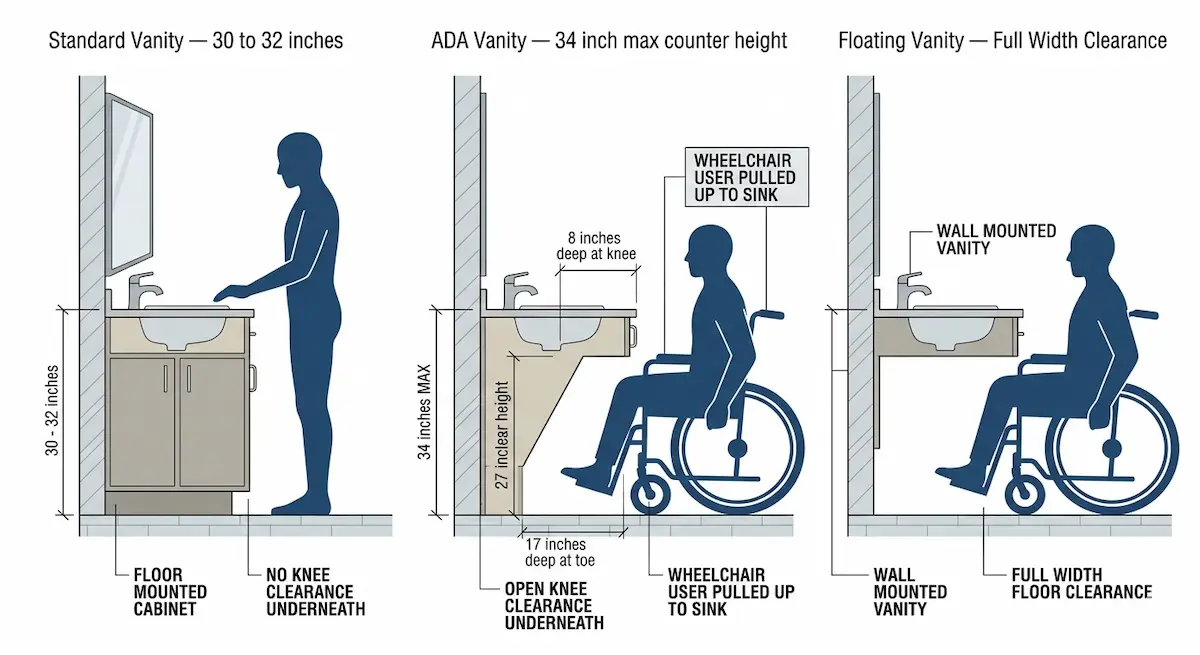
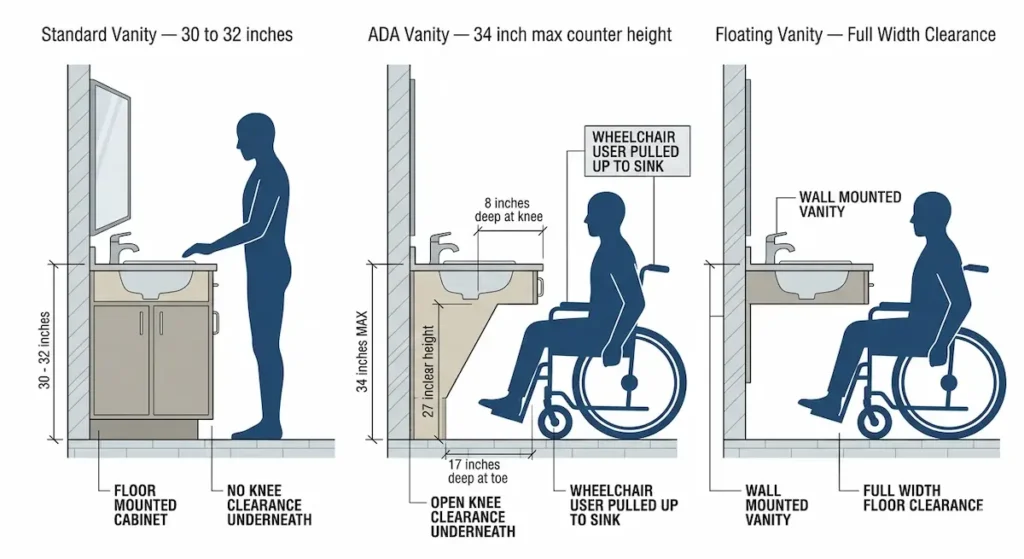
Standard vanity height in most homes runs 30 to 32 inches from floor to countertop. That’s a height designed for standing use, and it works fine for most adults in good health.
ADA guidelines call for a maximum counter height of 34 inches with knee clearance underneath — at least 27 inches of clear height under the counter, 8 inches deep at knee level, and 17 inches deep at toe level. That clearance is what allows a wheelchair user to pull up close to the sink and actually use it rather than reaching from a distance.
The practical distinction for an aging in place bathroom isn’t always about hitting exact ADA numbers — it’s about whether the vanity accommodates the way the person actually uses it. Someone who needs to sit in a chair to do their hair and makeup needs a different setup than someone who uses a power wheelchair full time. Both need clearance underneath. The exact height depends on the person.
One mistake I see fairly often — homeowners remove the cabinet doors thinking that creates accessible knee clearance. It doesn’t. Open cabinet doors give you visual openness but the cabinet box is still there. For a seated user to actually pull close enough to use the sink comfortably you need 27 inches of true vertical clearance with nothing blocking it, not an open cabinet face with the box still in the way. That’s the difference between a modification that looks accessible and one that actually is.
Wall Mounted vs. Floor Mounted: The Real Tradeoffs of a Bathroom Vanity for Seniors
This is the decision that drives most of the other decisions in a bathroom vanity for seniors renovation.
Floor mounted vanities
These are the standard — a cabinet sitting on the floor with the countertop on top. They’re easier to install, the cabinet and floor share the weight, and storage is typically better. For most seniors who don’t need full wheelchair clearance they’re a completely reasonable choice, especially with the right hardware and faucet upgrades.
One option worth knowing about for seniors who need knee clearance but prefer a floor mounted unit — manufacturers do make floor mounted vanities with an open center section and cabinets on both sides. You get the knee clearance of a floating vanity with the stability and storage of a floor mounted cabinet. The tradeoff is width — these units are wider than a standard vanity to accommodate the open center plus cabinets on either side, so your bathroom layout has to have the wall space to support it. Measure before you shop. In a smaller bathroom it may not be a realistic option but in a larger bathroom it’s worth looking at before defaulting to a floating vanity.
Wall mounted or floating vanities
These provide knee clearance across the full width of the fixture. There’s nothing on the floor underneath which makes them the better choice for wheelchair users and the cleaner option for anyone who needs to pull a chair up close. They also make the floor easier to clean which matters in a bathroom where moisture management is a concern.
The installation difference is significant. A floor mounted vanity sits on a cabinet — the floor and cabinet are doing the work. A wall mounted vanity is supported entirely by the wall framing behind it. That means it has to be screwed into studs or into blocking installed specifically for that purpose. It’s a more labor-intensive installation and the structural adequacy of the wall matters in a way it simply doesn’t with a floor mounted unit.
Details worth remembering
There’s one plumbing detail worth knowing before you commit to a floating vanity for wheelchair use or as a general bathroom vanity for seniors. A standard drain comes straight down in the center of the vanity — exactly where a wheelchair user’s legs need to go. An offset drain assembly moves the P-trap toward the back wall, clearing that center space so there’s no hard PVC or pipe in the way. It’s not a complicated fix but it’s one that has to be planned for before the vanity goes up, not after. If knee clearance is the reason you’re choosing a floating vanity, make sure the drain situation is part of the conversation with your plumber upfront. While you’re addressing the drain, make sure any exposed hot water supply lines under the vanity are insulated as well. A wheelchair user with reduced sensation who can’t feel their legs against a hot pipe is the same problem as water that’s too hot in the shower — if that’s a concern in your household my Anti-Scald Valve for Seniors Guide covers the temperature protection side of that equation.
The fall risk consideration
The fall risk consideration on floating vanities is worth understanding as well. A wall mounted vanity is built on mechanical fasteners — it’s structurally sound when properly installed into adequate framing, but it does not have the same inherent stability as a floor mounted cabinet. If someone grabs a floating vanity during a fall the load on those fasteners is significant and sudden. A well-built installation into solid blocking will handle that. A lightweight floating vanity with minimal fasteners into questionable framing may not. Look carefully at what you’re buying, how it’s designed to be mounted, and what’s behind the wall before you make that call. If there’s any question about the framing, add blocking before the vanity goes up.
This connects directly to a principle I apply in every aging in place bathroom — the same blocking conversation that applies to grab bars applies here. My Shower Grab Bar Placement Guide covers the blocking side of that in detail.
Pedestal Sinks and Vessel Sinks: Where They Work and Where They Don’t
Pedestal sinks — the traditional floor standing kind with the visible pedestal column — are generally not a good fit for aging in place use. The pedestal itself blocks knee clearance and there’s no storage. That said, wall mounted pedestal style sinks exist and are a different story. A wall mounted sink with a pedestal-style design provides the open knee clearance of a floating vanity without the cabinet, which can work well in a smaller bathroom where space is tight. Storage is essentially zero so that tradeoff has to make sense for the household.
Vessel sinks — the bowl that sits on top of the counter rather than dropping into it — add height to whatever vanity they’re mounted on. That sounds minor but in an aging in place bathroom it matters. Take your vanity height, add the height of the vessel bowl, and that’s your actual reach distance to the water. For a senior who needs to sit or who has limited reach that added height can make a functional vanity into an uncomfortable one. If a vessel sink is the aesthetic preference make sure the math works for the person using it before it gets installed.
Faucet Hardware on a Bathroom Vanity for Seniors: Levers, Knobs, and Sensors
This is where a lot of aging in place bathroom vanity upgrades start and end — and for good reason. You don’t always need a new vanity. Sometimes the existing vanity at the existing height works fine and the hardware is the only thing standing between the senior and a functional sink.
Levers vs. knobs
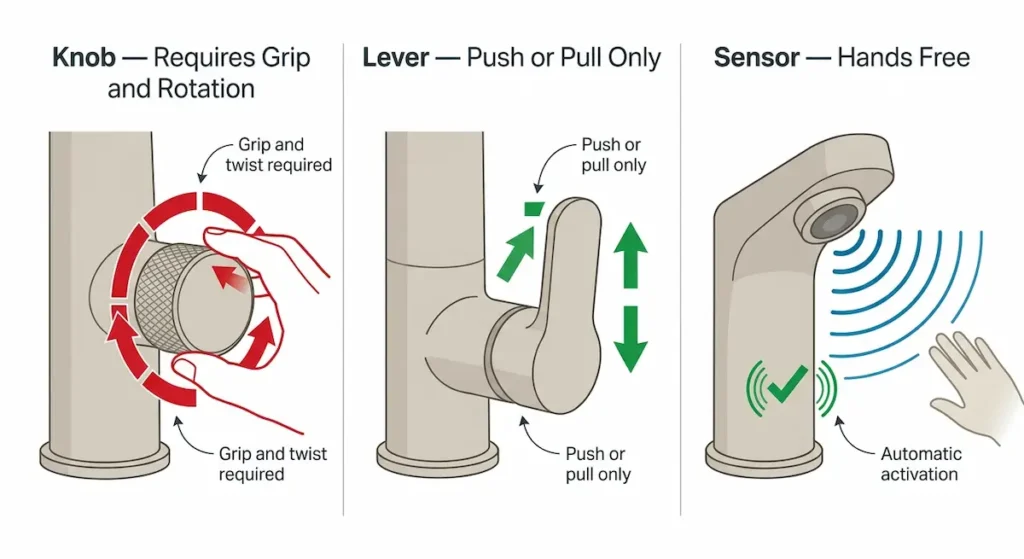
This is the real distinction, not single handle vs. double handle. A knob requires grip and rotation — you have to grab it, hold it, and turn it. For someone with arthritis, reduced grip strength, or any condition affecting hand dexterity that’s a real daily difficulty. A lever handle operates with a push or pull. It requires significantly less grip strength and is far more accessible for elderly seniors. If you do nothing else to the vanity, swapping knobs for levers on both the faucet and the cabinet hardware is one of the highest impact low cost upgrades in an aging in place bathroom.
Sensor faucets
These are worth serious consideration for a senior bathroom. The hands-free operation eliminates the hardware problem entirely — no grip, no turning, no lever. Water activates when hands are detected and shuts off automatically.
The installation breaks down into two options. Battery powered sensor faucets are a reasonable DIY install for anyone with basic plumbing skills — the sensor and valve run off batteries and no electrical work is required. My dad has one and it works fine. Hardwired sensor faucets plug into an outlet and require a GFCI outlet under the sink — in kitchens that outlet is often already there but in bathrooms it’s less common. Running electrical to add that outlet is a job for someone who knows what they’re doing, but if you’re already doing a full bathroom renovation it’s worth roughing in that outlet even if you don’t install the sensor faucet immediately. Future you will thank you.
One more thing worth knowing — most sensor faucets still have a manual override. If the sensor fails or the battery dies you can still turn the water on manually. It’s not an all-or-nothing situation.
Cabinet hardware
Cabinet hardware follows the same logic as faucet handles. Larger bar-style pulls require less grip than small round knobs and are easier to operate for someone with limited hand strength. If the vanity cabinet has round knobs, swap them for bar pulls. It’s a $20 to $50 fix that makes a real difference.
Changing Vanity Height: What’s Actually Involved
This is where the contractor reality check comes in. Changing the height of an existing vanity isn’t always as simple as it sounds and the answer depends almost entirely on what type of vanity you currently have.
Floor mounted cabinet vanity — if the existing vanity is a standard cabinet and countertop combination you can’t just cut the cabinet down to lower it. You need a new cabinet or a new vanity unit at the right height. Cutting down an existing cabinet doesn’t solve the knee clearance problem and the result looks exactly like what it is — a cut down cabinet. Budget for a replacement, not a modification.
Converting to a floating vanity — this is very doable but it’s job specific. Lowering a vanity that’s currently screwed into drywall is one thing. Lowering one that’s attached to tile is a different conversation — you can address the vanity itself but you can’t undo the holes left in the tile where the original unit was mounted. That’s a detail worth understanding before you commit to the project.
The plumbing is the other variable. Changing vanity height often means moving supply and drain lines depending on how far you’re moving and what your current rough-in looks like. That adds cost and complexity and it’s something to get a clear answer on before the work starts rather than after the wall is open.
What’s behind the wall won’t prevent the work — it may just change the complexity and the price of installing a bathroom vanity for seniors. More existing plumbing to relocate means more labor. Framing that needs blocking added means more time. Get a clear picture of what you’re working with before you commit to a budget.
Mobile Home Specifics on a Bathroom Vanity for Seniors
Most of the vanity considerations above apply the same way in a mobile home. The meaningful difference is the plumbing.
In a mobile home the supply and drain lines almost always come straight up through the floor rather than through the wall. That’s fine for a standard floor mounted vanity — the pipes come up inside the cabinet and nobody sees them. For a floating vanity it’s a problem. A wall mounted vanity with pipes running visibly out of the floor underneath it looks unfinished and those exposed pipes are more vulnerable to damage and temperature fluctuations than lines run inside a wall.
If you’re installing a floating vanity in a mobile home bathroom those lines need to be moved to the wall. Technically you don’t have to do it for a standard cabinet replacement, but if I’m already doing a bathroom renovation in a mobile home I always recommend moving the plumbing to the wall while we’re in there. It looks significantly better, the lines are better protected, and you’re already paying for the labor on the surrounding work. It’s the right time to do it.
My Mobile Home Bathroom Modifications for Seniors Guide covers the broader structural and plumbing realities that make those jobs different from standard construction.
Tilting Mirrors: The Detail Most People Miss
A standard fixed mirror works fine for someone standing at the vanity. For a seated user — wheelchair or otherwise — a standard mirror typically shows the top of their head at best. A tilting mirror on a pivot bracket solves this without any electrical work or major installation. The mirror angles downward so a seated user can see themselves clearly without craning their neck or leaning forward. It’s a small detail that makes a real functional difference and it’s one of the last things anyone thinks about until they’re sitting there trying to get ready and realizing they can’t see the mirror.
Cost Expectations- Bathroom Vanity for Seniors
A cost for a bathroom vanity for seniors is genuinely hard to pin down because three variables control the number — where you live, the complexity of the job, and what you’re buying.
Vanity units themselves range from a few hundred dollars for a basic floor mounted unit to several thousand for a quality wall mounted setup with a solid surface top. The labor to install a floor mounted vanity is straightforward. The labor to install a floating vanity with blocking, moved plumbing, and any wall patching is a different number entirely.
The honest answer is get a quote based on your specific bathroom, your specific vanity choice, and what your existing plumbing situation looks like. Anyone giving you a firm number without knowing those three things is guessing.
What I can tell you is that the hardware upgrades — lever faucet, bar pulls, sensor faucet if the outlet is already there — are the highest value per dollar spent in a bathroom vanity for seniors upgrade. Start there before committing to a full vanity replacement if budget is a constraint. If cost is a significant barrier my Aging in Place Grants and Funding Guide covers programs that may offset the cost of accessibility modifications.
FAQ: Bathroom Vanity for Seniors
Does every senior need an ADA vanity? No. A standard vanity works fine for many seniors depending on their mobility. The upgrade conversation becomes necessary when wheelchair access, seated use, or significant grip strength limitations are part of the picture.
What height should a bathroom vanity be for a wheelchair user? ADA guidelines call for a maximum 34 inch counter height with at least 27 inches of knee clearance underneath. The practical target depends on the specific wheelchair and the user — measure from the seated position rather than defaulting to a fixed number.
Is a floating vanity safe for seniors? A properly installed floating vanity mounted into solid framing or blocking is structurally sound for normal use. The consideration is what happens if someone grabs it during a fall — make sure the installation is robust and the framing behind it is adequate before relying on it in a senior bathroom.
Are sensor faucets worth it for elderly seniors? Yes for most situations. They eliminate the grip and dexterity requirements of a lever or knob entirely. Battery powered models are a reasonable DIY install. Hardwired models require a GFCI outlet under the sink — worth planning for during a renovation even if you don’t install the faucet immediately.
What’s the easiest bathroom vanity upgrade for seniors? Swapping knobs for lever handles on both the faucet and the cabinet hardware. It requires minimal plumbing skill, costs $20 to $50 in most cases, and makes a real difference for anyone with arthritis or reduced grip strength.
Does vanity height change in a mobile home? The vanity considerations are largely the same. The meaningful difference is the plumbing — mobile home supply and drain lines typically come through the floor rather than the wall, which affects floating vanity installations specifically.
The Bottom Line on Bathroom Vanity for Seniors
A bathroom vanity for seniors doesn’t have to mean a clinical looking accessibility fixture. It means a vanity at the right height, with the right clearance, with hardware that works for the person using it every day. Sometimes that’s a full floating vanity replacement. Sometimes it’s a lever faucet swap and a sensor retrofit on what’s already there.
Start with the person’s actual mobility situation and work backward from that. The vanity should serve them — not the other way around.
For the full senior bathroom renovation picture — grab bars, flooring, shower access, water temperature, lighting, and ventilation — my Senior Bathroom Safety Guide maps every element in the order a contractor would build it. And if you want to assess your current bathroom before spending anything, my Free Home Safety Checklist walks through every major risk zone room by room.