Keeping It Level:
A bidet for seniors is one of the simplest aging in place upgrades you can make (If you’re looking for the bigger picture on low-disruption upgrades, aging in place without a full remodel covers a lot of ground.). It cuts out the reaching and wiping that causes falls and strain for seniors with limited mobility. You’ve got four main options — standalone bidets, seat replacements, attachments, and handheld sprayers — each with different costs, installation requirements, and features. This article breaks down all four so you can pick the right fit for your bathroom and your budget.
Let’s be honest. Bidets are still a newer concept in most American homes. A lot of people are on the fence about them — and that’s fair. But when you look at it from an aging in place standpoint, the case gets pretty strong pretty fast.
For seniors with limited mobility, arthritis, or balance issues, the twisting and reaching involved in wiping is a real problem. It’s not glamorous to talk about, but it matters. A bidet handles most of that for you. That alone can keep someone safer and more independent in the bathroom for years longer.
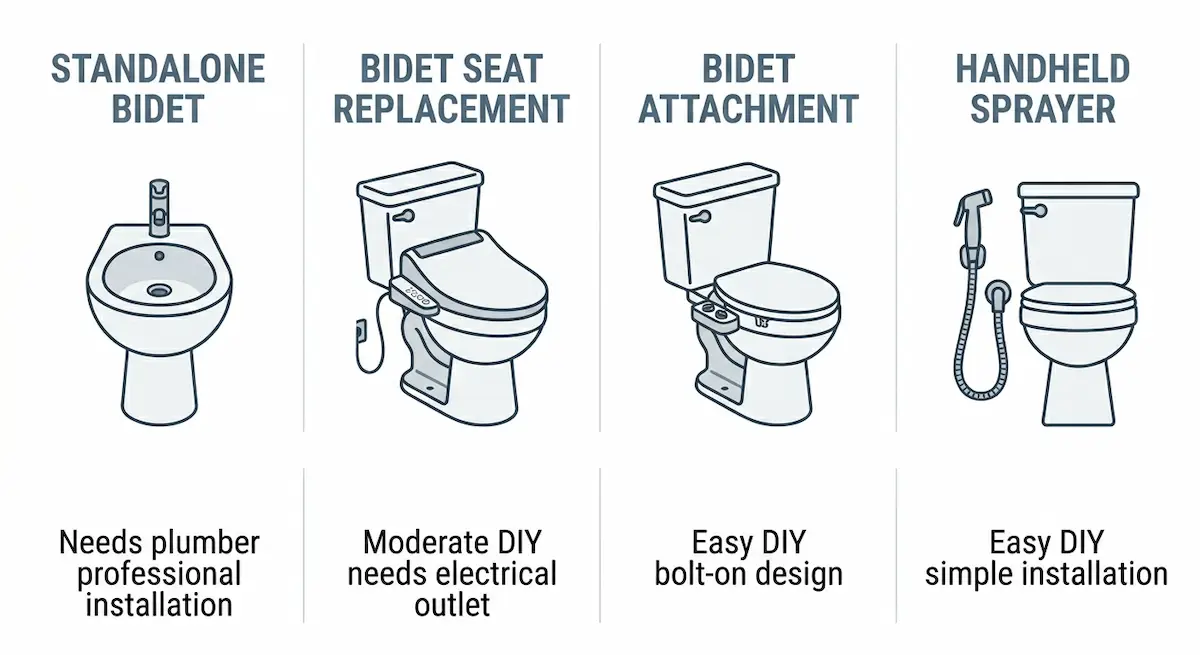
Here’s a look at the four main types, what each one costs, and what installation actually looks like.
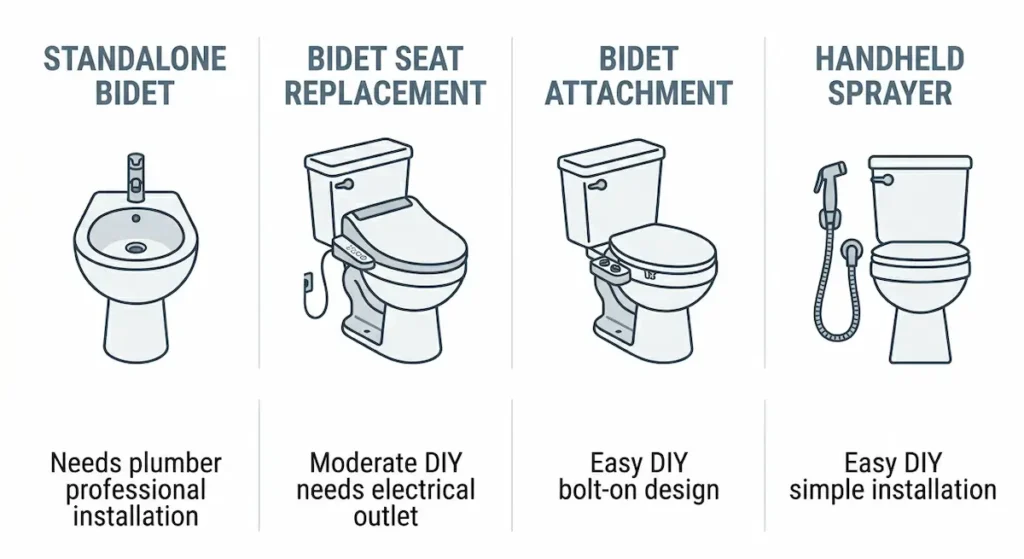
The four types of bidet for seniors
1. Standalone bidet
$200 – $700+ fixture cost Needs a plumber
A standalone bidet is a separate fixture — think of it like installing a second toilet next to your existing one. You use the toilet first, then move over to the bidet to clean up.
From a plumbing standpoint, it needs its own water supply line and drain. Depending on your setup, a plumber may be able to tap off the existing toilet supply line. But it still needs a dedicated drain connection, which means opening up the floor.
The biggest issue with standalone bidets in aging in place situations? Space. Older bathrooms tend to run small. Before you even think about buying one, measure your bathroom. You need enough room for the fixture itself plus comfortable clearance to transfer from toilet to bidet.
Contractor note: You wouldn’t believe how many people buy a fixture assuming they can “just make it fit.” Measure first. Always.
Pros
- Full wash-and-dry experience
- Traditional bidet functionality
- Durable, long-lasting fixture
Cons
- Requires moving from toilet to bidet
- Needs significant bathroom space
- Higher installation cost
- Not ideal for mobility issues
2. Bidet seat replacement
$30 – $700+ depending on features DIY or electrician needed
This is probably the most popular option right now. You remove your existing toilet seat and replace it with a bidet seat. You stay on the toilet the whole time — no moving around required. For seniors with balance or mobility challenges, that’s a big deal. If you haven’t already upgraded to a comfort height toilet, that’s worth looking at alongside this.
Before you buy one, know your toilet bowl shape. Round and elongated are not the same. Get the wrong one and it won’t fit right. Check your toilet before you order.
There are two versions: electric and non-electric.
Non-electric bidet seat:
Simple install. Drain the tank, use the included adapter to connect to your existing supply line, and you’re done. Most handy homeowners can handle this one themselves. No outlet needed. Water temperature is going to be whatever comes out of your cold supply line, so don’t expect warm water.
Electric bidet seat:
This is where it gets nice — heated water, heated seat, air dryer, adjustable pressure. Real comfort features that make a difference for elderly users spending more time in the bathroom.
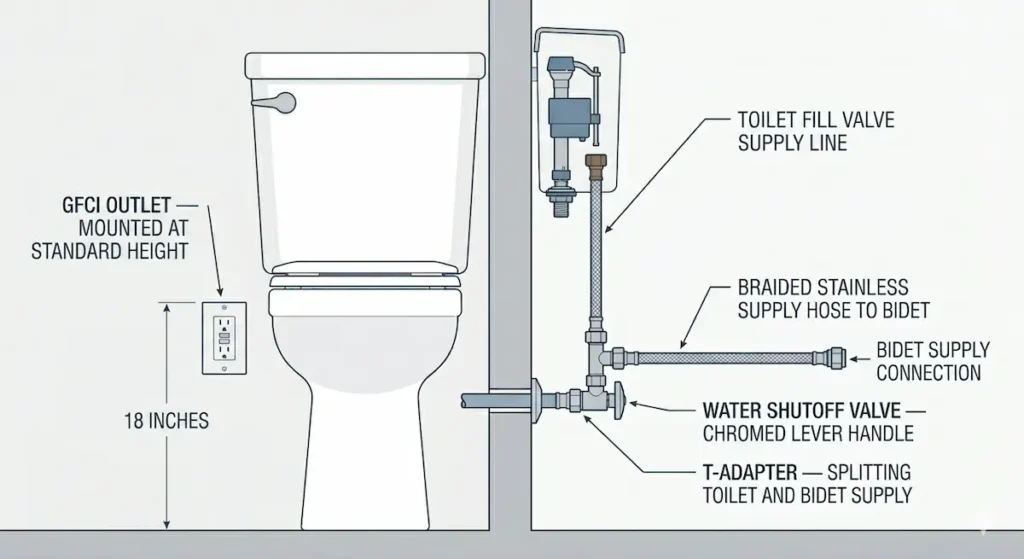
But electric means you need a power source. Specifically, you need a GFCI outlet within reach of your toilet. Some newer homes have a GFCI breaker in the panel that covers the circuit instead of a dedicated outlet. Either way, the protection needs to be there. If there is no outlet near your toilet already, stop. This is no longer a DIY job. Call an electrician. Unless you fully understand how your outlets are wired in series and know the difference between line and load terminals, do not touch those wires.
Pros
- No transfer needed — stay on toilet
- Wide price range for any budget
- Electric models have heated seat and dryer
- Easy non-electric DIY install
Cons
- Quality varies widely at lower price points
- Must match your bowl shape
- Electric models need GFCI outlet
3. Bidet attachment
$25 – $100 DIY friendly
A bidet attachment sits between your existing toilet seat and the bowl. It taps into your existing water supply line using a simple T-adapter that comes in the box. Drain the tank, swap in the adapter, connect the hoses, and you’re done.
No electricity involved. No special plumbing. Most people can install one in under 30 minutes.
The tradeoff is features. You’re not getting heated water or a dryer. What you get is a functional bidet at an entry-level price. For seniors who want the independence benefit without the cost, this is a solid starting point.
Pros
- Lowest cost option
- Easy DIY install
- No electrical work needed
- Works on most standard toilets
Cons
- Cold water only
- No dryer or heated seat
- Fewer comfort features
4. Handheld bidet sprayer
$20 – $60 DIY friendly
A handheld sprayer mounts to the side of your toilet and connects to the supply line the same way an attachment does. It looks like a small showerhead on a hose.
The user controls the spray manually, which does require some hand dexterity and grip strength. For seniors with limited hand mobility, this one may actually be the least practical option despite being simple and cheap. Something worth thinking through before recommending it.
That said, for caregivers assisting with hygiene, a handheld sprayer can be very useful.
Pros
- Very inexpensive
- Simple install
- Useful for caregivers
Cons
- Requires hand grip and dexterity
- Less ideal for hands-free independence
- Cold water only
Which bidet is right for a senior?
Here’s the honest answer: it depends on the person, the bathroom, and the budget.
If independence and minimal physical effort are the priority, an electric bidet seat is hard to beat. It keeps the senior on one fixture, handles everything automatically, and has the comfort features that matter for daily use. Budget for an electrician if there’s no outlet near the toilet.
If budget is tight, a bidet attachment gets the job done for under a hundred dollars and installs in an afternoon.
If the bathroom is large enough and a proper renovation is happening anyway, a standalone bidet is worth considering — but measure the space first and plan for plumbing work.
Handheld sprayers are the most limited option for aging in place use, but they have a place in caregiver-assisted situations. While you’re making changes near the toilet, grab bar placement around the toilet is worth reviewing at the same time.
Things to Check Before You Buy a Bidet for Seniors
1. Is the seat actually sturdy enough?
This one gets missed constantly. A standard toilet seat is bolted directly to the porcelain. Bidet seats sit on a plastic mounting bracket. Most have a weight limit — typically somewhere between 300 and 350 pounds — and cheaper models can shift or wobble when a larger person sits down.
A seat that moves when a senior sits is a fall waiting to happen. Full stop.
Check before you buy: Look for the weight capacity in the product specs. For larger seniors, look specifically for seats marketed as “heavy duty” or with a solid, stable mounting system. Do not assume all seats are built the same.
2. Can they reach the controls without losing their balance?
Most electric bidet seats have a control panel mounted on the side of the seat. For a healthy adult, no problem. For a senior with severe arthritis or limited shoulder mobility, reaching back and down to hit those buttons while seated can cause them to twist, lose their balance, or strain their shoulder.
Look for models that include a wireless remote. Better yet, look for one with a wall-mounted remote bracket. The senior keeps their back straight, both hands in front of them, and can actually see the buttons clearly. It gets marketed as a convenience feature. In an aging in place bathroom, it’s a safety feature.
What to look for: Wireless remote with wall-mount bracket. Large, clearly labeled buttons. If the remote requires fine motor skills to operate, keep looking.
3. Does it create a trip hazard?
Some non-electric bidet attachments are sold with a dual-temperature option. The idea is you run a hot water line from the sink vanity over to the toilet to get warm water without going electric. Sounds simple. In practice it means running a hose across the bathroom floor.
In an aging in place bathroom, a hose on the floor between the vanity and the toilet is a trip hazard. For a senior with a walker or unsteady gait, that hose is dangerous. Avoid it entirely.
Contractor advice: If warm water matters — and for many seniors it does — you have two clean options. Go electric and have an electrician add a GFCI outlet near the toilet. Or go with a dual-temperature non-electric attachment and have a plumber run a dedicated hot water line to your toilet service. If the attachment has a hot and cold hookup, it has a built-in water diverter to handle both lines. Either way, the hose-across-the-floor workaround is off the table in a bathroom used by a senior. If a plumber is already involved, it’s also a good time to check your anti-scald valve — hot water and seniors is a recurring safety issue worth addressing once rather than twice.
4. Watch out for pressure shock
Cheap bidet attachments often have a wide pressure range and not much in between. New users — especially seniors with sensitive skin — can get caught off guard by full pressure on the first use. That startle reflex is real, and in a bathroom it can cause someone to jerk or grab for the wall.
For aging in place, look for models with a gradual or adjustable pressure setting. Some electric seats offer a “pulsate” or “gentle” mode. That’s not just a comfort feature — it’s peace of mind for the first-time user.
What to look for: Adjustable pressure with a true low setting. Avoid attachments where “low” still feels aggressive. Read the reviews specifically from older users if you can find them.
FAQs: Bidet for Seniors
Are bidets sanitary?
Yes. Most bidet seats and attachments use fresh water directly from your supply line — the same water that comes out of your sink faucet. The nozzles on quality bidet seats are designed to self-clean before and after use. For most seniors, a bidet is actually more hygienic than traditional wiping, especially for those with limited reach or mobility.
Do I need to call a plumber to install a bidet?
It depends on the type. Bidet attachments, handheld sprayers, and non-electric seat replacements are generally DIY-friendly installs that connect to your existing supply line. Standalone bidets require a plumber for the drain and supply work. Electric bidet seats may require an electrician if there’s no GFCI outlet near your toilet.
Will a bidet fit my toilet?
Most bidet attachments and seat replacements are designed to fit standard toilets, but you do need to know your bowl shape — round or elongated. These are not interchangeable. Measure or check your toilet model before ordering. Standalone bidets require their own floor space, so bathroom size matters there too.
How much does it cost to add a bidet for an elderly person?
The range is wide. A basic bidet attachment runs $25 to $100 and is one of the cheapest aging in place upgrades you can make. A non-electric seat replacement lands in the $30 to $150 range. Electric bidet seats with heated water and dryer features run $150 to $700 or more. Standalone bidets start around $200 for the fixture alone, plus plumbing labor.
Can a bidet for seniors help with arthritis?
Yes, a bidet for seniors can help and this is one of the strongest arguments for them. Arthritis in the hands, shoulders, or hips makes the twisting and reaching involved in wiping painful and difficult. An electric bidet seat handles the cleaning automatically with no physical effort required. It’s a simple upgrade that can make a real difference in daily comfort and independence.
Do bidets use a lot of water?
No. A typical bidet cycle uses less than a pint of water. For comparison, manufacturing a single roll of toilet paper takes significantly more water than most people realize. From a water usage standpoint, bidets are actually the more efficient option.
Is a bidet for seniors covered by Medicare or insurance for seniors?
Generally no — a bidet for seniors is not covered by Medicare as durable medical equipment. However, if a bidet is recommended by a physician as medically necessary for a specific condition, it may be worth checking with a supplemental insurance provider. Some long-term care policies cover home modification costs, so that’s worth a conversation with an insurance agent.
What is the easiest bidet for seniors to use?
An electric bidet seat is typically the easiest bidet for seniors to use because it requires the least physical effort. Controls are usually on a side panel or remote, and the cleaning and drying functions are fully automated. Look for models with large, simple controls and consider a remote if reaching the side panel is difficult.
The bottom line on bidet for seniors
Bidets are not for everyone. But for a senior dealing with limited reach, joint pain, or balance issues, taking the effort out of bathroom hygiene is a real quality of life improvement. And compared to most aging in place modifications, the cost of entry is low.
If you’re planning a bathroom renovation with aging in place in mind it’s worth having the conversation — and if you’re thinking through the bathroom as a whole, our senior bathroom safety guide covers everything from flooring to fixtures. At minimum, rough in an outlet near the toilet during the remodel. Futureproofing that one detail costs almost nothing during a renovation and a lot more afterward.
Not sure where to start? Our free home safety checklist walks through the whole house.