Keeping It Level
A handheld shower head for seniors is one of the highest-impact aging-in-place upgrades you can make — and one of the easiest to get wrong. Before you buy anything check what’s behind your wall first. Make sure your flow rate matches your water pressure. If you’re mounting a slide bar the same structural rules that apply to grab bars apply here. And if your wall is already open for any reason seriously consider adding an anti-scald mixing valve while you’re in there.
I got called to a bathroom not long ago where a homeowner had a hairline crack in the drop-ear elbow behind his shower wall. He had no idea. Every time he turned that shower on water was leaking down the inside of his wall. The shower still worked fine from where he was standing — water came out the head like normal. So he kept taking showers like normal. Meanwhile that slow drip was quietly rotting the wall from the inside out.
Here’s something that sounds backwards but is actually true — when a drop-ear cracks you want it to crack all the way through right away. A complete break means no water comes out of your showerhead at all. You turn the shower on, and nothing happens. That’s obviously not right and every homeowner knows it immediately — you cut the water off and you call someone because clearly something is wrong. A complete failure announces itself.
A hairline crack is the dangerous one. The shower still works. The water still comes out. Everything seems fine. It’s just also leaking inside your wall every single time the shower runs and the homeowner has no idea until the damage is already done.
That story has nothing to do with which showerhead to buy. It has everything to do with what’s behind your wall before you add one.
A handheld shower head for seniors isn’t just a convenience upgrade — it’s a core component of a safe aging-in-place bathroom. A fixed showerhead is essentially useless from a seated position. A handheld wand on a slide bar puts the water where it needs to go from any height, reduces the need to twist and reach, and keeps a seated senior in a stable position throughout the entire shower routine. For the complete bathroom safety picture my Senior Bathroom Safety Guide maps out every element from floor to fixtures.
The Drop-Ear Elbow: Check This Before Installing Any Handheld Shower Head for Seniors
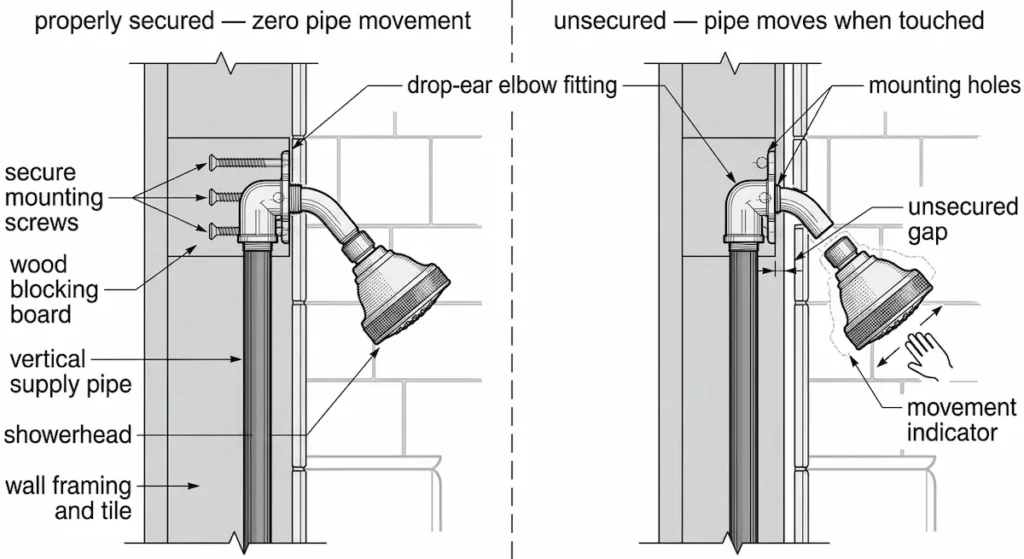
The drop-ear elbow is the fitting at the top of the shower supply pipe behind your wall — the part your showerhead threads into. Most homeowners have never heard of it. Most homeowners also never think about it until there’s water damage inside their wall.
Before you install a handheld shower head for seniors — or any showerhead at all — this is the first thing worth understanding.
What it is and why it matters
The drop-ear has to be securely fastened to the wall framing. New drop-ears have three holes in them specifically for this reason — they bolt directly into blocking and that’s what keeps the pipe from moving. When it’s installed correctly that supply pipe does not move. Period.
When it’s not installed correctly — or when it’s old and the connection has loosened over time — you’ll feel it. When you thread a showerhead on and the pipe moves around that’s your sign. That pipe should have zero movement. If it does there’s a good possibility it’s not properly connected to the framing, and adding the weight and movement of a handheld hose is going to make the problem worse over time.
Material matters — plastic is the problem
Drop-ears come in a few different materials. Brass is what you want — it’s durable, it handles the stress of daily use, and it doesn’t crack. Copper is fine too for the same reasons. The ones to watch out for are plastic — PVC or CPVC. Older homes have them. Mobile homes have them more often than not.
Plastic drop-ears crack. When they crack they leak — and as the story above shows it’s usually that slow intermittent leak that goes into the wall instead of out of it. If you’re replacing other components like a diverter valve and your wall is already open replace a plastic drop-ear with brass while you’re in there. It’s inexpensive, it takes a few minutes, and it’s straightforward preventative maintenance. You’re already in the wall. The cost of not doing it is a future water damage repair.
The no-wall-open check
If your wall isn’t open and you want a quick sense of whether your drop-ear is secured properly — thread your current showerhead off and gently move the pipe by hand. Any significant movement is a red flag. Not a guarantee of a problem but enough of a sign to mention to a plumber or contractor before you add a handheld hose with its extra weight and daily movement.
Mobile home note
In mobile homes plastic drop-ears are more common than in stick-built construction. If you’re installing a handheld shower head for seniors in a mobile home treat the drop-ear inspection as non-negotiable before anything else goes on that pipe.
Flow Rate vs Water Pressure: The Confusion That Costs Seniors Money
This is the most misunderstood part of buying any handheld shower head for seniors and it costs people money regularly. Flow rate and water pressure are two completely different things and mixing them up leads to buying the wrong product.
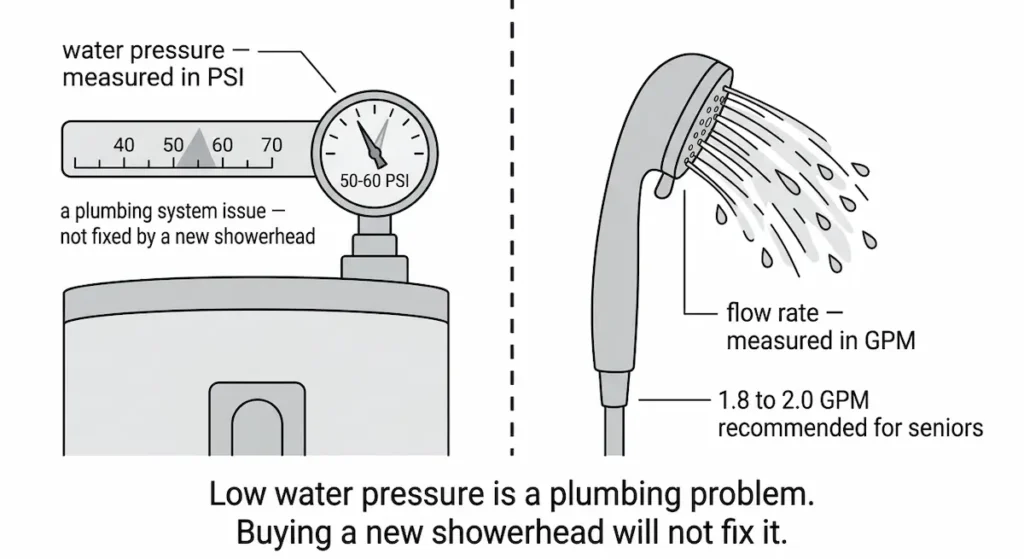
Flow rate is measured in gallons per minute — GPM. It’s a specification of the showerhead itself. It determines how much water comes out.
Water pressure is measured in PSI — pounds per square inch. It’s a characteristic of your home’s plumbing system. It has nothing to do with which showerhead you buy.
If you have low water pressure buying a different handheld shower head for seniors will not fix it. Low pressure is a plumbing problem not a showerhead problem. A new showerhead on a low-pressure system still has low pressure. This is one of the most common misconceptions I run into when seniors or their families are shopping for fixtures.
What you actually want
For a home with good water pressure you want somewhere around 50 to 60 PSI at the hot water tank — always check pressure at the tank itself not at a fixture. At that pressure range most showerheads perform well.
For flow rate a 1.8 to 2.0 GPM showerhead produces a comfortable strong stream for most seniors. Higher GPM produces more volume but at the same pressure the stream becomes softer and more dispersed. For aging in place use 1.8 to 2.0 GPM is the sweet spot.
The old school way to check your flow
Take a one-gallon jug and a timer to your shower. Turn the water on full and time how long it takes to fill the jug. If it fills in under 12 seconds you have decent flow (5 gallons a minute). If it takes 20 seconds or longer you have a flow issue worth investigating before spending money on a new showerhead.
Newer flow meters make this easier — they thread directly onto the pipe and give you a digital reading. But the jug method works fine and costs nothing.
When low pressure is worth fixing before anything else
If your water pressure is consistently below 40 PSI throughout the house the causes are worth investigating before any fixture upgrade. Common culprits include leaks somewhere in the system, a weak well pump if you’re on a well, a faulty pressure regulator, corroded pipes, or debris in the diverter valve. If you’re experiencing consistently low pressure it’s worth having a plumber take a look before spending money on a handheld shower head for seniors or any other fixture.
The Slide Bar: What Makes a Handheld Shower Head for Seniors Actually Work
The slide bar is what makes a handheld shower head for seniors function as a genuine safety tool rather than just a flexible hose. Without it the handheld either lives in your hand the entire shower or sits in a fixed mount at one height that works for standing but not for sitting.
A slide bar mounts vertically to the shower wall. The showerhead holder clips onto the bar and slides up and down to whatever height the user needs — higher for standing use, lower for seated use. One bar serves both positions without any permanent adjustment.
ADA rated vs decorative — a distinction that matters for seniors
Here is something most handheld shower head for seniors guides completely skip. There is a significant difference between a decorative slide bar and one rated for fall support and it’s a distinction that directly affects safety.
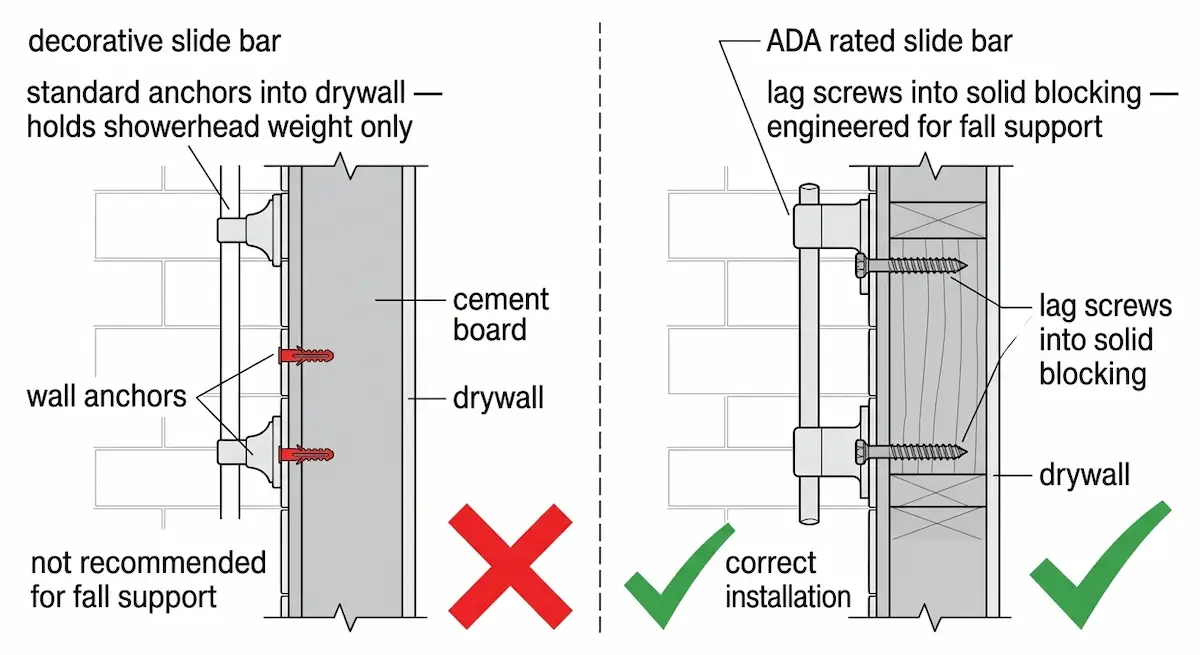
A decorative slide bar is designed to hold the weight of a showerhead. That’s it. If a senior grabs it during a loss of balance it may hold, it may not. You don’t know and you don’t want to find out the hard way.
An ADA rated slide bar follows the same structural requirements as a grab bar. It has a weight rating. It mounts into wall blocking or studs the same way a grab bar does. If a senior grabs it during a fall it’s engineered to handle that load. My Shower Zone Grab Bar Placement Guide covers exactly where both grab bars and slide bars need to go within the shower for maximum effectiveness
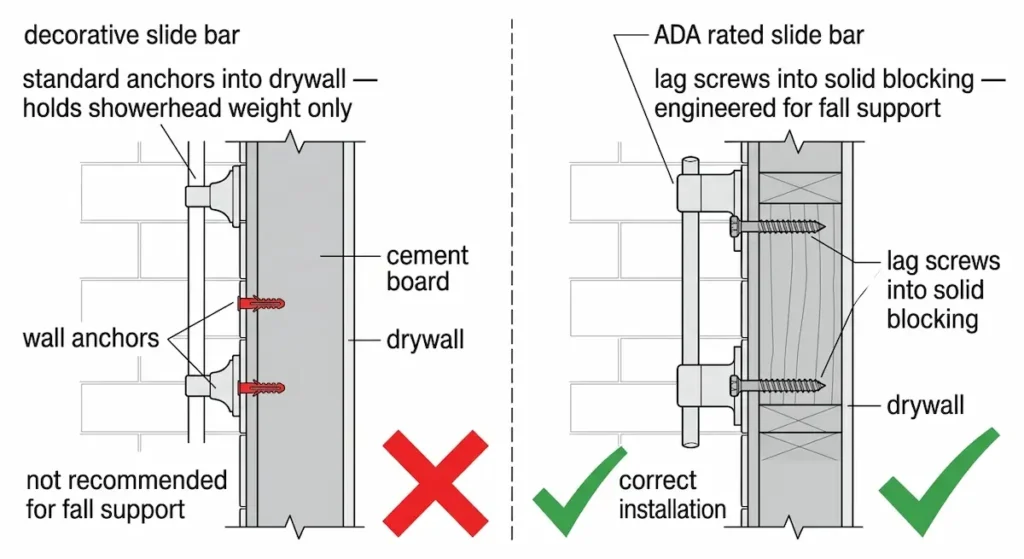
For any handheld shower head for seniors installation, I treat the slide bar the same way I treat a grab bar — check the weight rating on the packaging, mount it into solid wood, never into drywall or cement board alone. My Grab Bar Installation Guide covers the structural requirements in detail and every one of them applies to an ADA rated slide bar.
Hose length — the detail nobody mentions until it’s too late
Hose length is one of the most overlooked specifications when choosing a handheld shower head for seniors and it’s easy to get wrong. Standard handheld hoses run 60 to 72 inches. For a seated user in a larger shower that may not be enough reach — especially if the slide bar is mounted toward the entry end of the shower and the bench is toward the back. If you’re still deciding between a bench and a chair for the shower my Shower Bench vs Shower Chair Guide covers which option works best for your specific space and budget.
Before you buy measure the distance from your slide bar mounting location to where the seated user will actually be sitting. Add enough length so the hose reaches comfortably without pulling taut. A hose that pulls tight during use puts stress on the connection point and on the drop-ear behind the wall. It also forces the user to lean or shift to reach the water which defeats the entire purpose of installing a handheld shower head for seniors in the first place. For everything you need to know about getting seated height right my Shower Bench Height Guide covers the finished floor measurements that determine whether a seat actually works for the person using it daily
For most aging in place installations, I recommend a minimum 72-inch hose. Many quality units come with an 80-inch hose — that extra 8 inches makes a real difference in a larger shower.
Mobile home note
Studs in mobile homes are sometimes on 24 inch centers rather than the standard 16 inch centers in stick-built construction. Before mounting a slide bar for a handheld shower head for seniors in a mobile home locate your studs first — the same two-mark method that applies to grab bars applies here. Thinner walls mean shorter screw penetration into the stud so use the longest appropriate screw the wall assembly will allow.
The Diverter Valve: What It Does and When It Fails
The diverter valve is what turns your water on and controls where it goes — to the fixed showerhead, to the handheld, or split between both. Keep in mind if you have a dual showerhead system you have your main diverter (the one that controls and mixes the water at your shower handles) and another diverter that controls the showerheads themselves. These are often called shower diverters, transfer valves, or 2-way diverters. When you’re adding a handheld shower head for seniors the diverter becomes part of the conversation whether you planned for it or not.
Signs a diverter is failing
In a stand-up shower — water coming out of both the fixed head and the handheld simultaneously when you only want one is a diverter issue. Weak pressure at the showerhead, water dripping from the head when it should be fully off, and any signs of leaking inside the wall are all indicators the diverter needs attention.
In a tub-shower combo — if you’re getting water from both the tub spout and the showerhead simultaneously check the stopper on the spout first. That’s the small piece you pull up to divert water to the shower. It gets stuck or wears out and it’s often the culprit before the diverter valve itself is the problem.
Access and the case for an access panel
Some diverter valves can be accessed without opening the wall depending on what was installed. Others require cutting in. When I have to open a wall for a diverter repair or any plumbing work in the shower I always try to install an access panel on the way out if the layout allows it.
The last diverter I replaced I was able to reach from the closet directly behind the shower. When the job was done, I installed an access panel in that closet wall. Nobody sees it, it doesn’t affect anything, but if there’s ever a plumbing issue behind that shower again nobody has to cut through tile to get to it. Most homeowners appreciate the idea when it’s something that can be pulled off. It’s a small thing that can save a significant amount of money and disruption down the road.
Anti-scald valves and why they matter for seniors specifically
This is where the diverter conversation connects directly to senior safety. Seniors with neuropathy — reduced sensation in the hands and feet — may not realize water is dangerously hot until they’ve already been burned. The natural reaction to scalding water is to jump back. In a shower that can mean a fall. If you’re still deciding between a walk-in tub and a walk-in shower for a senior with reduced sensation my Walk-In Tub vs Walk-In Shower Guide covers the practical differences between the two options.
A thermostatic mixing valve solves this. It installs at the hot and cold-water supply lines in the wall — hot water enters one side, cold enters the other, properly tempered water comes out the top line. You set it once to 120 degrees — the temperature theU.S. Consumer Product Safety Commission recommends to prevent scalding — and it won’t spike above that at that shower regardless of what else is happening elsewhere in the house.
Do I recommend it on every aging-in-place job involving a handheld shower head for seniors? Yes. Does it always get done? No — and that’s the homeowner’s call to make. My job is to explain what it does, why it matters for a senior with reduced sensation, and what the installation involves. After that the decision belongs to the person writing the check.
If your existing diverter doesn’t include anti-scald protection and you want to add a mixing valve it gets installed at the supply lines in the wall. Depending on which valve you buy there’s either a dial or a screw adjustment to set the temperature — follow the manufacturer’s instructions for your specific valve since they vary between products. After installation you test the water temperature at the fixture and adjust until you hit 120 degrees.
Choosing a Handheld Shower Head for Seniors: What Actually Matters
There are thousands of handheld showerheads on the market at every price point. Nobody has tested them all. What matters for a handheld shower head for seniors comes down to a short list of features regardless of brand or budget.
Features worth prioritizing:
A pause button or flow control on the wand — lets a seated senior pause the water while soaping up without reaching back to the valve. A small feature that makes a meaningful difference in how independent the shower routine feels.
Multiple spray settings — a gentle setting for sensitive skin, a stronger setting for rinsing. Seniors with skin sensitivity or neuropathy benefit from having options rather than one fixed spray pattern.
An ergonomic grip — the wand gets held, moved, and set down repeatedly during every shower. Grip design matters more for a senior with arthritis or limited hand strength than it does for a younger user.
A metal braided hose not a plastic one — plastic hoses kink, crack, and eventually fail at the connection points. A stainless steel braided hose handles the daily movement of a handheld wand without degrading over time.
On brand and budget
Delta makes reliable handheld shower heads for seniors across multiple price points and holds up well in the field. Moen is consistent. Kohler is quality. At the lower price points the hose quality and connection fittings are usually where corners get cut first — check reviews specifically mentioning hose durability and connection leaks before committing to a budget option.
The right handheld shower head for seniors is the one that fits the user’s needs and the budget in front of you. A $40 handheld with a quality ADA rated slide bar properly mounted into blocking does exactly what a $150 handheld does for a senior who needs to shower safely from a seated position. Don’t let perfect be the enemy of good.
Installation: What a Proper Aging in Place Job Looks Like
A complete handheld shower head for seniors installation done correctly covers these steps in order:
Check the drop-ear first — any pipe movement means address the framing before anything else goes on that pipe.
Locate studs or blocking for the slide bar — same method as grab bars, same structural requirements for an ADA rated bar.
Measure hose length against actual seated reach distance before purchasing — measure first, buy second.
Thread the showerhead connection with plumber’s tape — two to three wraps on the threads prevents leaks at the connection point without over-tightening.
Test for leaks at both the drop-ear connection and the hose connection before finishing — run the shower for several minutes and check both points carefully.
If the wall is already open for any reason — drop-ear replacement, diverter work, slide bar blocking — have the anti-scald conversation before closing it back up. If you’re already doing structural work in the shower my Curbless Shower Subfloor Guide covers what else is worth addressing while the floor and walls are open.
FAQ: Handheld Shower Head for Seniors
What is the best handheld shower head for seniors aging in place?
There’s no single best option because it depends on budget, water pressure, and the specific user’s needs. Look for a metal braided hose minimum 72 inches long, multiple spray settings, a pause button on the wand, and an ergonomic grip. Pair it with an ADA rated slide bar mounted into solid blocking — not drywall. Delta and Moen both make reliable handheld shower heads for seniors across multiple price points.
What height should the slide bar be mounted for an elderly user?
The slide bar should be positioned so the showerhead holder can reach both standing height and seated height for the specific user. The exact mounting position depends on the bar length and the user’s height — there’s no universal number. The goal is that the holder slides low enough for a comfortably seated user and high enough for a standing user without the hose pulling taut at either position.
Do I need blocking to mount a slide bar for a handheld shower head for elderly users?
For a decorative slide bar — standard wall anchors may suffice. For an ADA rated slide bar that could be grabbed during a fall — yes, same blocking requirements as a grab bar. Never mount a weight-bearing slide bar into drywall or cement board alone regardless of what the packaging says about anchor strength.
More FAQs
What is a drop-ear elbow and why does it matter when installing a handheld shower head for seniors?
The drop-ear elbow is the fitting behind your shower wall that the showerhead threads into. It must be securely fastened to wall framing. A loose or cracked drop-ear can leak inside the wall every time the shower runs — often without any visible sign until significant water damage has already occurred. Check for pipe movement before installation and replace plastic drop-ears with brass when the wall is open for any reason.
What flow rate should I look for in a handheld shower head for seniors?
For homes with good water pressure — 50 to 60 PSI at the hot water tank — a flow rate of 1.8 to 2.0 GPM provides a comfortable strong stream. If your home has consistently low water pressure a new showerhead won’t fix it. Low pressure is a plumbing system issue not a showerhead issue and is worth having a plumber evaluate before purchasing new fixtures.
Should I add an anti-scald valve when installing a handheld shower head for seniors?
If the senior using the shower has neuropathy or reduced sensation yes — a thermostatic mixing valve set to 120 degrees prevents burns from temperature spikes and removes the risk of the reflexive jump-back that causes falls in wet environments. If the wall is already open for any part of the installation it’s the right time to add one. It’s the homeowner’s decision but it’s one worth having the conversation about before the wall closes back up.
Field Tested Products
Delta 4-Spray Handheld Shower Head with Slide Bar — Brushed Nickel A reliable mid-range handheld shower head for seniors that holds up in the field. Multiple spray settings, pause button on the wand, metal hose connections. Available at Home Depot and Amazon at a price point that works for most budgets without sacrificing the features that matter for aging in place use.
Moen Handheld Shower Head with Grab Bar Rated Slide Bar My recommendation when structural support from the slide bar is a priority for seniors aging in place. Moen’s grab-bar rated slide bar meets the same weight capacity standards as their grab bars — engineered for fall support not just showerhead holding. SecureMount system tolerates minor stud misalignment in retrofit situations. Available at Home Depot and Amazon.
Watts Premier Thermostatic Mixing Valve For anti-scald protection at the supply line. Adjustable temperature setting, installs at the hot and cold supply lines, straightforward adjustment process. Confirm compatibility with your existing plumbing configuration before purchasing. Worth the conversation on every handheld shower head for seniors installation where the wall is already open.
Ready to evaluate the rest of your bathroom safety setup? My Free Home Safety Checklist walks through the same room by room framework I use on job sites — so you can find the risks before they find you.