Choosing non-slip bathroom flooring for seniors starts the moment you walk into a tile showroom — and it’s easy to get overwhelmed.
You see gleaming polished marble that looks like it belongs in a five-star hotel. Ultra-sleek porcelain tiles smooth as silk. Everything looks like it belongs in a spa.
And that’s usually the moment I have to step in and play the “bad guy”.
As a contractor in aging-in-place renovations, I’ve watched too many homeowners spend $15,000 on a gorgeous bathroom remodel only to discover—on the very first shower—that they’ve accidentally built a vertical ice rink.
When we’re talking about senior-safe bathrooms, “pretty” tile doesn’t matter if it becomes slippery when it’s wet.
Homeowners often ask me what the best non-slip shower tile for seniors is, or how to choose a slip-resistant bathroom floor that stays safe when wet.
So how do you know if a tile is actually safe?
Choosing non-slip bathroom flooring for seniors — or for an aging parent — starts with one number most showroom salespeople will never mention.
Quick Answer: What Tile Is Safest for a Shower Floor?
Look for tile with a DCOF rating of at least 0.42 — but for a senior bathroom, aim for 0.60 or higher.
DCOF stands for Dynamic Coefficient of Friction. It measures how much grip a tile provides when someone walks across it while the surface is wet. The higher the number, the less likely someone is to slip.
My “War Story”: The Polished Marble Mistake
A few years ago I was called to a beautiful home in a retirement community.
The couple had just finished a high-end “accessible” bathroom remodel with another contractor. On paper it looked perfect:
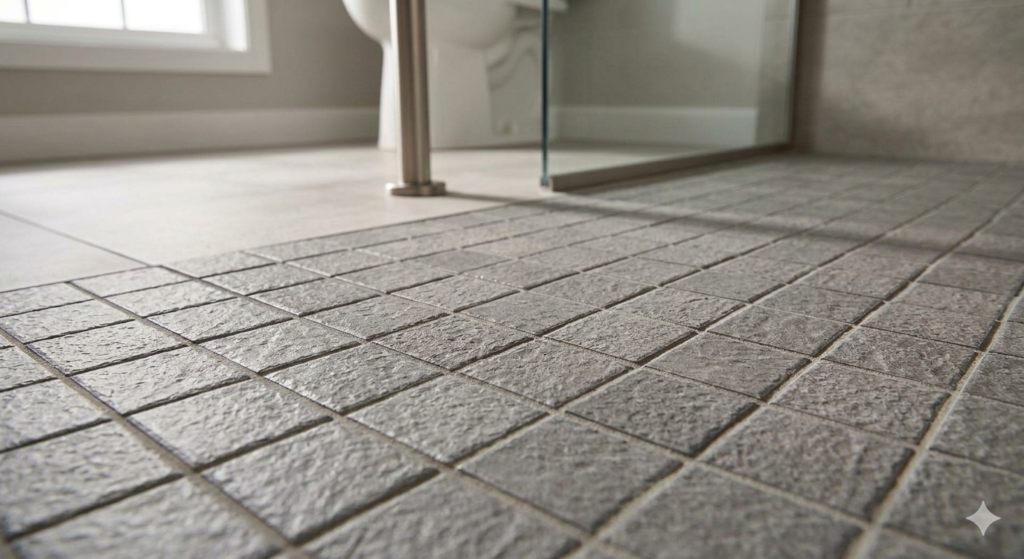
On paper it looked perfect — zero-entry shower, teak bench seating, wide doorways, and gorgeous polished white marble floors throughout
But there was one major problem.
The wife used a walker, and when she tried to walk across the bathroom floor, her walker literally skated across the tile like it was on a hockey rink.
They were terrified to use their own bathroom.
We ended up tearing out brand-new marble tile and replacing it.
Why?
Because the original contractor focused on the look of the tile and ignored its DCOF rating.
Before I even evaluate something like a curbless shower design, slip-resistant flooring is one of the first things I check.
Before I evaluate anything else in a bathroom remodel — curbless shower design, grab bar placement, bench height — slip-resistant flooring is the first thing I check. It’s the foundation everything else builds on. My Senior Bathroom Safety Guide covers the full picture.
Quick Home Safety Tip
That marble bathroom I mentioned earlier is actually a perfect example of something I see constantly during home safety inspections.
Slippery floors, poorly placed grab bars, and narrow doorways tend to show up together.
That’s why I put together a simple Home Safety Checklist based on the same walkthrough I use when evaluating aging-in-place homes.
It covers common hazards in bathrooms, stairways, entryways, and hallways.
Download it here:
Free Home Safety Checklist
What Is DCOF (And Why Should You Care)?
DCOF stands for Dynamic Coefficient of Friction.
In plain English: it measures how much grip a tile has when someone is walking across it while it’s wet.
Years ago the tile industry used something called SCOF — Static Coefficient of Friction. That test measured how much force it took to start a foot moving from a standstill.
But here’s the thing.
You don’t slip when you’re standing still. You slip when you’re stepping forward.
That’s why the industry switched to DCOF, which simulates an actual step on a wet surface. It’s a better test because it reflects what actually happens in a bathroom.
It’s the single most important spec to understand when choosing non-slip bathroom flooring for seniors.
The Golden Number for Bathroom Safety: 0.42
If you’re choosing tile for a bathroom floor — especially a shower — memorize this number: 0.42
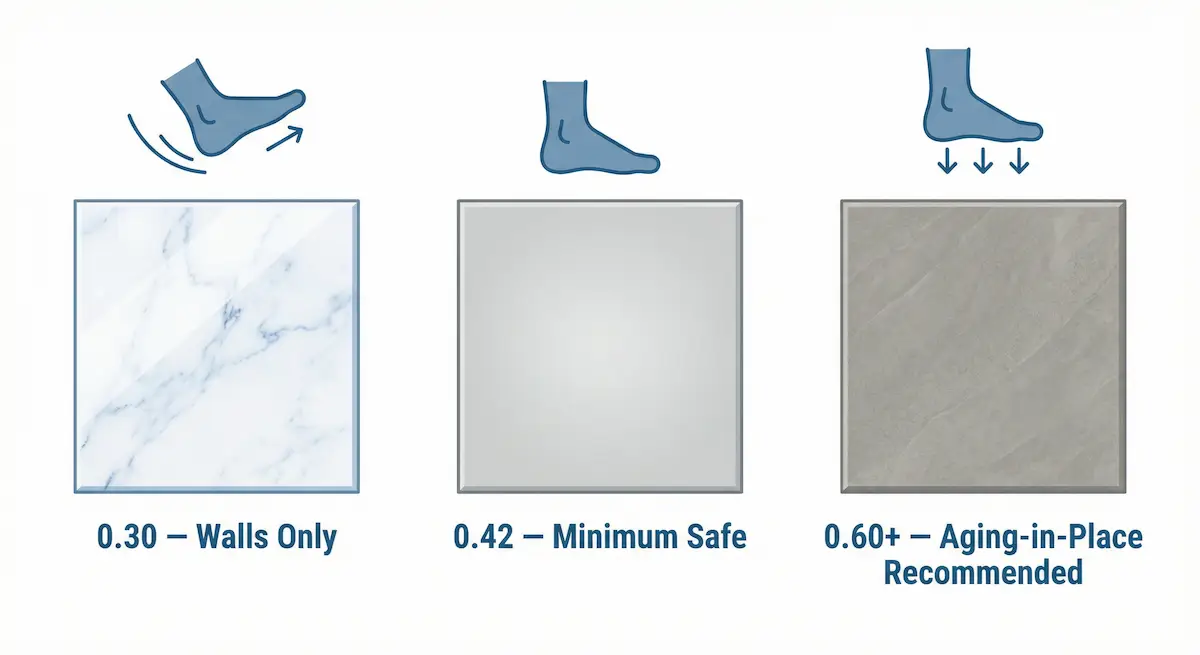
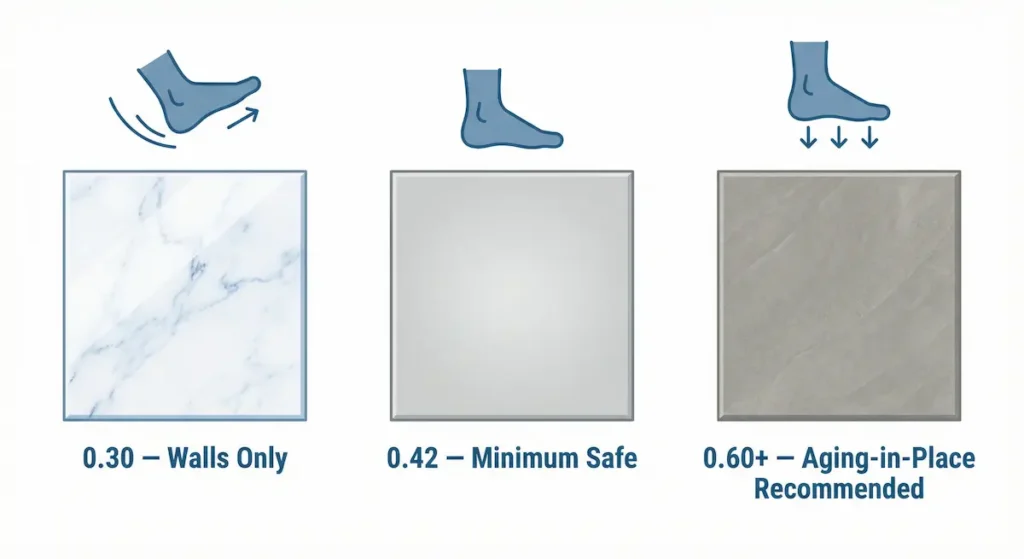
According to ANSI, tiles used in interior areas that may become wet need a minimum DCOF rating of 0.42. Here’s how I interpret those numbers on a job site:
Below 0.42 — Walls and decorative areas only. Installing these on a bathroom floor is a liability, not just a safety risk.
0.42 — The minimum. Legal, but I wouldn’t put it in my own bathroom.
0.60 or higher — This is where I start feeling good about a floor. For aging-in-place work, this is the target.
The Contractor’s Shortlist: What to Ask for at the Showroom
When shopping for non-slip bathroom flooring for seniors, don’t walk into a tile shop and ask for ‘non-slip’. That phrase means nothing — every tile manufacturer claims their product is slip-resistant.
Ask for the spec sheet. Specifically, ask them to show you the DCOF rating in writing.
If you want a starting point, look for the StepWise™ label on brands like Daltile or Marazzi. Lines like Saddle Brook XT give you a wood look without sacrificing traction. Owen Stone by Crossville in the Textured finish is another one I’ve spec’d on jobs. These aren’t just matte tiles — they’re engineered to hit that 0.60 threshold.
One important caveat: always verify the current rating on the spec sheet before you order. Manufacturers sometimes update finishes between product generations, and the version on the shelf today may not match what was rated two years ago.
The “Matte Tile” Trap
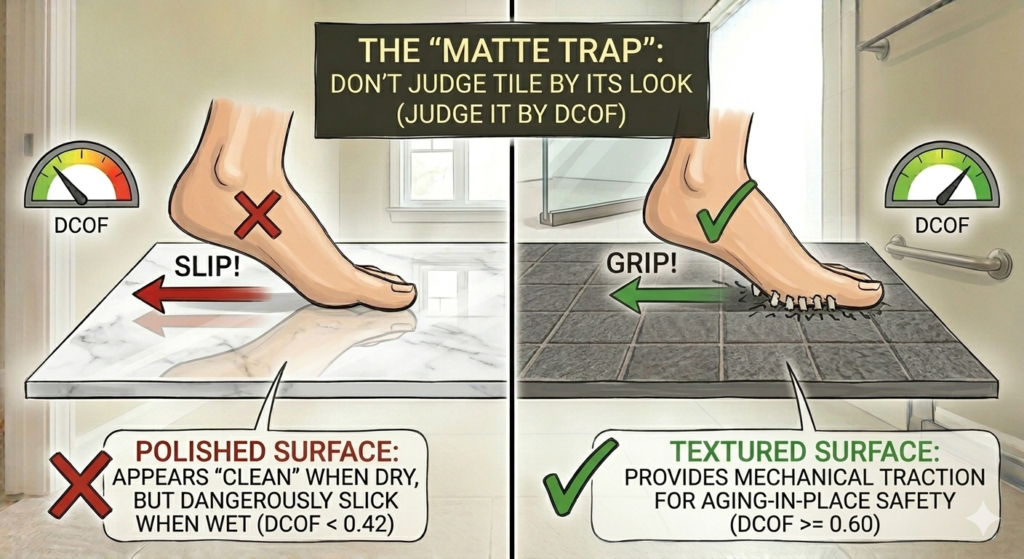
One of the biggest misconceptions I see during bathroom remodels is what I call the Matte Trap.
Many homeowners assume that if a tile isn’t shiny, it must not be slippery.
That’s not always true.
I’ve handled matte finish porcelain tiles that felt like silk when they got soapy water on them — and that’s a serious problem for elderly users whose grip strength and reaction time may already be compromised.
On the flip side, some textured tiles actually have a slight sheen but still provide excellent traction.
Contractor rule:
Never judge a tile by how it looks or feels when it’s dry.
Always ask the showroom for the tile specification sheet and check the DCOF rating.
Best Non-Slip Bathroom Flooring for Seniors and Elderly Bathrooms
If safety is your priority, these are the materials I reach for first.
Textured Porcelain This is my default recommendation for most aging-in-place bathrooms. Manufacturers have gotten good at making textured surfaces that look like stone, slate, or wood — you’d never know from looking at them that they were spec’d for safety. Traction without the institutional look.
Mosaic Tile Small format tiles — typically 2×2 inches — naturally perform well because of the grout lines. Those lines create a grid of tiny ridges that give your feet something to grab. More grout lines means more traction, which is why I’ll sometimes specify a mosaic floor even when the main tile only hits 0.42.
Honed Natural Stone Slate and honed granite can work well when properly sealed. The key word is “properly.” Natural stone needs more maintenance than porcelain, and an unsealed stone floor in a wet shower is a different problem entirely. For elderly users, I’d lean toward textured porcelain over natural stone simply because it requires less ongoing maintenance to stay safe
Slip-Resistant Ceramic Often overlooked. Many ceramic lines are specifically engineered for wet environments and hit respectable DCOF numbers. Budget-friendly and widely available.
If you’re considering luxury vinyl instead of tile my Non-Slip LVT Flooring for Seniors Guide covers waterproof core requirements, thickness, and what to check before installation.
A Note on Grout: The Part Most People Forget
You can choose the perfect high-DCOF tile and still end up with a slippery, unsafe floor if you get the grout wrong.
Here’s what I tell every homeowner:
The tile gets the traction. The grout has to keep it.
Choosing the Right Grout Type
Use unsanded grout for joints under 1/8 inch and sanded grout for anything wider. For shower floors, I almost always specify sanded grout — it’s more durable under foot traffic and moisture, and it holds up better against the freeze-thaw expansion that happens even in indoor wet environments over time.
More importantly: seal your grout. Unsealed grout in a shower absorbs water, grows mold, and slowly breaks down. Once grout starts crumbling, those grout lines you were counting on for traction become divots — and divots catch water instead of draining it.
For aging-in-place bathrooms, I recommend:
- Epoxy grout as the gold standard — it’s non-porous, stain-resistant, and never needs sealing
- Cement grout with penetrating sealer as a solid budget-friendly alternative — seal it at installation and reseal every 1–2 years
- Avoid white or light grout in shower floors — it shows mold quickly and can make it psychologically harder for someone with low vision to distinguish the floor surface
Grout Color and Safety for Low Vision
One more thing: grout color contrast matters for safety. A tile with grout lines that visually blend in looks clean, but for a senior with low vision, that contrast between tile and grout is actually a navigational cue. A slightly contrasting grout color helps the floor read as a surface rather than a flat void.
And from a purely practical standpoint — lighter grout shows dirt faster. A lot faster. If you have dogs, kids, or what I generously call “high-traffic humans” moving through your house, white or cream grout on a bathroom floor is going to look dingy within months no matter how often you clean it. A medium gray or warm beige grout hides daily grime, photographs well, and ages gracefully.
Contractor Tips for Choosing Non-Slip Bathroom Flooring for Seniors
1. The Small Tile Advantage
If a tile you love only meets the minimum 0.42 rating, consider using the mosaic version of that tile for the shower floor.
More grout lines mean more traction.
Even slightly slick tiles become safer when there’s a grid of grout every couple of inches.
This is especially important near a shower bench, where wet feet and standing transitions happen constantly. If you’re still figuring out bench height and positioning, my Shower Bench Height Guide for Seniors covers exactly how to get that right
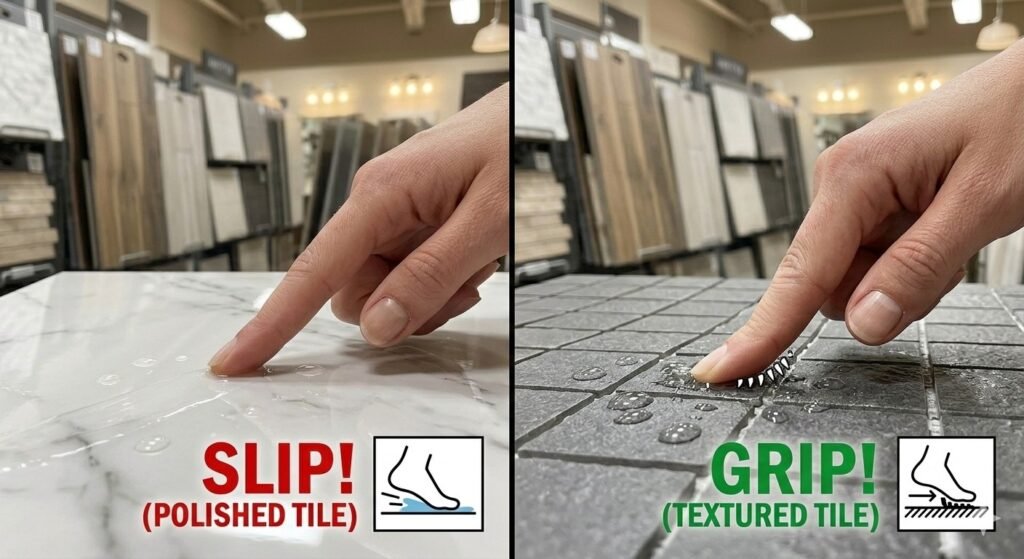
2. The “Finger Slip” Test
Put a few drops of water on the tile sample.
Press your bare finger down and try to slide it.
If your finger glides smoothly across the tile, that’s usually a bad sign.
If you feel your finger stuttering or grabbing, the surface likely has better traction. This is an especially useful trick when you’re shopping on behalf of an aging parent who can’t easily make it to the showroom.
3. Be Careful With Lappato Finishes
Lappato is a semi-polished tile finish.
It looks beautiful because it combines polished and matte areas.
Unfortunately, those polished peaks can become extremely slippery, especially for someone with a shuffling gait or balance issues.
For aging-in-place bathrooms — especially where an elderly parent or someone recovering from surgery will be using the shower daily — I almost always recommend structured or textured finishes instead.
Pairing Non-Slip Bathroom Flooring with Other Senior Safety Upgrades
Non-slip bathroom flooring for seniors is the foundation — but it works best as part of a larger safety system. The safest bathrooms I’ve worked on combine slip-resistant flooring with properly placed grab bars, a curbless shower entry, a shower bench at the right height, and doorways wide enough for a walker or wheelchair. Each one of those elements makes the others work better.
The tile is only as safe as what’s underneath it — my Senior Bathroom Backerboard Guide covers what needs to happen behind the wall before any flooring goes down.
Contractor FAQ: Non-Slip Bathroom Tile
What is the best non-slip bathroom flooring for seniors?
.Textured porcelain tile with a DCOF rating of 0.60 or higher is the safest choice for non-slip bathroom flooring for seniors. Small mosaic tiles are a strong second option — the grout lines add extra grip. Avoid polished marble or lappato finishes in wet areas.
Is non-slip tile harder to clean?
I’ll be honest—yes, slightly.
Textured surfaces hold onto soap residue more than smooth ones. For shower floors, epoxy grout and a weekly rinse with a pH-neutral cleaner keeps maintenance manageable. The extra cleaning is a worthwhile tradeoff for fall prevention.
I’d much rather see someone spend five extra minutes cleaning the floor than five weeks recovering from a fall.
Can I add a non-slip coating to slippery tile?
There are coatings available, but I don’t usually recommend them as a long-term solution.
They wear off over time, and most homeowners don’t realize the coating is gone until the floor becomes slippery again.
Replacing the tile with a high-DCOF product is the most reliable solution.
Will slip-resistant tile make my bathroom look institutional?
Not anymore. Modern manufacturers produce stone-look and wood-look tiles that meet 0.60+ DCOF ratings. You can have a bathroom that looks like a design magazine and is still completely safe to use.
If you’re weighing bigger decisions about the bathing setup itself — not just the floor — my Walk-In Tub vs Walk-In Shower Guide breaks down which option makes more sense depending on the user’s mobility level and long-term needs.
What DCOF rating do I need for a shower floor?
The minimum DCOF rating for any wet interior floor is 0.42, per ANSI standards. For aging-in-place bathrooms, most contractors recommend 0.60 or higher for a meaningful safety margin.
Is matte tile always slip-resistant?
No. Matte finish does not guarantee slip resistance. Some matte tiles can still be slippery when wet or soapy. Always check the tile’s DCOF rating on the specification sheet — never judge by appearance alone.
What grout should I use with non-slip bathroom flooring??
Epoxy grout is the best choice for shower floors — it’s non-porous, stain-resistant, and never needs sealing. If budget is a concern, cement grout with a penetrating sealer is a solid alternative. Reseal cement grout every one to two years. Avoid light-colored grout on shower floors; it shows mold and dirt quickly and degrades the visual contrast that helps low-vision users navigate the space.
Final Thoughts From the Job Site
When you’re selecting non-slip bathroom flooring for seniors or an aging parent, don’t let someone talk you into polished flooring just because it looks expensive.
A truly high-end bathroom isn’t one where the tile shines like glass.
It’s one where you don’t have to hold your breath every time you step out of the shower.
Before ordering that pallet of tile, ask the showroom one simple question:
“What’s the DCOF rating?”
If they can’t show you a number higher than 0.42, keep looking.
Your safety is worth more than a trendy floor.