Keeping It Level
You don’t always need a sledgehammer to make a bathroom safer. Most of the highest-impact upgrades — grab bars, lighting, seating, and floor friction — can be done without touching the tile. But “without remodeling” doesn’t mean without standards. A grab bar anchored into drywall is worse than no bar at all. Every shortcut has a weight limit.
I recently walked into a home where a well-meaning family member had tried to solve a slippery floor by layering three different bathmats. Instead of a safe surface, they had created a literal obstacle course of curled edges and sliding rubber. That’s the reality of senior bathroom safety without remodeling — sometimes the quick fix creates a brand-new hazard.
Here’s how senior bathroom safety without remodeling actually works — and where the limits are. Most homeowners assume safety requires a sledgehammer. In reality, I’ve spent years improving bathroom stability through smart, non-demolition upgrades. You don’t always need a remodel; you need better support, proper anchoring, and a realistic understanding of how people actually move in a wet environment.
My Bathroom Safety Guide provides the full strategic overview for these upgrades, but today we’re looking at the high-impact changes that leave your tile intact.
1. Grab Bars: The Foundation of Stability
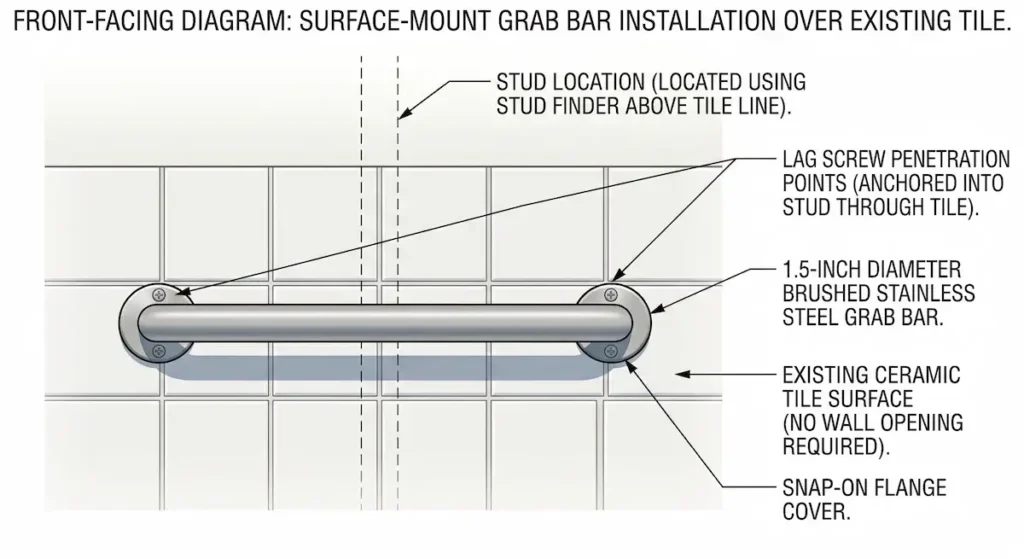
A grab bar is only as good as what it’s fastened into. I’ve personally pulled bars right out of the wall where someone used simple drywall anchors. That isn’t an installation; it’s a liability.
What I Look for on a Job Site
- The “Johnson Rule”: If Mrs. Johnson is 5’1″, I am not mounting a bar at the “standard” height meant for a 6’2″ adult. ADA guidelines suggest 33–36 inches from the floor, and that’s a solid baseline, but in a private home, we adjust for the specific user.
- The Transfer Path: If we are adding a shower chair, we need a bar positioned for the transfer—the moment of sitting down—not just standing balance.
- Structural Hits: If I can’t find a stud or solid blocking behind the tile, I won’t install the bar. Period.
For a full breakdown of exactly where every bar should go, see my Grab Bar Placement Guide.
2. Lighting: The Most Overlooked Safety Tool
This one surprises people, but I’ve done jobs where the primary “safety” issue was actually just poor visibility. Shadows near the tub entry or dim vanity lights cause a homeowner to pause or second-guess their footing. Good lighting reduces hesitation. Hesitation reduces instability. This is one of the most overlooked aspects of senior bathroom safety without remodeling — and can be one of the cheapest fixes on the list.
- The Fix: Switch to high-output LED bulbs (avoid the soft yellow “mood” lighting). For guidance on choosing the right bulbs, the U.S. Department of Energy has a straightforward lighting efficiency guide.
- Motion Sensors: Install motion-activated night lights for the path from the bed to the toilet.
- Glare Reduction: In small bathrooms, ensure lighting is at eye level to reduce the glare off mirrors and tile, which can be disorienting for those with changing vision.
My guide on lighting for an aging in place bathroom provides a more detailed look.
3. Shower Fixtures and Seating
If the shower is under 30 inches wide, a fixed bench often crowds the space too much. In these tight layouts, a compact shower chair with non-slip feet is often the superior choice because it can be removed for cleaning or to create standing room. My Shower Bench vs. Shower Chair Guide compares these two in detail. If a low entry shower pan is on the list my Non-Slip Shower Pans for Aging in Place Guide covers the threshold heights and installation details that make the most difference for elderly seniors.
The Handheld Showerhead Advantage
When an elderly user can sit and control water direction without twisting their torso or reaching for a high fixed head, their balance improves instantly— my Handheld Shower Head for Seniors Guide covers everything you need to know before installing one.
- Contractor Tip: Always check the “drop-ear” elbow behind the wall. Older plumbing connections are often loose, and the added weight of a handheld hose can cause leaks if the pipe isn’t secured to the framing.
4. Toilet Safety and Clearance Realities
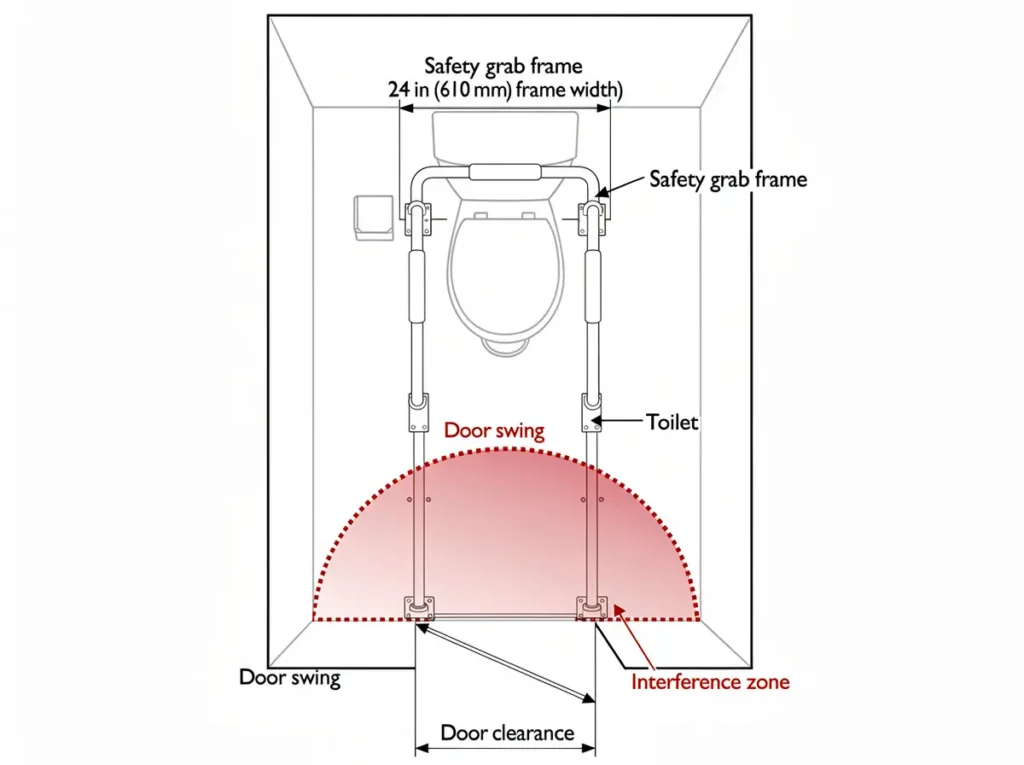
If someone has knee or hip weakness, a raised seat or a safety frame is essential. However, I often see these installed without considering the “door swing” or the user’s specific reach.
- The Clearance Trap: In small bathrooms, a toilet safety frame can actually block the door from opening fully. If the door barely clears the toilet now, adding a 24-inch-wide frame will trap you in (or out of) the room.
- Stability Check: Avoid “clamp-on” risers that wobble. If the riser doesn’t bolt directly to the porcelain, it can shift during a sit-down, leading to a fall.
5. Senior Bathroom Safety Without Remodeling: Friction Over Equipment
Here is something most home-improvement blogs won’t tell you: In small bathrooms, safety is about reducing friction and clutter, not just adding equipment. Sometimes the best “installation” I do involves clearing the path rather than adding a new gadget.
- Removing unnecessary shelving that forces a user to turn awkwardly in a tight radius.
- Relocating towel bars so they are within a 6-inch reach of the shower exit, preventing that “wet-floor shuffle.”
- Repositioning storage so essential items are at waist height, eliminating the need to bend or reach overhead while on a slick surface.
The vanity is another area where a hardware swap rather than a full replacement can make a meaningful difference without touching the tile. Swapping knobs for lever handles on the faucet and cabinet hardware is a low cost upgrade that significantly reduces the grip and dexterity required for daily use. My Bathroom Vanity for Seniors Guide covers that alongside the fuller vanity upgrade options if the budget allows for more.
When a Remodel Actually IS Necessary
I pride myself on saving homeowners money, but there are times I have to say, ‘This isn’t a quick-fix situation.’ Senior bathroom safety without remodeling has real limits:
- Subfloor Rot: If the floor feels “spongy” near the toilet or tub, no amount of grab bars will make it safe.
- High Tub Walls: If a homeowner can no longer lift their leg high enough to clear a standard 14-inch tub wall safely, a conversion is the only path forward. My guide to curbless shower installation covers what that structural work actually involves and whether your subfloor can support it.
- Water Damage: If tile is popping off the wall, there is likely mold or structural decay behind it that hardware won’t fix.
Frequently Asked Questions (From the Job Site)
How much does it cost to make a bathroom safer without remodeling? Many professional safety upgrades fall into these price ranges:
- Basic ($300–$800): 2 grab bars + high-quality non-slip floor treatments.
- Moderate ($800–$2,000): Bars, motion lighting, and a high-quality shower chair.
- Advanced ($1,500–$3,500): Professional installation of multiple bars, fold-down seating, and new accessible fixtures.
*Note: These are estimates only. Every home and situation presents its own unique challenges that can affect these prices.
Do I need a full bathroom remodel to age in place safely? No—not in all cases. If the structure is solid and the layout isn’t fighting you, we can usually improve safety with grab bars, slip resistance, lighting, and seating. I only recommend a full remodel when the tub wall is too high to step over safely, there’s subfloor damage, or the layout physically prevents safe movement.
More Frequently Asked Questions
How do I know if my bathroom layout is unsafe? If you have to twist awkwardly to reach the faucet, step over a high tub wall, or grab a towel bar (which isn’t weight-rated) for balance, the layout is fighting you. Look for “hesitation points”—places where you have to stop and think before moving.
Is a shower bench safer than a shower chair? For elderly users it depends on the layout — in wider showers with proper wall backing, a professionally installed folding bench is great. In smaller stalls, a compact shower chair often works better because it doesn’t block movement.
Are suction grab bars safe? I don’t trust them for primary support. They can work as temporary balance aids, but I would never rely on them to hold full body weight during a slip. If we’re doing it, we’re anchoring into framing. (I personally am not a fan)
When should I NOT add safety equipment? Don’t add equipment if the wall behind the tile is “mushy” or damaged, or if there is no solid anchoring point. Additionally, don’t add equipment if it creates a new trip hazard or blocks a clear exit path.
Final Thoughts
Most bathroom accidents aren’t dramatic falls; they are small moments of imbalance that go wrong. Senior bathroom safety without remodeling is about eliminating those moments before they happen. You don’t need to tear out tile to do that—you need solid anchoring, realistic placement, and someone who understands how people actually move.
Ready to evaluate the rest of your home for hidden safety risks? My Free Home Safety Checklist walks through the room-by-room framework — so you can find the risks before they find you.