Keeping It Level
Exterior doors for seniors come down to five things: the door is installed right, it opens easily, the opening is wide enough, the threshold doesn’t trip anyone, and the storm door isn’t making life harder. This guide covers all of it. Door types, door width for wheelchair and walker users, inswing vs. outswing, storm doors for seniors, sticking doors, and door threshold for seniors. Every situation is different, so I’ll give you the tradeoffs and let you decide.
- Door Types: Steel, Fiberglass, PVC, and Wood
- Door Width for Wheelchair and Walker Users
- Inswing vs. Outswing
- Storm Doors for Seniors
- Why Your Door Sticks (And What to Check First)
- Weatherstripping and Door Sweeps
- Door Threshold for Seniors
- Sliding Doors
- When the Front Door Isn't the Answer
- FAQs: Exterior Doors for Seniors
- The Bottom Line on Exterior Doors for Seniors
This is the next piece in my Last Fifty Feet series. The rest of the series gets someone safely to the door. My Door Handles for Seniors article covers the hardware. This one is about the door itself.
An elderly woman called me about her front door. She’d hired someone a year earlier to replace it. That door leaked from day one.
Why did she wait a year to call? She lives on a fixed income. She paid a good chunk of money to have it done. It was done wrong. And when you’ve already paid once, you don’t have a second pile of money sitting around.
I’ve written about this exact problem in The Last Guy: A Contractor’s Guide to Hiring Right. If a guy doesn’t do it right the first time, he’s not coming back to fix it.
The door was wrong top to bottom. Not flashed right. Gaps at the top. I could see daylight with the door closed. The threshold wasn’t sealed. The door wasn’t plumb. It wasn’t seated all the way in.
By the time I got there, the water had rotted everything. She needed a new door and new framing around it. Every bit of that damage came from a bad install, full stop.
I can work within a budget. What I can’t do is change the price of materials. Even with free labor, she’d have been out the cost of a new door and the wood.
That’s why installation comes first in any article about exterior doors for seniors. A bad door isn’t just drafty. For an elderly person, a door that sticks, leaks, or won’t close is a daily fight.
Door Types: Steel, Fiberglass, PVC, and Wood
Exterior doors come in steel, fiberglass, PVC, and wood.
The two I install most on a front door are steel and fiberglass. Fiberglass usually costs a little more than steel. PVC and wood doors exist too. You just don’t see many people choosing them.
Then there’s the jamb. That’s the frame the door hangs in. You can get a wood jamb, a steel jamb, or a PVC jamb. Wood is the most common, and it’s the cheapest.
Pre-hung vs. slab. A pre-hung door comes with the jamb and hinges already on it. A slab is just the door.
If you’re only replacing the door, you’re buying a slab. Some come with holes drilled. Most don’t. You’ll need a mortise kit for the handle and deadbolt. I cover that in Door Handles for Seniors.
I don’t buy slabs with pre-drilled holes. You’re matching a new door to hinges and a strike plate that are already in the old jamb. The holes have to line up with that hardware. It’s easier to drill them yourself.
Door Width for Wheelchair and Walker Users
A standard door in new construction is 36 inches or wider. That works for wheelchairs and walkers.
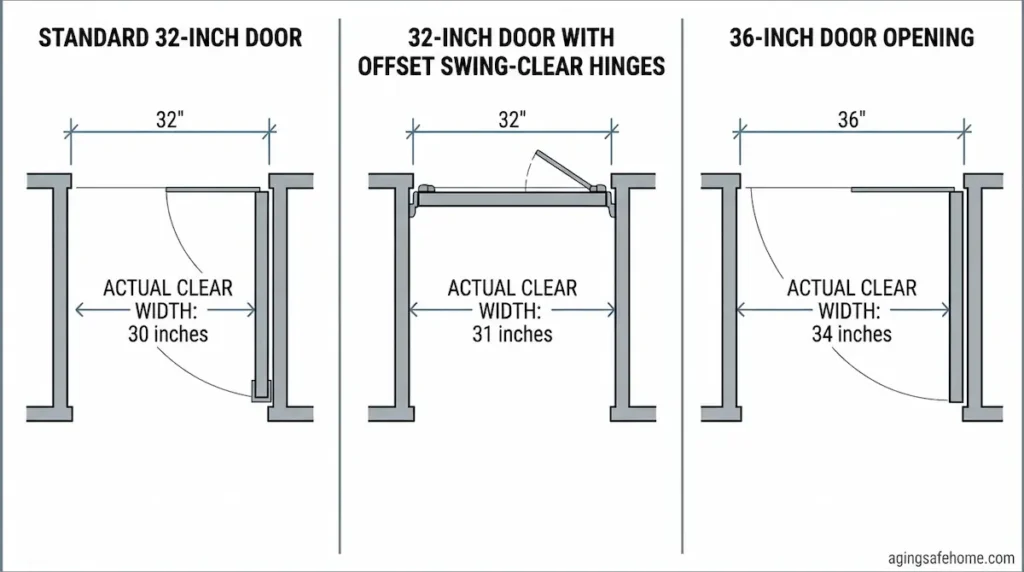
I’ve seen plenty of 32-inch front doors, mostly when someone has replaced the door and gone with a smaller one. A 32-inch door is fine…if you’re not in a wheelchair. But here’s what most people miss: a 32-inch door is not a 32-inch opening.
The door itself sits in the opening when it’s open. It eats a couple of inches. So a 32-inch door leaves you with a clear opening that’s tighter than the number on the box. That’s the number that matters for a wheelchair.
Offset hinges fix part of it. They swing the door out of the path and can add up an inch or so of clear width. It’s a cheap fix. What offset hinges can’t do is fix the width of your jamb that sticks out in the doorway, that’s going to be your true doorway clear width measurement.
But if you’re already at the point of replacing the door, think about going wider if you have the means. I go into the full details in my Widening a Doorway article. Also just remember these measurements are ADA compliant and work for standard wheelchairs/walking assistant devices but its always good practice to measure the actual device you’re using.
Inswing vs. Outswing
This one is personal preference. I’ll walk through the situations so you can decide.
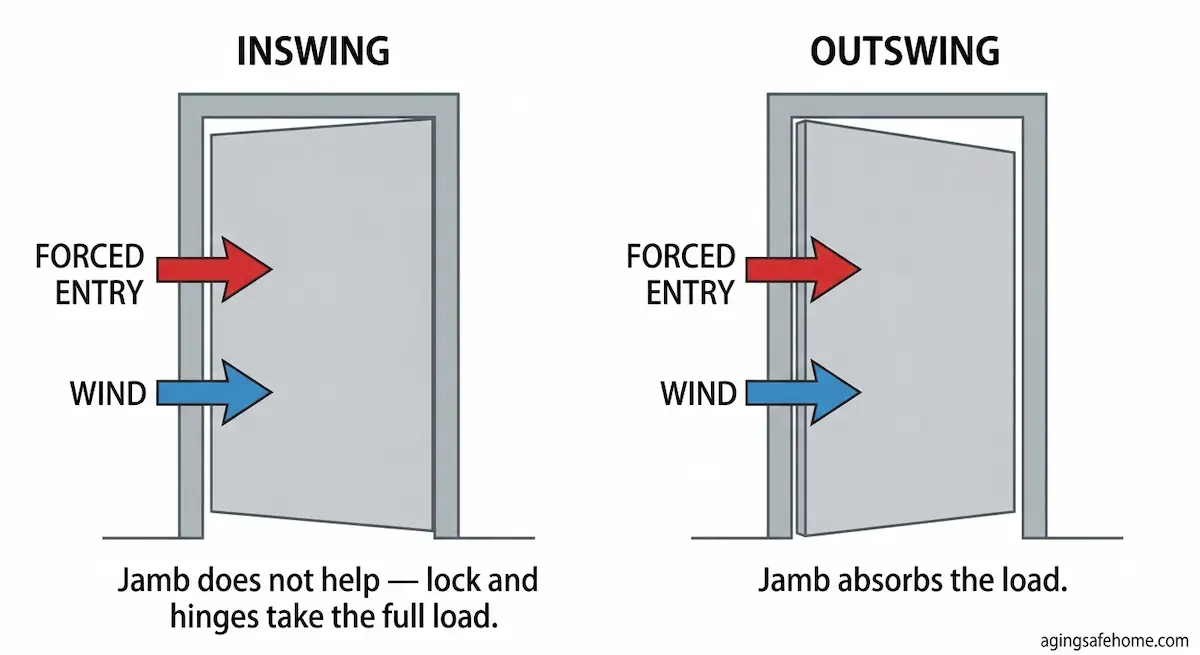
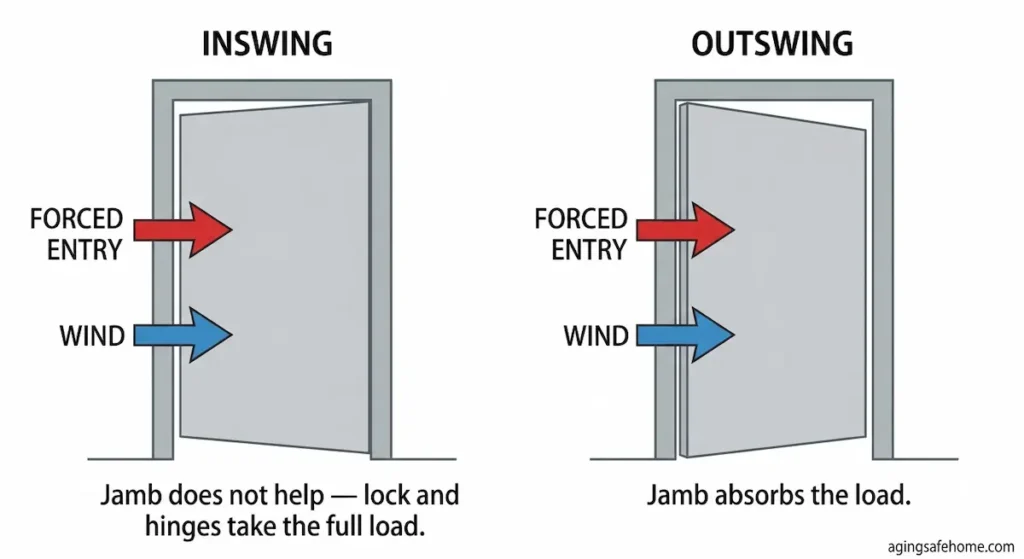
Outswing doors are more secure in some ways. To force one open, you have to pry the door away from the frame. You can’t just kick it in. The jamb is doing real work.
On an inswing door, the only things holding it are the lock and the hinges. The jamb is there, but it’s not helping. You’re pushing into it, not pulling away from it.
Wind matters too. If you’re in a hurricane or high-wind area, an outswing door resists the wind because it’s pressed into the jamb. Some areas mandate outswing doors. If yours does, that’s the answer.
Inswing doors are easier for emergency access. If a family member or emergency personnel needs to get in fast, an inswing door is easier to open. For a senior living alone, that matters.
I see inswing doors more often than outswing.
One rule on outswing: use security hinges. Every time. Most pre-hung outswing doors come with them. This keeps someone from just popping the hinge pins.
Room to move. An outswing door needs room to back up on the landing. An inswing door needs room inside. Check both before you decide. My Ramps for Seniors article covers landings.
Storm Doors for Seniors
Now the storm door. This is another personal preference. My honest opinion is that a storm door is an extra hindrance in an elderly person’s day. It’s one more door to open, hold, and close.
But my papaw has one and loves it. Who am I to tell him no?
Here’s something I hadn’t thought about until I experienced it myself. In the summer, when he leaves and locks the front door and shuts the storm door over it, the handle gets hot. I’m talking grabbing-a-pan-out-of-the-oven hot. His front door gets full sun most of the day. He’s got a brass handle. The storm door traps and magnifies the heat.
A covered porch or an awning would probably fix it. That’s in my Covered Porches article. His fix? He props the storm door open when he leaves. He doesn’t care how it looks. He’s a problem solver.
If you’re buying a storm door for a senior, here’s what to check:
- Handles. Some storm doors let you swap the handle. Some don’t. Many come with lever handles. Papaw’s has one. If you can get a lever, get a lever.
- Weight. A full-glass storm door is heavier than a standard screen door. Heavy is harder to open and harder to control in the wind.
- Sweeps. On a screen door, a brush-style door sweep lets air move. That prevents the suction that makes a door harder to open.
Look at the trim. A storm door mounts to the brick moulding, the trim around the frame. If that trim is old wood and it rots or shifts, the storm door sags. The hinges bend. The door goes out of plumb.
I also see brick moulding held on with nothing but the little pin nails that came on a pre-hung door. Then somebody hangs a heavy security storm door on it. Those pin nails can’t hold that weight.
Step one: make sure the moulding is secure and fastened for the weight of the door.
Closers, Two Speeds
Here’s something most people don’t know about their storm door closer, and it’s worth the extra thirty seconds to set up right. A good hydraulic closer has two separate adjustment screws, not one. One controls the sweep speed, that’s the door moving through most of its swing. The other controls the latch speed, that’s the last few inches right before it clicks shut.
For a senior using a walker, the sweep speed is the one that matters. You want that door moving slow enough that somebody can actually get all the way through it without it catching them from behind on the way through. I tell people to time it: from wide open down to almost closed should take at least 5 seconds, not 2. If you can count “one-Mississippi” to five before it’s most of the way shut, you’re in good shape. If it’s swinging shut before you can get your walker through, tighten down that sweep screw and slow it down.
The latch speed screw is a different job. That one’s just there to make sure the door actually latches and locks instead of bouncing back open. You can leave that one closer to normal.
Most people adjust the closer once, when the door’s brand new and slamming too hard, and never touch it again. But a closer that’s fine for you might not be fine for your mom or your papaw. It’s worth going back out there and checking it with them, or watching them walk through it once, before you call it done.
Why Your Door Sticks (And What to Check First)
A door that fights back is one of the most common problems I see on exterior doors for seniors. Don’t rush to buy a new door. Doors are expensive. Check everything else first.
Out of plumb at the top. Have you ever opened a door and had it start scraping the floor halfway through? That’s the top out of plumb. The weight is pulling it down. It happens at install, or slowly over time from gravity. Check the hinges and jamb to see if any adjustments can be made. Sometimes the hinge is just wore out and needs to be replaced.
If it’s out of plumb at the bottom, the swing goes higher. That’s usually a bad install. Most of the time, it’s the top.
Nails walking out. In older houses, the frames were nailed in, not screwed. Over decades, those nails walk back out and the frame moves. You can go back and re-secure your framing (as long as its not rotted) with screws, a screw won’t walk out on you.
Hinge screws. Pre-hung doors usually come with long screws, about 3 inches, taped to the door. They match the ones for the hinge plate. Put the long screw in the hinge screw hole so it reaches the stud. If the screws in your hinge are too short (I’ve seen a lot of 1-inch screws) and aren’t reaching the framing, go buy yourself some matching 3-inch screws to replace the short ones with. This will allow them to reach the framing and keep your door secure.
Hinge shims. These small shims go behind the hinge plate and push it out a little to level the door. You can buy them or make your own out of scrap wood.
Planing. You can plane a door, but only if it’s wood. Lots of people do it. Personally, I always adjust the hinges and go through the other steps first. I’d rather not make your door not square anymore.
If your framing is still solid, don’t panic. I’ve adjusted plenty of old doors.
Wood swells. If I’m building a custom wood slab, I back cut a 2-degree bevel on the handle side, on the jamb side, toward the inside of the swing. It lets the door swing without touching. It’s small enough that you’ll never see it.
Nail it off. I nail off both the inside of the jamb and the brick moulding. Most people only do the moulding with those little pin nails. I’ve also seen some people only nail off the trim and not the jamb. Then the door’s only held by trim. Don’t do that. That door will fall out.
Weatherstripping and Door Sweeps
If the door drags, look at the door sweep first. Nine times out of ten, that’s what’s causing the friction.
If it’s set too low and dragging on the ground, it makes the door harder to move. If it’s too high, it doesn’t seal. You want it to just touch the threshold.
Door Threshold for Seniors
A lot of people ask about swapping the threshold or adding a ramp. I talk more about this in my Ramps for Seniors article.
Here’s the big thing. Make sure you have proper drainage on the outside. Not a big gap. A small weep gap so water can get out. Otherwise water builds up against the door and ruins it.
You solved one problem and created another. That’s the mistake I see most.
A low door threshold for seniors is worth it. Just don’t do it by blocking the way water leaves.
Sliding Doors
A sliding door is a sliding door. You get what you spend. You’re not going to put one on your front door.
But sliders have one advantage. They take up no real space, inside or outside. That takes the swing problem off the table.
When the Front Door Isn’t the Answer
One of my customers used a power scooter. There wasn’t enough room to run a ramp to his front door.
So we left the front door alone. We built the ramp around the side of the house and up onto the back porch. The porch was covered. He’d come in through the slider.
We recessed the threshold so he could roll straight in. To do that, you notch out the framing so the sill sits lower. Then you lower the whole door by ¾ of an inch so it sits flush with the floor. The outside deck has to be tapered a little. Because it was a covered porch, water wasn’t a big worry.
Another option is to build the floor up on the inside to match the door, instead of recessing the door. It depends on your situation.
That’s what I mean when I say every situation is different. The best door for a senior isn’t always the one on the front of the house.
FAQs: Exterior Doors for Seniors
What is the best exterior door for seniors?
It depends on the person and the house. I install steel and fiberglass most often. The bigger factors are a proper install, a wide enough opening, a low threshold, and hardware they can operate. See Door Handles for Seniors for the hardware side.
How wide should a door be for a wheelchair?
36 inches is a good target. A 32-inch opening meets ADA standard, but it’s tighter, because the open door takes up part of the opening. Also worth remembering that ADA standards are meant for commercial use but are a good baseline to go on for Aging in Place. Offset hinges can add up to about 2 inches of clear width. See Widening a Doorway.
Should an exterior door swing in or out for a senior?
It’s personal preference. Outswing is more secure and resists wind. Inswing is easier for emergency access. Some hurricane areas require outswing. I see inswing more often.
Are storm doors good for seniors?
Personally, I think they’re an extra hindrance. But some people love them. If you get one, look for a lever handle, check the weight, and adjust the closer so it doesn’t slam back.
Why is my exterior door hard to open?
Check the door sweep first. Then check whether the door is out of plumb, whether nails have walked out, and whether the wood has swelled. Adjust the hinges before you buy a new door.
What is a good door threshold for seniors?
As low as you can safely go, with a small gap so water can drain. Don’t seal the drainage off. It’ll just rot your door.
The Bottom Line on Exterior Doors for Seniors
Exterior doors for seniors aren’t complicated. They’re detail work. A door installed right. An opening wide enough. A swing that fits the person. A storm door that helps, not hurts. A threshold that drains.
Most of the problems I see start with a bad install. Check everything before you spend money on a new door. And if you’re hiring someone, read The Last Guy first.
If you’re working through a full aging in place plan, grab our free Home Safety Checklist and walk through it room by room, inside and out.