You Don’t Have to Do It All at Once. Here’s How to Get It Done Right on a Budget That’s Real.
Keeping It Level
A home is one of the most expensive investments a person will make in their lifetime — and not everyone can do it all at once. That’s not a failure. That’s reality. Phased remodeling is how real work gets done for real people on real budgets, and for seniors and elderly homeowners on fixed incomes it’s often the only way to get there. Here’s how fixed income home renovations actually get done right.
- You Don't Have To Do It All At Once
- What's Most Important To You
- Needs Versus Wants — And The Hierarchy That Matters
- Talk About Your Budget — Please
- It's Not Just The Materials
- Phased Remodeling Only Works If Someone Can See The Whole Picture
- How Phases Actually Work — And What They're Not
- The Returning Customer
- FAQ: Senior Fixed Income Home Renovations
- Do I have to know my budget before I call a contractor?
- What if my budget is really small — is it even worth calling?
- How do I figure out what to do first?
- Can I phase a project myself without a contractor?
- How do I make sure the contractor remembers what phase two looks like?
- Does the estimate cover materials and labor both?
- Are there grants that can help cover the cost of aging in place modifications?
- The Bottom Line
You Don’t Have To Do It All At Once
I don’t use fancy language when I’m sitting across from someone in their home. I’m the guy who shows up in an old work truck I wouldn’t trade for the world, broken-in work boots, and a shirt that probably came from a Walmart value pack. So when someone tells me everything they want done and then gets quiet about what it costs, I just say it plain:
We can do this in phases if you want. You don’t have to do it all at once. I know it can be overwhelming.
That’s it. No sales pitch. No pressure. Just an honest conversation about how to get from where you are to where you want to be without doing it all at once.
The truth is sometimes people can’t afford to get everything done. There’s nothing wrong with that. This stuff is expensive — and I don’t just mean labor. Have you seen the cost of wood lately? Materials are real money and they’ve only gone up in price. For seniors and elderly homeowners on fixed incomes trying to make aging in place modifications to their home, the gap between what needs to happen and what the budget allows can feel impossible. It doesn’t have to be. It just has to be sequenced right.
And phased remodeling isn’t only for people who are stretched thin. It’s just smart. I remodeled my own house this way — room by room, in phases — and my labor is free. It keeps the project manageable, keeps the home livable while the work is happening, and lets you make better decisions when you’re not trying to do everything at once. Some of the most thoughtful renovation projects I’ve been part of weren’t driven by budget limitations at all. They were driven by someone who understood that doing it right takes time.
For the full picture of what aging in place modifications look like in this region — what’s involved, what it costs, and what to think through before any project starts — the Eastern Kentucky aging in place guide is a good place to start.
What’s Most Important To You
The first thing I ask every single person before we talk about anything else is this: what’s most important to you?
It’s their home. Their life. They know what’s been bothering them. Maybe the toilet is too short and getting up every morning is a struggle. Maybe the previous homeowner painted the walls a color that makes them want to contemplate that person’s demise every time they walk in the room. Maybe the shower hasn’t felt safe in years and they’ve been white-knuckling it every morning hoping today isn’t the day something goes wrong.
Whatever it is — that’s where we start. Not where I think we should start. Not what I think matters most. What they think matters most, because they’re the one living there every single day.
For elderly adults and seniors aging in place, that question matters even more. Their home isn’t just a building. It’s where they’ve spent their lives. The modifications that make the biggest difference to their daily comfort and safety aren’t always the ones on a standard checklist — they’re the ones that have been quietly making things harder for years. Ask first. Listen to the answer.
Needs Versus Wants — And The Hierarchy That Matters
Here’s where it gets real. Most of the time I’m not getting called in because someone has been staring at puke green walls for too long. Most of the time I get called in because something broke. Something’s leaking. The hot water heater blew up out of nowhere. Something that used to work doesn’t anymore and it can’t wait.
When that happens the sequence isn’t a conversation — it’s a given.
Hot water heater floods the laundry room? First things first: you need hot water. That’s getting done. Then if you need a new floor it needs to happen eventually, but if the money isn’t there right now it’s not going to destroy anything to wait a little while. Water first. Floor second. Not negotiable.
That hierarchy — needs before wants, and within needs the most urgent first — is the foundation of every phased project I’ve ever done. Safety issues don’t wait. A floor that’s soft in one corner can wait a few months if there’s no money right now. A grab bar that a senior or elderly adult is depending on every single morning to get in and out of the shower safely does not wait.
Once the urgent stuff is handled, then we get back to the list. Then we talk about what they wanted to do and figure out the order that makes the most sense given what’s left in the budget and what phase two looks like.
And if the Kentucky Power bill is part of what’s making the budget tight in the first place, that’s worth addressing alongside the renovation conversation. See the Kentucky Power Bill guide for what a contractor can actually do to bring that number down before it eats into what you have left for everything else.
Talk About Your Budget — Please
This is the conversation nobody wants to have and the one that matters most especially on fixed income home renovations.
Every time I ask a homeowner what their budget is I can feel them hesitate. I understand why. Nobody wants to say a number and feel like that number is going to magically become the exact cost of the job. That’s not how I work and it’s not how any honest contractor should work.
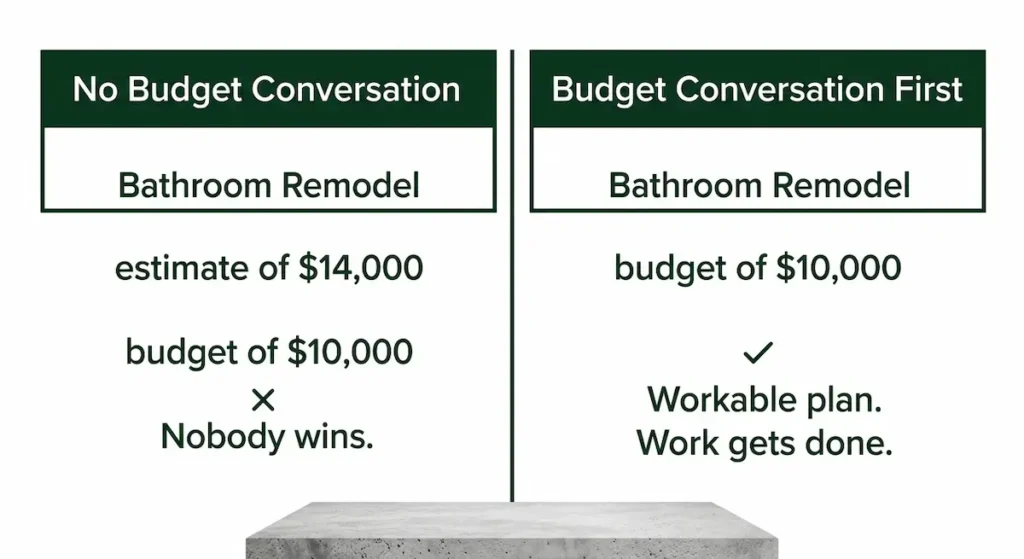
Here’s why I need to know: if you tell me you want gutted floors, new flooring, reframed walls, recessed lighting, a new ceiling, a PVC shower surround, new pan, full remodel, and I put together an estimate for all of that and hand you a number of $14,000 — but your budget was $10,000 — nobody wins. You’re not happy because it’s way over what you had. I’m probably not getting a call back. We’ve both wasted time on a conversation that didn’t have to go that way.
But if you tell me upfront your budget is $10,000, I can actually help you. I can look at that list with you and say — alright, everything together is going to run more than that, so let’s go through it and see where you’re willing to compromise. Maybe instead of a PVC surround we do a pre-fab one. Maybe we look at different flooring. Maybe we do it in phases and come back for the rest when you’ve had time to save. I can work with a number I know. I can’t work with a number I’m guessing at.
When I give you an estimate, that number covers everything — materials and labor, all inclusive. That’s how I operate. Not every contractor works that way, which is exactly why you have to ask. Before you agree to anything confirm whether the estimate covers materials and labor both or just one of them. That one question can save you from a bill that looks nothing like what you were expecting. Make sure you both know what that number covers before anyone starts anything.
The budget conversation protects you and it protects me. Have it first.
If grant funding is part of how you’re planning to cover the cost — and for many seniors and elderly homeowners in Eastern Kentucky it should be — the budget conversation gets more layered. Grants have limits, approval timelines, and material requirements that affect how you sequence the work. The Senior Home Repair Grants in Eastern Kentucky guide covers every program available in this region and what the process actually looks like from the contractor side.
It’s Not Just The Materials
Here’s something most homeowners don’t know and most contractors never explain: the cost of labor isn’t just about what material you pick. It’s about what you’re asking someone to do with it and what knowledge that requires.
The wood for a basic handrail and the wood for a routered, custom designed handrail with fancy pickets costs the same at the lumber yard. What’s different is the skill and time it takes to turn one into the other. That’s not a materials cost. That’s a knowledge cost.
A pre-fab shower surround I screw into the wall costs less in labor than a custom PVC surround I have to trim to fit and glue up. A light fixture screwed up and left as it sits costs less than the same fixture framed out with crown moulding to look like it was built into the ceiling. Custom cabinet lighting where the wires are hidden and you never see them costs more than a strip light anyone could put up — because I have to know how to drill those cabinets, route the wires, and make it look like it was always supposed to be there. That trim that looks like one solid seamless piece running around a room? I have to mud in those lines, sand them down, and work until the finished product looks like it grew there. That takes time. Time costs money.
For seniors and elderly homeowners trying to stretch a fixed income across a list of aging in place modifications, understanding this relationship matters. Sometimes the simpler option is genuinely the right call. Sometimes it’s worth spending more on the thing you’ll look at every day and saving somewhere you won’t notice. A good contractor explains the tradeoff and lets you decide. A good homeowner asks.
Phased Remodeling Only Works If Someone Can See The Whole Picture
This is the part that doesn’t get talked about enough.
Phased remodeling isn’t just payment plans for fixed income home renovations. It’s a plan — a real one, thought through from beginning to end before the first phase ever starts. And that requires a contractor who can hold the entire project in their head from day one, not just the phase in front of them.
I’m currently working on a long phased project — kitchen updated first, then the dining room, walls, ceiling, lighting, all of it, then the living room the same way. All in phases over months. At the end of it all we’ll run new flooring throughout the whole space. Not in the kitchen when we did the kitchen. Not in the dining room when we did the dining room. All of it at the end, bought at once, installed at once.
Here’s why that matters: if I’d put the dining room floor down eight months ago without knowing the kitchen and living room were coming, and then by the time we got there the product was discontinued — now we have a problem that didn’t have to exist. Mismatched flooring throughout a connected open space because nobody thought past the phase they were in.
Every home is different. Every project has a different sequence that makes sense for that specific house, that specific homeowner, and that specific list of what needs to happen. A contractor who can only see what’s directly in front of them isn’t the right contractor for a phased project. You need someone who can picture the finished version from the first conversation and work backward from there to figure out exactly where and how the phases can break without creating problems down the road.
That’s not a skill everyone has. It’s worth asking about before you start.
How Phases Actually Work — And What They’re Not
Fixed income home renovations work best when every stopping point makes sense for the person living there. I had a customer whose floor had literally fallen through. That was the call — not a renovation conversation, not a wish list. The floor gave out and something had to happen.
I went over, tore the floor up, got the plywood down. And we stopped there. She had another fully functioning bathroom she could use, so it wasn’t a hardship to wait. They didn’t have the money for the new flooring yet or to pay me to put it down. So we stopped. The subfloor is solid. Nobody is falling through it. The rest comes when the money is there.
That’s phased remodeling. It’s not glamorous. It doesn’t look like a reveal on a television show. It looks like a subfloor in a room that’s waiting for the next chapter. And that’s fine — because the problem that couldn’t wait got solved, and the rest will get done when it can.
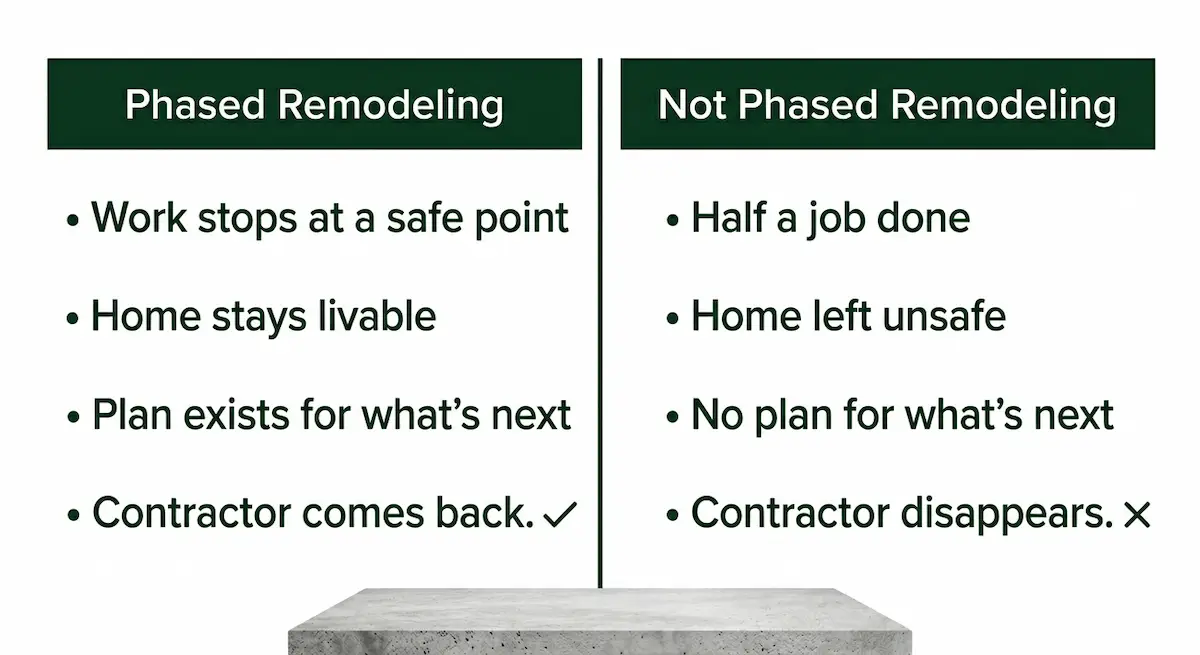
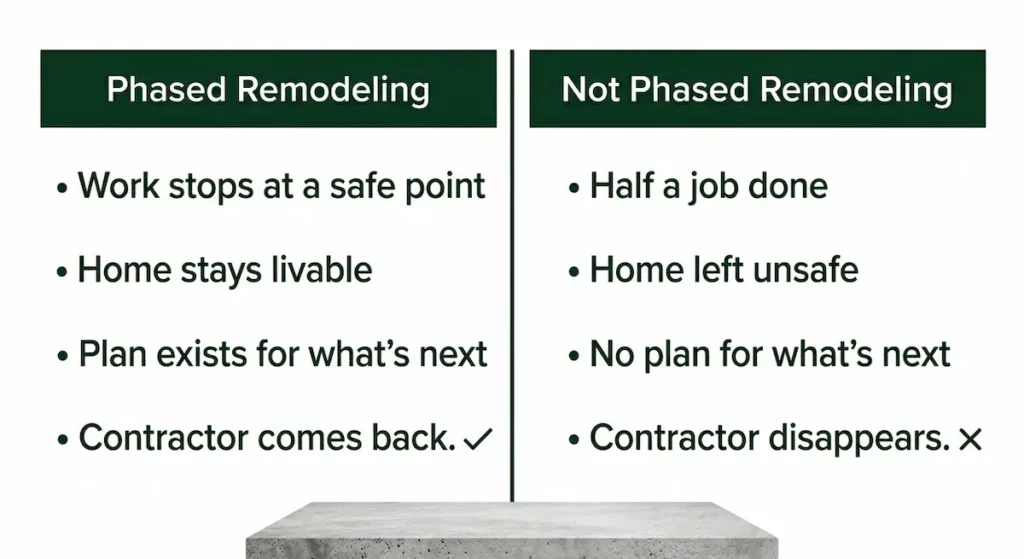
But here’s what phased remodeling is not: it is not leaving someone in an unsafe or unlivable situation and calling it a plan. Every phase has to end with the home in a condition that’s safe and livable when you walk out the door. A senior or elderly adult living alone with one bathroom cannot live on a subfloor indefinitely waiting for phase two. That’s not a phase — that’s a problem. The situation above worked because there was another bathroom available. That detail changes everything. Every project is different and every stopping point has to make sense for the specific situation and the specific person living there.
Phased remodeling also isn’t an excuse for a contractor to do half a job and disappear. If someone takes your money, does part of the work, and you never hear from them again — that’s not phased remodeling. That’s a last guy story. Before you hand anyone money for phase one, make sure you’ve done your homework on who you’re hiring. The Last Guy covers exactly what to look for before anyone starts.
Before I come back for any phase I verify current prices. The economy is what it is and I’m not going to show up at someone’s door with a number that doesn’t match what I quoted months ago without warning them first. I try to give the most honest rough estimate I can when we’re planning and then I confirm before I come back. Everyone deserves to know what’s coming.
I try to meet people where they’re at. That’s the whole thing. A home is one of the most expensive investments a person will make in their lifetime. It’s important and it matters. The least I can do is be honest about what it costs and flexible about how we get there.
The Returning Customer
Most of my work comes through word of mouth. That’s how it’s always worked out here — neighbor to neighbor, family to family. There’s no app for it. Your reputation travels the way it always has, and when you take care of people they tell someone.
I have a customer — we’ll keep her anonymous — who heard about me through word of mouth and called me in to fix her plumbing. Cast iron supply lines, the old stuff. We swapped it out for PEX and that was that. Now she calls me for any and everything. I joke that she’s my number one fan.
Most of the jobs are miniscule. She had a water leak under the sink once — small thing, easy fix. But she wasn’t calling about the leak. She was calling because the leak had messed up a drawer in her vanity and that drawer was clearly the most important thing in the world to her at that moment. I fixed the leak first, obviously. Then I rebuilt her drawer. Because that was what mattered to her and that’s the job.
She’s in her eighties, set in her ways, and once you earn her trust you’ve got it for life. She’ll sing your praises from the mountaintops and she always makes sure I leave with a cup of coffee. That’s what a returning customer relationship looks like out here. And honestly it’s one of my favorite parts of this work.
When phased remodeling works the way it should, it builds exactly that kind of relationship. You’re not starting from scratch every time something needs to happen. There’s already someone who knows the house, knows the plan, knows what phase three looks like. For elderly adults and seniors aging in place that continuity has real value — the hard work of finding someone they trust is already done.
I genuinely care about giving people something they love. Not something that’s finished — something they actually love. There’s a difference. And the only way to get there is to keep showing up, do what you said you’d do, be straight about the money, and come back when they call.
FAQ: Senior Fixed Income Home Renovations
Do I have to know my budget before I call a contractor?
You don’t have to have an exact number but having a ballpark makes the first conversation a lot more useful for both of you. Even a rough range — I’ve got somewhere around $5,000 to work with — gives a contractor something to plan around. Without it they’re guessing and the estimate they hand you may not have anything to do with what you can actually spend.
What if my budget is really small — is it even worth calling?
Yes. A small budget still gets something done. Even if it’s one room, one modification, one problem solved — that matters. For seniors and elderly homeowners on fixed incomes, getting the most urgent thing handled now and building a plan for the rest later is a completely legitimate approach. Don’t let a limited budget be the reason nothing happens.
How do I figure out what to do first?
Start with safety. If something is a genuine hazard — a soft floor, a missing grab bar, a heating situation that puts an elderly person at risk — that goes first regardless of what else is on the list. After safety, go with what’s bothering you most. You know your home. Trust that.
Can I phase a project myself without a contractor?
For some things yes. If you’re doing the work yourself and you have a little common sense the order usually makes itself clear — trim can’t go up before the walls, flooring goes down before baseboards. Where it gets complicated is when the sequence affects structural work, plumbing, or electrical. Those have consequences if you get the order wrong. Know what you’re working with before you decide to sequence it yourself.
How do I make sure the contractor remembers what phase two looks like?
In my experience homeowners never forget. It’s their home and their money and their list. But get it in writing anyway — a simple note of what was done, what’s planned, and the rough estimate for what’s next. That protects both of you if anything changes.
Does the estimate cover materials and labor both?
Mine do, but that isn’t necessarily true for everyone. Always ask: is this number all inclusive — materials and labor both? If the answer is unclear ask again until it isn’t.
Are there grants that can help cover the cost of aging in place modifications?
Yes — and more of them than most people realize. For seniors and elderly homeowners in Eastern Kentucky the grants and funding guide covers every program available in this region, who qualifies, and how to apply.
The Bottom Line
You don’t have to do it all at once. You never did.
For seniors and elderly homeowners navigating fixed income home renovations trying to make aging in place modifications work on a budget that’s real — this is how it gets done. Not all at once. Not in a single reveal. In phases, in order, with honesty about what things cost and flexibility about how we get there.
Find a contractor who can see the whole picture from the first conversation. Tell them your budget. Tell them what matters most. And then build a plan together that gets you from where you are to where you want to be — one phase at a time.
My hands are the best tools I was ever given. I intend to keep using them.
For more on finding the right contractor before anyone starts — and what to watch out for before you hand anyone your money — see The Last Guy.