Keeping It Level
Everyone out here has a generator. That’s not an exaggeration — if you’ve lived in Eastern Kentucky long enough you’ve learned that the power goes out and sometimes it stays out. Usually, the solution is a generator sitting in a shed or a building somewhere on the property, ready to go when the lines go down. And for most of Eastern Kentucky’s history, that worked fine. Here’s what nobody talks about: what happens when the person who runs that generator gets old? Choosing the right generators for seniors aging in place is a different conversation than buying one for a job site or a camping trip. Most people figure that out too late.
- My Papaw's Generator
- The Real Question About Generators for Seniors Aging in Place
- Pull Start Portable Generators
- Electric Start Portable Generators
- Whole Home Standby Generators for Seniors
- Maintaining Whole Home Generators for Seniors
- FAQ: Generators for Seniors Aging in Place in Eastern Kentucky
- What size generator do I need for a senior living alone?
- Can an elderly person safely operate a portable generator?
- What is a critical loads subpanel?
- What size propane tank do I need for a whole home generator?
- How often does a whole home generator need to be serviced?
- Are there grants available to help pay for a generator in Eastern Kentucky?
- The Bottom Line
My Papaw’s Generator
My papaw has lived in the same place his whole life. He’s dealt with power outages for decades — longer than I’ve been alive — and they used to be worse than they are now. Of course he has a generator. A good one. He paid good money for it, and it works exactly like it’s supposed to.
The problem showed up a few years ago and it wasn’t with the generator.
It was with him.
He’s in his late seventies now. Still strong as an ox by most people’s standards — but that strength has changed. The generator that used to be no problem to pull out of the building, hook into the electric box, and yank to life on a pull start? That’s not something he can do anymore. The moving. The pulling. The physical work of it.
So now when the power goes out for any significant stretch of time, my phone rings.
“Honey, it’s time to fire up the generator. Who knows when they’ll get this power back on.”
And I go. Every time, no question. He could ask me to roll that generator four houses down the road and I would, because that’s my papaw. But I think about the papaws out there who don’t have someone like that. The ones living alone. The ones whose family is two hours away. The ones who figured the generator solved the problem and never thought about whether they’d still be able to operate it ten years down the road.
That’s what this article is about.
The Real Question About Generators for Seniors Aging in Place
For elderly adults aging in place in Eastern Kentucky — especially those living alone or with a spouse who also has physical limitations — the right question isn’t do you have a generator. It’s can you actually use it when you need it.
A generator you can’t move, start, or safely operate in the middle of a winter storm isn’t a backup power solution. It’s something sitting in a building.
There are three main options worth understanding, and they are not equal when it comes to what they ask of the person running them.
Pull Start Portable Generators
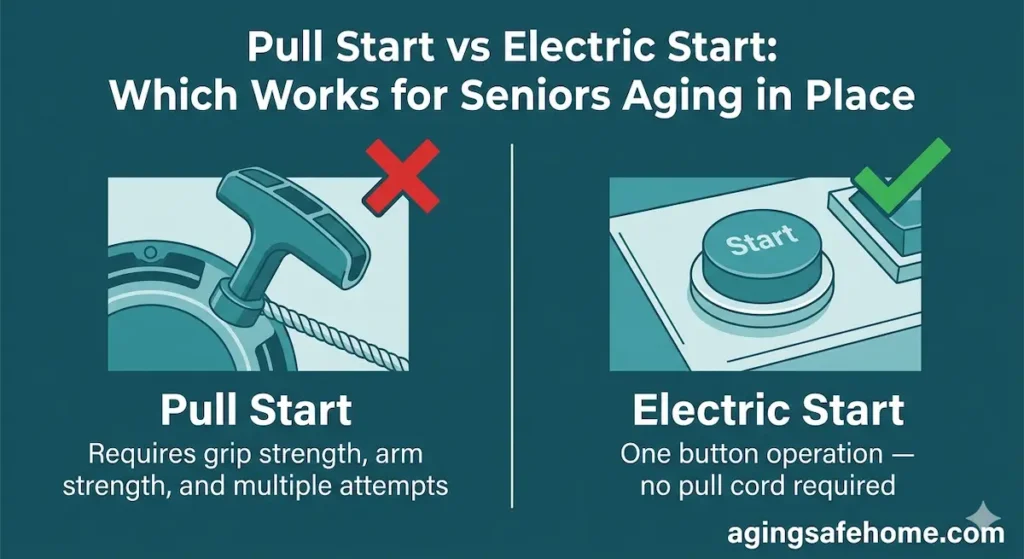
Pull start portable generators are what most people have — but for generators for seniors aging in place they present the most obvious physical challenge. They come in a range of sizes based on wattage — the higher the wattage the more you can run on it — and they’re generally the least expensive option.
The problem for seniors aging in place should be obvious from the name. Pull starting requires grip strength, arm strength, and sometimes multiple attempts. Moving the generator from storage to where it needs to be requires physical capability. In bad weather, on uneven ground, for an elderly person in their seventies or eighties — that combination of requirements is exactly where the system breaks down.
If you have a pull start generator and you’re planning to age in place, the honest question is whether you’ll still be able to use it in five years. Or ten.
Electric Start Portable Generators
The difference here is exactly what it sounds like — instead of a pull cord, you push a button to start it. That single change removes one of the biggest physical barriers for elderly adults and seniors aging in place.
They’re still portable, still need to be moved and hooked up, and still come in different wattage sizes depending on what you need to run. But for a senior who has the strength to move the unit and make the connections but can no longer manage a pull start, an electric start generator is a meaningful upgrade worth considering.
Cost is generally higher than a comparable pull start model but significantly lower than a whole home system. If you have a permanent spot, you can keep it, as long as it has a proper cover or doghouse built over it to protect it from the elements. The electric start option eliminates one of the most physically demanding parts of the process.
One thing that cannot be overstated: if you build a cover or enclosure over a generator, it must be able to fully open for operation. A generator running in an enclosed space produces carbon monoxide. Carbon monoxide is odorless, colorless, and will kill you. This is not a precaution. It is the difference between a solution and a tragedy.
The battery problem nobody mentions
Electric start generators rely on a small 12-volt battery to crank when you push that button — similar to a motorcycle battery. If that generator sits in a cold shed for six months without being touched, that battery will be dead when the ice storm hits. For an elderly person or senior who physically cannot pull start it as a backup, a dead button is the same as no generator at all.
The fix is simple, but it has to be done. Keep the battery connected to a trickle charger plugged into a wall outlet while the generator is in storage. Battery tender style chargers are inexpensive and designed exactly for this. Some newer models have a built-in charging port specifically for this purpose. Check your model and use it. A generator that won’t start when the power goes out isn’t a backup — it’s a very expensive disappointment.
Whole Home Standby Generators for Seniors
When it comes to generators for seniors aging in place, nothing takes the human out of the equation more completely than a whole home standby system. — that matters more than almost any other feature.
A whole home standby generator is permanently installed, connected to your home’s electrical system, and runs on propane, natural gas, or diesel. When the power goes out it detects the outage automatically — usually within seconds to a few minutes — and starts itself. It feeds the house, disconnects from the main grid automatically so it’s not back-feeding the lines, and when the utility power comes back on it detects that too and shuts itself down.
You don’t move it. You don’t start it. You don’t go outside in a January ice storm to hook anything up. The lights just come back on.
The elderly couple down the road from me has one. When the power goes out and the rest of us are figuring out generators and extension cords, their house is just running. Every time. I’m not going to pretend the rest of the holler isn’t a little jealous.
The major brands are Generac, Cummins, and Kohler. This is not a DIY installation. A whole home standby generator requires a licensed electrician. Full stop. The connection to your home’s electrical system, the transfer switch, the fuel line — none of that is a homeowner project. Get it done right. Before you hire anyone, read The Last Guy: A Contractor’s Guide to Hiring Right for Senior Home Renovations in Eastern Kentucky so you know exactly what to look for before anyone shows up at your door.
The propane tank conversation nobody has until it’s too late.
Natural gas lines don’t run through most Eastern Kentucky hollers, which means if you’re going with a propane-fueled whole home generator — and most people out here will be — you need to have a serious conversation about tank size before anyone orders anything.
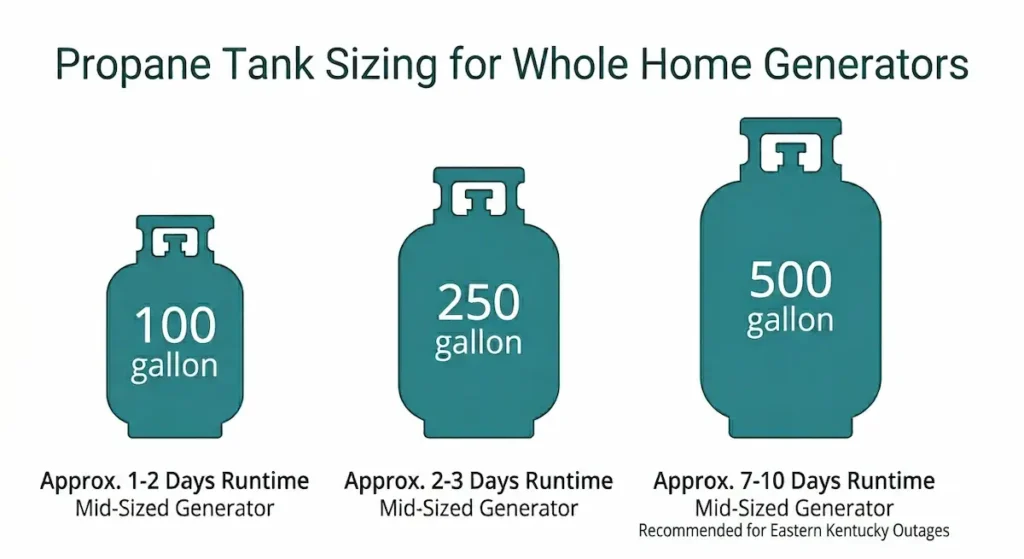
The little 100-gallon tank you’ve been using for your gas logs or cookstove won’t cut it for a whole home generator under real load. A 100-gallon tank might run a mid-sized generator for a day or two. For extended Eastern Kentucky outages that can stretch three, four, five days or longer, that’s not enough. Most propane suppliers and electricians won’t hook up a standby generator to a tank under 250 gallons, and a 500-gallon tank is the standard recommendation for reliable whole-home backup power.
Call your propane supplier before the electrician shows up. Get the tank situation sorted out first. And when you call, tell them explicitly that you are adding a standby generator — don’t assume they’ll ask. They may need to upgrade the regulators on your existing lines or verify that the tank valve can handle the high-volume fuel draw a generator engine requires under load. That conversation needs to happen before installation day, not after.
One more note for mobile homeowners specifically: the land and foundation questions that affect what modifications are possible on a manufactured home apply here too. If you’re on a rented lot or don’t own the land, a permanent whole home installation may not be the right path. The Aging in Place in a Mobile Home article covers the land ownership question in detail.
While you’re having the propane conversation, it’s worth thinking about your hot water heater too. An electric unit on 240 volts goes down with the power and requires a larger generator to run — one more draw on a system you’re already sizing carefully. A propane hot water heater runs on 110 volts for ignition and can be kept going on a small generator during an extended outage. If you’re already committing to a propane infrastructure for the generator, it’s a natural time to have that conversation. The Hot Water Heater for Seniors guide covers the full comparison.
You don’t have to power the whole house.
For seniors and elderly adults on fixed incomes, the cost of a whole home generator can feel out of reach — especially when you’re thinking about powering every outlet, every light, every appliance. Here’s what most people don’t realize: you don’t have to.
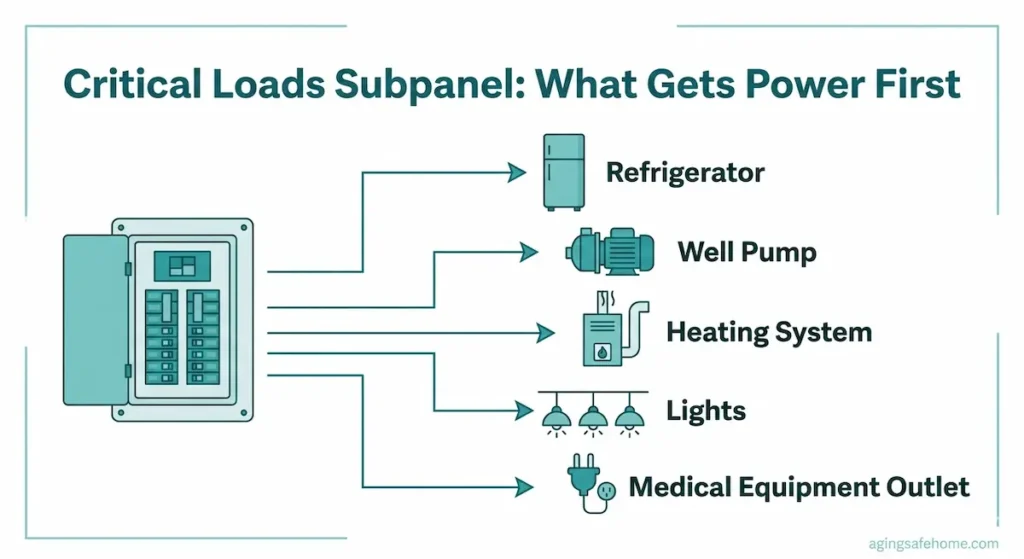
A licensed electrician can wire your generator to a critical loads subpanel — a smaller panel that controls just the circuits that matter most. The refrigerator. The well pump if you have one. The heating system. A few lights. The outlets where medical equipment plugs in. Sizing the generator to those critical circuits instead of the whole house can cut the cost of the unit significantly and still keep an elderly person or senior safe and functional through an extended outage. Talk to your electrician about critical loads before you decide a whole home system is out of reach financially. If the cost still feels overwhelming, there are grant and funding programs in Eastern Kentucky specifically designed for situations like this. And if you’re on well water, keeping that pump running during an outage is only half the equation — what’s coming out of it matters too. The Well Water and Aging in Place guide covers testing, filtration, and what your well water may be doing to your hardware and your health.
The whole home generator tests itself
This is one of the features that matters most for elderly adults and seniors aging in place and it doesn’t get mentioned enough. Whole home standby generators are programmed to automatically start up and run for ten to twelve minutes on a set schedule — typically once a week — just to exercise the engine, circulate the oil, and keep the battery charged. It does this whether you think about it or not.
For a senior living alone who isn’t going to remember to go start the generator every few weeks to make sure it’s still working, this is not a small thing. The machine checks itself. If a warning light comes on during one of those test cycles, you call for service before the storm hits rather than finding out it won’t start when you need it most.
Maintaining Whole Home Generators for Seniors
Whole home generators for seniors aging in place are low maintenance by design but they do need annual professional service to stay reliable. The automatic exercise cycle handles the basics, but plan on professional service roughly once a year or every 100-200 hours of run time. A technician will go through the full point check — oil and filter change, spark plugs, air filter, battery, transfer switch operation. Think of it like maintaining a vehicle engine.
Between professional visits, do your own visual checks. Look for fluid leaks. Check that the status light is green and the unit isn’t showing fault codes. Make sure the area around the unit is clear. That’s it. For a system that runs your whole house automatically every time the power goes out, the maintenance ask is reasonable.
FAQ: Generators for Seniors Aging in Place in Eastern Kentucky
What size generator do I need for a senior living alone?
For generators for seniors aging in place, the answer depends on what you need to run. A portable generator in the 3,500 to 5,000 watt range will handle a refrigerator, some lights, and a CPAP machine. If you want to run a well pump or heating system you need to go higher. For a whole home standby system a licensed electrician will size it to your specific critical loads — which is always the better conversation to have before you buy anything.
Can an elderly person safely operate a portable generator?
It depends entirely on the person and the generator. A pull start portable is increasingly difficult for elderly adults as strength and grip decline — that’s the whole point of this article. An electric start model removes the pull cord problem but still requires moving the unit and making connections. For seniors aging in place who live alone or whose physical capability has declined, a whole home standby generator is the option that removes physical operation from the equation entirely.
What is a critical loads subpanel?
A critical loads subpanel is a smaller electrical panel wired by a licensed electrician that controls only your most essential circuits — refrigerator, well pump, heating system, a few lights, medical equipment outlets. When paired with a whole home generator sized to those circuits instead of the whole house, it can cut the cost of the system significantly. For elderly adults and seniors on fixed incomes it’s the option that makes a whole home system financially realistic.
What size propane tank do I need for a whole home generator?
For generators for seniors running on propane — which most Eastern Kentucky homes will since natural gas lines don’t reach most hollers — a 500-gallon tank is the standard recommendation for extended outages. A 100-gallon tank will run a mid-sized generator for a day or two at most. Eastern Kentucky outages can stretch three, four, five days or longer. Size the tank for the worst case, not the average case. And call your propane supplier before the electrician shows up — they may need to upgrade your regulators or verify your tank valve can handle the high-volume fuel draw a generator requires under load.
How often does a whole home generator need to be serviced?
Plan on professional service once a year or every 100 hours of run time. A technician will go through the full point check — oil and filter, spark plugs, air filter, battery, transfer switch. Between visits you can do your own visual checks: look for leaks, make sure the status light is green, check for fault codes. The whole home unit also runs an automatic self-test cycle roughly once a week to exercise the engine and keep itself ready — so for seniors aging in place who won’t remember to test it manually, the machine is already handling that.
Are there grants available to help pay for a generator in Eastern Kentucky?
Grants for generators for seniors specifically are limited but the broader home modification and safety programs in Eastern Kentucky are worth exploring before you assume the cost is out of reach. USDA Rural Development, Area Agency on Aging programs, and Kentucky Medicaid waiver programs all exist to help elderly adults and seniors aging in place cover the cost of modifications that make staying home possible. See the Senior Home Repair Grants in Eastern Kentucky article for every program available in the region and what it actually takes to qualify.
The Bottom Line
Power outages in Eastern Kentucky aren’t a minor inconvenience the way they might be somewhere else. They can last hours. Sometimes days. In winter that means heat. It means medication that needs refrigeration. It means a CPAP machine that needs power. It means a phone that needs charging to call for help.
For an elderly person or senior aging in place and living alone, a multi-day outage without power isn’t just uncomfortable. It can be genuinely dangerous- and for generators for seniors to actually solve the problem, the right system has to match the person operating it
The generator sitting in the building solved that problem for years. The question worth asking now — before the next outage, not during it — is whether it still solves the problem for the person who has to operate it.
If the answer is no, or not for much longer, that’s the conversation to have. The options exist. They work. And for the right situation, a whole home standby generator isn’t just a convenience — it’s what makes aging in place possible when the lines go down. And if the Kentucky Power bill is the bigger day-to-day problem — not just when the power goes out but every single month — see the Kentucky Power Bill guide for what a contractor can do to bring that number down.
For more on the infrastructure and modification questions that come up when planning to age in place in Eastern Kentucky, including ramps, mobile home modifications, phased remodeling, and available funding, see the Eastern Kentucky Aging in Place Guide.