Keeping It Level
Aging in place in a mobile home is different from site-built homes — thinner drywall, smaller joists, non-standard fixtures — but none of it makes aging in place modifications impossible. The main things to know before you start: beef up framing and subfloor while you’re already in the walls, choose a low-entry shower base over a curbless shower, address the double wide seam as a trip hazard early, and find out whether you own the land before committing to any permanent exterior structure. The fundamentals are the same as any home. The margins for error are just a little thinner when aging in place in a mobile home.
- The construction is different. That's it.
- HUD code and permits — the rules are different than you think
- The land question changes everything
- The double wide seam and the transition strip problem
- The Subfloor Situation
- Why Curbless Showers Are Usually the Wrong Call for Aging in Place in a Mobile Home
- Walk-in Tubs and Floor Load
- The cost reality — and the help that exists
- Mobile home-specific fixtures
- The DIY mistakes that show up everywhere — and hit harder in a mobile home
- Heating, cooling, and what's under the floor
- Plumbing — it depends on the age
- The stigma is wrong
- FAQ: Aging in Place in a Mobile Home
- FAQs: Before You Start
- Staying in your home in Eastern Kentucky
Mobile homes get a bad reputation they don’t deserve. When it comes to aging in place modifications for seniors and elderly adults, the differences between a trailer and a stick-built home are real but they’re manageable. You just need to know what you’re working with before you start. That’s true whether you’re in an older single wide trailer, a double wide, or a newer manufactured home.
A note on who this post is for: some of you reading this are the senior or elderly adult who wants to stay in your home. Some of you are the adult child doing the research on behalf of a parent. Both of you belong here. The practical information is the same either way, but the questions you’re asking might be different — and that’s worth acknowledging.
This post covers what makes mobile home construction different, what that means for aging in place modifications, and what to think through before you start any project — whether you’re doing it yourself or hiring someone.
The construction is different. That’s it.
A mobile home isn’t an inferior home. It’s a different kind of home built to different specifications. Modern double wides in particular are closer to a stick-built home than most people realize. The differences that matter for aging in place modifications for elderly and senior residents come down to a few specific structural realities.
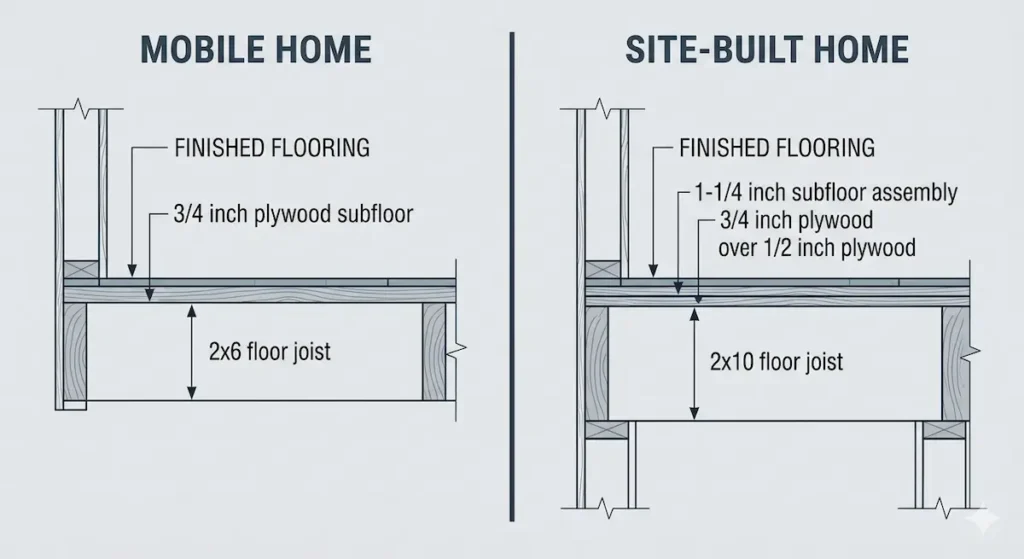
Floor joists run 2×6 instead of the 2×10 you’d find in a site-built home. Walls use 2×3 interior framing instead of 2×4. Drywall is 3/8 inch instead of 1/2 inch. None of these things make aging in place modifications impossible. They just mean you need to account for them before you start.
The most important thing to understand is that if you’re already opening up walls or floors to do the work, beef everything up while you’re in there. Replace the framing, upgrade the substrate, do it right once. The incremental cost of doing it properly while you’re already in there is a fraction of what it costs to go back in later.
HUD code and permits — the rules are different than you think
Manufactured homes built after June 1976 are regulated federally under HUD code, not local building codes. That’s the baseline. What it means in practice is that when you start making modifications, you’re operating in two different systems at once — the federal standards the home was built to, and whatever your local jurisdiction requires for the work you’re doing.
Here’s the plain version: the rules depend heavily on where your home is. A manufactured home in northern New Jersey is going to have stricter permit requirements, more inspections, and more oversight than one in a rural county in Kentucky. Before you pull a permit — or before you assume you don’t need one — call your local building department and tell them specifically that it’s a manufactured home. Don’t assume it works the same as a stick-built project. Getting that wrong can cause problems when you sell or when an insurer looks at the work.
The land question changes everything
This is the most important practical question to ask before any significant exterior modifications on a mobile home.
Do you own the land?
If you own the land, a permanent deck, a poured concrete ramp, a fixed structure — all of that makes sense. Build it properly, attach it to the structure, concrete the posts.
If you’re in a mobile home park or renting the land your home sits on, permanent structures are a problem. Whatever you build needs to be able to move with the home if it ever needs to relocate. That changes the conversation entirely.
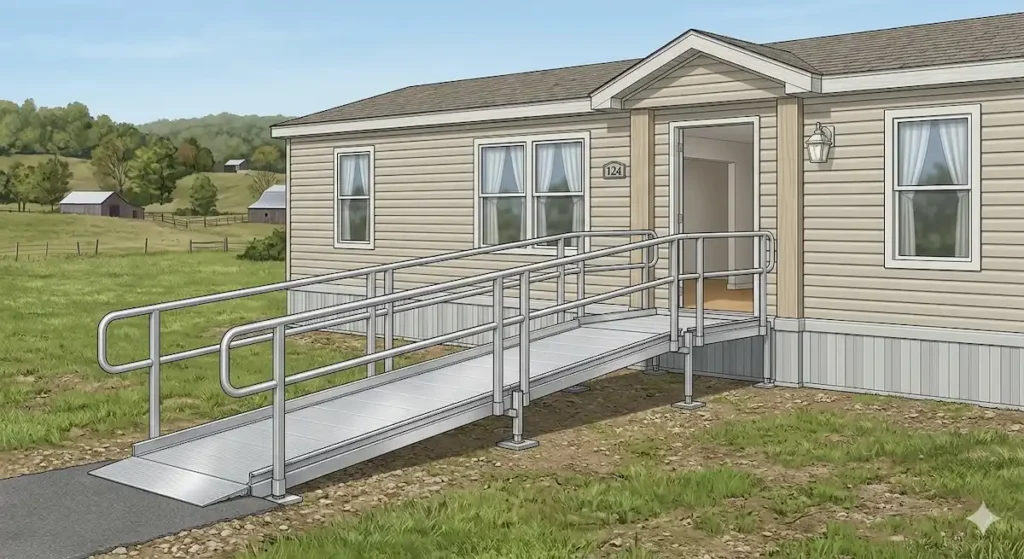
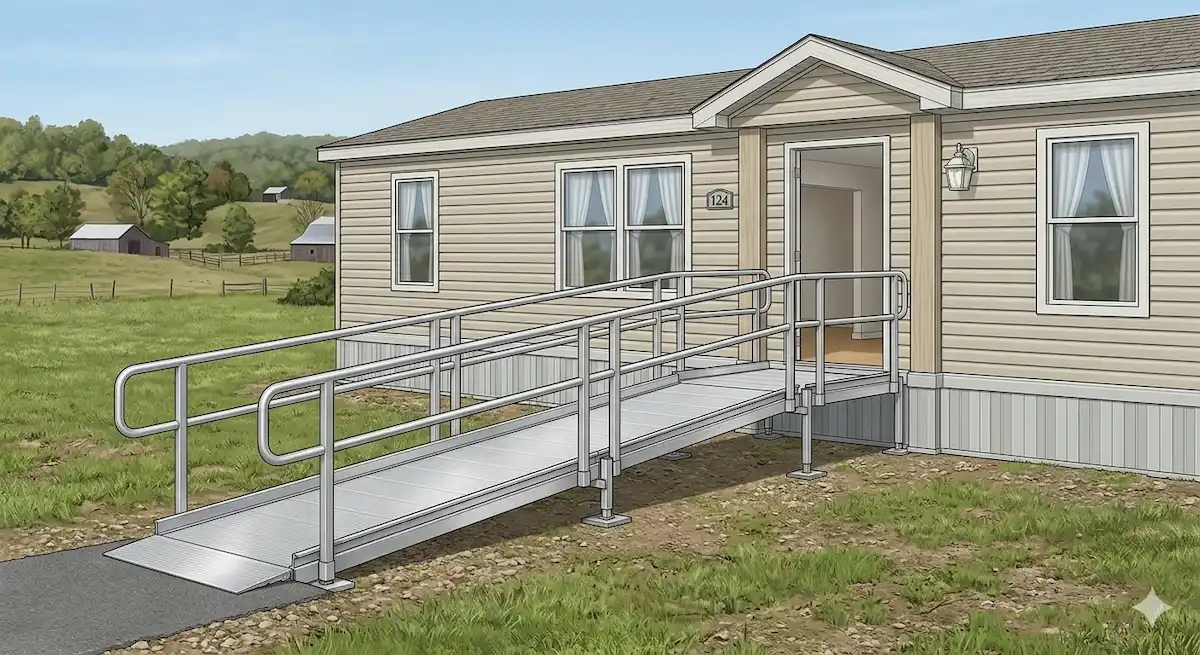
For ramp access — one of the most common aging in place modifications for elderly and senior adults — an aluminum modular ramp system is often the right answer in a land-rental situation. It installs without permanent footings, meets accessibility requirements, and moves with the home if necessary. The cost is higher than a built-in-place wood ramp, but the flexibility has real value when you don’t own the ground under your home. For a full breakdown of ramp requirements and how to build one correctly, see Wheelchair Ramp in Eastern Kentucky: Build It Right or Don’t Build It
If the lot configuration makes even a modular ramp system complicated, a vertical platform lift is worth considering — A Contractor’s Perspective: When the Ramp Guy Recommends Lifts gives the full comparison including costs and what to look for before you buy.
The double wide seam and the transition strip problem
This one gets overlooked constantly. A double wide arrives in two halves and gets joined on site. Where those two halves meet there’s typically a transition strip running across the floor. In a newer double wide with linoleum flooring that strip can be significant.
For a senior or elderly person with mobility issues, a walker, or an unsteady gait, that transition strip is a trip hazard sitting in the middle of the main living area. It needs to be addressed early in any aging in place planning conversation.
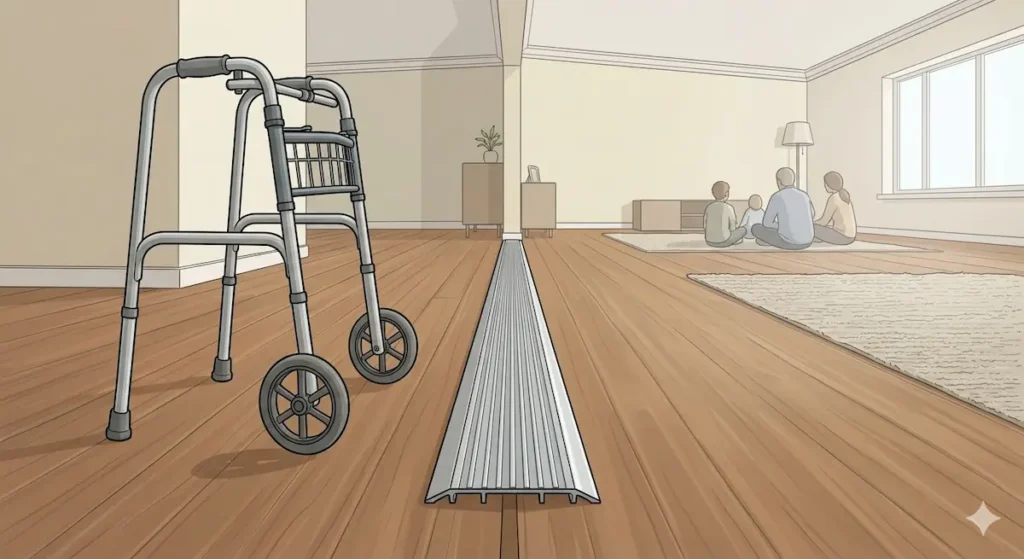
The cleanest solution is LVP or LVT floating floor installation over the entire surface, which covers the seam and eliminates the transition strip. The tradeoff is worth understanding before you commit. A floating floor in a mobile home that sits on rented land or in a mobile home park needs to be considered carefully. If you ever move the home the flooring has to come up and it’s not salvageable. Weigh that against the safety benefit and make the right call for your situation.
The full breakdown of LVT installation is in my LVT Flooring post.
The Subfloor Situation
A lot of mobile homes — especially older ones — came with MDF subflooring. If you find it, replace it. MDF and moisture do not coexist, and in a bathroom modification context that’s not a question of if it fails but when. Replace it with properly rated subfloor material while you’re in there. This is non-negotiable.
While you’re under the home, check the crawl space condition too. The vapor barrier, belly board insulation, and overall moisture level directly affect how long your subfloor lasts and the air quality inside. A damp, uninsulated crawl space accelerates subfloor failure and matters more as residents age. If it needs attention, address it as part of the project.
The subfloor and plumbing specifics — including what to do if you find polybutylene pipe while the walls are open — are covered in detail in the Mobile Home Bathroom Modifications post.
Why Curbless Showers Are Usually the Wrong Call for Aging in Place in a Mobile Home
The 2×6 floor joists are the reason. A curbless shower requires dropping the floor to create a sloped drain. In a stick-built home with 2×10 joists you have the depth to work with. In a mobile home you don’t — and what it actually takes to do it right structurally makes the cost prohibitive in most cases.
The better solution is a low-entry shower base. You get most of the accessibility benefit — easy step-in, no high threshold to navigate — without the structural complexity. For most senior and elderly mobile home residents, this is the right answer.
The full contractor breakdown of why curbless showers rarely work in a mobile home, and what a proper low-entry installation actually involves, is in the Mobile Home Bathroom Modifications post.
Walk-in Tubs and Floor Load
If a senior or elderly family member is asking about a walk-in tub in a mobile home, the first conversation is about floor load capacity. A filled walk-in tub is extremely heavy, and the 2×6 floor joists in a standard mobile home are not designed to handle that load without reinforcement. It can be done — but the structural assessment has to happen before anyone orders anything, and that assessment determines whether the project is straightforward or more complex. More on what that assessment involves is in the Mobile Home Bathroom Modifications post.
The cost reality — and the help that exists
Doing these modifications right costs money, and a lot of mobile home owners — particularly elderly adults on fixed incomes — are working with limited budgets. That tension is real and it’s worth naming directly.
The good news is that grant and loan programs exist specifically for this situation. USDA Rural Development offers programs that help low-income rural homeowners repair and modify their homes, and manufactured homes can qualify. State-level programs vary, but many have funding specifically for aging in place modifications for seniors and elderly residents. Some area agencies on aging administer local assistance programs that most people don’t know about until someone tells them.
In Eastern Kentucky specifically, there are resources available that go underutilized because people either don’t know about them or assume they won’t qualify. The funding is out there. It’s worth looking into before you decide a project isn’t possible.
For a guide on these programs see my Senior Home Repair Grants in Eastern Kentucky article. And if grant funding isn’t available or you need to move faster than an application timeline allows, working through modifications in phases is how most families make this manageable without waiting on outside help.
Mobile home-specific fixtures
This catches DIYers constantly. Mobile home fixtures are not standard residential dimensions in many cases. A common example is the vanity and sink. If you’re replacing just the sink bowl in a mobile home vanity, the opening is smaller than a standard residential sink. You need either a mobile home-specific replacement sink or you need to modify the vanity opening.
The cleaner solution in most aging in place situations for senior and elderly homeowners is to replace the entire vanity. Aging in place vanities with proper knee clearance for wheelchair access, open base designs, and comfort-height dimensions are worth installing correctly rather than retrofitting into an undersized mobile home original.
The same principle applies to toilets, shower bases, and other fixtures. Check mobile home compatibility before you order anything.
The full breakdown of aging in place vanity options and installation is in my Vanity post.
The DIY mistakes that show up everywhere — and hit harder in a mobile home
Some mistakes happen whether you’re in a trailer in Leslie County or a condo in Myrtle Beach. In a mobile home, the thinner construction leaves less margin for error, so the fundamentals matter more, not less.
Grab bars into drywall will fail. At 3/8 inch, mobile home drywall is even less forgiving than standard construction. Blocking in the walls or hitting studs is non-negotiable for any grab bar installation — one of the most critical aging in place safety upgrades for elderly adults.
Tile over plywood without a proper membrane will fail. This isn’t a mobile home problem — it’s a substrate problem that shows up everywhere. Don’t skip the membrane.
Flooring run too tight to the wall without an expansion gap will buckle. Leave the gap.
The mobile home-specific version of these mistakes is underestimating how thin everything is. 2×3 studs and 3/8 inch drywall mean there’s less room to recover from a shortcut. Do it right the first time.
Heating, cooling, and what’s under the floor
This doesn’t come up in most aging in place conversations, but it should. In a mobile home, the ductwork typically runs under the floor rather than through the attic or walls the way it can in a site-built home. That’s worth knowing for multiple reasons.
When you’re doing any floor-level modification — subfloor replacement, joist reinforcement, walk-in tub installation — you need to know where the ductwork is before you start cutting. It’s not where you’d expect it to be if you’re used to stick-built construction.
Mobile homes are also notoriously inefficient to heat and cool — the underpinning, the belly board insulation, and the ductwork running under the floor all contribute to a Kentucky Power bill that can be brutal on a fixed income. The Kentucky Power Bill guide covers what a contractor can do to bring that number down, most of which applies directly to manufactured housing.
Plumbing — it depends on the age
Newer mobile homes typically come with PEX plumbing, which is actually an advantage in some ways. PEX is flexible, freeze-resistant, and easier to work with than rigid pipe.
Older mobile homes are a different story. Cast iron supply lines, galvanized pipe, polybutylene in some cases — polybutylene was widely used and has since been pulled from the market due to failure rates — what you find depends entirely on when the home was built and what work has been done since. Opening up walls in an older mobile home sometimes means dealing with plumbing that was industry standard forty years ago and has since been superseded for good reason.
This isn’t a mobile home-specific problem. It’s an old home problem. The industry evolved. The materials in older homes didn’t evolve with it. You work with what you find, and you upgrade what needs upgrading while you’re in there.
The water heater is part of that same conversation — an older electric unit in a mobile home is working harder than it should and costing more on the power bill every month than most people realize. The Hot Water Heater for Seniors guide covers the full picture on what it’s costing, when to replace it, and why propane might be the right call for Eastern Kentucky mobile home residents on a fixed income. And if you’re on well water — which many Eastern Kentucky mobile home residents are — what’s coming out of that well affects every pipe, fixture, and appliance in the home. The Well Water and Aging in Place guide covers testing, filtration, and what untreated well water quietly does to your hardware over time.
The stigma is wrong
Mobile homes get dismissed in a way that isn’t fair and isn’t accurate. A modern double wide is a legitimate, comfortable home. Many newer manufactured homes are equivalent to cookie-cutter stick-built construction in terms of quality and livability. The differences are real but they’re manageable with the right knowledge and the right approach.
Almost anything is possible when it comes to aging in place in a mobile home — including making it work for elderly and senior residents, just like in a site-built home. The questions to ask are the same ones you’d ask anywhere: what am I working with, what does it need, and what’s the right way to do it. Finding someone who can answer those questions honestly is the harder part. Before you hire anyone for aging in place work in Eastern Kentucky, read this first.
FAQ: Aging in Place in a Mobile Home
Can you age in place in a mobile home? Yes — and most of what makes a home safe and accessible for an elderly or senior adult is completely achievable in a manufactured home without extraordinary effort or expense. Grab bars, comfort height toilets, low-entry showers, better flooring, accessible fixtures — none of that requires structural heroics in a mobile home. The constraints are real but they’re specific, and knowing what they are before you start is most of the battle.
What are the biggest challenges of aging in place in a mobile home? The three that come up most consistently are the subfloor condition, the floor joist depth, and the non-standard fixture dimensions. MDF subflooring fails under moisture and has to be replaced when found. The 2×6 floor joists limit what’s possible with shower modifications and heavy fixtures like walk-in tubs. And mobile home fixtures aren’t standard residential dimensions, which catches a lot of people off guard when they start ordering materials. None of these are dealbreakers — they’re just the things to know going in.
Can a double wide be modified for wheelchair access? Yes. Doorway widening, ramp installation, accessible bathroom modifications, flooring changes to eliminate the transition strip at the center seam — all of it is achievable in a double wide. The land question matters for exterior modifications like ramps — whether you own the land or rent it determines what kind of ramp system makes sense. The interior modifications follow the same principles as any home with the structural considerations specific to manufactured housing factored in.
FAQs: Before You Start
What should I do first when planning aging in place modifications in a mobile home? Start with an honest assessment of what you’re working with. Get under the home and look at the floor joists and subfloor condition. Find out what plumbing you have. Know whether you own the land or rent it. Understand the HUD code implications for your specific modifications. The condition of what’s already there drives everything else about scope and cost — a home in good structural condition is a completely different project from one with water damage, MDF subfloor, and aging plumbing. Know what you have before you commit to anything.
Is it worth modifying a mobile home for aging in place or should I just move? For most people in most situations, modifying is worth it — especially in Eastern Kentucky where the connection to home and land runs deeper than a simple cost calculation can capture. The modifications that matter most aren’t prohibitively expensive in a home that’s in reasonable condition. A comfort height toilet, grab bars with correct blocking, a low-entry shower, and safer flooring can transform how a senior or elderly adult moves through their home every day. The cases where moving makes more sense are when the home itself is in significant disrepair and the remediation cost before modifications even begin makes the project financially unworkable.
Staying in your home in Eastern Kentucky
The desire to stay in your home as you age is universal. Nursing homes are expensive, institutional, and for most seniors simply not what they want. That’s true everywhere.
In Eastern Kentucky it carries something extra. The roots here run deep in a way that’s hard to explain to someone who didn’t grow up here or hasn’t spent time here. People don’t just own their land. They built it. They cleared it, leveled it, poured their lives into making it what it is. My papaw did that. My godfather literally hand-dug his basement — took him years — and it’s still standing strong decades later. He’s gone now, but that basement will be standing long after all of us.
When someone out here says they want to stay in their home, they’re not just talking about a building. They’re talking about everything that land means to their family and everything they put into it.
That’s worth building a ramp for. That’s worth replacing the subfloor and beefing up the joists and figuring out the grab bar blocking in a 2×3 wall.
That’s what this work is actually about.
That’s also why power outages can’t be an afterthought. For a senior living alone in a holler, a multi-day ice storm without heat or refrigeration isn’t an inconvenience — it’s a safety crisis. The generator guide covers every option from portable to whole home standby, including what actually works for elderly adults who can’t be outside yanking a pull cord in January.
For a full overview of what makes aging in place different in this region, including terrain, housing stock, and available funding, visit our Eastern Kentucky aging in place guide.