Keeping It Level
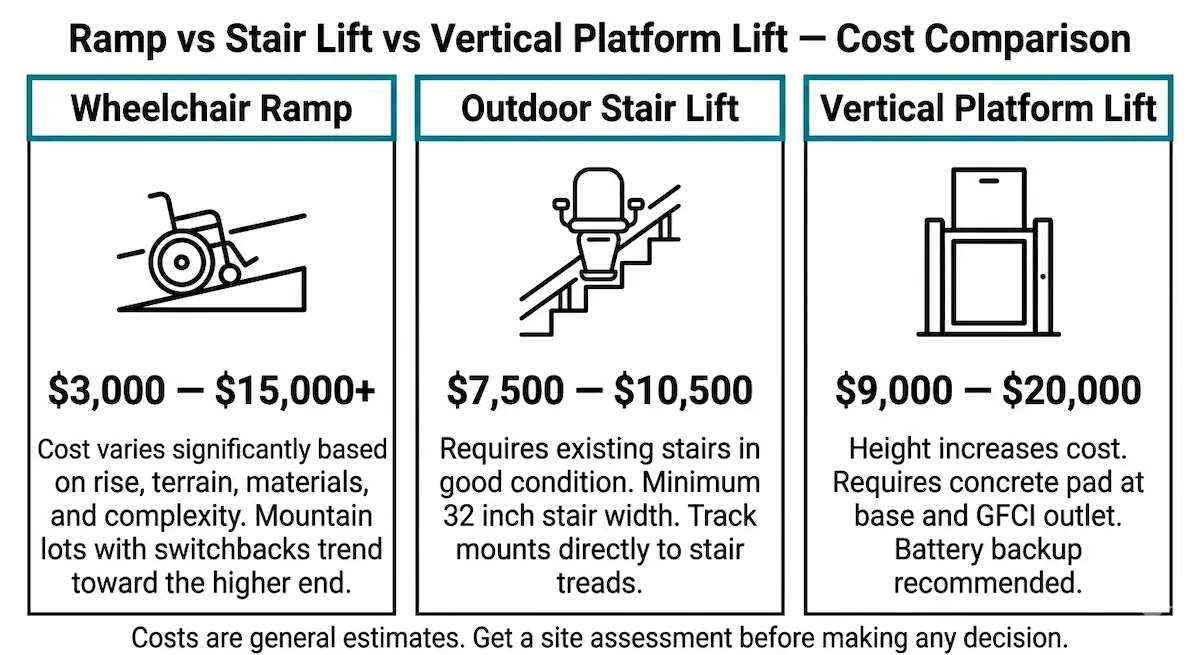
I’m a ramp guy. But the terrain around here doesn’t always give you the easy answer — and sometimes a lift is the right call. Before you decide, know this: a vertical platform lift runs $9,000 to $20,000, an outdoor stair lift runs $7,500 to $10,500, and a complicated switchback ramp on a mountain lot can put you in the same price neighborhood with a much bigger footprint. The right answer is whichever one gets the person in and out of their home safely. This post covers how to figure out which one that is, what to look for before you buy a lift, who to call in Eastern Kentucky, and where to find help paying for it. Whatever you choose — don’t cheap out on it.
I’m a ramp guy.
I’ve built hundreds of them. I can calculate a 1:12 slope in my sleep. I know the second I look at one whether it’s right or wrong. Ramps are what I do, and if you’ve read the ramp post you already know how I feel about doing them right.
So when I tell you there are situations where a lift makes more sense than a ramp, I need you to understand that’s not coming from someone who doesn’t know ramps. It’s coming from someone who does.
Out here in Eastern Kentucky — the hollers, the hillsides, the lots with no room to run a straight shot — the terrain doesn’t always give you the easy answer. Sometimes a ramp is simply not the right solution for the space. And when that happens, a vertical platform lift or an outdoor stair lift deserves a serious look.
I know what you’re thinking. That’s something out of the Jetsons. I get it. I do. Between walking a ramp and getting on a lift, I’m choosing the ramp every single time — because that ramp isn’t going to stop halfway up, isn’t going to freeze up, isn’t going to malfunction and leave me suspended in mid-air. On a ramp I’m still in control. We’re not birds. We’ve got no business being suspended up in the air.
But that’s just me being a control freak. The reality is there are situations where a lift is the right answer. And if that’s where you are, here’s what you need to know before you spend a dime. If you’re new to the specific challenges of aging in place out here, our Eastern Kentucky aging in place guide covers the full regional picture before you get into the specifics. And if you’re still mapping out everything between the car and the front door, the last fifty feet covers the full outdoor picture before you get into the specifics of any one solution.
When a ramp stops making sense
A properly built wheelchair ramp needs one inch of rise for every twelve inches of run. That’s the 1:12 ADA standard and it doesn’t move. If your door threshold sits 30 inches above the ground, you need 30 feet of ramp minimum — and that’s before you account for landings at the top, bottom, and every turn.
On flat ground that’s manageable. On a mountain lot in Eastern Kentucky with a hillside dropping away from the front door and a holler lot with no room to swing a switchback, 30 feet of ramp can become a genuine engineering problem. The full breakdown of how to plan and build a ramp correctly on mountain terrain is in the ramp post. But when you’ve done the math and the ramp route either doesn’t fit the lot or the cost of doing it right starts climbing past what a lift would run, that’s when the conversation changes. If you’re on rented land in a mobile home park this conversation has an extra layer — see Aging in Place in a Mobile Home for the full breakdown of what permanent versus temporary structures mean for your situation.
The cost reality
This is where people get surprised.
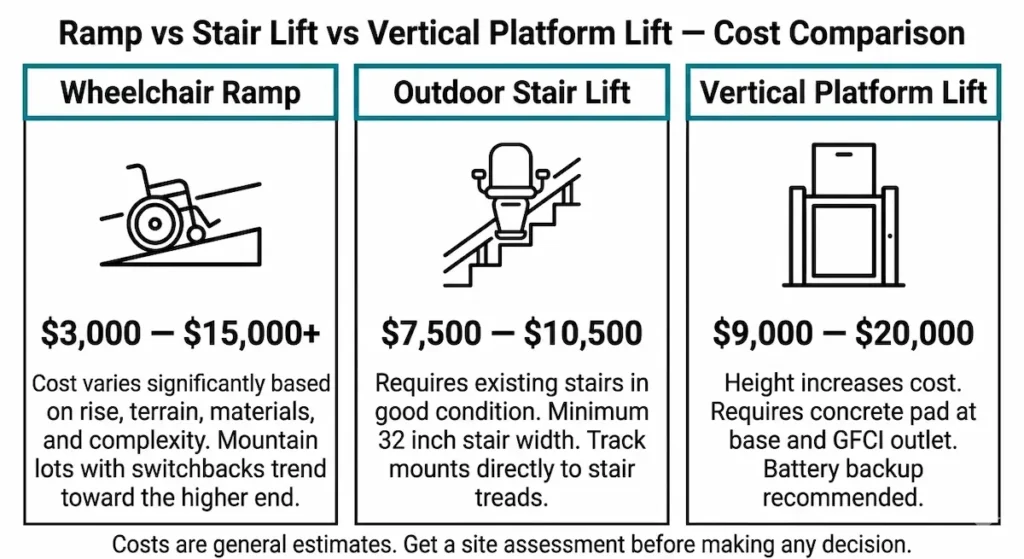
A straight outdoor stair lift runs roughly $7,500 to $10,500 installed. A vertical platform lift runs $9,000 to $20,000 depending on height, platform size, and features. Those are real numbers and they’re not cheap.
But a substantial wood ramp — the kind with multiple switchback landings, 6×6 posts, properly sized footings, composite decking, and handrails on both sides — can run well into that same range when you add up materials and labor. And it takes up a lot of real estate on a lot that may not have it to give.
The lift doesn’t always cost more. On a complicated mountain lot, the math is sometimes closer than people think. Know your numbers before you decide.
Vertical platform lifts — what they are and how they work
A vertical platform lift is exactly what it sounds like. A platform that goes straight up and straight down. You roll on — in a wheelchair, on a scooter, with a walker — press the button, and it takes you to the next level. No stairs, no ramp, straight vertical travel.
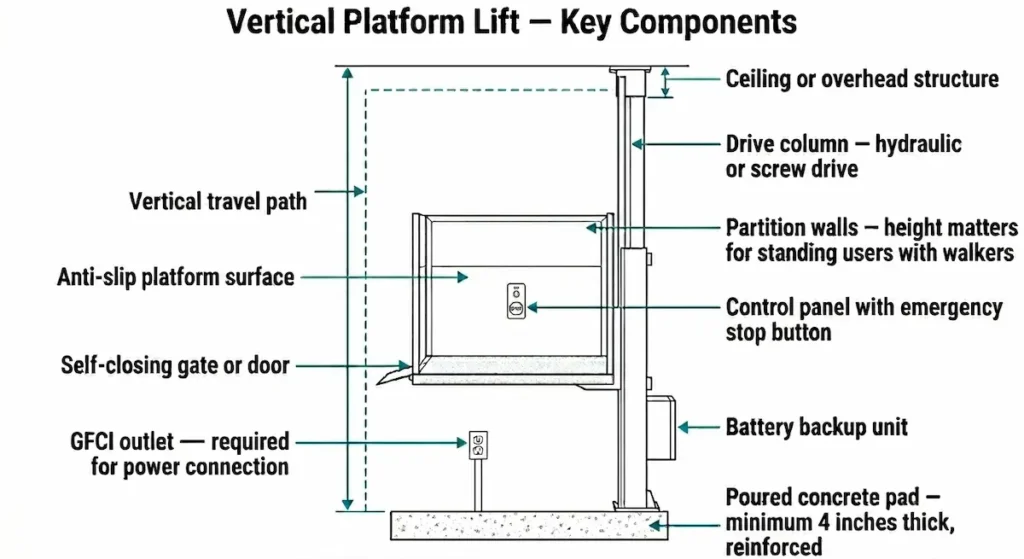
They run on one of two drive systems. A hydraulic pump — same basic principle as the lift holding your car up in a shop — uses fluid pressure to raise and lower the platform. A mechanical screw drive uses a threaded column that rotates to move the platform up and down, also called a worm drive.
My preference, for whatever it’s worth coming from someone whose primary expertise is ramps, is hydraulic. Hydraulics lift cars. If they can handle that they can handle getting me up a few feet. That said I’d double check the manual override on any lift before I bought it regardless of drive system — more on that in a minute.
Before any of that mechanical conversation matters there’s something more fundamental. A vertical platform lift cannot sit on bare dirt, gravel, or a rotting porch deck. This is a heavy piece of machinery concentrating thousands of pounds of pressure — its own weight plus the user and whatever they’re riding — onto a small footprint. It needs a flat, level, poured concrete pad at the base. Minimum four inches thick, properly reinforced. If the last guy set your lift on unreinforced ground or a soft wood surface, it will shift, tilt, and bind the drive system within months. The machinery above it is only as good as what it’s sitting on — same principle as every footing conversation in the ramp post. Get the pad right first.
Most vertical platform lifts plug into a standard GFCI outlet wired near the lift. That means you may need an electrician before installation. Budget for it.
Height drives cost. The taller the lift needs to travel, the more it’s going to run. Short rise lifts under five feet are the most affordable. If you’re going higher the price goes up accordingly.
What to look for before you buy
This is the most important section in this post. Know what you’re getting before you spend the money.
Weight capacity — and do the math correctly.
Every lift has a weight rating. That rating needs to account for your weight plus the weight of whatever you’re riding on. A standard wheelchair and a power scooter are not the same weight. A power scooter or power chair can be significantly heavier than a manual wheelchair. Know what you’re rolling onto that platform and make sure the lift is rated for the combined load. This is the same principle as grab bars and shower benches — the weight rating isn’t a suggestion.
Platform dimensions
Will whatever you’re riding actually fit on the platform? Measure your chair or scooter before you buy. A lift that’s rated for the weight but too small for the footprint doesn’t solve the problem.
Partition height.
The walls around the platform — the partitions — matter depending on how you’re using it. If you’re in a wheelchair, you’re seated and lower partitions may be fine. If you’re standing with a walker, you need higher partitions for safety. Know how the person using it will be positioned and confirm the partition height works for them.
Emergency stop and independent operation.
Does the lift have an emergency stop button? Can the user operate it independently or does someone else have to be present? For an elderly adult or senior aging in place, a lift that requires another person to operate defeats a significant part of the purpose. Confirm both before you buy.
Battery backup and manual override.
Back here in the hollers we lose power. It happens regularly and sometimes it’s not for a few hours — it’s for a few days. The February 2025 floods kept a lot of people in Eastern Kentucky without power for an extended stretch. Most lifts come with a battery backup and manual override for exactly this reason — but always always confirm it’s there before you purchase and find out how long those batteries last under real use conditions. A battery backup that lasts four hours doesn’t help much if the power is out for three days.
One more thing on batteries that nobody puts in the brochure. A deep-cycle battery sitting outside through Eastern Kentucky winters will lose charge capacity over time if it isn’t maintained. If nobody has tested that backup battery in three years the family is going to find out it’s dead during the worst possible moment — a February ice storm with the power out and an elderly parent stuck at the bottom of the lift. Test the backup battery before winter every single year. Put it on the calendar the same way you’d put oil change reminders. It’s a five-minute check that could matter a great deal.
Maintenance.
Most manufacturers recommend servicing twice a year — spring and fall are the natural intervals. That means inspecting the rails or drive column, motor, gearbox, battery, and controls. This is not optional maintenance and it’s not something to defer the way you might put off painting the porch. A lift that hasn’t been serviced is a lift you can’t fully trust, and a lift you can’t fully trust is just an expensive way to get stranded.
Before you buy, find out who services the unit in your area and what that service contract looks like. In Eastern Kentucky that currently means calling Transitions Lift and Elevator, Vertical Solutions, or AmeriGlide Lexington — the same providers listed at the bottom of this post. If a provider sells you a lift but can’t tell you who services it locally, that’s a problem worth taking seriously before you sign anything.
Weather.
If the lift is going outside — and for a home entry situation it usually is — you need an outdoor rated unit. Outdoor lifts are built specifically to handle the elements. If you have a garage or can build a covering over the lift, do it. An awning or simple roof over the unit keeps snow and ice off the platform and extends the life of the equipment. Things freeze out here. A platform covered in ice isn’t a solution — it’s a new problem.
Obstruction sensors.
Most modern lifts operate like a car liftgate — if something is underneath the platform it stops automatically. Confirm this feature is present. It’s a basic safety requirement.
Simple over complicated.
I’m a contractor. I love a well-made handrail, custom lighting, making things look exactly right. But when something is literally suspending me in the air, I want the simplest version that does the job. Every bell and whistle is a potential failure point. Electric doors, extra features, fancy controls — all of that is more that can go wrong. Get from point A to point B safely. That’s the job.
Don’t cheap out.
This is not the place to find a deal on an unfamiliar brand from an unknown seller. A lift is a safety device. It is suspending a person — possibly an elderly adult with limited strength and balance — off the ground. Buy a quality unit from a reputable manufacturer with a service network. If it breaks down in six months and nobody can get parts for it, you haven’t solved anything. Don’t order one off Temu and wonder why it quits on you. And before any contractor shows up to do the installation, know what to look for before you hire anyone.
Outdoor stair lifts — a different solution for a different situation
A vertical platform lift goes straight up. An outdoor stair lift follows the stairs.
If you have an existing set of exterior steps in good condition — key words being good condition, not steps that look like they survived the Civil War — an outdoor stair lift is a track mounted directly to the stair treads that carries the user up and down in a seat. No wall attachment required. The track mounts to the stairs themselves.
Your stairs need to be at least 32 inches wide to accommodate one. I prefer wider stairs anyway — it’s just good practice — but 32 inches is the minimum.
If you’ve seen the movie Up — the scene where the old man rides the stairlift and it moves slower than a Tuesday afternoon — that’s the mental image most people have. And look, they’re not Formula One. But they’re not that slow either, and at the end of the day a stair lift that gets someone up and down their steps safely is doing its job regardless of how impatient the rest of us are watching it.
Outdoor stair lifts are built specifically to handle weather — rain, cold, and everything Eastern Kentucky throws at them. They typically swivel at the top or bottom for the user to get on and off and fold up when not in use so the stairs remain usable by everyone else.
Make sure you are buying an outdoor rated unit. Indoor and outdoor stair lifts are different products. An indoor unit outside won’t last and more importantly won’t be safe.
Who to call in Eastern Kentucky
I’m a ramp guy. Lift installation is a specialized trade and it’s not mine. When someone calls me about a lift I want to be able to point them somewhere legitimate. Here are the providers I’m aware of that serve Eastern Kentucky:
Transitions Lift and Elevator — covers Eastern Kentucky along with Greater Cincinnati, Louisville, Nashville, and surrounding regions. They sell and service vertical platform lifts and stair lifts for both residential and commercial settings. transitionsmobility.com
Vertical Solutions Inc. — headquartered in Johnson City, Tennessee and serves a five state region including Kentucky and Virginia. Sells, maintains, and services vertical platform lifts, stair lifts, and residential elevators. verticalsolutionsinc.com
AmeriGlide Lexington — one of the larger mobility equipment providers in Kentucky, located in Lexington. Carries vertical platform lifts and stair lifts with financing options available. ameriglide-lexington-ky.com
Call and get a consultation before you buy anything. A legitimate provider will assess your specific situation — your rise, your lot, your steps, your door configuration — and tell you what actually makes sense. If they’re trying to sell you something before they’ve looked at your space, find someone else.
One more reason to use a reputable local dealer rather than buying a unit online and figuring out the installation yourself — vertical platform lifts fall under residential elevator codes in many jurisdictions, not standard ramp permit categories. That means specific inspections and municipal sign-offs that a basic wood ramp doesn’t require. A legitimate dealer handles local permitting and code compliance as part of the installation process. If you’re buying cheap online and bootlegging the installation, you’re not just risking a mechanical failure — you’re likely out of code compliance and possibly uninsured if something goes wrong.
This list covers what I’m aware of that serves Eastern Kentucky. If you’ve worked with a reputable provider not listed here and want to share the experience, send us an email at info@agingsafehome.com. If it checks out, we’ll add it. The goal is to make sure people around here have somewhere legitimate to turn.
Funding and grants
The cost of a lift is real and for elderly adults and seniors on fixed incomes in Eastern Kentucky it can feel out of reach. There are programs that exist specifically for this situation.
HUD Older Adult Home Modification Program — aimed at helping low-income senior homeowners make necessary modifications to their homes including stair lifts and accessibility equipment. Start at hud.gov.
Medicaid Home and Community Based Services Waivers — Kentucky Medicaid HCBS waivers can fund home accessibility modifications for qualifying individuals. Contact your state Medicaid office or call 211 to find out what’s available in your county.
VA Benefits — Veterans who sustained injury in service may have VA health care cover a lift. For elderly veterans whose mobility challenges are unrelated to military service, the VA Aid and Attendance benefit is worth looking into. The Veterans Directed Home and Community Based Services program also covers products that improve independent living.
Your local Area Agency on Aging — the same offices that handle ramp grant programs handle lift assistance too. In Eastern Kentucky that’s KRADD in Hazard (606-436-3158), Big Sandy in Prestonsburg (606-886-2375), or FIVCO in Grayson (606-929-1366) depending on your county. Call and ask specifically about home modification assistance and mobility equipment programs.
Apply before you purchase. Most programs require approval before work begins or equipment is bought.
For a full breakdown see my Senior Home Repair Grants in Eastern Kentucky guide.
FAQs
📐 The Decision
When does a lift make more sense than a ramp? When the lot won’t fit a proper 1:12 ramp, when the switchback math puts you in the same price range as a lift anyway, or when existing steps are already solid and a stair lift is the simpler solution. The ramp is still the first answer. But terrain doesn’t always cooperate.
When does the cost actually favor a lift? A vertical platform lift runs $9,000 to $20,000. An outdoor stair lift runs $7,500 to $10,500. A complicated switchback ramp on a mountain lot with proper footings, landings, and handrails can land in the same range. Know your numbers before you decide.
⚙️ Before You Buy
What does a vertical platform lift sit on? A flat, level, poured concrete pad — minimum four inches thick, properly reinforced. Not dirt, not gravel, not a wood deck.
Will it work when the power goes out? Most come with battery backup and manual override — but confirm it before you purchase and test that battery every year before winter. Back here power outages are a reality not a possibility.
Does it need a permit? In most jurisdictions yes — vertical platform lifts fall under residential elevator codes. A reputable dealer handles permitting as part of installation. Another reason not to buy cheap online and figure it out yourself.
💰 Funding
Does Medicare cover lifts? Standard Medicare does not. Medicare Advantage sometimes does. Medicaid HCBS waivers can cover lifts for qualifying individuals. VA benefits cover eligible veterans. Your local Area Agency on Aging — KRADD, Big Sandy, or FIVCO depending on your county — is the best first call.
The Bottom Line
A ramp is still my first answer. It’s passive, it’s simple, it requires no power, and when it’s built right it’ll outlast everything around it. There’s no battery to fail, no motor to service, no platform to freeze over. You walk on, you walk off.
But sometimes the mountain wins.
The lot won’t fit the ramp. The math says the lift makes more sense. The steps are already there and solid and a stair lift is the most practical solution anyone could ask for. The right answer is the one that gets the person in and out of their home safely — and sometimes that answer looks a little like something out of the Jetsons.
But what else is new. The people around here have always had a get it done attitude. If the first solution doesn’t fit the lot, find another one. If there’s a problem there will be a solution. That’s just how it works back here. Always has been.