Keeping It Level
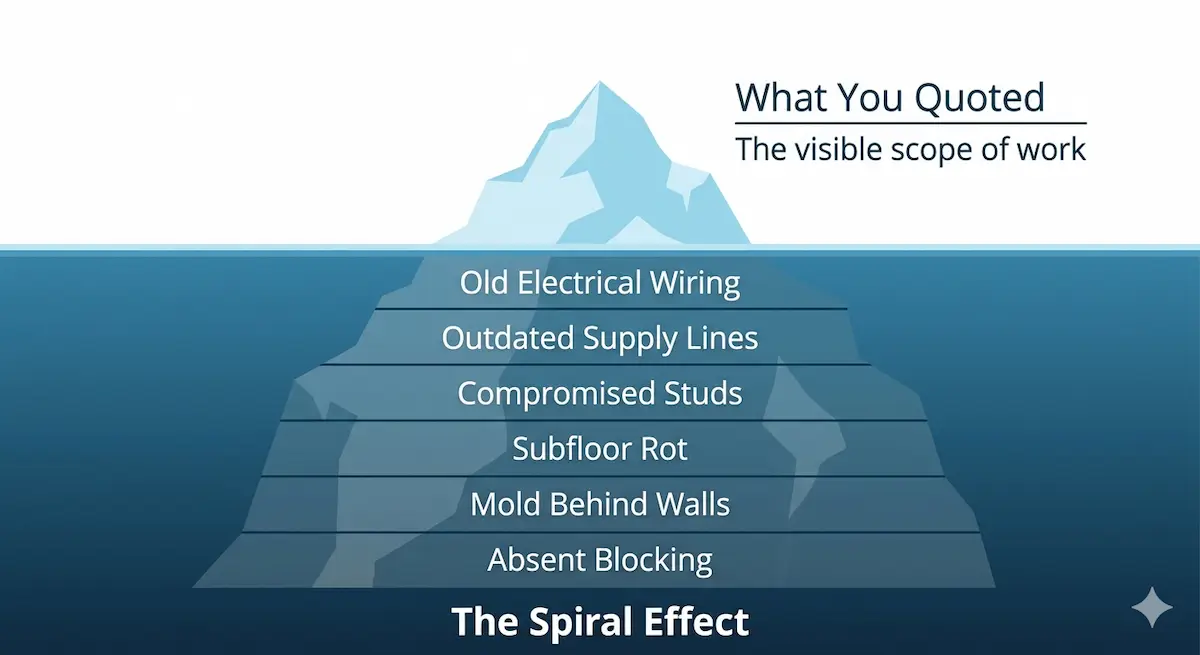
Hidden structural costs aren’t a contractor trying to get more money out of you — they’re what happens when a wall gets opened and reality doesn’t match what anyone expected. A good contractor tells you upfront what they might find and stops the job the moment they find it to explain what it means. The spiral effect is real — one wall can lead to electrical, electrical can lead to the panel, the panel leads to the whole service. Budget 20 percent contingency for hidden costs of aging in place bathroom renovations and understand that number exists for a reason.
Every aging in place bathroom renovation starts with what you can see. The grab bar locations, the shower configuration, the vanity height, the flooring. That’s what gets quoted and that’s what gets planned. What doesn’t get quoted is what’s behind the wall — because until that wall is open nobody knows what’s back there.
Hidden costs of aging in place bathroom renovations are not a contractor trying to squeeze more money out of a job. They’re the reality of working in existing homes where decades of decisions, deferred maintenance, and previous work — some of it done well, some of it not — are sitting behind finished surfaces waiting to be discovered. Every experienced contractor has opened a wall expecting one thing and found something entirely different.
The difference between a good contractor and a bad one isn’t whether hidden structural costs come up. They come up on jobs everywhere. The difference is whether the homeowner hears about it before the work starts as a possibility, and immediately when it’s discovered as a reality.
For the complete picture of what a senior bathroom renovation involves structurally, my Senior Bathroom Safety Guide covers every element in the order a contractor would actually build it.
What “Hidden” Actually Means
The hidden costs of aging in place bathroom renovations are specifically the things a contractor cannot see before the work begins. Not things they missed. Not things they should have caught. Things that are physically behind finished surfaces — inside walls, under floors, above ceilings — that are only visible once demolition starts.
A good contractor can make educated guesses. If there’s visible water staining on a wall I can tell you there’s probably damage behind it. When the floor feels soft near the toilet, I can tell you the subfloor is likely compromised. If the house was built in 1965 and has never had an electrical update I can tell you there’s a reasonable chance, we’re going to find something behind that wall that needs attention.
What I can’t tell you is the extent of it. I’m not a magician. I can give you my best educated guess based on what I can see and what I know about how homes of that age and type are typically built. But the wall has to come open before anyone knows for certain what’s back there.
The right contractor conversation before any aging in place bathroom renovation starts sounds like this — here’s what I’m quoting based on what I can see, here’s what I think we might find, and here’s what it could mean for the budget and timeline if we do. That conversation should happen before the first tool comes out. If it doesn’t, find a different contractor.
A note on homes built before 1980.
Opening walls or pulling up old floor tile in a pre-1978 home can trigger lead paint concerns. In many pre-1980s mobile homes asbestos was used in floor tiles and wallboard. Professional testing and remediation isn’t just a hidden cost in these situations — it’s a health and legal requirement before the renovation can continue. This isn’t something to speculate about or work around. If the home falls into that age range and you’re doing significant demolition, factor testing into the budget upfront. In Eastern Kentucky where older housing stock and mobile homes are common this comes up more than people expect.
When You Find It: The Mid-Job Reality of Hidden Costs of Aging in Place Bathroom Renovations
The moment something unexpected is discovered behind a wall the job stops. Not pauses — stops. The homeowner gets a call or a conversation, I show them what we found, I explain what it means structurally, and I explain what has to happen to address it correctly. Then we make a decision together.
I’ve never had a significant problem with a homeowner when I handle it that way. People want to know what’s going on — it’s their house and their money and they deserve a straight answer about both. The contractor who tries to hide a mid-job discovery or minimize it to avoid a difficult conversation is the one who ends up in disputes. Transparency isn’t just the ethical approach, it’s the practical one.
What homeowners struggle with isn’t the cost as much as the surprise. Nobody likes being told something costs more than they planned. But there’s a difference between a surprise and a blindside. A surprise is something that couldn’t have been predicted. A blindside is something a contractor knew was likely and didn’t mention. One is part of the job. The other is a failure of professionalism.
The Spiral Effect
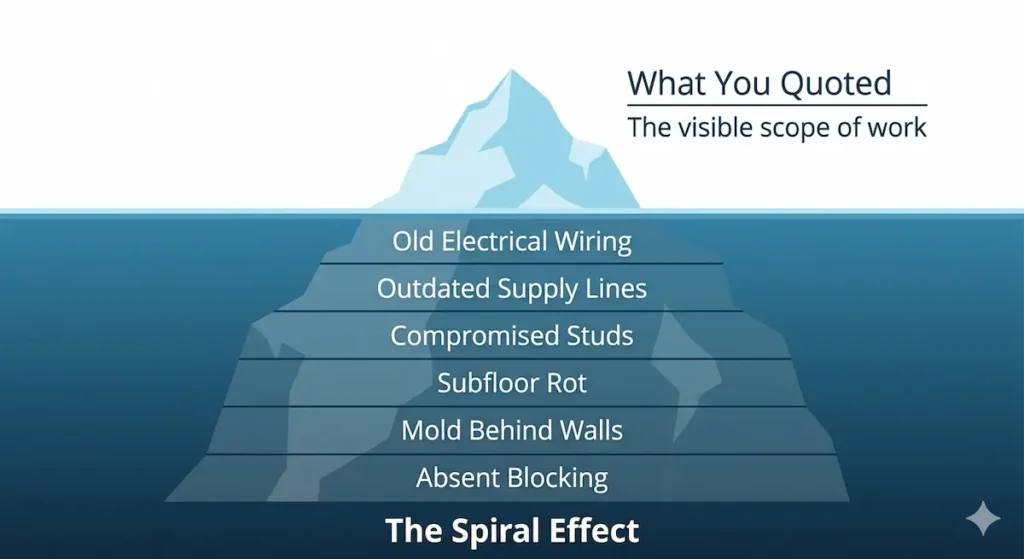
This is the hidden costs of aging in place bathroom renovations conversation that catches homeowners most off guard — not one unexpected discovery but a chain of them. Each fix leads to the next requirement which leads to the next cost.
The most common version involves electrical. You’re opening a wall for a completely unrelated reason. Behind that wall is wiring that predates current code — knob and tube, aluminum wiring, undersized circuits. Now that the wall is open and I can see it, I can’t legally walk away from it. As a licensed contractor I have to bring what I’ve opened up to current code. So now we’re updating the electrical in the opened wall space. That new wire has to run back to the panel. When we get to the panel it turns out the panel itself is undersized or outdated and needs to be replaced too. Your $800 project just became a several thousand-dollar project and every single step of that chain was a legitimate requirement, not a contractor inventing work.
The same spiral can happen with plumbing. Cast iron supply lines in an older home need to go — I’ve covered this in my Anti-Scald Valve for Seniors Guide. You’re not consuming water that’s been sitting in corroding cast iron. When a wall opens and reveals those lines the right answer is replacement, not patching around them.
The spiral isn’t a contractor problem. It’s a deferred maintenance problem that the renovation surfaces. The house needed those things addressed whether the renovation happened or not. The renovation just made them visible.
The Specific Hidden Costs of Aging in Place Bathroom Renovations Worth Understanding
Blocking
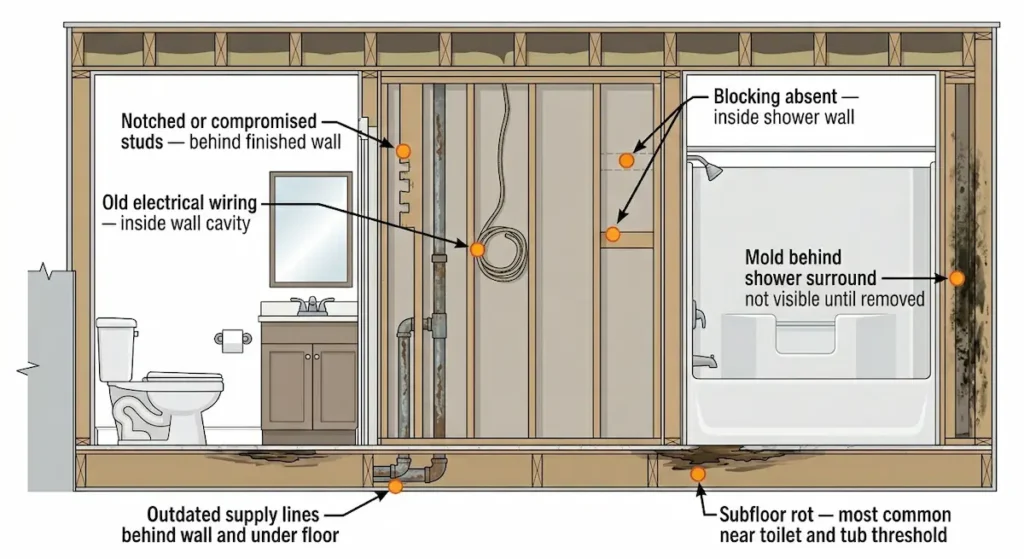
I’ve covered blocking extensively in other articles — my Shower Grab Bar Placement Guide and Toilet Grab Bar Placement Guide both address it in detail. The short version is that blocking has to be there for grab bars to be safe and most homes don’t have it. If the wall is already open for any reason, adding blocking at that point costs a fraction of what it costs to go back in later. It’s not a hidden cost so much as a known requirement that gets added to the scope once the wall is open.
One specific framing issue worth calling out separately — in older homes, particularly those built between the 1950s and 1970s, wall studs were often notched or bored out to run old plumbing and electrical through them. By the time you open that wall decades later those studs have been compromised enough that they no longer meet current structural requirements for supporting blocking or a heavy ADA vanity. The fix is sistering — adding new lumber alongside the damaged stud to restore the structural integrity. It’s not complicated work but it’s material and labor that nobody budgeted for when the job was quoted. If you’re renovating an older home and opening walls for grab bar blocking or a floating vanity installation, sistered studs are a real possibility worth knowing about before you start.
Subfloor Rot and Water Damage
The most common place I find subfloor damage is around the tub and shower threshold and near the toilet. Those are the two areas in a bathroom where water is most likely to have been getting somewhere it shouldn’t over a period of years. Sometimes it’s a small patch. Sometimes when I pull the flooring, I find the damage extends significantly further than the surface evidence suggested.
The cost depends entirely on how much subfloor needs to be replaced — a patch is one number; a full replacement is a very different number. Mobile homes and older homes also frequently have MDF subfloor rather than plywood. MDF doesn’t belong in a wet environment, and I always recommend replacing it while we’re already in the floor regardless of whether there’s active rot. That’s not a hidden cost exactly — it’s a known inadequacy I address when I have the opportunity.
Mold and Water Damage Behind Walls
Any material that has been contaminated by mold has to come out. Sheetrock, wood framing, insulation — if it’s been sitting wet long enough to grow mold it’s not getting covered back up. That’s not a contractor opinion, it’s a health and structural reality.
Sometimes there are visible signs before the wall opens — staining, soft spots, odor. Sometimes the damage is completely hidden behind a shower surround or tile that looks perfectly fine from the outside. I’ve removed shower surrounds that looked acceptable on the surface and found significant mold colonization behind them that the homeowner had no idea existed.
Putting a new shower surround over a contaminated wall is not a renovation — it’s just moving the problem out of sight for a few years until it’s worse and more expensive. If we find it, we fix it. My Shower Surrounds for Seniors Guide and Senior Bathroom Backerboard Guide cover what proper wall preparation looks like before anything goes back up.
Previous Work Done Wrong
This one doesn’t get talked about enough. When you’re working in a house that’s had multiple owners and multiple contractors over the years you have no idea what the person before you did. I can’t tell you how many times I’ve opened a wall and found plumbing that wasn’t where it should be, wiring that was spliced incorrectly, or structural modifications that made no sense. Previous work done wrong isn’t visible from the outside. It only shows up when you get in there.
This isn’t about blaming previous contractors — sometimes work was done by homeowners, sometimes codes have changed, sometimes what was acceptable thirty years ago isn’t acceptable now. It doesn’t matter how it got there. What matters is that it gets addressed correctly while the wall is open rather than covered back up and left for the next person to deal with.
Electrical and Plumbing Code Requirements
Once a wall is open the work inside that wall has to meet current code. That’s not a contractor choice — it’s a legal requirement. If outdated wiring or plumbing is exposed during a renovation it has to be brought up to standard. The specific requirements vary by location — electrical, plumbing, HVAC, and framing are generally the categories that require permits most consistently, but local codes vary significantly. What requires a permit in one county may not require one in the next. Know your local requirements before you start.
One important distinction — if you’re a homeowner doing your own work in your own home you have more latitude than a licensed contractor does. A licensed contractor who opens a wall and sees code violations cannot legally walk away from them. A homeowner working on their own home operates under different rules. That’s not an endorsement of ignoring code — it’s just a reality of how licensing and liability work.
How to Price a Job With Unknowns
When it comes to hidden costs of aging in place bathroom renovations you price what you can see and you’re honest about what you can’t. That’s the whole answer.
I quote the visible scope, I explain what I expect we might find based on the age of the home, the visible condition, and what I’ve seen in similar homes in similar neighborhoods, and I give the homeowner a clear picture of what those discoveries could cost if we find them. In neighborhoods where I’ve already worked on several homes with the same issue I can say with reasonable confidence that we’re likely to find the same problem here — that’s experience, not guessing.
A 20 percent contingency on the total project value is a reasonable buffer for most aging in place bathroom renovations. On a larger or more complex project in an older home that number might need to be higher. On a newer home with no visible signs of issues it might be conservative. But if someone asks me what to set aside for unknowns, 20 percent is where I start the conversation.
Getting a second opinion on a significant renovation is always reasonable. A second set of experienced eyes on a job before it starts — especially in an older home or a home with visible signs of deferred maintenance — is worth the time.
Mobile Home Specifics
Hidden costs of aging in place bathroom renovations in mobile homes aren’t necessarily worse than in site-built homes — damage is damage regardless of construction type. What’s different is what you’re more likely to find.
MDF subfloor is significantly more common in mobile homes and older site built homes. It doesn’t belong in a bathroom environment and replacement is almost always the right call when we’re already in the floor. The 2×6 floor joists common in older mobile homes are another consideration — depending on what the renovation requires those may need to be sistered or replaced, particularly for anything involving a curbless shower conversion where the subfloor has to be modified for drainage slope.
One plumbing specific issue worth flagging for mobile homes — polybutylene pipe. If you open a mobile home wall and see gray PB pipe, that’s a problem that goes beyond whatever you came in to fix. Polybutylene was widely used in mobile homes and site built homes from the late 1970s through the mid 1990s and it has a well documented history of failure — it degrades over time and fails without warning. A good contractor tells you that straight. Fixing one anti-scald valve or one supply line connection in a bathroom full of PB pipe is a short term patch on a long term problem. The honest conversation is about repiping the bathroom at minimum while the wall is already open. That’s the spiral effect in mobile home plumbing form — you came in to fix one valve and left with a repiped bathroom. It’s not the contractor creating work. It’s the house telling you what it needs.
My Mobile Home Bathroom Modifications for Seniors Guide covers the structural realities specific to manufactured housing in more detail.
What to Ask Your Contractor Before Work Starts
When it comes to hidden costs of aging in place bathroom renovations, these are the questions worth asking before a single wall gets opened:
What do you expect to find when you get behind the wall and what will it cost if you do? A contractor who has done this type of work in homes of this age and type should have an educated answer, not a blank stare.
How do you handle unexpected discoveries mid-job? The answer should involve stopping the work, showing you what was found, explaining what it means, and getting your approval before proceeding. If the answer is anything other than that, pay attention.
What requires a permit in this area for this type of work? You want a contractor who knows the local requirements and pulls the permits that are required, not one who avoids them to save time.
What’s your recommendation for a contingency budget on this specific job? The answer will tell you how honestly they’re thinking about the unknowns.
FAQ: Hidden Costs of Aging in Place Bathroom Renovation
Why do hidden costs come up mid-renovation?
Hidden costs of aging in place bathroom renovations come up because finished surfaces hide what’s behind them. A contractor can make educated guesses based on the age of the home, visible conditions, and experience with similar projects — but the actual condition of framing, subfloor, plumbing, and electrical is only visible once demolition begins.
Is a contractor trying to get more money when hidden costs come up?
A legitimate hidden cost is something that couldn’t be seen before the wall opened and has to be addressed to complete the job correctly. The distinction is whether the contractor communicated the possibility upfront and stopped immediately to explain the discovery. A contractor who springs costs on you without prior warning or explanation is a different conversation entirely.
What’s a reasonable contingency budget for hidden costs of aging in place bathroom renovations?
20 percent of the total project value is a reasonable starting point. More for an older home with visible signs of deferred maintenance, potentially less for a newer home in good condition.
What are the most expensive hidden costs of aging in place bathroom renovation?
Subfloor replacement and framing issues are typically the most costly. Electrical panel replacement triggered by the spiral effect is another significant one. Extensive mold remediation requiring full wall tear out can also escalate quickly.
Should I get a second opinion before starting a major renovation?
Yes, particularly for an older home or a home with visible signs of water damage or deferred maintenance. A second experienced set of eyes before the work starts is worth the time.
Are hidden costs of aging in place bathroom renovations worse in mobile homes?
Not necessarily worse — different. MDF subfloor and 2×6 floor joists are more common in mobile homes and older homes and create specific considerations depending on what the renovation requires.
The Bottom Line on Hidden Costs of Aging in Place Bathroom Renovation
Hidden costs of aging in place bathroom renovations are not a contractor problem — it’s a home condition problem that the renovation makes visible. The spiral effect is real, the discoveries are unpredictable, and the extent of damage behind a finished surface is genuinely unknowable until the wall comes open.
What is predictable is how a good contractor handles it. Upfront communication about what might be found. Immediate transparency when it is found. A clear explanation of what it means and what it costs. Your approval before the scope changes.
Budget 20 percent contingency. Ask the right questions before work starts. And understand that the hidden cost you address during a renovation is almost always cheaper than the hidden cost you cover back up and deal with later.
If you want to assess your current bathroom before committing to any work my Free Home Safety Checklist walks through every major risk zone room by room.