Every Homeowner in Eastern Kentucky Has a Story. Here’s What to Do Before You Become One.
Keeping It Level
Every homeowner in Eastern Kentucky has a last guy story. The contractor who said it couldn’t be done when it absolutely could. The one who took your money, did the work wrong, and was gone before you figured that out. The one who put a new roof on, and it leaked, came back and put blackjack over new construction, and it still leaked. If you’ve lived here long enough you either have one of these stories or you know someone who does. It is especially true for elderly homeowners and seniors living alone who are trying to make their homes safer and more accessible. Senior home renovations in Eastern Kentucky come with a unique set of risks — and the wrong contractor makes them worse. Here’s what to know before anyone shows up at your door. This post is about making sure the next chapter of your story doesn’t start with “well, the last guy…”
- The Two Kinds of Last Guy
- The Last Guy Who Did It Wrong
- The Last Guy Who Said It Couldn't Be Done
- This Ain't HGTV
- What to Actually Look For
- Do Enough Research to Be an Informed Participant
- A Final Note on Doing It Yourself
- FAQs: Hiring a Contractor for Senior Home Renovations in Eastern Kentucky
- What should I ask a contractor before hiring them for aging in place modifications?
- What about getting more than one estimate?
- What if I'm worried something unexpected gets found mid-job?
- What if a contractor tells me something can't be done?
- Is there any recourse if a contractor does bad work in Eastern Kentucky?
- Does it matter if a contractor is licensed for small jobs?
- Are there grants or financial assistance programs that can help pay for aging in place modifications?
- The Bottom Line
The Two Kinds of Last Guy
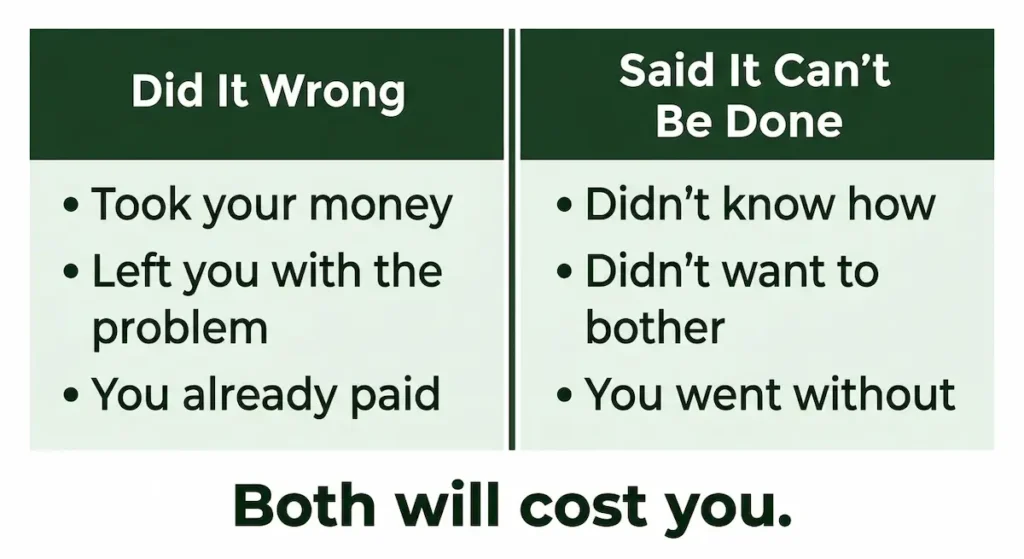
In twenty years of contracting, I’ve come in behind a lot of last guys. And while no two situations are exactly alike, the last guy almost always falls into one of two categories.
The first one does the work. He just does it wrong.
The second one doesn’t do the work at all — and makes up a reason why it can’t be done.
Both of them will cost you. The first one costs you money and leaves you with a problem you still have to fix. The second one costs you something harder to measure — the time you spent believing something wasn’t possible when it was.
The Last Guy Who Did It Wrong
I’ve been called in behind a contractor who built a roof addition that leaked for months. When he came back to fix it, he put blackjack over brand new roofing material. Black jack. On new construction. It still leaked. I was the next call.
I’ve fixed plumbing repairs that flooded a kitchen within a week of the previous contractor walking out the door. The homeowner had already paid in full. The contractor had already moved on.
I’ve seen a $1,600 front door installation that has leaked since the day it was put in. That’s not bad luck. That’s a door that wasn’t installed correctly — flashing wrong, threshold wrong, something fundamental that was done in a hurry or done by someone who didn’t know what they were doing.
In all of these cases the homeowner had already paid. In most of them they had very little recourse. That’s the honest reality of how this works in Eastern Kentucky. The licensing enforcement, the permit system, the inspection process — the safety nets that exist in other places either don’t exist the same way here or aren’t actively enforced. Which means the vetting you do before anyone shows up at your door is the protection you have. There isn’t much on the back end.
The Last Guy Who Said It Couldn’t Be Done
This one doesn’t get talked about enough because there’s no obvious damage. No leak. No flood. Just a homeowner who was told something wasn’t possible and believed it.
I went to put in ceiling fans for a woman and she told me the last guy said it couldn’t be done because it was a mobile home. I’m still not sure what to do with that. I installed them. It took a normal amount of time. They work fine.
I’ve heard the same thing about electrical problems that turned out to be a single outlet that wasn’t wired in correctly. The last guy said the electric couldn’t be fixed. What he meant, apparently, was that he didn’t know how to fix it or didn’t want to bother. One outlet. Not wired in. That’s a diagnosis, not a death sentence.
And I’ve been told — more than once — that a previous contractor looked at a crawl space situation and said it was fine that there was no insulation under the flooring. In a manufactured home in Eastern Kentucky. Fine. It is very much not fine. Missing floor insulation in our climate effects energy costs, moisture levels, subfloor longevity, and the comfort of the person living there — especially a senior or elderly person whose body has a harder time regulating temperature. That’s not a minor thing to wave off.
The Thing About Mobile Homes
Most things can be done. Simple repairs, fans, insulation, outlets — any real contractor can handle those in a manufactured home without breaking a sweat. Where it becomes a different conversation is structural modifications: cutting into load-bearing walls, chassis work, that kind of thing. But here’s the thing — that’s a different conversation in a site-built home too. If a contractor tells you something can’t be done on a manufactured home, the more likely explanation is that they don’t understand how the engineering differs from stick-built construction, and they’d rather say no than figure it out. For a deeper look at what’s actually involved, the mobile home article covers it in more detail.
The can’t-be-done last guy is often more comfortable than the one who does bad work, because he doesn’t leave obvious damage. But he leaves something behind anyway — a homeowner who stopped asking, who assumed their situation was a special case, who went without something they needed because someone who didn’t know what they were doing told them it wasn’t possible.
This Ain’t HGTV
One of the fastest tools in the wrong contractor’s kit is the timeline promise. They’ll have it done fast. Impressively fast. Faster than you’d think.
Here’s what’s true about that: what you see on television renovation shows isn’t construction. The timelines are compressed, the crews are massive, the problems get edited out, and the reveal happens on schedule because it has to for production. That is entertainment. Real work takes the time it takes. Doing it right takes more time than doing it fast. Anyone promising you otherwise is either cutting corners, lying to you, or both.
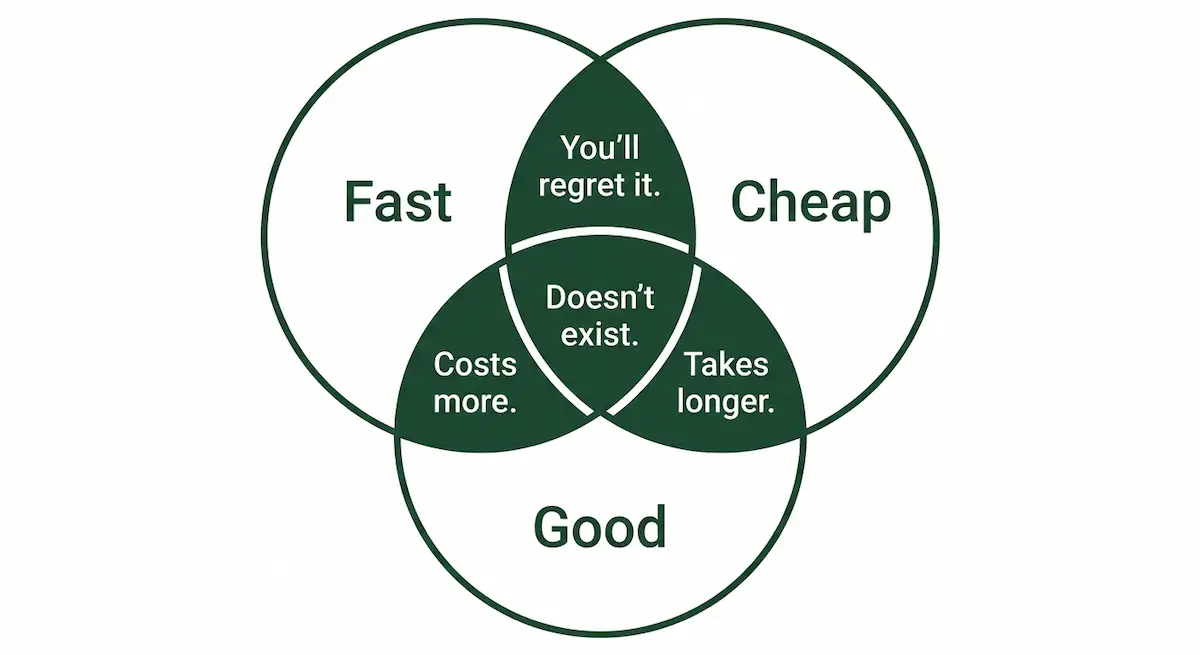
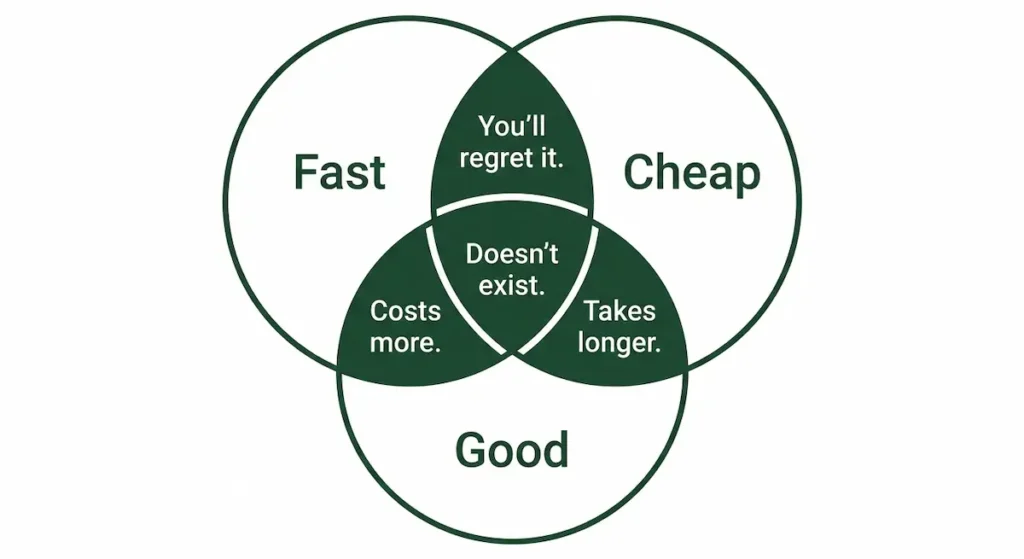
Fast, cheap, and good. Pick two. That’s not cynicism — that’s how construction actually works.
If you want it done fast and done right, it’s going to cost more. You’re paying for priority and quality together.
If you want it cheap and fast, something is getting cut. You’ll find out what eventually.
If you want it done right and want to keep the cost reasonable, it’s going to take the time it takes.
What you cannot have is all three. The contractor who promises you all three is not telling you the truth. That promise is a red flag, not a selling point.
What to Actually Look For
Ask to see previous work or talk to someone who can speak to it. A contractor who does good work has people who will say so. A contractor who doesn’t will have reasons why that’s complicated.
Pay attention to honesty. An honest contractor will tell you when they haven’t done something before. I’ve told customers that more times than I can count. What I also tell them is this: I’ve never done that specific thing, but with everything I know and everything I’ve done that’s close to it, I’m confident I can do it right. That’s how I ended up rebuilding a wooden boat once. Honesty about the limits of your specific experience combined with real confidence in your overall ability — that’s what a straight answer sounds like.
A contractor who’s done everything, always, perfectly, faster than you’d expect, for less than you’d think — that’s not confidence. That’s a performance.
Ask if they’re licensed. Not the second question. The first one. Before you talk about the project, before you walk them through anything. Licensed and insured? If grant work is involved it’s not a preference — it’s a requirement. An unlicensed contractor cannot legally perform the work and the grant organization will not pay for it. You will have gone through the entire application process and have nothing to show for it.
That said, a license alone doesn’t tell you everything you need to know. Getting licensed in Kentucky isn’t a particularly high bar — you pay the fee, you’re licensed. It doesn’t mean you’ve ever picked up a hammer. So, use the license check as a starting point, not a finish line. The real vetting happens when you look at previous work and ask questions. If you want grab bars installed, ask your contractor how they plan to secure them. If the answer is toggle bolts into a fiberglass surround, that’s your answer — and it’s time to make the next call. Knowing enough about what the work involves to recognize a good answer from a bad one is more useful than any piece of paper.
There’s one more thing worth being honest about. A lot of last guy stories don’t start with a predatory contractor — they start with a homeowner who picked the lowest number. That’s not a criticism. Money is real, especially here. But if someone bids a custom tile shower at half of what everyone else quoted, there’s a reason. Maybe they’ve never done one. Maybe they’re planning to do it fast. Maybe they just want the job, and they’ll figure it out as they go. And when it goes wrong — and it goes wrong — you’re now paying someone else to tear out the bad work and do it right. Which means you paid twice. I know this because that’s how I got most of my last guy stories. Someone took the low bid, it didn’t go well, and I got the call. The goal isn’t to spend more than you have to. The goal is to not spend the same money twice.
Do Enough Research to Be an Informed Participant
You don’t need to know how to do the job. That’s why you’re hiring someone. But think about it this way — if your doctor told you they were ordering an MRI you’d probably look that up before you went. Not to become a radiologist. Just to understand what’s happening and why.
Same principle here. You don’t need to know how to block for a grab bar or how to frame a widened doorway. But knowing roughly what those things involve, what they require, and what reasonable expectations look like gives you enough to evaluate what you’re being told. Ask questions. A contractor worth hiring can answer them. One who can’t — or won’t — is telling you something. It’s literally the job to know, and if the answer isn’t known yet, it’s the job to figure it out.
That’s the difference between being a customer and being an informed participant in your own project.
This site exists partly for that reason. The more you understand about what aging in place modifications actually require — what a proper ramp needs on mountain terrain, whether a ramp or a lift makes more sense for your situation, what grab bar installation actually involves, what a bathroom modification should look like from start to finish — the harder it is for someone to song and dance you..
A Final Note on Doing It Yourself
If you’re a homeowner who wants to tackle something yourself — good. Seriously.
There is nothing wrong with doing your own work. For smaller aging in place modifications especially, a capable homeowner can absolutely handle some of this. A homeowner who drywalls their own bathroom and it’s not quite perfect did something real. There’s a difference between a homeowner doing a job and it not being perfect and a so-called professional taking your money and not doing it right. That difference matters.
I’ll never walk into someone’s home and critique what they built themselves. What I will do is help you understand what the work actually involves so you can make informed decisions — whether that’s picking up the tools yourself or knowing what to ask before you hand someone else the money.
You deserve honest work done right. In Eastern Kentucky that means doing your homework before anyone shows up at your door. Because once they’re gone, the options narrow fast.

FAQs: Hiring a Contractor for Senior Home Renovations in Eastern Kentucky
What should I ask a contractor before hiring them for aging in place modifications?
Are you licensed and insured? Have you done this type of work before — and can I talk to someone you did it for? What does your timeline look like and why? Get the estimate in writing with specifics and make sure both of you sign it before any work starts. Vague estimates produce vague results. And get a rough number before anyone touches anything — even a verbal ballpark. I’ve known homeowners who had work done without ever asking what it would cost and walked away with a bill that made their eyes water. Ask first. This is especially important for seniors and elderly homeowners who may be working with grant funding or on a fixed income.
What about getting more than one estimate?
If you can, do it. Around here that’s easier said than done — a lot of homeowners are lucky to get one contractor to show up, let alone two or three. But if you have options, use them. At minimum, knowing that multiple estimates are possible means you’re not locked into the first number you hear.
What if I’m worried something unexpected gets found mid-job?
A contractor worth hiring will tell you what they might find before they ever open a wall. If your shower surround has been leaking for years, there’s a real chance something behind it is rotted or molded. Before anything gets opened up, you should hear a best case and a worst case. And if something unexpected does turn up once work starts — rotted framing, a structural issue that wasn’t visible — everything should stop. Pictures get taken. You look at it together and decide what comes next before anything else happens. That’s not a special service. That’s how work should go.
What if a contractor tells me something can’t be done?
Get a second opinion before you believe it. “It can’t be done” from someone who doesn’t know how to do it sounds exactly the same as “it can’t be done” from someone who actually evaluated your situation. In my experience most things can be done — the question is what it takes to do them right.
Is there any recourse if a contractor does bad work in Eastern Kentucky?
Realistically, it’s limited. If a contractor is licensed you can file a complaint with the Kentucky Department of Housing, Buildings and Construction. If a contract was signed and money was paid for work not completed, small claims court is an option for amounts under $2,500. But the honest answer is that the enforcement systems that exist in more urban areas are thinner here. That’s true whether you’re in Leslie County, Perry County, Knott County, Letcher County, or anywhere else across the region. The vetting you do upfront is your real protection.
Does it matter if a contractor is licensed for small jobs?
Yes — especially if grant funding is involved, which requires a licensed contractor by rule. For aging in place modifications specifically, licensing matters because grab bars, ramp construction, bathroom modifications, and doorway widening all have safety implications. A mistake in any of those isn’t just cosmetic.
Are there grants or financial assistance programs that can help pay for aging in place modifications?
Yes — and there are more options than most people realize especially for senior home renovations in Eastern Kentucky. For a full breakdown of what’s available in Eastern Kentucky and how to apply, see the grants and funding article. If grant funding isn’t available or the timeline doesn’t work for your situation, working through modifications in phases is how most families make this manageable on a fixed income — and it’s worth understanding before anyone picks up a tool.
The Bottom Line
Every homeowner- and especially every senior or elderly homeowner- in Eastern Kentucky has a last guy story. The goal of this post — and honestly the goal of most of what’s on this site — is to make sure you’re not the next one.
The last guy who does bad work and takes your money is a real problem. So is the last guy who tells you something can’t be done when it can, and leaves you going without something you needed.
Ask the right questions before anyone starts. Understand enough about the work to know when you’re being told the truth. And if someone tells you it can’t be done — get another opinion. Because in twenty years of doing this work, “it can’t be done” has almost never been the right answer.
It can almost always be done. The question is whether the person standing in front of you knows how.
If you’re a homeowner reading this, don’t hire the last guy. If you’re a contractor reading this, don’t be the last guy.
For more on what aging in place modifications actually involve — what they require, what they cost, and what they should look like when they’re done right — start with the Eastern Kentucky aging in place guide.