Keeping It Level
Senior home repair grants in Eastern Kentucky exist and there are more of them than most people realize. This post covers every major program and local organization available in this region — federal, state, nonprofit, and faith-based — and the part nobody else writes about, what the process actually looks like from the contractor side.
- Where to Start with Aging in Place Grants in Eastern Kentucky
- The Programs
- Faith-Based and Ministry Organizations
- Big Creek Missions — Leslie, Clay, and Perry counties
- Hand in Hand Ministries — Floyd, Johnson, Magoffin, and Martin counties
- Christian Appalachian Project — Floyd, Jackson, Johnson, Knott, Magoffin, Martin, McCreary, and Rockcastle counties
- Appalachia Service Project — Multiple Eastern Kentucky counties
- Heritage Ministries — Bell, Clay, Harlan, Knox, Leslie, Letcher, and Perry counties
- Hills to Hollers Outreach Center — Clay and Leslie counties
- If You Don't Qualify for Grants
- What Grant Work Actually Looks Like — A Contractor's Perspective
- FAQs: Home Repair Grants in Eastern Kentucky
- The Bottom Line
Eastern Kentucky has more home repair grant options than most people realize — and more of them are built around the realities of this region than you’d expect. The programs that exist here account for rural land ownership, manufactured housing, and the kind of situations that don’t fit neatly into a standard application. The problem isn’t that the money doesn’t exist. The problem is that most people don’t know where to look, and the ones who do find the programs often get tripped up by details nobody warned them about.
This post covers what’s available, who qualifies, how to apply, and the things that go wrong that nobody else writes about — including what grant work actually looks like from the contractor side.
One important note before we get into it. Federal and state program budgets can change. Funding availability, income limits, and program specifics are subject to annual review. Everything here is accurate as of the time of writing but always verify current details directly with each organization before you apply or make any decisions based on this information.
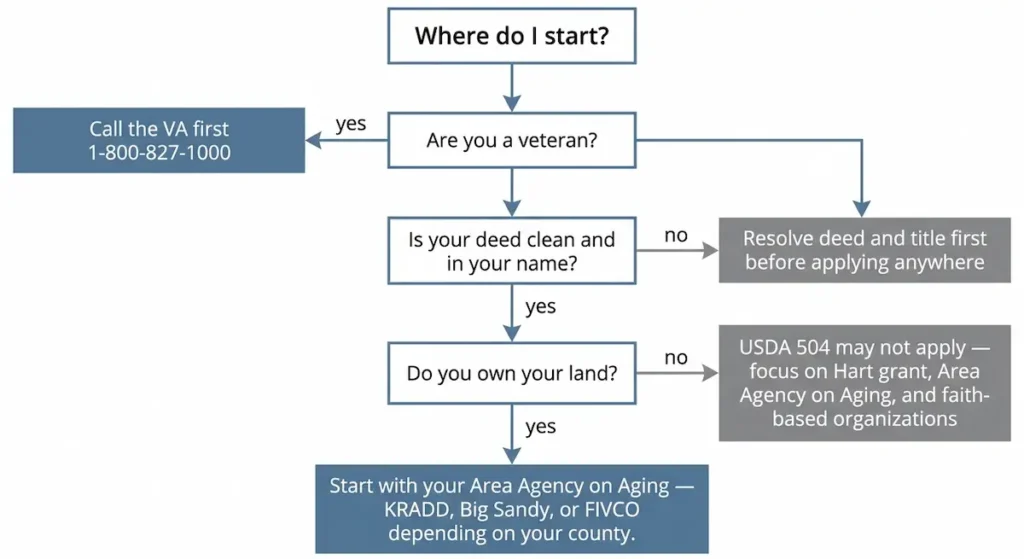
Where to Start with Aging in Place Grants in Eastern Kentucky
You must have a clean deed in your name.
Every government-backed grant program requires documented proof that you own the home you’re applying to modify. That sounds straightforward. In Eastern Kentucky it often isn’t.
Heir property is common out here. Houses passed down through generations without a formal probate court transfer. Deeds still in a deceased parent’s or grandparent’s name. A senior who has lived in a house for thirty years but whose name has never been formally transferred onto the deed. If your name is not cleanly on that deed the grant application will be rejected regardless of how well you qualify on every other criteria.
Before you apply for anything check your deed status. If the deed is still in someone else’s name or the estate was never formally settled, get that paperwork sorted out first. Contact a local attorney or your county clerk’s office. It is worth doing before you invest time in an application that will be denied on ownership grounds.
Be strategic about what you ask for.
When it comes to senior home repair grants in Eastern Kentucky there is only so much money to go around. Most programs have funding limits, annual caps, and in some cases waitlists. If you need multiple modifications — a ramp, grab bars, a low entry shower — you cannot necessarily fund all of them through one program.
Prioritize by cost. Ask for the most expensive modification first. Pay for the smaller things yourself if you have to choose. If you need a ramp and grab bars and can only get one funded, fund the ramp. The grab bars are inexpensive by comparison. Don’t use your grant funding on the least expensive item on your list and have nothing left for the one that actually needed it. If a ramp is what you need, our wheelchair ramp in Eastern Kentucky guide covers slope requirements, materials, footings, and what to ask before anyone starts cutting lumber. Or, if you’re weighing a ramp against a lift and aren’t sure which one makes sense for your lot and your budget, our ramps vs lifts in Eastern Kentucky post covers the real cost comparison and when the terrain changes the answer.
A Warning About State Inspections
When a USDA or Area Agency on Aging inspector comes out to assess a modification request they don’t just look at the specific project. They look at the whole house for major health and safety issues.
If you apply for a ramp grant and the inspector walks inside and finds severe underlying problems — dangerous electrical, soft floors, a failing roof — the grant may not move forward until those baseline issues are addressed first. The state will not fund a ramp on a house that has unresolved code violations or significant safety hazards. The project gets stuck.
This isn’t punitive. It’s a program requirement. But it catches families off guard when a straightforward ramp application suddenly turns into a conversation about the electrical panel.
If the home has known underlying issues it’s worth having an honest assessment of the overall condition before you apply. Knowing what an inspector might find lets you address it or plan for it rather than being blindsided in the middle of the process.
The Programs
USDA Section 504 Home Repair Program
This is the program most people in Eastern Kentucky have heard of and for good reason. It’s one of the strongest rural home repair programs in the country and virtually all of Eastern Kentucky qualifies as a rural area under USDA guidelines.
What it covers: grants up to $10,000 for very low-income homeowners age 62 and older to remove health and safety hazards. Accessibility modifications — ramps, grab bars, bathroom modifications — fall squarely within the program’s purpose. Loans up to $40,000 are available for lower income homeowners of any age. Loans and grants can be combined for up to $50,000 in total assistance. USDA Rural Development also covers water and waste disposal improvements for qualifying rural homeowners — which means well water testing and filtration systems may be fundable through the same program. See the Well Water and Aging in Place guide for what those improvements typically cost and what to ask for.
Who qualifies: you must be 62 or older for the grant component, own and occupy the home as your primary residence, have very low income as defined by USDA guidelines for your area, and be unable to obtain affordable credit elsewhere.
Important: if you sell the home within three years of receiving a grant it must be repaid.
Mobile homeowners — read this carefully.
The USDA Section 504 program can cover manufactured and mobile homes but only if you own both the home and the land it sits on. If your home is on a rented lot, in a mobile home park, or on family land without a clean deed in your name you will not qualify. Additionally, the home must be on or placed on a permanent foundation — not sitting on blocks with skirting. If your mobile home does not meet the permanent foundation requirement the USDA will not fund the repair. Clarify your deed status and foundation situation before you apply. For a full breakdown of what makes mobile home construction different and what to think through before any modification project, see our guide to aging in place in a mobile home.
How to apply: contact the local USDA Rural Development office directly.
USDA Rural Development — Hazard Office 305 Dawahare Drive, Hazard, KY 41701 Phone: 606-910-3342 rd.usda.gov
Hart Supported Living Program
This one surprises people because it’s disability focused rather than age focused. If you or someone in your household has a disability as defined by the Americans with Disabilities Act age doesn’t matter. A mobility disability that limits daily function qualifies. An elderly person with limited mobility very often qualifies under this program.
What it covers: home modifications, adaptive equipment, personal care services, attendant care, transportation, and more. It’s a broad and flexible program specifically designed to help people with disabilities live in their homes and communities rather than institutions.
The deadline nobody mentions: applications are due April 1st every year. Funding becomes available July 1st. Miss the April 1st deadline and you wait until the following year. Put it on your calendar.
How to apply: contact the Department for Aging and Independent Living directly or reach out to your regional Hart Supported Living coordinator.
Kentucky Department for Aging and Independent Living Phone: 502-564-6930 Email: HSL@ky.gov chfs.ky.gov
Kentucky Medicaid Home and Community Based Waiver
The HCB Waiver is Kentucky Medicaid’s program for elderly and disabled residents who need nursing home level care but want to remain at home. Home modifications for safety and accessibility are a covered service under this waiver.
Who qualifies: you must be 65 or older or disabled, meet nursing facility level of care criteria, and meet Medicaid financial eligibility requirements.
The honest reality: there is a waitlist. The HCB Waiver is not an entitlement. Enrollment slots are limited and when they fill up applicants go on a waitlist. This is especially true in Eastern Kentucky where demand for home-based care is high. Apply as early as possible. The earlier you apply the earlier your place in line.
How to apply: through kynect, Kentucky’s benefits portal, or by calling the Department for Community Based Services.
kynect.ky.gov Phone: 855-306-8959
VA Benefits for Veterans
If the person who needs modifications is a veteran this should be the first call before exploring any other funding source. VA home modification grants are among the most generous available and are significantly underutilized — most veterans don’t know they exist.
Three main programs.
The HISA grant covers medically necessary home modifications including grab bars, ramps, widened doorways, and accessible bathrooms. This is the most relevant program for elderly veterans aging in place because it is available to both service-connected and non-service-connected veterans. Modifications must be medically necessary and prescribed by a VA physician.
The SAH grant provides up to $117,014 for veterans with severe service-connected disabilities. This is for significant modifications or new construction.
The SHA grant provides up to $22,036 for veterans with less severe but significant service-connected disabilities.
Working with a Veterans Service Officer through the VFW or American Legion is strongly recommended. They file claims at no charge and typically achieve better outcomes than veterans filing on their own.
VA main line: 1-800-827-1000 va.gov/housing-assistance/disability-housing-grants
Area Agency on Aging Programs
Your local Area Agency on Aging administers the Older Americans Act Title IIIB Home Repair Services program which provides minor home modifications to help older adults live safely and independently. These offices also know about every other program available in your county and are often the best first call regardless of which program you ultimately pursue.
Knott, Leslie, Letcher, Perry, Breathitt, Lee, Owsley, or Wolfe County: Kentucky River Area Development District — KRADD 606-436-3158 or 1-800-928-5723 kradd.org
Floyd, Johnson, Magoffin, Martin, or Pike County: Big Sandy Area Agency on Aging 606-886-2375 or 1-800-737-2723 bigsandy.org
Boyd, Carter, Elliott, Greenup, or Lawrence County: FIVCO Area Development District 606-929-1366 or 1-800-491-5191 fivco.org
Call and ask specifically about home modification assistance.
LKLP Community Action Council
LKLP serves Leslie, Knott, Letcher, and Perry counties and administers multiple assistance programs for low income residents including elderly and disabled individuals. A local organization worth contacting directly to ask what housing and home modification assistance is currently available.
Leslie County: 121 Maple Street, Hyden, KY 41749 — 606-672-2155
Knott County: 131 West Main Street, Hindman, KY 41822 — 606-785-3322
Letcher County: 165 Carr Creek Hill Road, Redfox, KY 41847 — 606-642-3332
Perry County: 412 Roy Campbell Drive, Hazard, KY 41701 — 606-436-3161
Housing Development Alliance
HDA is an established nonprofit serving Breathitt, Knott, Leslie, and Perry counties with over 1,100 home repairs and rehabilitations completed across the region. Their home repair program serves income eligible homeowners including mobile home owners which matters significantly in Eastern Kentucky.
Faith-Based and Ministry Organizations
Not every resource on this page is a formal home repair grant. In Eastern Kentucky some of the most accessible help comes from faith-based organizations that operate outside the grant system entirely.
These organizations operate differently from government programs. No income verification, no lengthy applications, no traditional waitlists. Volunteers do the work at no charge to the homeowner. Homes with elderly or disabled residents and accessibility needs consistently receive priority.
One important thing to understand about how these organizations work: most of them are seasonal. They do the bulk of their construction work when volunteer teams arrive which is primarily summer months with some activity in spring and fall. If you apply in October you may be approved but the physical work won’t happen until the following summer when volunteer groups come through. Plan accordingly. Apply early rather than waiting until the need is urgent.
Big Creek Missions — Leslie, Clay, and Perry counties
Free home repairs including ramps and accessibility modifications. Must own the home. Apply online at bigcreekmissions.com/homerepairs. bigcreekmissions.com
Hand in Hand Ministries — Floyd, Johnson, Magoffin, and Martin counties
Serves the Big Sandy area with free home repair including wheelchair ramps. Must meet income guidelines and reside in one of the four counties. Does not cover plumbing, electrical, or cosmetic repairs. To apply visit the office or call to request an application — they can deliver it to homebound residents.
Phone: 606-886-0709
myhandinhand.org
Christian Appalachian Project — Floyd, Jackson, Johnson, Knott, Magoffin, Martin, McCreary, and Rockcastle counties
CAP has been doing home repair work in Eastern Kentucky since 1964 and operates year-round rather than just during summer volunteer seasons. Their repair teams are led by industry-trained crew leaders working alongside volunteers. Work includes roof repair, accessibility modifications, siding, windows, doors, and heating upgrades. In rare situations where a home is beyond repair they will build a new home if financing can be arranged. There is a waiting list. To find out how to apply and whether your situation qualifies, call them directly.
Phone: 1-866-270-4227 christianapp.org
Appalachia Service Project — Multiple Eastern Kentucky counties
ASP sends volunteer teams to communities across Central Appalachia each summer to do home repair work including accessibility modifications and wheelchair ramps. Their primary model is recruiting church and school volunteer groups but homeowners in need of repairs can apply through their website.
Heritage Ministries — Bell, Clay, Harlan, Knox, Leslie, Letcher, and Perry counties
Builds handicap ramps and completes home repairs free of charge for Harlan County residents who cannot afford a contractor. Phone: 606-848-0550 heritagemin.org
Hills to Hollers Outreach Center — Clay and Leslie counties
Hills to Hollers is a small but active community outreach organization based in Big Creek serving Clay and Leslie county residents. They’re newer than some of the larger organizations on this list but they’re doing real work in the community — food assistance, household goods, emergency relief, and home repair help when resources allow. If you’re in Clay or Leslie county and need assistance or aren’t sure where to turn, they’re worth a call. They’re local people who know the area and will point you in the right direction even if they can’t always do the work themselves.
17618 S Highway 421, Big Creek, KY 40914 hills2hollers.org (also easily reachable through their facebook)
Know of a local organization, ministry, or resource serving Eastern Kentucky that isn’t on this list? Send me an email at info@agingsafehome.com. If it checks out I’ll add it. The goal is to make this the most complete resource available for this region.
Still not sure about your specific situation? Call 211 from any phone — it’s free, available 24 hours a day, and Kentucky 211 specialists can connect you with local resources and tell you which programs are currently active in your county. It’s one call that can point you in the right direction before you start filling out applications.
If You Don’t Qualify for Grants
One option for people who don’t qualify for grants or need more than grants cover is the Kentucky Assistive Technology Loan Corporation, which provides low interest loans for home modifications and equipment. The program has been paused while they seek a new lending partner — call 1-877-675-0195 or check katlc.ky.gov for current status before pursuing this option. For those who need to move forward without waiting on outside funding, working through modifications in phases is how most families make this manageable on a fixed income.
What Grant Work Actually Looks Like — A Contractor’s Perspective
This is the part nobody else writes about.
The first question you ask any contractor is whether they are licensed.
Not the second question. The first one. Before you discuss the project, before you talk about timeline, before you let them look at anything. Are you licensed?
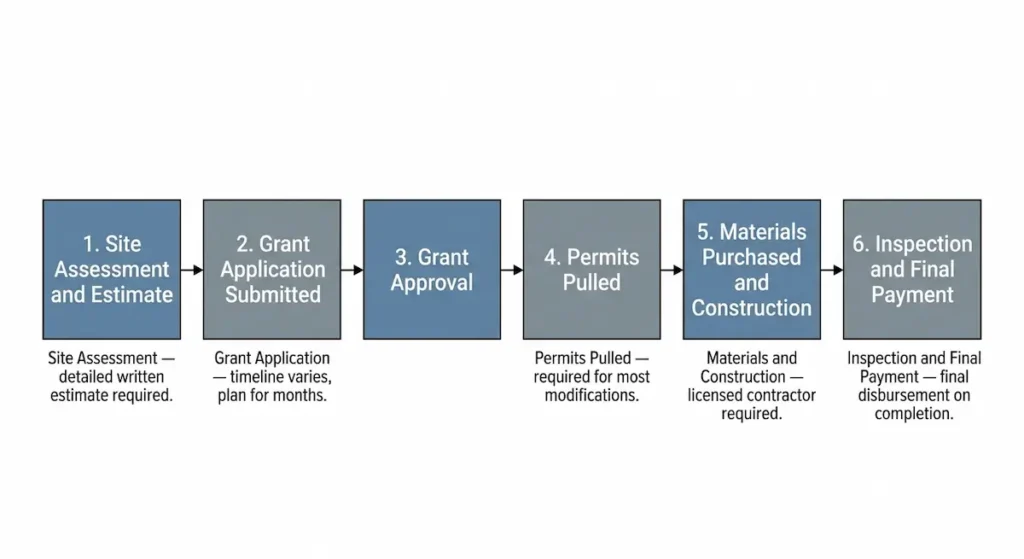
The last grant estimate I went on was for a Hart grant. The woman told me she’d already had a contractor come out — the last guy — who showed up, talked a good game, and it came out he wasn’t even licensed. That wasn’t happening. A licensed and insured contractor is a requirement on grant work not a preference. An unlicensed contractor cannot legally perform the work and the grant organization will not pay for it. You will have gone through the entire application process and have nothing to show for it.
Ask first. Every time.
For the full picture of what to look for before hiring anyone — licensed or not — The Last Guy covers it in detail.
The second question is whether they have done grant work before.
Experience with grant work is valuable but a no isn’t automatically disqualifying. What matters is whether the contractor is willing to put in the effort to understand the process. When I did that Hart grant estimate I had done state work before but never specifically the Hart program. So I looked up the contact for the person overseeing the program in our county and called them. Asked how payment works, when it happens, what the estimate needs to look like. That’s what a contractor willing to do the job right does. They make the call.
The timeline is not fast.
I submitted that estimate a couple of months ago and still won’t know anything definitive for probably another three to four months. If someone needs a modification completed immediately grant funding is not the answer for that modification. Plan ahead.
The estimate has to be specific.
You cannot write tear out tub, install new shower. You need measurements. Step by step description of the work. Exactly what you’re installing and what it’s replacing. The more specific the estimate the more confidence the grant organization has that the money is going where it belongs.
Mid grade materials.
Grants are not funding custom tile or premium fixtures. Think functional, quality, mid grade. The kind of materials a contractor puts in when they want the work to last and the client to be safe on a reasonable budget.
FAQs: Home Repair Grants in Eastern Kentucky
Do I have to own my land to qualify? For most government programs yes. USDA 504 requires you to own both the home and the land. If your mobile home sits on rented land or a family lot without a deed in your name you will likely be denied. Sort out your deed situation before you apply to anything.
Does USDA 504 cover mobile homes? Only if you own the land and the home is on a permanent foundation — not blocks with skirting. If either of those conditions isn’t met you won’t qualify. Call the Hazard office at 606-910-3342 to clarify your situation before applying.
How long does the process take? Longer than most people expect. The Hart grant alone can take three to four months from application to approval. Plan ahead and apply before the need becomes urgent.
What is the Hart grant deadline? April 1st every year. Miss it and you wait until the following year.
Do I need a licensed contractor for grant work? Yes. Every program requires work to be performed by a licensed and insured contractor. An unlicensed contractor disqualifies the project regardless of how far along the application is.
Are there grants for veterans specifically? Yes and they should be your first call. The VA HISA grant covers medically necessary modifications for both service-connected and non-service-connected veterans. Call 1-800-827-1000 before pursuing any other program.
Can I get a grant for a wheelchair ramp? Yes. Ramps are covered under USDA 504, Area Agency on Aging programs, Hart Supported Living, and several of the faith-based organizations on this list. See our [wheelchair ramp in Eastern Kentucky] guide for what a proper ramp actually requires before anyone starts building.
The Bottom Line
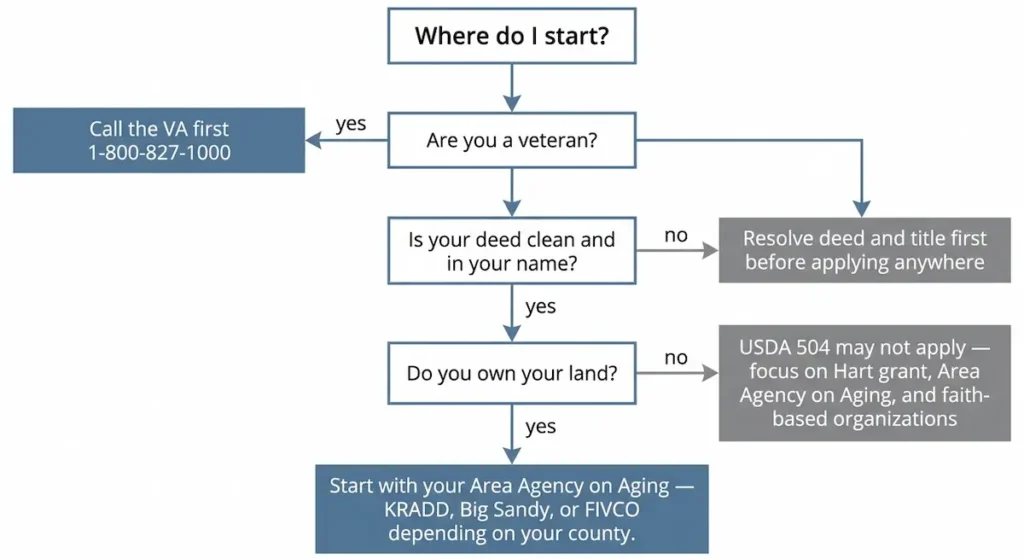
This page covers a lot of ground. If you’re overwhelmed by the home repair grants available in Eastern Kentucky and aren’t sure where to begin, here’s the simple answer, call your Area Agency on Aging first. KRADD, Big Sandy, or FIVCO depending on your county. Tell them you’re looking for home modification assistance and ask what’s currently available for your situation. These offices know the local landscape better than anyone.
If anyone in the household is a veteran call the VA first at 1-800-827-1000 before anything else.
Apply before you purchase anything and before any work starts. Most programs require prior approval. Starting work before approval is the fastest way to lose your funding.
And get that deed sorted out before you do anything else. Everything else is easier once ownership is documented.
For the full picture of aging in place resources specific to this region, including terrain, housing stock, and what makes Eastern Kentucky different from anywhere else, see our Eastern Kentucky aging in place guide.