Keeping It Level
Most people think about grab bars and ramp rails when they hear “aging in place.” And yeah, those matter — we’ve talked about them. But I’m going to tell you something I tell every family I sit down with, the single cheapest, most impactful thing you can do for a senior’s safety at home is fix the lighting. Not the floors. Not the doorways. The lighting. You cannot avoid what you cannot see, and I don’t know how to make it any simpler than that. Outdoor lighting for aging in place isn’t a luxury upgrade — it’s the foundation everything else gets built on. My papaw has lighting from the moment he opens his front door all the way down his ramp to his car. Noon or midnight, he can see every inch of that path. That’s the standard we’re working toward.
- Why Outdoor Lighting Is Different for Seniors and the Elderly
- The Danger Zones: Where Elderly Falls Actually Happen
- Light the Routine, Not Just the Door
- Understanding the Numbers of Outdoor Lighting for Aging in Place: Lumens, Watts, and Kelvins
- LED vs. Everything Else
- Motion Sensors: Good Idea or False Security?
- Hardwired, Low-Voltage, or Solar: Picking the Right Outdoor Lighting for Aging in Place System
- What About Renters?
- The Fancy Stuff Worth Knowing About- Outdoor Lighting for Aging in Place
- The Bottom Line
- FAQs: Outdoor Lighting for Aging in Place
- How bright should outdoor lighting be for seniors and the elderly?
- What color temperature is best for elderly outdoor lighting?
- Are solar lights good enough for senior safety?
- Should I use motion sensor lights for an elderly parent?
- What is low-voltage landscape lighting and is it safe?
- Can I improve outdoor lighting for aging in place without hardwiring anything?
- What are the most dangerous outdoor spots for elderly falls?
- Is LED lighting better for senior outdoor safety?
- FAQs: Outdoor Lighting for Aging in Place
Why Outdoor Lighting Is Different for Seniors and the Elderly
Here’s something most people don’t think about: aging eyes don’t work the same way younger eyes do. By the time someone hits their mid-60s, they need roughly twice the light to see as clearly as they could at 20. By 80, we’re talking about six times more light. That’s not an opinion — that’s biology.
What does that mean practically? It means the porch light that works just fine for you when you walk out to grab the mail might be completely inadequate for your elderly parent navigating those same steps at dusk. What looks “bright enough” to you can genuinely look dim to them.
On top of that, aging eyes are more sensitive to glare and have a much harder time adjusting when moving between bright and dark spaces — like stepping out of a lit house onto a dark porch. That transition moment is where people get hurt.
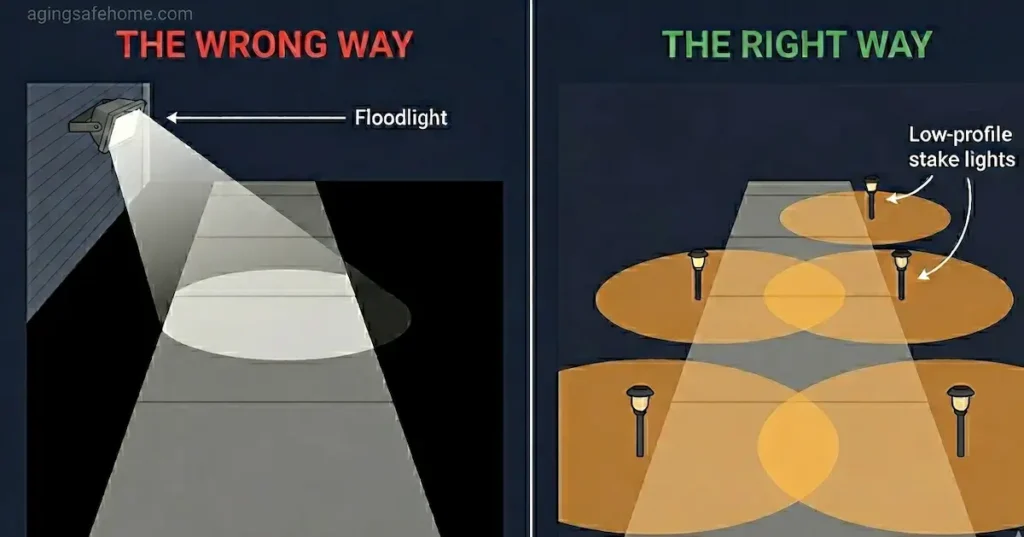
And here’s something most lighting guides don’t tell you: it’s not just about having enough light. It’s about having the right light in the right places. A single blindingly bright floodlight pointed at your walkway might seem like a solid fix. It’s not. What it actually creates is a hot spot — one blinding cone of light surrounded by pitch black. For an elderly person, that’s a visual trap. Their eyes lock onto the bright area, the surrounding darkness becomes invisible to them, and anything outside that cone — a step edge, a pavement lip, the end of a ramp — disappears completely.
The fix isn’t one powerful light. It’s multiple, well-spaced fixtures that create even, consistent coverage across the whole path. Two or three 800-lumen fixtures spread along a walkway will always outperform a single 2500-lumen spotlight — and they’re far safer for aging eyes that are already struggling with contrast and glare.
Bad outdoor lighting for aging in place doesn’t just fail to help. It can actively make things worse. For elderly individuals with any degree of dementia or cognitive decline, harsh shadows can look like holes in the ground. I’ve heard stories of folks going ten feet out of their way to walk around a shadow because to them it genuinely looked like a drop-off. Even, uniform light eliminates that problem. It’s not about maximum brightness — it’s about no dark spots.
The Danger Zones: Where Elderly Falls Actually Happen
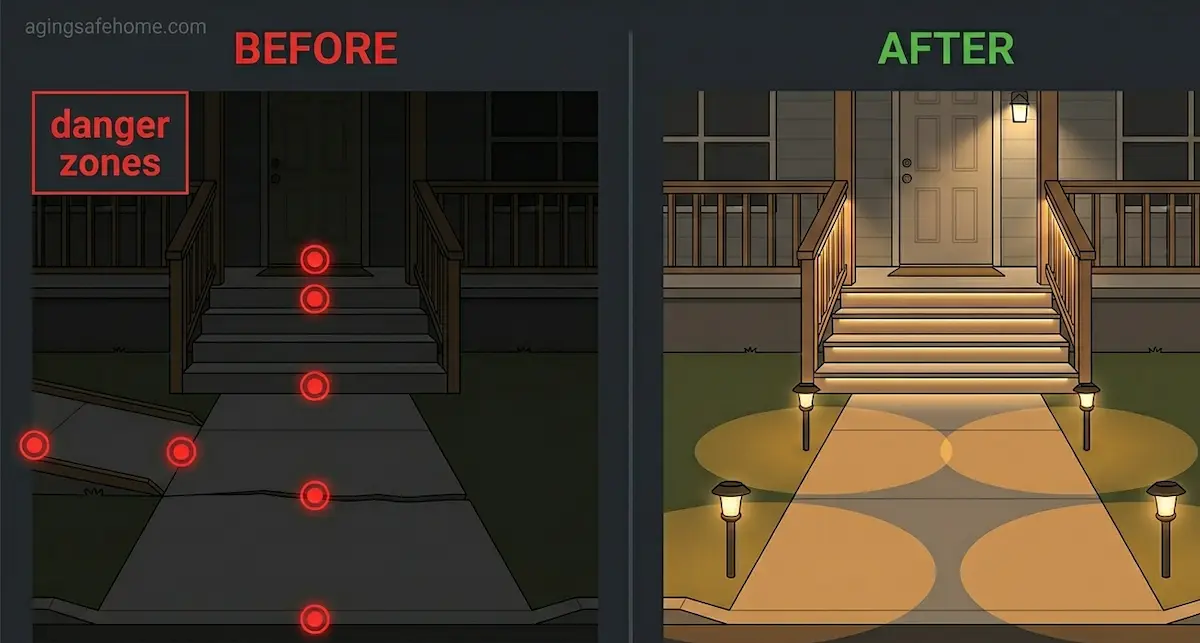
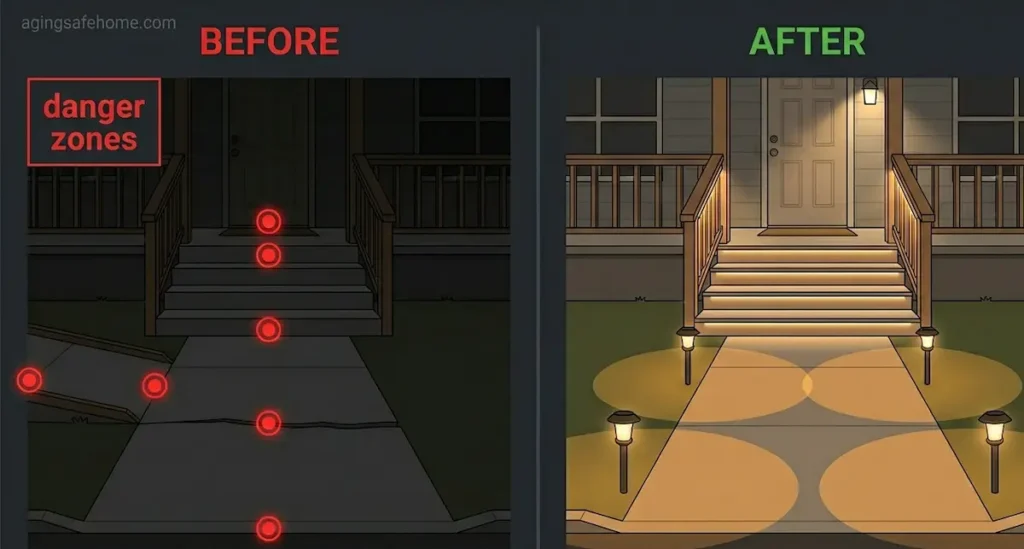
When I walk a property for a senior home assessment as part of the last fifty feet, I’m looking at the same spots every single time. These are where people actually get hurt:
The front door threshold.
Coming in and out of the door itself — especially if there’s any kind of step up or down. If your porch light is positioned poorly, the threshold can sit in shadow even when the light is technically on. That threshold has its own hidden hazard beyond lighting too; most porches are actually built with a few inches drop below the indoor floor on purpose. I cover that, along with the rest of what to check on an existing deck or porch, in my deck and porch safety guide.
Even with a well-lit porch, aiming a key at a small dark keyhole is its own challenge for aging eyes. I cover high-contrast hardware and keyless options in my Door Handles for Seniors guide.
Steps and stairs.
Every step edge needs to be clearly visible. Not the general area — the actual nosing of each tread. A senior who can’t see where one step ends and the next begins is going to misjudge it, and a misjudged step is a fall. I go into the full breakdown of riser height, nosing, and tread safety in my guide to exterior steps for seniors. One of the most effective things you can do here is mount weather-resistant LED strip lighting to the underside of the handrail, or install small, recessed step lights directly into the riser. Either approach casts light straight down onto the tread nosings — right where you need it — without shining up into the senior’s eyes. I covered how dangerous that bottom step transition is in our handrail guide, and the right lighting is what makes all that hardware actually work after dark.
Uneven walkways.
Any place where concrete has heaved, where a seam isn’t flush, where the walkway meets the driveway and there’s a lip — those all need light on them. You can’t avoid what you can’t see. I go into more depth on these uneven surfaces — and the other hazards hiding in a yard that look harmless — in my Outdoor Fall Hazards for Seniors guide.
The edges of ramps and driveways.
Where the concrete drops off, where the ramp ends and the ground begins, where the driveway edge isn’t flush — these are all trip-and-fall locations after dark. If your person uses a ramp, we covered everything you need to know about getting that ramp built right in our wheelchair ramp guide.
The car.
Think about the full path: door to car. Most people only think about the front entrance. But if your person walks 30 feet across a driveway to get to their vehicle, that 30 feet needs coverage too.
Light the Routine, Not Just the Door
This is the piece that most contractors and most homeowners miss. When I’m evaluating a senior’s outdoor lighting situation, I don’t just look at the entrances and walkways — though yes, those are non-negotiable. I ask about the nightly routine.
Does your person walk the dog at night? Then the yard needs light, not just the path to the car. Do they sit on the back porch in the evening? Then that porch and the path to it need coverage. Do they take the trash out after dark? Check the mailbox at night?
The answers to those questions change the lighting plan completely. A standard entrance-and-walkway setup might be totally adequate for one person’s lifestyle and completely miss the mark for someone else. Outdoor lighting for aging in place has to match how that specific person actually lives — not just what a generic safety checklist says.
The good news is that outdoor lighting for aging in place is essentially infinite. You can always add more. There’s no such thing as too much coverage when it comes to keeping an elderly person safe outside their home. I’m the kind of guy who will light it up like Times Square if the situation calls for it, and I make no apologies for that.
Understanding the Numbers of Outdoor Lighting for Aging in Place: Lumens, Watts, and Kelvins
Here’s where a lot of DIYers go sideways. They get online, find two solar pathway lights that look almost identical, see a price difference, and grab the cheaper one. Nine times out of ten they’ve just bought something that won’t actually do the job.
So let me break down what you’re actually looking at when you shop for outdoor lighting:
Lumens — This is brightness. How much light the fixture actually puts out. For outdoor senior safety lighting, lumens are the number that matters most. Higher lumens mean more light, more area covered, better visibility. When you’re comparing two fixtures and one is cheaper, check the lumens first — that’s usually where the difference is hiding.
Watts — This measures energy use, not brightness. It’s useful for knowing what something costs to run, but it doesn’t tell you how bright the light is. Don’t shop by watts.
Kelvins (K) — This is color temperature. It tells you whether a light looks warm or cool:
- 2700K–3000K — Warm white. Cozy and familiar, similar to old incandescent bulbs.
- 3500K–4100K — Neutral to cool white. Crisp and bright, good visibility.
- 5000K–6500K — Daylight. Very bright and bluish-white, maximum contrast and clarity.
For senior safety outdoors, I lean toward the 3000K–4000K range. It gives you strong visibility without the harsh glare that pure daylight bulbs can cause for aging eyes that are already sensitive to brightness.
Bottom line: lead with lumens and color temperature. Watts are secondary.
LED vs. Everything Else
If you still have incandescent outdoor lighting, change it. Today. LED is more energy efficient, lasts dramatically longer, performs better in cold and wet conditions, and gives you better, more consistent light output. It’s not even close.
Same goes for halogen — a lot of older security lights and big spotlights run on halogen, and they burn hot, burn out fast, and are expensive to run. Almost every halogen fixture has an LED conversion available now. Make the switch.
For outdoor aging in place applications specifically, LED is the right call every time. You get better brightness per watt, longer intervals between bulb changes (which matters a lot when you’re dealing with fixtures in hard-to-reach spots), and options across every color temperature you’d want.
Motion Sensors: Good Idea or False Security?
Motion sensors get a mixed reputation and honestly some of that is deserved. A light that only comes on when triggered can leave a senior standing in the dark for that half-second delay, or worse, fail to trigger entirely when someone moves slowly.
That said, I like motion sensors for elderly home safety as a budget option — with one caveat. The ones I recommend aren’t strictly on/off. I prefer fixtures that stay at a low, ambient dim level at all times and go to full brightness when motion is detected. That way you always have some baseline illumination, and the sensor gives you a boost when someone’s actually moving through the space.
Pure on/off motion sensors work fine as a supplement — adding extra brightness at a driveway entrance, for example — but I wouldn’t rely on them as the primary light source for any path a senior uses regularly.
Hardwired, Low-Voltage, or Solar: Picking the Right Outdoor Lighting for Aging in Place System
One of the most common questions I get is whether to go hardwired or solar. The honest answer is that there are actually three options worth knowing about, and the right one depends on your situation.
Hardwired (120V) lighting
This is what most people think of when they picture permanent exterior fixtures — your porch lights, mounted wall lights, wired-in security lights. These are reliable, powerful, and run off your home’s main electrical system. For primary fixtures at the front door and main entry points, this is still my first choice. The downside is that installation typically requires a licensed electrician, especially if you’re adding new circuits or trenching conduit across a yard.
Low-voltage (12V) landscape lighting
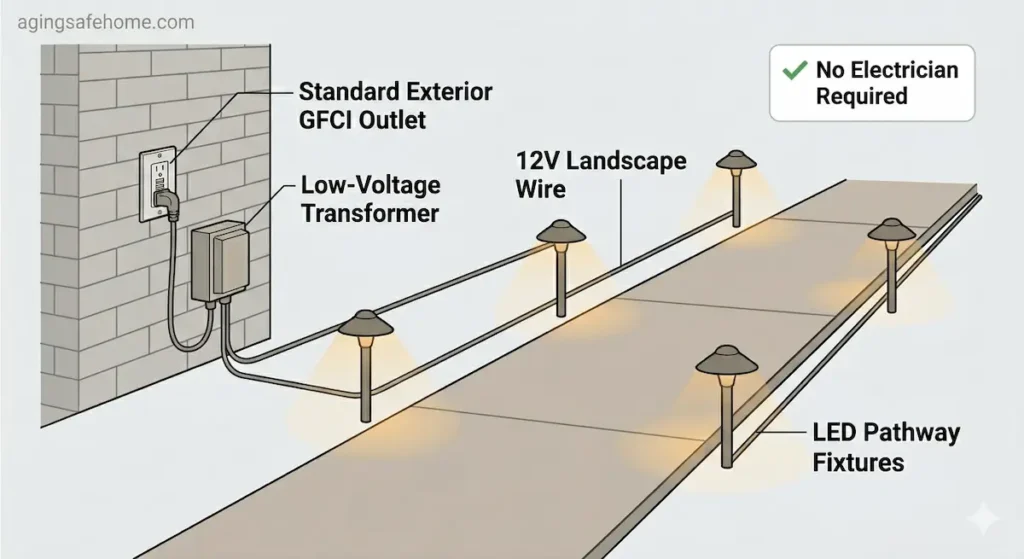
The contractor’s best-kept secret for this kind of project, and honestly it should get more attention than it does. A low-voltage system runs off a transformer that plugs into a standard exterior GFCI outlet — no electrician required, no trenching, no permits in most cases. You run lightweight 12V wire from the transformer out to your fixtures, stake pathway lights wherever you need them, and you’re done. It powers reliably every single night just like a hardwired system, but a motivated person can install a complete pathway lighting setup at their home over a single weekend with basic tools. For coverage along walkways, ramps, driveways, and yard areas, this is where I send most people first.
One upgrade worth knowing: plugging your transformer into a weather-protected battery backup — sometimes called a UPS, or uninterruptible power supply. Because LED landscape lights draw so little wattage, even a compact battery backup can keep your entire pathway lit for hours if the power goes out. On a pitch-black, stormy night when the grid goes down and solar isn’t an option, that battery kicks in automatically and your path stays lit. These are typically a separate purchase on top of your transformer and fixtures, so it’s an added cost to factor in — but for a senior living alone where a blackout means complete darkness on an outdoor path, it’s worth having the conversation about whether it belongs in the budget. If backup power is already on your radar for other reasons beyond lighting, our generator guide covers the broader picture of keeping a senior’s home running when the grid goes down.
Solar lighting
It has come a long way and is a genuinely solid option for supplemental coverage and areas where running any wire isn’t practical. The key is buying quality — which brings us back to lumens. Cheap solar lights often produce barely enough light to see the fixture itself. Quality solar pathway lights can do real work. One thing most people don’t know: you can get solar fixtures with detached panels. So, if you want to light a covered porch or carport that doesn’t get direct sun, you mount the panel somewhere that does — a roof edge, a nearby fence post — and run the low-voltage wire to the fixture. If you’re planning new coverage over your entryway anyway, it’s worth thinking about lighting placement at the same time, a low-pitched awning built without that in mind can throw a shadow right over your door. I cover that, along with the rest of what goes into doing it right, in my porch awnings guide.
For a complete outdoor lighting for aging in place setup, my typical recommendation is hardwired fixtures at the primary entry points, a low-voltage landscape system along pathways and walkways, and solar to fill any remaining gaps or reach areas too far from an outlet.
What About Renters?
If your elderly person rents or lives somewhere they can’t mount permanent fixtures or run wire, solar is your best immediate option. Quality solar pathway lights staked along a walkway can be installed in 20 minutes, zero tools, zero landlord permission, zero electrical work. They go where you need them, power themselves, and can move if the person moves.
It’s not a forever solution, but it’s a right now solution that can meaningfully reduce fall risk tonight. And sometimes that’s exactly what’s needed.
The Fancy Stuff Worth Knowing About- Outdoor Lighting for Aging in Place
Lighting technology has gotten impressive, and some of it is genuinely useful in outdoor lighting for aging in place applications.
Permanent color-changing smart lights — I’ve installed a lot of these. They’re great. For senior safety, the relevant feature isn’t the light show — it’s the smart control. Being able to turn lights on from a phone or voice assistant means your person doesn’t have to remember to flip switches, and a family member can check or control the lighting remotely. That’s legitimately useful.
Dusk-to-dawn sensors — These fixtures have a built-in photocell that turns them on at sunset and off at sunrise automatically. For an elderly person who shouldn’t have to think about whether their outdoor lights are on, this is a simple, low-tech solution that works reliably every night.
Smart plugs and timers — For existing fixtures that don’t have built-in sensors, a smart plug or a simple mechanical timer can automate them. One of the most overlooked and underpriced upgrades in senior home safety.
The Bottom Line
Outdoor lighting for aging in place isn’t complicated, but it does require actually thinking about it — and most people don’t until after something goes wrong. You need even, consistent coverage across every entrance, every step, every edge, and every part of the path your person actually uses at night. You need to understand lumens and kelvins so you’re buying fixtures that do real work. And you need to match the plan to the routine, not just the building.
Hot spots and dark gaps are just as dangerous as no light at all. One bright light in the wrong place surrounded by darkness is not a solution — it’s a different kind of problem.
My papaw steps out his front door and can see everything — every inch of that porch, every board of that ramp, all the way to his car. That’s not an accident. That’s a plan. Make one for yourself or your person.
FAQs: Outdoor Lighting for Aging in Place
How bright should outdoor lighting be for seniors and the elderly?
For primary pathways and entrances, look for fixtures in the 700–1200 lumen range. For broader areas like driveways, 2000+ lumens is appropriate. More important than total brightness is even distribution — multiple lower-output fixtures spread across an area consistently outperform a single high-output spotlight that creates hot spots and shadows.
What color temperature is best for elderly outdoor lighting?
The 3000K–4000K range — neutral to cool white — gives you strong visibility without the harsh glare that daylight-range bulbs (5000K+) can cause for aging eyes that are sensitive to brightness.
Are solar lights good enough for senior safety?
Quality solar lights are effective for pathway and supplemental outdoor lighting for aging in place. The key word is quality — check lumens before you buy, not just price. For primary entry points, hardwired or low-voltage landscape lighting is more reliable.
Should I use motion sensor lights for an elderly parent?
Motion sensors work well as a supplement but not as your sole light source. I prefer fixtures that stay dimly lit at all times and go to full brightness when motion is detected. Pure on/off sensors can leave a senior in the dark during the trigger delay.
What is low-voltage landscape lighting and is it safe?
Low-voltage (12V) landscape lighting runs off a transformer plugged into a standard exterior outlet. It’s safe, reliable, and requires no licensed electrician for most installations. It’s one of the most practical options for adding complete pathway and walkway coverage to a senior’s home, and a motivated person can install a full system over a weekend.
Can I improve outdoor lighting for aging in place without hardwiring anything?
Absolutely. Low-voltage landscape systems plug into a standard outlet, and quality solar pathway lights require no wiring at all. Either option can meaningfully improve safety for an elderly person without electrical work.
What are the most dangerous outdoor spots for elderly falls?
Door thresholds, step nosings, uneven walkway seams, ramp edges, and driveway drop-offs are the highest-risk areas. These should be your first priority — and step lighting in particular should cast light downward onto the tread, not upward into the senior’s eyes.
Is LED lighting better for senior outdoor safety?
Yes, without question. LED outlasts incandescent and halogen, performs better outdoors, and is available in every color temperature. If you’re still running incandescent or halogen outdoors, switching to LED is one of the highest value changes you can make in outdoor lighting for aging in place.
Think your person’s home could use a full safety assessment? Start with our Home Safety Checklist and see where outdoor lighting fits into the bigger picture.