Keeping It Level
Most homes have a guardrail on their porch steps. Most homes do not have proper handrails for seniors. Those are two completely different things with two completely different jobs and confusing them is one of the most common — and most dangerous — oversights I see. This article breaks down what each one is, what it does, what it’s made of, and what you actually need if you want a senior to safely navigate that last fifty feet from the car to the front door.
- Guardrail vs. Handrail: Let's Clear This Up First
- Handrails for Seniors: How Many Steps Before You Need One?
- Before You Add Anything: Check What You Already Have
- Load Rating: Why This Matters More Than You Think
- Height: The Numbers Actually Matter Here
- Graspability: The Word You Need to Know for Handrails for Seniors
- Two Sides Are Better Than One on Handrails for Seniors
- Bring It All the Way Down: Don't Stop the Rail Short
- Watch the Ends: Returned Handrails
- Material Options: What Holds Up Outdoors
- Grip: Don't Overlook the Surface
- Pre-Made Options: What to Look for on Handrails for Seniors
- FAQs: Handrails for Seniors
- Do I legally need a handrail on exterior steps for a senior?
- What is the correct height for an exterior handrail for seniors?
- What's the difference between a guardrail and a handrail?
- What material is best for an exterior handrail for elderly family members?
- My parents have a 2×4 cap on their porch railing — is that safe for aging in place?
- Does a handrail for seniors need to run all the way to the bottom step?
- What is the load rating for exterior handrails for seniors?
- The Bottom Line
If you landed here looking for exterior handrails for seniors, welcome — you’re in the right place. But before we talk about what to buy or what to install, we need to have a quick conversation about terminology, because most people don’t actually know the difference between what they have and what they need. And for a senior aging in place, that difference isn’t just technical — it’s a safety issue.
So pull up a chair. Let’s talk through this together.
Guardrail vs. Handrail: Let’s Clear This Up First
Here’s where I need you to stay with me for just a second, because I promise this matters.
A guardrail
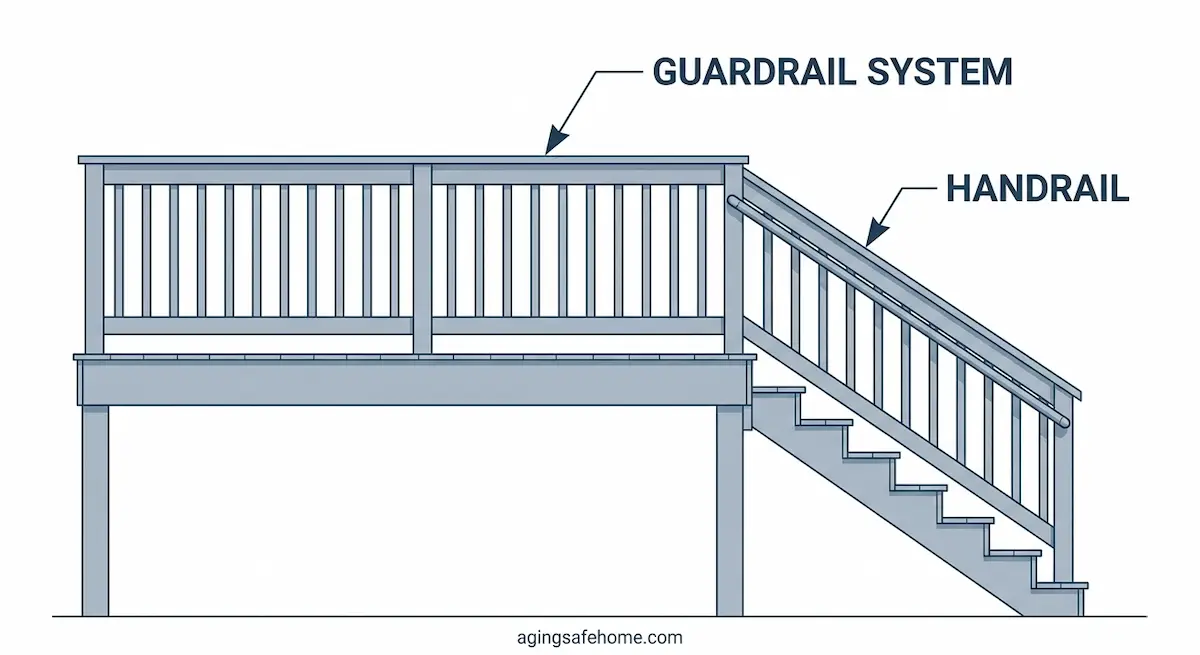
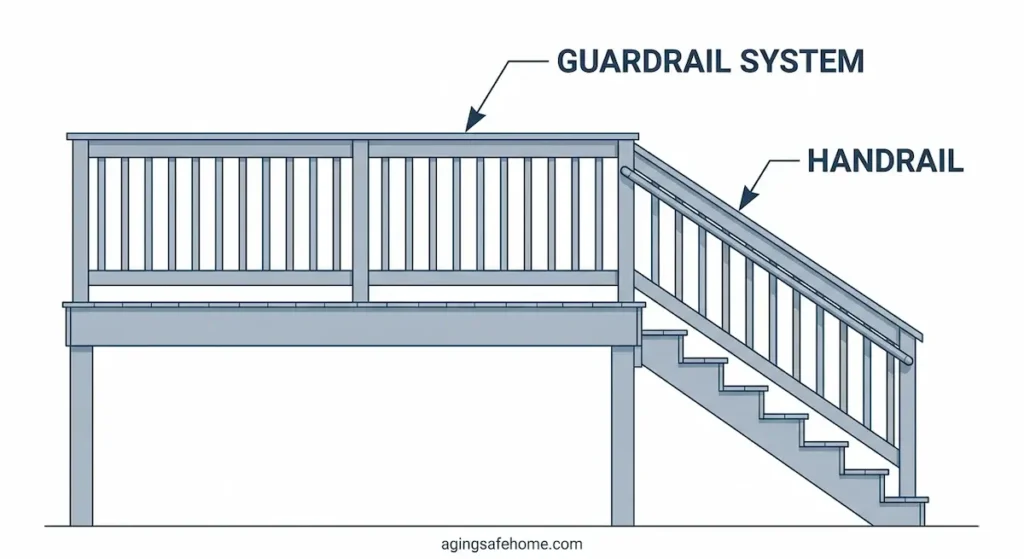
is exactly what it sounds like — a guard. Think of the guardrails on the highway. Their one job is to keep your car from going over the edge. Your porch guardrail works the same way. It’s the full barrier system — the posts, the pickets or balusters, the whole assembly. It keeps you from falling off the side of the steps or the edge of the porch. That’s it. That’s its job. It is not designed to help you navigate the steps. It is a barrier.
A handrail
is the rounded, graspable bar that you actually hold onto for support and guidance going up and down the steps. It can be mounted directly to the guardrail system — either on the inside, on top, or bolted to the side depending on the size of your guardrail — or it can be independently anchored to a wall. It is specifically engineered to be gripped, to be grabbed, and to support you if your footing goes wrong.
One keeps you in. One helps you move. You need both.
Speaking of code — and I want to be really clear about this — code is the minimum. It’s the floor, not the ceiling. It’s the least you are legally required to do. When we’re talking about a senior aging in place, I’d encourage you to think about it differently. We’re not building to pass inspection. We’re building so that your person can safely get in and out of their home every single day for years to come. Code is the Motel 6. Let’s build your grandparents the Ritz.
And while we’re talking about the outside of the home — we’ll leave the lights on too. Outdoor lighting is just as critical as anything we’re going to talk about in this article, and we cover it in depth in our outdoor lighting guide for seniors. But first, let’s make sure there’s something solid to hold onto.
One quick technical note worth mentioning:
A guardrail cap rail CAN legally serve as the handrail if it meets graspability requirements, is at the correct height, and has properly returned ends. So technically you don’t always need two completely separate systems — you need one system that does both jobs correctly. The problem is that the vast majority of older residential guardrails don’t meet those requirements. The cap is too wide, the height is wrong, the ends are open, or all three. Which is exactly why most homes end up needing a separate graspable handrail added to what’s already there. And even when a guardrail cap does meet code — it’s worth knowing that it won’t meet ADA standards, and a dedicated round handrail is still the better choice. Your hand locks completely around a proper handrail in a way it simply can’t on a cap rail. If your existing guardrail happens to meet every building code requirement — great. But if you want the safest possible option for your person, a dedicated handrail is always the answer. If it doesn’t meet code at all — and most don’t — that’s what we’re here to fix.
Handrails for Seniors: How Many Steps Before You Need One?
Standard residential code in most regions doesn’t require a handrail until you have four or more risers. So technically, three steps to your front porch might not require one by code.
Here’s my rule for aging in place: if there is a single step where a foot can slip, it gets a rail. Full stop. Don’t let a code exception make the safety decision for you. A senior with any kind of balance issue, reduced lower body strength, or mobility challenge doesn’t get a pass on physics just because the building department doesn’t require a handrail on three steps. One missed step is all it takes.
Before You Add Anything: Check What You Already Have
Before you add any handrail to an existing guardrail system, get your hands on those posts and shake them. Push on them. If anything moves, if anything is loose, if any post has any play in it at all — that gets fixed first. Always.
Think about it the same way you’d think about a grab bar in the bathroom. What good is a grab bar on a wall that moves when you grab it? The answer is none — and in fact it’s worse than nothing, because it gives a false sense of security and then fails at exactly the wrong moment. A handrail is only as secure as the structure it’s attached to. A wobbly guardrail with a brand-new handrail bolted to it is still a wobbly guardrail. Secure the structure first, then add the rail.
That same shake test applies to your deck or porch railing generally, not just where a handrail’s about to go, I cover the full walkthrough in my deck and porch safety guide.
Load Rating: Why This Matters More Than You Think
Let me tell you a quick story.
There are these little wrought iron grab rails — you’ve seen them, they sell them at every big box store, they bolt right to the brick or the wall next to the steps. One and a quarter inch. They look sturdy enough. They technically meet the bare minimum code requirements in a lot of regions. They are, by the strictest definition, a handrail.
My father — a hefty guy — grabbed onto one of those with his full body weight, ripped it clean out of the wall, and flattened me like a pancake.
Now here’s the thing — the rail itself wasn’t the problem. Wrought iron is incredibly strong. The problem was the anchoring. Whoever installed it used cheap fasteners in old crumbling brick mortar, and the whole thing pulled right out of the wall when it mattered most. The strength of a handrail is only as good as what’s holding it to the structure. The right anchoring method depends on what you’re going into. If you’re anchoring into masonry — brick, block, concrete — use heavy duty epoxy masonry anchors. If you’re anchoring into wood framing, through-bolt it. Either way, do not rely on plastic anchors in old brick or cheap fasteners in crumbling mortar. That’s exactly what failed my father, and it’ll fail your person too at exactly the wrong moment.
OSHA recommends a minimum 200 lb load rating for residential handrails. The ADA standard is 250 lbs. My personal standard is simple — I want to know it’s not going anywhere. When I build something for an elderly or aging in place family member, I build it to last and I build it to hold. False security is worse than no security. If a senior grabs onto a handrail that feels solid and it isn’t — that’s a fall waiting to happen at exactly the wrong moment. Know what your person needs, build accordingly, and anchor it like you mean it. It’s the same principle that runs through every part of the last fifty feet — from the driveway to the door, every element has to actually hold when it matters.
Height: The Numbers Actually Matter Here
Height requirements for guardrails vary by region — I’ve worked places where the perimeter guardrail had to be 36 inches and others where commercial required 42. Always check your local code for guardrail height before you build.
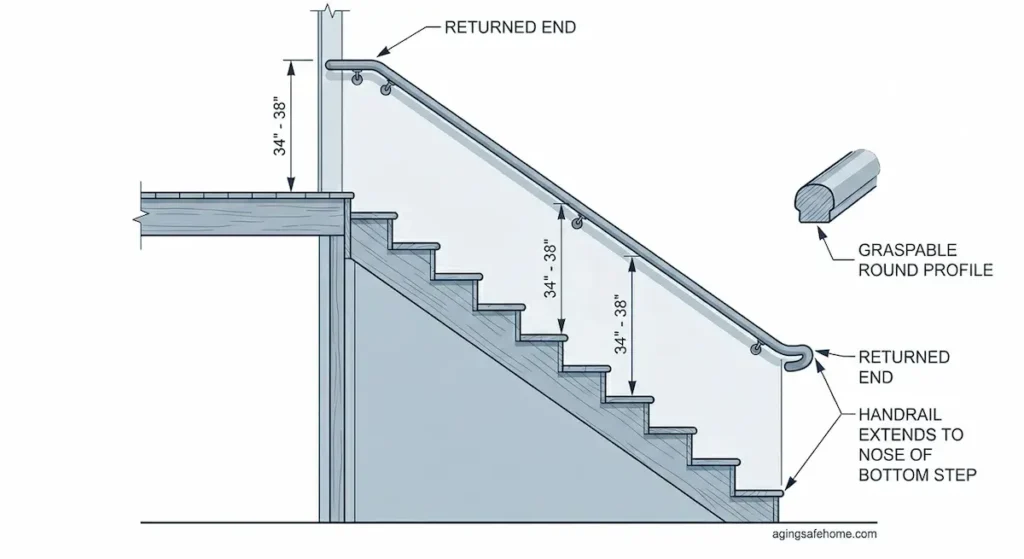
But for a dedicated handrail on steps, the sweet spot is always between 34 and 38 inches measured vertically from the edge of the step up to the top of the rail. That range exists for a reason — it keeps the handrail in the natural, comfortable grip zone where a person can actually use it effectively going up and down. If a handrail is too high, your senior is reaching above their head to grab it. If it’s too low, they’re bending over to reach it. Either way you’ve thrown off their center of gravity at the exact moment they need the most stability. This isn’t arbitrary. It’s biomechanics.
Also make sure there’s adequate clearance between the handrail and any adjacent wall or structure. You need enough space for a hand to actually wrap completely around the rail. If it’s mounted too close to the wall you’ve created a rail nobody can properly grip.
Graspability: The Word You Need to Know for Handrails for Seniors
Let’s talk about the 2×4 cap situation.
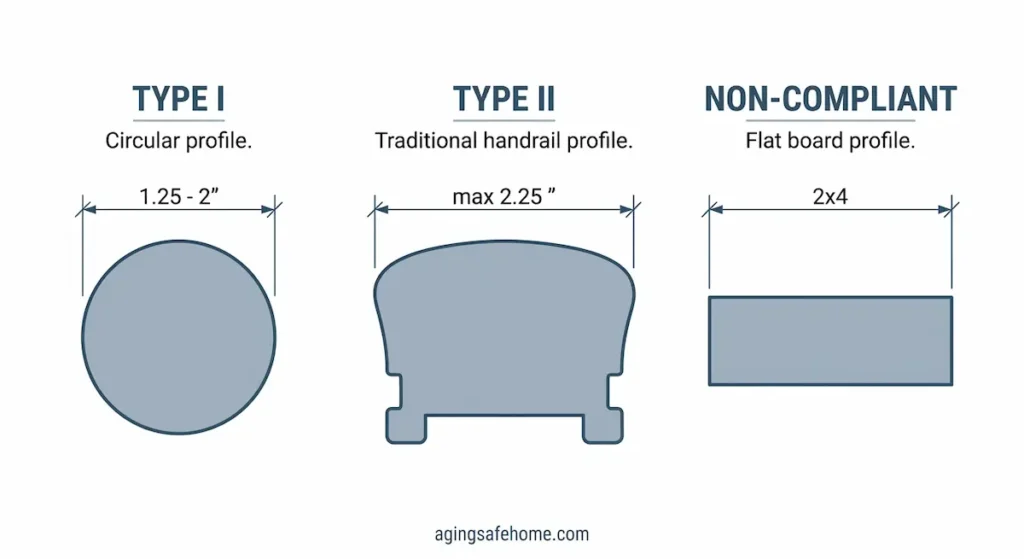
Probably 90% of the residential wooden decks I’ve seen have a guardrail with a 2×4 cap across the top. Does that pass residential code inspection in most regions? Yes. Is it a legal guardrail? Absolutely.
But here’s what it doesn’t do: it doesn’t meet what the building code calls graspability.
What the Code Actually Requires
Under the IRC, a proper handrail has to be either Type I — a circular profile with an outside diameter between 1.25 and 2 inches — or Type II, which has specific finger recess requirements. The reason is simple: your fingers have to be able to wrap completely around the rail and form a secure power grip. A flat 2×4 cap fails that completely. You can rest your palm on it. You can pinch the edge of it. But when your foot slips and your body weight shifts and you need to actually catch yourself — a 2×4 cap is not what saves you.
Do you want your mamaw trying to pinch-grip the flat top of a wide 2×4 deck cap when her foot slips? She needs a graspable handrail — a continuous, rounded rail that her fingers can actually wrap completely around to lock her grip. We are not building this for someone in their twenties who can balance on one foot and still drink their morning coffee. We are building this for an aging senior who may already have reduced hand strength, reduced graspability, and who may already have some trouble walking. The grip matters.
When you’re talking to a contractor or shopping at a big box store, use that word: graspable. Ask if the handrail meets IRC Type I or Type II requirements. It gives you the exact vocabulary you need to make sure you’re getting the right thing. That same graspability principle carries over to armrests on outdoor benches and seating — a decorative curved rail might look nice, but it needs a flat, grippable surface just like a proper handrail does. More on that in my guide to outdoor seating for seniors.
The same graspability principle applies to the door at the top of those steps. I cover lever handles, spring tension, and what to look for in my Door Handles for Seniors guide.
The 2×4 Cap Fix
If you walk outside and see a 2×4 cap on your parents’ porch, don’t panic — you don’t have to tear the deck down.
The easiest, most budget-friendly fix is to leave the guardrail exactly where it is and simply mount a separate, round 1.5-inch graspable pipe rail directly to the inside face of the existing posts or top depending on the height using exterior-rated brackets. It saves the budget, keeps the inspector happy, and gives your elderly or aging in place family member a real rail to lock onto.
Two Sides Are Better Than One on Handrails for Seniors
If you can put a handrail on both sides of the steps, put a handrail on both sides of the steps. I do it every time without exception, and here’s why.
On a wider staircase — and I’ll be honest, I prefer wider staircases — a single rail on one side means your senior has to cross the full width of the steps to reach it. That’s not a handrail, that’s an obstacle course. Two rails means there’s always something within reach no matter where they are on the steps.
But here’s the thing most people never think about: going up and coming down are two different directions, which means the strong side and the weak side flip. A senior with weakness or limited grip on one side wants their strong hand on the rail going up. Coming back down, that’s now the opposite rail. Two rails solves that problem completely — no one has to think about it, plan for it, or remember which side to favor. They just grab what’s there.
And honestly? Two rails looks better. A staircase with matching rails on both sides looks intentional, finished, and solid. It doesn’t look institutional. It looks like someone built it right. Which they did.
Bring It All the Way Down: Don’t Stop the Rail Short
This one comes straight from personal experience watching my own mamaw navigate steps.
That last transition — from the bottom step onto the actual ground — is almost always the hardest one. The footing changes, the angle changes, and for a senior that moment of transition is where things go wrong. I’ve seen it more times than I can count.
Your handrail needs to run all the way down to the nose of the last step. Not almost to the bottom. Not stopping a step or two short because it looked like enough. All the way down to the nose of that last step, so your senior has something solid to hold onto through the entire transition from steps to ground. Don’t shorten your railings. Every inch of that run matters.
Watch the Ends: Returned Handrails
When a handrail stops abruptly with an open end sticking out — at the top, the bottom, or anywhere along the run — that open end becomes a hook. A loose jacket sleeve catches on it. A purse strap catches on it. A walker bag catches on it. And it pulls a senior off balance at exactly the wrong moment.
The correct way to finish a handrail is to return it — curve the end back smoothly into the wall or the post so there’s no open projection sticking out. This is called a returned end, and it’s required under ADA standards and modern IRC code. If you’re buying a pre-made system, make sure it comes with return fittings or that you buy them separately. If you’re hiring someone to install it, ask specifically how they’re terminating the ends before the work starts.
Material Options: What Holds Up Outdoors
Aluminum is the top pick for exterior handrails for seniors. It doesn’t rot, it doesn’t splinter, it won’t rust, and it will outlast almost everything else with minimal maintenance. If budget allows, aluminum is the move.
Composite materials are a close second for the same reasons — no rot, no splinters, low maintenance, and the newer products look great.
Wood is a completely viable option. It will work and it will last. Under a covered porch, protected from direct sun and rain, a properly built wood handrail serves aging in place needs well for years. Out in full sun getting baked every day, it’s going to have a shorter lifespan than aluminum or composite — but shorter doesn’t mean it’s a bad choice. It just means going into it with realistic expectations. Whatever wood product you use, make sure it’s rated for exterior use. That part is non-negotiable.
Vinyl does well outdoors and the newer products are genuinely durable and easy to maintain. One important note: if the product says it’s a post sleeve, it is a sleeve — it goes over a wood post. Do not install it without the wood post inside. A vinyl sleeve with no structural post inside is not a handrail system, it’s a decoration. Read the product specs and install it the way it was designed to be installed.
Grip: Don’t Overlook the Surface
A handrail for seniors that’s the right height, the right profile, and properly anchored can still let them down if the surface itself is slippery — and bare metal in wet or cold conditions absolutely can be. When you’re selecting a handrail, look at the finish the same way you’d look at the profile: it needs to actually work in your conditions.
For aluminum, look for a knurled or peened finish — the same aggressive texture you see on grab bars in bathrooms. That texture exists for exactly this reason. Powder coating adds a layer of grip over bare aluminum and holds up well outdoors. If you already have a rail installed and grip is a concern, rubber or vinyl grip sleeves are a simple retrofit that go right over the existing rail.
Whatever finish you choose, the test is simple: wet your hand and grab it. If it feels secure, it probably is.
The rail is only half the equation, though. If the deck or step surface underneath your feet is just as slick as an ungripped rail would be, you’ve only solved half the problem. I cover the full breakdown of anti-slip coatings, paint, stain, and what actually holds up on wood, composite, and concrete, in my anti-slip deck coatings guide.
Pre-Made Options: What to Look for on Handrails for Seniors
There are plenty of pre-made handrail systems on the market and a lot of them are genuinely solid products. If you go that route, here’s your checklist:
- Rated for exterior use — non-negotiable
- Load rating that meets or exceeds your needs
- If it says sleeve, use a post inside it
- Graspable profile — Type I or Type II under IRC, fingers need to wrap around it completely
- Return fittings for the ends
- Height that will meet your local code requirements — confirm before you install
- Runs all the way to the nose of the last step — don’t let a pre-cut length shortchange you on coverage
FAQs: Handrails for Seniors
Do I legally need a handrail on exterior steps for a senior?
Standard residential code in most regions requires a handrail when you have four or more risers. However, for elderly and aging in place family members, the recommendation is a handrail for any steps at all — even one or two. Code is the minimum legal requirement, not the safety standard.
What is the correct height for an exterior handrail for seniors?
For a dedicated handrail on steps, the sweet spot under IRC and ADA guidelines is between 34 and 38 inches measured vertically from the nosing of the stair tread up to the top of the rail. Guardrail height requirements vary by region so always check local code for that separately.
What’s the difference between a guardrail and a handrail?
A guardrail is the full barrier system — posts, balusters, the whole assembly — that keeps you from falling off the side of steps or a deck. A handrail is the rounded, graspable bar you actually hold onto for support going up and down. Most older homes have a guardrail. Fewer have a proper graspable handrail. You need both.
What material is best for an exterior handrail for elderly family members?
Aluminum is the top pick for longevity and low maintenance outdoors. Composite is a close second. Wood is a solid and affordable option, especially under a covered porch. Vinyl works well when installed correctly. Whatever material you choose, make sure it’s rated for exterior use.
My parents have a 2×4 cap on their porch railing — is that safe for aging in place?
A 2×4 cap is a legal guardrail in most residential code. It is not a graspable handrail. For an elderly or aging in place family member, the fix is straightforward — leave the existing guardrail in place and mount a separate 1.5-inch round graspable rail to the inside face of the posts using exterior-rated brackets. You don’t have to tear anything down.
Does a handrail for seniors need to run all the way to the bottom step?
Yes. The handrail should run all the way to the nose of the last step. That final transition from the bottom step to the ground is one of the most difficult moments for a senior navigating steps. Make sure there’s something solid to hold onto through the entire transition.
What is the load rating for exterior handrails for seniors?
OSHA recommends a minimum of 200 lbs for residential handrails. The ADA standard is 250 lbs. If your family member’s needs exceed those standards, build accordingly. The right load rating is the one that gives your person a genuinely secure hold — not just the one that meets the minimum on paper.
The Bottom Line
A guardrail keeps you from going over the edge. Having handrails for seniors is what actually helps elderly or aging in place family members get up and down safely. Most older homes have one and not the other. Getting the right handrail installed correctly — properly anchored, at the right height, with a graspable profile, with returned ends, running all the way to the nose of that last step, out of the right material for your conditions — that is one of the single most impactful things you can do for exterior safety.
Code is the minimum. It’s the Motel 6 of safety standards. Your person deserves the Ritz. Build it right, build it strong, and build it so it’s still there doing its job ten years from now.
Ready to do a full exterior safety assessment? Download the free Aging Safe Home Safety Checklist and walk through every area of the home.