Keeping It Level:
Not all well water for seniors and elderly adults aging in place is the same — especially across Eastern Kentucky counties like Leslie, Perry, Knott, Letcher, and Breathitt — what’s coming out of your well determines exactly how far you need to go to protect your home, your health, and your hardware. This guide covers well water testing, what your water is trying to tell you, whole home filtration versus fixture-specific systems, filter stages and what they actually do, medical equipment and well water, and what to know about your well pump. Start with a test. Everything else follows from what you find.
- Well Water for Seniors: It's Not All the Same
- What Your Well Water Is Trying to Tell You
- Get It Tested First
- What Untreated Well Water Does to Your Home
- Grab bars and safety hardware.
- Showerheads and diverters.
- Pipes and supply lines.
- Appliances.
- Well Water for Seniors: Should You Drink It?
- Medical Equipment and Well Water for Seniors
- Whole Home Filtration vs. Fixture-Specific — Why Whole Home Wins
- The Filter Stages Explained Without the Jargon
- Where You Put the Filter Matters — Especially for Seniors
- Well Pump Failure — Know Your Pump, Know Who to Call
- FAQ: Well Water for Seniors Aging in Place
- Do I really need to get my well water tested if I've been drinking it for years with no problems?
- My water smells like rotten eggs. Is it safe?
- Can I just put a filter on my showerhead and call it done?
- How do I know when to change my filter?
- Is there financial help available for seniors who need water filtration systems?
- We have a submersible pump and don't know how old it is. Should we be worried?
- The Bottom Line
Well Water for Seniors: It’s Not All the Same
Here’s the thing people get wrong right out of the gate when it comes to well water for seniors aging in place: they hear “well water” and treat it like one thing. It’s not. Well water is as individual as the ground it comes from, and what’s in your neighbor’s well two hollers over might be completely different from what’s in yours.
Think of it like bottled water. There’s a reason some people won’t touch certain brands and drink others just fine. The label says water. The contents tell a different story. Well water works the same way. Some of it is genuinely clean and causes no problems whatsoever. Some of it will turn your shower orange, smell like rotten eggs when you run the tap, and shorten the life of every piece of hardware in your bathroom. The difference isn’t the well — it’s what’s in the ground around it.
That’s why the starting point for any conversation about well water for seniors aging in place isn’t a filtration system. It’s a test. You cannot make good decisions about what your water needs until you know what’s actually in it. Everything in this article follows from that.
What Your Well Water Is Trying to Tell You
Before you test anything, your water may already be giving you information worth paying attention to. For seniors and elderly adults aging in place, knowing what to look for can save real money and prevent real problems.
Orange or rust-colored staining
This staining in your shower, your toilet bowl, or around your faucets means iron. High iron content is one of the most common well water problems in Eastern Kentucky, and it doesn’t just stain — it builds up in showerheads, clogs diverters, and shortens the life of fixtures and hardware. If you’ve got grab bars in that shower, iron-heavy water is working against them every single day.
A rotten egg smell when you run the water
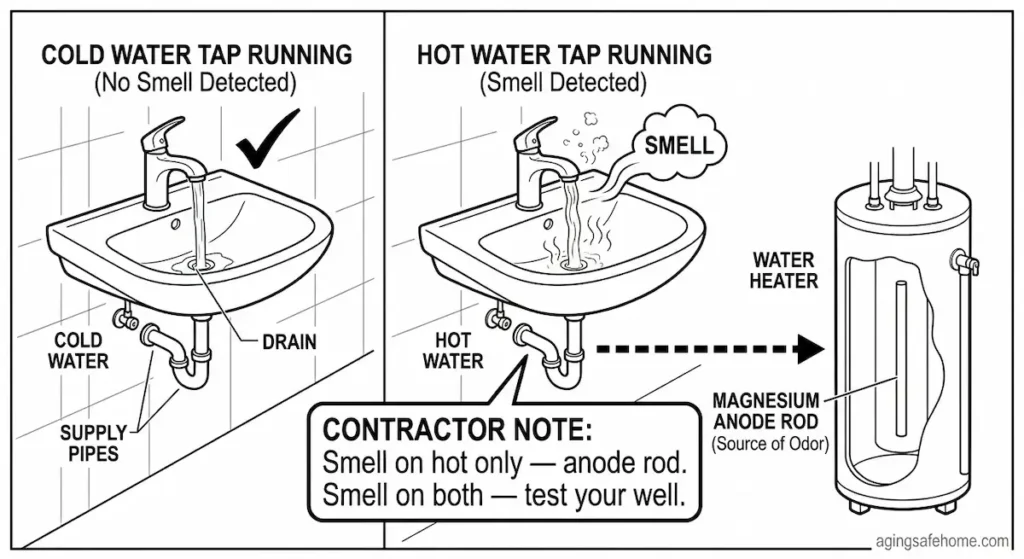
This means hydrogen sulfide gas. Here’s a quick contractor trick that will tell you whether the problem is your well or your water heater: run your cold-water tap, then run your hot tap separately and compare. If the smell is only coming from the hot water, your well isn’t the problem — your well water minerals are reacting with the magnesium anode rod inside your water heater and that’s what’s producing the smell. Swap it for an aluminum/zinc anode rod or a powered anode rod and the problem usually goes away. If the smell is coming from both hot and cold, it’s coming from the ground and your well needs to be tested and treated. Don’t assume it’s one or the other until you’ve run that test. For a full breakdown of what your water heater is actually costing you and how well water affects its lifespan, see the Your Water Heater Is Costing You More Than You Think guide.
White or gray crusty buildup
This buildup around faucets and showerheads means hard water — high calcium and magnesium content. Hard water isn’t a health threat, but it is a hardware threat. It clogs showerheads, gunks up diverters, reduces water pressure over time, and will shorten the life of water-using appliances. For elderly adults aging in place on a fixed income who can’t afford to be replacing fixtures constantly, hard water is a real and ongoing problem.
Skin irritation, dryness, or rashes
Irritation after showering can be related to water quality — minerals, bacteria, or other contaminants that irritate skin. As we age, skin becomes thinner and more sensitive. What a younger person’s skin tolerates without issue can cause real discomfort for an elderly person, particularly one already managing skin conditions.
No visible symptoms at all
This doesn’t mean the water is clean. Some of the most serious contaminants — bacteria, nitrates, heavy metals — have no color, no smell, and no taste. You won’t know they’re there without a test. For seniors aging in place on well water, that invisible category is the one worth taking most seriously.
Get It Tested First
For seniors and elderly adults aging in place on well water — whether you’re in Leslie County, Perry County, Knott County, Letcher County, Breathitt County, or anywhere else in rural Eastern Kentucky — getting your well water tested is the single most important first step. The EPA recommends annual testing for all private well owners and maintains a resource specifically for private well households. Well water for seniors aging in place is not a conversation you can have productively without knowing what’s actually in the water. You cannot treat what you haven’t identified.
Where to get it tested:
Your local county health department is the first call to make. Many county health departments offer free or very low-cost water testing kits, and in some states seniors over 65 qualify for one free bacteria test and one minerals analysis annually. Call your county health department first before you spend money anywhere else.
Your local cooperative extension office is the second option and often the most accessible for rural Eastern Kentucky residents. Extension offices have been helping rural homeowners with water quality questions for decades and they know the regional issues specific to your area.
Mail-in lab kits are a step up in comprehensiveness. You collect the sample yourself following the kit instructions and ship it to a certified lab. Results come back with a full breakdown of what’s in your water. These are more thorough than a basic county test and are a good option if you want a complete picture.
A licensed well water testing company gives you the most thorough results but also the highest cost. If your county test comes back with concerns or you’re near a mining or industrial site — which is a real consideration in parts of Eastern Kentucky — a professional test is worth the investment.
What to expect to pay:
- County health department kits: $20 to $75, sometimes free for seniors
- DIY mail-in kits: $25 to $150 depending on what’s included
- Professional lab testing: $100 to $350
- Comprehensive testing including heavy metals: $200 to $500
Test annually for bacteria at minimum. Minerals and metals every two to three years, or immediately if you notice any change in taste, smell, color, or pressure.
What Untreated Well Water Does to Your Home
This is the part that doesn’t get talked about enough in the context of well water for seniors aging in place, and it matters more than most people realize.
For seniors and elderly adults who have invested in bathroom safety modifications — grab bars, handheld shower heads, shower benches, accessible fixtures — the quality of your well water directly affects how long that investment lasts.
Grab bars and safety hardware.
If your water has high iron, calcium, or other mineral content, that buildup is working on your grab bars, your mounting hardware, and your fixture finishes every single day. A grab bar that isn’t kept clean in hard or iron-heavy water will develop buildup around the mounting points. Over time that can affect the finish, create areas that are harder to grip, and in severe cases contribute to corrosion at the wall connection. For an elderly person or senior whose safety depends on that bar holding under load, this isn’t a cosmetic issue.
Showerheads and diverters.
Sediment and mineral buildup clog showerheads and diverters faster than most homeowners expect. Reduced water pressure in the shower is annoying for anyone. For a senior aging in place using a handheld showerhead for safety, a clogged or failing showerhead is a functional problem. Regular cleaning helps but doesn’t solve the underlying water quality issue.
Pipes and supply lines.
This is the argument for whole home filtration that most people miss. Fixture-specific filters treat the water at the point of use — but the pipes running to that fixture have already carried untreated water the entire way. Sediment and mineral buildup in supply lines reduces flow, creates pressure problems, and shortens the life of the pipes themselves. A whole home filter on the main line addresses this before the water ever reaches those pipes.
Appliances.
Water-using appliances — water heaters, washing machines, dishwashers — all take a beating from hard or sediment-heavy well water. For elderly adults and seniors on fixed incomes, replacing an appliance before its time is a budget hit nobody needs.
Well Water for Seniors: Should You Drink It?
This is a question worth answering directly because a lot of elderly adults aging in place on well water have been drinking it their whole lives without a second thought — and for many of them that’s completely fine. For others it’s not, and the difference is entirely in what’s actually in the water.
Here’s the honest contractor answer: I don’t drink my well water. We have a whole home filtration system and I still buy bottled water for drinking. My papaw is the same way. That’s a personal choice based on knowing what’s in the ground around here and deciding the margin for error isn’t worth it.
What I recommend to seniors and elderly adults aging in place on well water:
Get it tested first.
If the test comes back clean and continues to come back clean annually, drinking it may be perfectly fine. If there are any concerns at all — bacteria, nitrates, heavy metals — don’t rely on the filtration system alone for your drinking water.
For drinking, use certified purified bottled water or a dedicated reverse osmosis filter at the kitchen tap.
Reverse osmosis removes contaminants without stripping out everything the way distillation does, which makes it the better long-term drinking water solution for seniors aging in place. A countertop or under-sink RO unit paired with a whole home system gives you the most complete coverage — filtered water throughout the house for bathing and appliances, and a dedicated clean drinking source at the kitchen tap.
Save the distilled water for your medical equipment,
Distilled and purified are not the same thing and they’re not interchangeable for every use.
As we age, immune systems become less resilient. Contaminants that a healthy 40-year-old handles without issue can cause real problems for an elderly person, particularly one managing chronic conditions or taking multiple medications. The margin for error shrinks with age. Don’t leave it to chance.
Medical Equipment and Well Water for Seniors
This is the angle that almost nobody covers seriously when writing about well water for seniors aging in place — and it matters enormously for elderly adults managing health conditions at home.
CPAP and BiPAP machines
These are among the most common pieces of home medical equipment used by elderly adults and seniors aging in place. These machines require distilled water in the humidifier chamber — not filtered water, not bottled spring water, not purified water. Distilled water specifically. Well water in a CPAP humidifier will leave mineral deposits in the chamber and the tubing, shorten the life of the machine, and create a breeding environment for bacteria and mold. Even city water with its chlorine content will shorten the life of these machines faster than distilled water. Distilled water is not a suggestion from the manufacturer — it’s a maintenance requirement. Buy it specifically for this purpose and don’t substitute.
Home humidifiers
Humidifiers have the same issue. Hard well water in a humidifier creates white dust — mineral particulate that gets dispersed into the air along with the moisture. For an elderly person with respiratory issues, that mineral particulate in the air is not a small thing. Distilled water in humidifiers eliminates that problem completely.
Nebulizers and other respiratory equipment
Ones that use water should also use distilled water for the same reasons. If the equipment manufacturer specifies distilled, that’s what goes in it. No exceptions.
The point here isn’t complicated: for any medical device that uses water, use distilled. It protects the equipment and it protects the person using it. A gallon of distilled water costs next to nothing compared to replacing medical equipment that failed before its time or dealing with a respiratory issue caused by mineral particulate in the air.
Whole Home Filtration vs. Fixture-Specific — Why Whole Home Wins
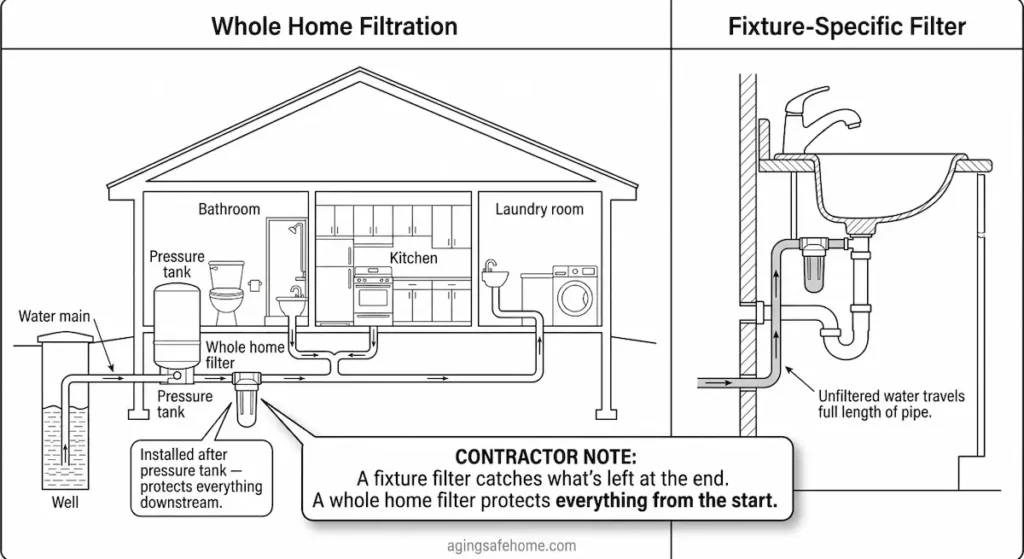
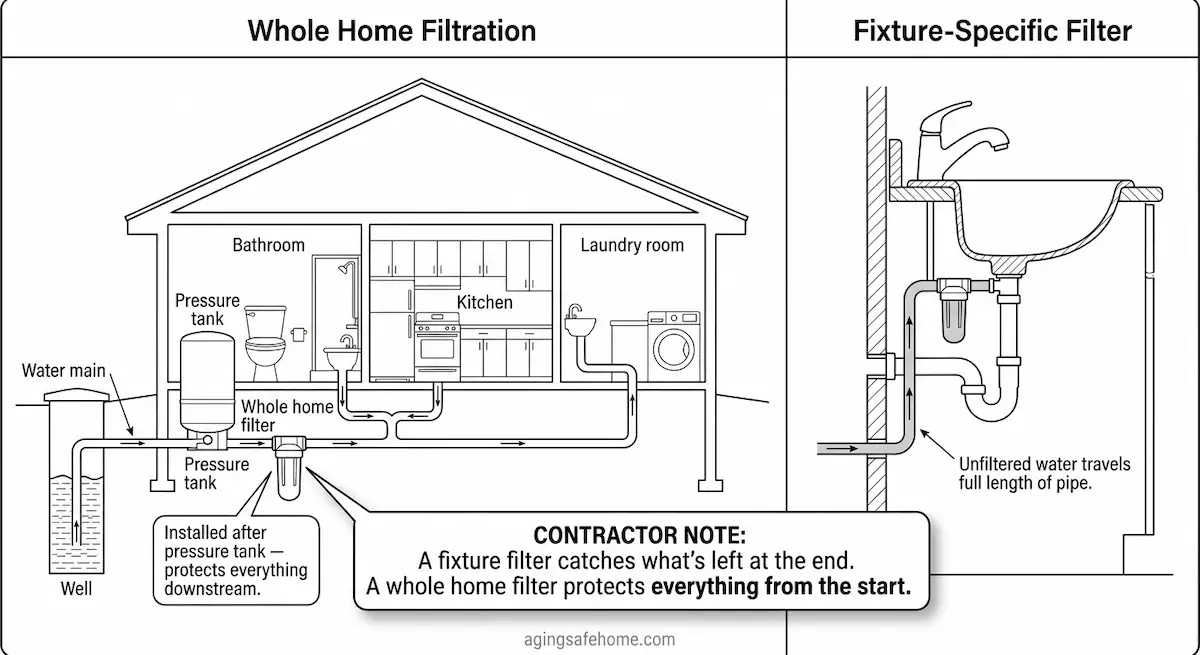
For seniors and elderly adults aging in place on well water, this is one of the most important decisions in the whole conversation — and the answer is almost always whole home.
Here’s the argument in plain terms: a fixture-specific filter treats the water at one point of use. Under the sink, on the showerhead, at the tap. That’s fine for what it is. But the pipes running to that fixture have been carrying untreated water the entire way. Whatever is in your well water — sediment, iron, minerals — has been moving through those supply lines unfiltered right up until the last few inches before the filter catches it. The pipes are still getting the full impact. Every fixture upstream of that filter is still getting the full impact.
A whole home filtration system installs on the main line coming into the house — before the water branches off to any fixture, any appliance, any pipe in the home. Everything downstream gets filtered water. The pipes are protected. The fixtures are protected. The appliances are protected. The shower your elderly parent uses every morning is getting filtered water from the moment it enters the house.
Contractor note — this is important:
Make sure your plumber installs the filtration system downstream of your well’s pressure tank — meaning after it, not before it. If a filter gets installed between the well pump and the pressure tank and that filter gets clogged with heavy sediment, it will back up pressure against the pump. The pump keeps running, pressure builds, and you end up with a burned-out pump or a blown line. After the pressure tank. Make sure whoever does the work understands that before they start.
The Filter Stages Explained Without the Jargon
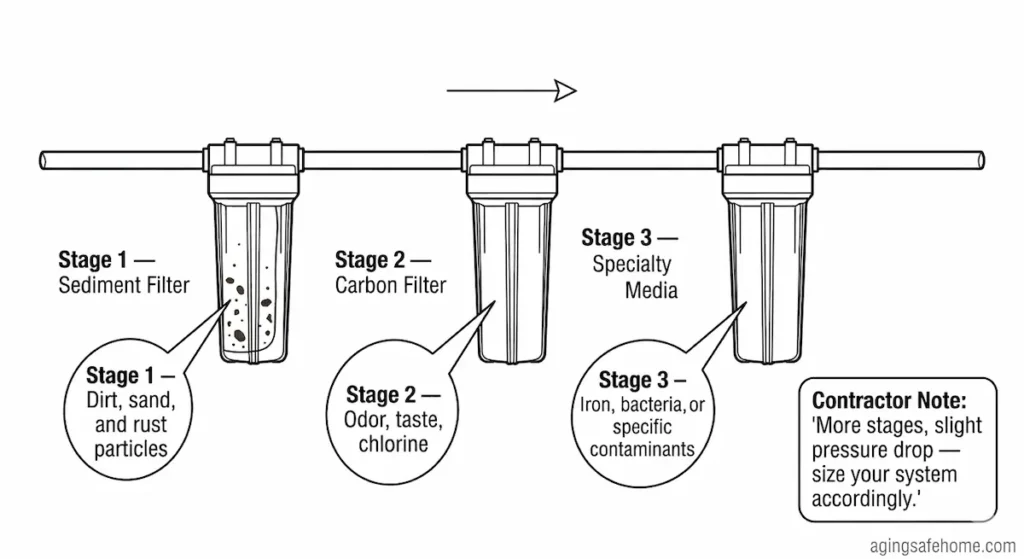
Whole home filtration systems come in different configurations and different price points. Here’s what the stages actually mean and what each one does — and what they mean for well water for seniors aging in place specifically.
Single stage — sediment filter
This is the bare minimum for any home on well water. A sediment filter catches particulate matter — dirt, sand, rust, and debris — before it moves through your pipes and into your fixtures. If you have well water and no filtration at all right now, a single sediment filter is where you start. It won’t solve iron, bacteria, or chemical problems — but it addresses the most immediate hardware protection issue, and it is the foundation every other stage builds on.
Dual stage
Adds a second filter stage — typically a carbon filter — after the sediment filter. Carbon filtration addresses taste, odor, chlorine, and some chemical contaminants. If your water has any smell or taste issues beyond what a sediment filter handles, a dual stage system is the next step up.
Three stage
Three stage systems combine sediment filtration, carbon filtration, and a third stage — which depending on the system might be a finer sediment filter, a specialty media filter for iron or specific contaminants, or other targeted treatment. More stages mean more comprehensive coverage and less chance of something getting through. If your water test comes back with multiple concerns, a three-stage system is where to start the conversation with a plumber.
A word on water pressure before you decide on stages.
Every filter stage you add creates a slight restriction on water flow. If your well pump is already older and struggling to give you a strong shower, pushing that water through two or three tight filter stages can drop your pressure to a trickle. Before you commit to a multi-stage system, check your starting water pressure and have that conversation with your installer. A good plumber will size the system correctly, so filtration doesn’t come at the cost of usable water pressure. This matters especially for elderly adults and seniors aging in place who depend on consistent shower pressure for safe bathing.
Specialty additions — chlorine injectors, UV treatment, water softeners
These address specific problems. Chlorine injectors treat bacteria in the water supply. UV treatment kills bacteria and viruses without chemicals. Water softeners specifically address hard water — high calcium and magnesium — which is a separate issue from filtration. Your water test results will tell you which of these you actually need. Don’t buy specialty additions before you have test results telling you there’s something to treat.
The cost range:
A basic single sediment filter runs a few hundred dollars installed depending on what you buy. A comprehensive multi-stage system with specialty treatment can run into the thousands depending on what your water requires and who installs it. Get the test first, then have the conversation about what system your specific water actually needs. If the cost of a multi-stage system feels like too much at once, see the Doing It in Phases guide for how to plan improvements in the right order without doing everything at once.
Where You Put the Filter Matters — Especially for Seniors
This is something I want every elderly adult and senior aging in place on well water to hear clearly: where your filtration system is physically located in your home matters as much as what kind of system it is — maybe more, if you’re the one who has to maintain it.
Filters need to be changed. How often depends on your water quality, your system, and how much water your household uses — but they need to be changed. And if the filter is somewhere an elderly person can’t safely or comfortably access, it won’t get changed on schedule. An overloaded filter that goes too long without replacement stops doing its job and can actually make water quality worse.
The right location for a whole home filtration system for seniors aging in place is somewhere accessible. A utility closet at a reasonable height. A garage. A pump house if you have one. Somewhere you can walk to, stand comfortably, and reach the filter housing without crawling, bending into a tight space, or climbing.
My filtration system is in my garage, mounted at a height that makes it easy to reach. That was intentional. My papaw, on the other hand, had his put in the only place that made sense at the time — right underneath his trailer. A decade ago that was inconvenient but manageable. Now? Guess who’s crawling under there to change the filter. Me. Every time.
When a plumber installs your system, have that conversation before they start running lines. Tell them you need it somewhere accessible as you get older. A good plumber will work with you on placement. If they dismiss that concern, find a different plumber. If you’re in a mobile home specifically, filter placement deserves extra thought before anyone starts running lines. See the Aging in Place in a Mobile Home guide for the full picture on modification planning in manufactured housing.

Well Pump Failure — Know Your Pump, Know Who to Call
For seniors and elderly adults aging in place on well water — particularly in rural Eastern Kentucky counties like Leslie, Perry, Knott, Letcher, and Breathitt — the well pump is the piece of the system that doesn’t get thought about until it stops working. Then it gets thought about immediately.
There are two main types of residential well pumps and it’s worth knowing which one you have.
Submersible pumps
These are installed down inside the well itself, below the water line. They’re completely out of sight and out of reach. When a submersible pump fails, the repair requires pulling it up out of the well — that’s a job for a licensed well pump technician and there’s no version of it that makes sense to attempt yourself.
Jet pumps
sit above ground, typically in a pump house or a utility space near the well. You can see them, hear them running, and notice when something changes. Jet pumps are still a call-a-professional situation when they fail — but the accessibility makes diagnosis and service somewhat more straightforward.
Either way the recommendation for seniors and elderly adults aging in place is the same: know which type of pump you have, know who to call when it fails, and have that number before you need it. A well pump failure in January in Leslie County is not the time to start looking for someone who knows what they’re doing.
One note worth making: just like choosing a plumber for your filtration system, make sure whoever you call for well pump work has actual experience with wells. There are contractors in every trade who will take a job they’re not really qualified for. A plumber who has spent their career on city water systems may have never dealt with a submersible pump or a rural well setup. Ask directly. If not, you might end up with The Last Guy.
If your pump sits in a pump house, keep it insulated and protected from freezing through Eastern Kentucky winters. Heat tape on exposed lines, adequate insulation in the structure, and a check before hard freezes hit are the maintenance habits that prevent an emergency. A pump house that freezes is a much bigger and more expensive problem than one that was properly winterized going into November.
FAQ: Well Water for Seniors Aging in Place
Do I really need to get my well water tested if I’ve been drinking it for years with no problems?
Yes. The most serious contaminants in well water for seniors — bacteria, nitrates, heavy metals — have no taste, no color, and no smell. You won’t know they’re there without a test. Wells also change over time, especially after flooding, construction, or mining activity nearby. Annual bacteria testing is the minimum regardless of how long you’ve been on the same well without issues.
My water smells like rotten eggs. Is it safe?
Run this test before you do anything else. Turn on your cold tap, then your hot tap separately and compare. If the smell is only on the hot side, your well is likely fine — the smell is coming from a reaction between your well water minerals and the magnesium anode rod in your water heater. An aluminum/zinc or powered anode rod swap usually solves it. If the smell is on both hot and cold, it’s coming from the ground and your well needs to be tested. Don’t drink cold water with that smell until you know what you’re dealing with.
Can I just put a filter on my showerhead and call it done?
No. For well water for seniors aging in place a showerhead filter treats one fixture and leaves everything else — your pipes, appliances, and every other water source in the home — completely unprotected. A whole home system installed after the pressure tank is the right answer when well water has quality issues.
How do I know when to change my filter?
It depends on your system, your water quality, and household size. Filters are rated by gallon capacity — a single elderly person living alone gets more life out of a filter than a larger household. A general range is every one to six months. When the system gets installed ask the plumber for a specific replacement schedule based on your water and your usage. Set a reminder and stick to it — a filter past its service life stops doing its job.
Is there financial help available for seniors who need water filtration systems?
Potentially yes. USDA Rural Development offers loans and grants for rural homeowners covering water and waste disposal improvements. The Kentucky Weatherization Assistance Program and Area Agency on Aging programs may also cover qualifying improvements for elderly adults and seniors. See the Senior Home Repair Grants in Eastern Kentucky guide for every available program and what it takes to qualify before you assume the cost is out of reach.
We have a submersible pump and don’t know how old it is. Should we be worried?
Submersible pumps typically last 10 to 15 years with proper maintenance. A well service technician can give you a general assessment during a service call if you don’t know the age. Watch for these warning signs: reduced water pressure, the pump cycling on and off more than normal, air sputtering from the tap, or discolored water that wasn’t there before. A planned replacement on your schedule is a very different situation than an emergency call during a January ice storm in Eastern Kentucky — don’t wait until it fails completely.
The Bottom Line
Well water for seniors aging in place starts with one step — get it tested. Your county health department, local extension office, or a mail-in kit will tell you exactly what you’re dealing with. Everything in this article follows from that answer.
Clean water gets tested annually and left alone. Problem water gets a whole home filtration system on the main line, after the pressure tank, sized correctly for your household. Purified or reverse osmosis for drinking. Distilled for medical equipment. Know your pump and have a number to call before something goes wrong.
Your well is the foundation of everything else. Don’t guess at what’s in it.
For aging in place resources and modifications specific to Leslie, Perry, Knott, Letcher, and Breathitt counties see the Eastern Kentucky Aging in Place Guide. For funding help see the Senior Home Repair Grants in Eastern Kentucky guide.
Stay safe. Keep the water clean.