Keeping It Level:
A hot water heater for seniors aging in place is the second largest energy expense in the average eastern Kentucky home right behind the HVAC system — and most elderly adults living in Leslie, Perry, Knott, Letcher, and Breathitt counties have no idea. An old inefficient unit can account for 18 to 25 percent of your electric bill every single month. This guide covers what every senior aging in place in eastern Kentucky needs to know from a contractor’s perspective — the cheap fixes that help immediately, the warning signs a replacement is coming, the honest comparison between electric, propane, and tankless systems, and what a failing water heater can do to a home on a fixed income if nobody catches it in time.
- The Second Biggest Line Item on Your Bill
- The Dollar Store Thermos vs. The Stanley
- Hot Water Heater for Seniors: The Cheap Fixes First
- Warning Signs a Hot Water Heater for Seniors Is on Its Way Out
- Electric vs. Propane vs. Tankless: The Honest Conversation
- Well Water and Your Water Heater
- Know How to Shut the Water Off
- Help Paying for a New Hot Water Heater for Seniors
- FAQ: Hot Water Heater for Seniors in Eastern Kentucky
- How much of my Kentucky Power bill is my water heater responsible for?
- How often should I flush my hot water heater in eastern Kentucky?
- Should an elderly person in eastern Kentucky get a propane or electric water heater?
- Is tankless worth it as a hot water heater for seniors on a fixed income?
- What are the warning signs a hot water heater for seniors is failing?
- Is there help paying for a hot water heater for seniors in eastern Kentucky?
- The Bottom Line
I got a call not long ago about a water heater that had stopped working. Not unusual. I go out, take a look, and I ask the homeowner when it was last serviced. Maintained. Flushed. Anything.
Thirty years. The unit was thirty years old and had never been touched.
I want you to understand what thirty years of sediment buildup looks like inside a water heater. I want you to understand what thirty years of neglect does to a unit that was only ever designed to last ten. At that point you’re not calling a contractor to fix a water heater. You’re calling a contractor to tell you what you already know — that it’s time to buy a new one and pray it didn’t leak somewhere you haven’t found yet.
That call is what this article is about. Not because I think every elderly adult aging in place in eastern Kentucky has a thirty year old water heater sitting in their utility room. But because I think a lot of seniors on fixed incomes are running units that are older and less efficient than they realize, costing them more on their Kentucky Power bill every single month than they should be paying, and nobody has ever sat down and explained what to do about it.
That’s what we’re doing here.
The Second Biggest Line Item on Your Bill
Most people think about the HVAC system when they think about their electric bill. And they’re right to — it’s the biggest energy expense in an average home. But the hot water heater for seniors aging in place is sitting right behind it in second place and it doesn’t get nearly the attention it deserves, especially for elderly adults on a fixed income in eastern Kentucky.
Here’s what the numbers actually look like. A unit that is ten years old or older is typically responsible for 18 to 25 percent of your electric bill. A newer more efficient hot water heater for seniors runs 14 to 18 percent. The better the quality of the unit the lower that number goes. That difference compounds every single month on top of whatever Kentucky Power is already charging you — and if you haven’t read the Kentucky Power bill article yet, that’s worth your time.
How do you know how efficient your unit is? Look at it. There is a label on every water heater that tells you exactly how many kilowatt hours it uses. The lower that number the more efficient the unit. If you have an old water heater and you’ve never looked at that label, go look at it. What you find might surprise you.
The Dollar Store Thermos vs. The Stanley
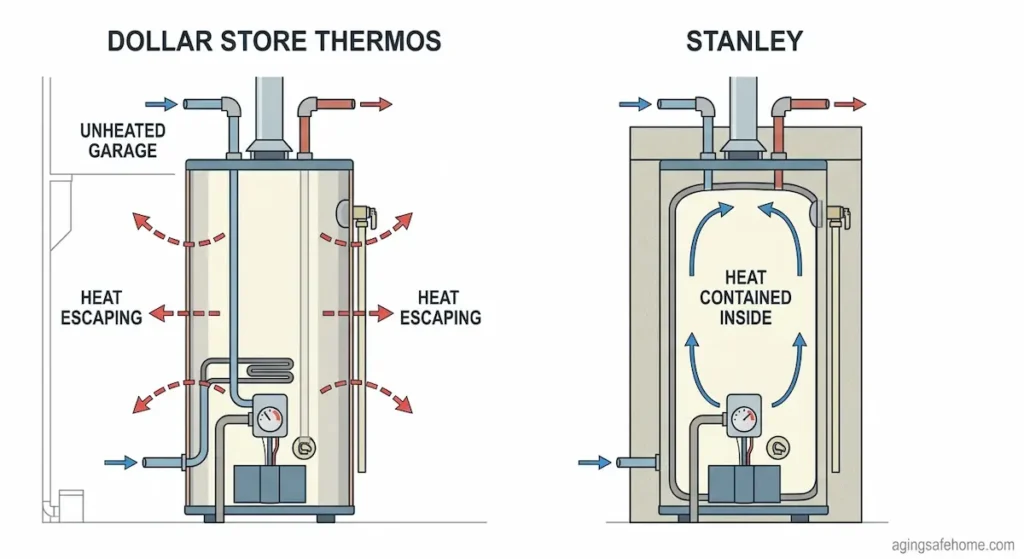
You already know the cooler analogy from the Kentucky Power bill article. Your home is a Yeti or a dollar store cooler depending on how well it’s sealed and insulated. The right hot water heater for seniors works exactly the same way.
A water heater heats your water to the desired temperature and then kicks off. It holds that temperature for a while — like a thermos. But eventually even a thermos gets cold. The better the unit the longer it holds that temperature before it has to kick back on. The worse it is — old, inefficient, uninsulated, sitting in an unheated garage in January — the faster it loses that heat and the more often it kicks back on to compensate.
Do you want the dollar store thermos or the Stanley? Because that’s the question every eastern Kentucky senior aging in place should be asking about their water heater. Every time that unit kicks on unnecessarily it’s running up your bill. Every time it holds temperature longer it’s saving you money.
The good news is there are things you can do about this right now, some of them for next to nothing.
Hot Water Heater for Seniors: The Cheap Fixes First
Insulation blanket.
If your hot water heater is in a garage, basement, crawl space, or any area that isn’t climate controlled, an insulation blanket is one of the best cheap investments you can make. It wraps around the tank and helps it hold temperature longer — same concept as the thermos, just adding another layer between the hot water and the cold air around it. Even if the unit is inside the home in a closet a blanket still helps, just not as dramatically. They’re inexpensive, widely available, and most homeowners can put one on themselves. If your hot water heater is sitting in an unheated space in eastern Kentucky in January without one, it is working harder than it needs to.
Temperature setting.
The ADA standard for water heater temperature for elderly adults and seniors aging in place is 120 degrees. A lot of units out here are set higher — 140 degrees is common — which means the heater is working harder than necessary to maintain a temperature you don’t actually need. Turn it down to 120. It costs nothing and reduces how often the unit has to run. As a private homeowner you can set it wherever you want, but 120 is the right number for most households and the standard recommendation for seniors specifically.
Flushing sediment.
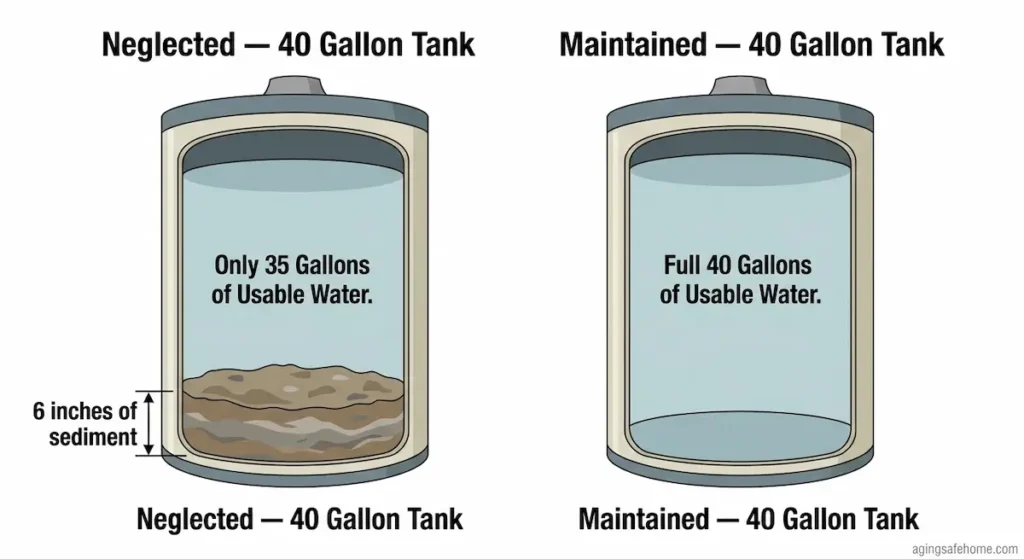
This is the maintenance task most people never do, and it is quietly killing hot water heaters across eastern Kentucky. Here’s what sediment actually does: it takes up space inside the tank. If you have a 40-gallon water heater and six inches of sediment sitting in the bottom you’ve lost four or five gallons of capacity. You’re not running a 40-gallon water heater anymore — you’re running a 35 gallon one and running out of hot water faster than you should be.
Sediment also forces the unit to work harder to heat the water above it, which increases wear and drives up the bill. And if you never flush it, it keeps building until eventually it clogs the drain valve and the unit can’t be flushed at all. That’s usually when the replacement conversation starts whether you’re ready for it or not.
How to flush it is straightforward — there’s a hose bib at the bottom of the tank. Hook up a garden hose, run it outside to wherever you want the water to go, open the valve, and let it drain until the water runs clear. Depending on the size of the tank that’s anywhere from 10 to 30 minutes. It’s a DIY job most homeowners can handle themselves.
How often? Manufacturers say once a year. I say twice — every six months — for eastern Kentucky homes on well water with higher sediment loads. If you’re living alone on city water with an electric water heater you can probably get by with once a year. Gas water heaters accumulate sediment faster than electric ones and need it more often.
One warning:
If your hot water heater has never been flushed and it’s been years, proceed carefully. A drain valve that hasn’t been opened in a decade may not want to close properly again once you open it. If you’re not sure, call someone. Don’t find out the hard way that the valve won’t close with the hose running.
Warning Signs a Hot Water Heater for Seniors Is on Its Way Out
For seniors and elderly adults aging in place in eastern Kentucky — especially those living alone in Leslie, Perry, Knott, Letcher, and Breathitt counties — knowing what a failing water heater looks like before it becomes a crisis matters. Water is one of the most damaging things that can happen to a home outside of fire. A slow leak in a utility room that nobody catches for a week does serious damage. On a fixed income, serious water damage is not just an inconvenience. It can be a genuine threat to staying in the home.
Here’s what to watch for:
Black sediment or flecks in the water from the hot tap.
This usually means the magnesium anode rod — the sacrificial rod designed to keep your tank from rusting out — is completely degraded. The anode rod and the heating element are two different components. The anode rod’s whole job is to corrode so the tank doesn’t. When it’s gone the tank starts going next. If the water turns rusty rather than showing black flecks, the tank itself is already corroding from the inside. Either way you’re looking at a replacement, not a repair.
Running out of hot water faster than you used to.
Could be sediment buildup reducing your effective tank capacity. Could be a failing heating element. Worth having someone look at it.
Noises.
Rumbling, popping, banging — that’s sediment that has hardened at the bottom of the tank being heated. The unit is working harder than it should and it’s telling you about it.
Leaks or moisture around the base.
Don’t ignore this. A small leak around a fitting can sometimes be repaired. A leak from the tank itself usually can’t. Water on the floor around your water heater is worth a call to someone.
The bill spiking.
Harder to catch when Kentucky Power makes it genuinely difficult to know if your bill went up because of your appliances or because of another rate increase — but a sudden unexplained spike is worth investigating and the water heater is one of the first places to look.
Tripping the breaker frequently.
A water heater should not be tripping your breaker. If it is, something is wrong with the heating element or the electrical connection, and it needs attention.
Here’s the honest caveat: sometimes there are no signs at all. A lot of the condominium bylaws I worked with in my coastal years required replacement at ten years — the property manager would check annually. There’s a reason for that standard. If your hot water heater for seniors is approaching that ten-year mark, start setting aside money for a replacement before it makes the decision for you.
Electric vs. Propane vs. Tankless: The Honest Conversation
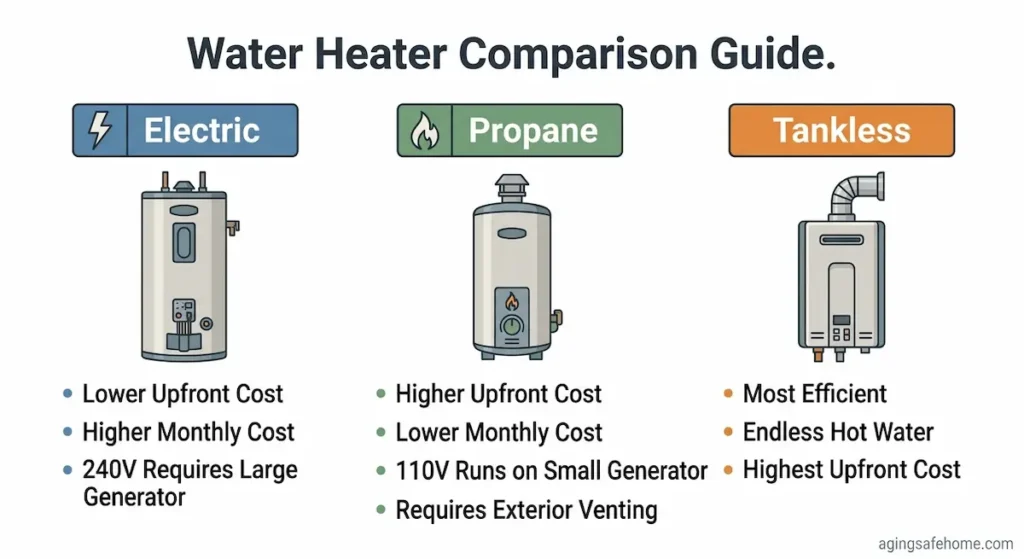
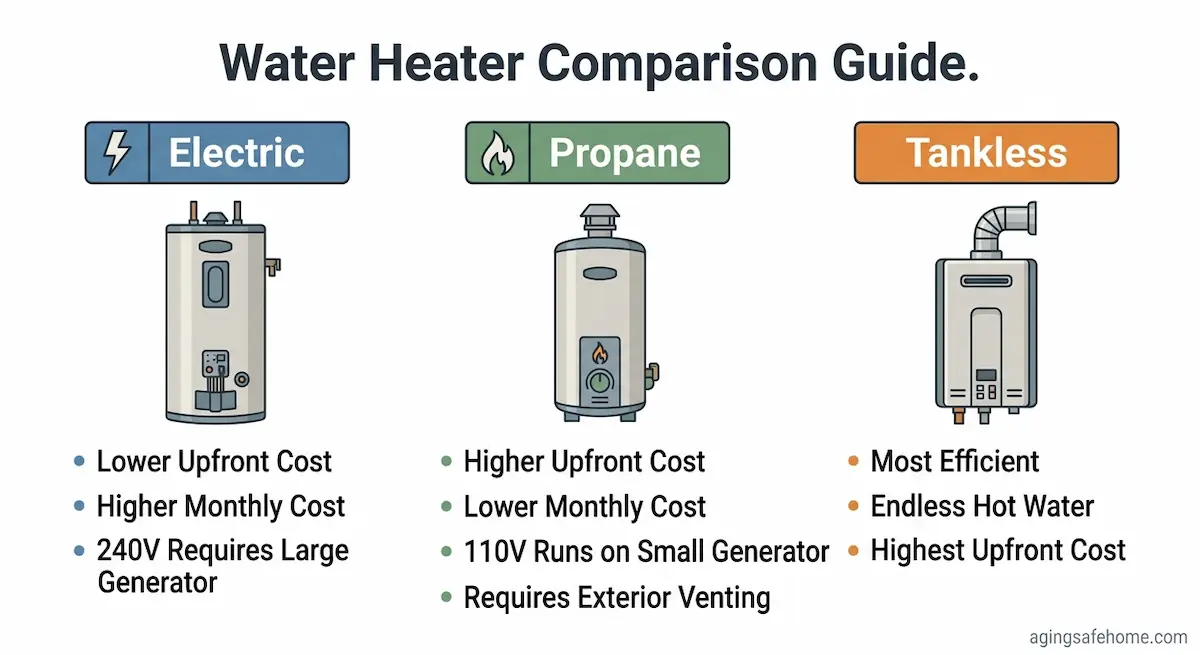
Choosing the right hot water heater for seniors aging in place in eastern Kentucky is shaped by the same reality that shapes the heating conversation — natural gas lines don’t run through most hollers out here. You’re choosing between electric and propane for a traditional tank unit or going tankless in either fuel type.
Electric.
The most common setup in eastern Kentucky and the easiest to install. Lower upfront cost than propane. But electric hot water heaters cost between 30 and 50 percent more to run monthly than propane equivalents — and in a region where Kentucky Power is already taking a significant bite out of a fixed income that monthly difference adds up fast. There’s also the power outage problem: an electric water heater runs on 240 volts and is dead when the lines go down. It also takes a larger generator to run one. For seniors aging in place in Leslie, Perry, Knott, Letcher, and Breathitt counties where outages are a regular part of winter life, that’s worth factoring in.
Propane.
Higher upfront cost than electric. Lower monthly operating cost — significantly lower. Heats water faster. And here’s the outage advantage most people don’t think about: most propane water heaters run on 110 volts for ignition — same concept as the propane wall heater from the Secondary Heat Sources article. You just need the electric to ignite it, meaning a small generator can keep a propane water heater for seniors running during an outage where an electric unit on 240 volts cannot. I have an electric water heater right now and I will be switching to propane within the next year. I think you can guess how I feel about giving Kentucky Power any more money than I have to.
One important note for anyone switching from electric to propane: an electric water heater doesn’t produce exhaust so it can sit in a sealed closet without venting. A propane unit produces combustion exhaust and must be properly vented through an exterior wall or the roof. A contractor will need to run that vent line as part of the install — it adds to the upfront cost but it is not optional. Don’t buy a propane unit assuming it drops straight into the space where the electric one was without that conversation happening first.
Tankless.
The most efficient hot water heater for seniors — 20 to 30 percent more efficient than a standard tank unit — and it only heats water when you actually need it rather than maintaining a tank temperature around the clock. For elderly adults aging in place there’s also a quality-of-life argument: no more timing your shower around whether the tank has recovered. Endless hot water matters more than people realize for someone who moves more slowly, takes longer to get comfortable, or has a caregiver helping them bathe.
The honest fixed income reality on tankless: the upfront cost is significant. A 6.6 gallon per minute system adequate for most average sized eastern Kentucky homes runs around $1,300 for the unit alone. Add plumbing, venting, and potential upgrades to your gas lines or electrical panel — a propane tankless often requires upsizing to a three-quarter inch gas line, and an electric tankless can demand significant panel upgrades in older eastern Kentucky homes running 100-amp service. You’re looking at several thousand dollars total. That’s a broad estimate and your specific situation could be higher or lower depending on what’s already there.
Is it going to save you money in the long run? Yes. But, if you’re staring down a failing 20-year-old water heater with a limited budget, a standard propane or electric replacement is still a meaningful upgrade over what you have. Don’t let perfect be the enemy of better.
Tankless propane is the best outage option of all — runs on 110 for ignition, heats on demand, no tank to maintain temperature. For a senior aging in place in eastern Kentucky who wants the most efficient and outage-resilient setup possible and has the budget for it, that’s the combination worth aiming for.
Well Water and Your Water Heater
For the significant portion of eastern Kentucky seniors aging in place who are on well water — and in Leslie, Perry, Knott, and Letcher counties that’s a lot of people — the sediment and mineral content of that water is working on your hot water heater every single day. As long as you’re maintaining it and flushing it on the schedule above, you’re in good shape. But a whole home filtration system is worth knowing about. Even a basic one makes a real difference in what’s running through your tank, pipes, appliances, and fixtures. Clean water going in means less sediment building up and a longer life for everything downstream. For the full picture on what’s in your well water, how to test it, and what filtration system your home actually needs, see the Well Water and Aging in Place guide.
Know How to Shut the Water Off
This deserves its own section. I cannot tell you how many calls I’ve gotten from homeowners — including elderly adults aging in place in eastern Kentucky who live alone — who had a hot water heater leak and did not know how to shut the water off to the house. Water is one of the most damaging things outside of fire that can happen to a home. A leak that runs for an hour while you’re waiting on a contractor does significantly more damage than one that runs for five minutes because you knew where the shutoff was.
Find your main water shutoff valve. Know where it is. Make sure you can operate it. If you have an elderly parent aging in place in a holler in Leslie or Letcher County and you’re not sure they know where it is, that’s a conversation worth having on your next visit. It takes two minutes and it could save thousands of dollars in water damage.
If the hot water heater is leaking — don’t panic. Turn the water off first. Then call. I’ll figure out the rest when I get there. But I can’t undo an hour of water running into a subfloor on a fixed income homeowner’s behalf.
Help Paying for a New Hot Water Heater for Seniors
For elderly adults on fixed incomes in eastern Kentucky, replacing a hot water heater can feel out of reach. It doesn’t have to be. Kentucky Power’s Targeted Energy Efficiency Program covers water heater upgrades for income-qualifying customers — worth a call before you pay out of pocket. The same grant and funding programs that cover home modifications and energy efficiency improvements can cover water heater replacement in many cases — USDA Rural Development, Area Agency on Aging programs, and Kentucky Medicaid waiver programs have all been used for exactly this kind of work. See the Senior Home Repair Grants in Eastern Kentucky guide for the full picture of what’s available, who qualifies, and what the process actually looks like.
FAQ: Hot Water Heater for Seniors in Eastern Kentucky
How much of my Kentucky Power bill is my water heater responsible for?
More than most people realize. The hot water heater for seniors aging in place is the second largest energy expense in an average eastern Kentucky home behind the HVAC system. An older unit ten years or more can account for 18 to 25 percent of your monthly electric bill. A newer efficient unit runs 14 to 18 percent. For elderly adults on fixed incomes already fighting a brutal power bill that difference compounds every single month.
How often should I flush my hot water heater in eastern Kentucky?
Twice a year if you’re on well water or have a gas water heater — both accumulate sediment faster. Once a year is acceptable if you’re on city water with an electric unit and live alone. Don’t skip it. Sediment buildup reduces your effective tank capacity, makes the unit work harder, drives up the bill, and shortens the life of the water heater for seniors on a fixed income who can’t afford an early replacement.
Should an elderly person in eastern Kentucky get a propane or electric water heater?
Propane costs significantly less to run monthly — 30 to 50 percent less than electric — and most propane units run on 110 volts for ignition meaning they can operate on a small generator during a power outage where an electric unit on 240 volts cannot. For seniors aging in place in eastern Kentucky where outages are a regular part of winter and Kentucky Power bills are already difficult on a fixed income, propane can be worth the higher upfront cost. Just remember that switching from electric to propane requires proper exterior venting — that’s a contractor conversation before you buy anything.
Is tankless worth it as a hot water heater for seniors on a fixed income?
It depends on the budget. Tankless is 20 to 30 percent more efficient than a standard tank unit and provides endless hot water which has real quality of life value for elderly adults aging in place. But the upfront cost including potential gas line or electrical panel upgrades can run several thousand dollars. If the budget allows it, it’s the best long-term investment. If it doesn’t, a new standard unit is still a meaningful improvement over an old inefficient electric one. Don’t let the best choice stop you from making a good one.
What are the warning signs a hot water heater for seniors is failing?
Black flecks or sediment from the hot tap indicating a degraded anode rod, rusty water indicating the tank itself is corroding, running out of hot water faster than usual, rumbling or banging noises, leaks or moisture at the base of the unit, the breaker tripping frequently, and unexplained spikes in the power bill. Sometimes there are no warning signs at all. If your unit is approaching ten years old start setting money aside for a replacement before it makes the decision for you.
Is there help paying for a hot water heater for seniors in eastern Kentucky?
Yes. Kentucky Power’s Targeted Energy Efficiency Program covers water heater upgrades for income-qualifying customers. USDA Rural Development, Area Agency on Aging programs, and Kentucky Medicaid waiver programs can also cover replacement costs for elderly adults aging in place. See the Senior Home Repair Grants in Eastern Kentucky guide for the full breakdown of available programs and how to apply.
The Bottom Line
The hot water heater for seniors aging in place is sitting quietly right now in a utility room or garage in eastern Kentucky, running up the bill every time it kicks on, losing efficiency every year it ages, and waiting for the day it decides to make itself known in the worst possible way. For elderly adults on a fixed income in Leslie, Perry, Knott, Letcher, and Breathitt counties, that’s not a small thing.
Flush it twice a year. Put a blanket on it if it’s in an unheated space. Set it to 120 degrees. Know what the warning signs look like. And if it’s approaching ten years old start the conversation about replacement before the choice gets made for you on a cold January morning.
Electric to propane can be worth the switch for some eastern Kentucky households when replacement time comes — just make sure the venting conversation happens before anything gets installed. Tankless is worth it if the budget allows. And whatever you’re running — know where your water shutoff valve is.
For the full picture of what aging in place in this region actually requires, see the Eastern Kentucky Aging in Place Guide.
Keep your water hot. Keep your money.