Keeping It Level
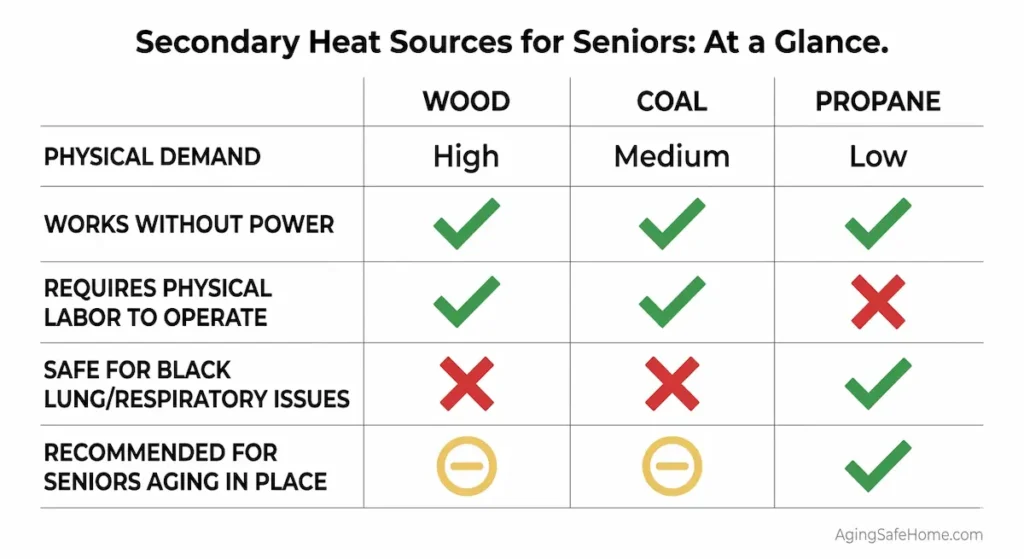
Secondary heat sources for seniors aging in place in Eastern Kentucky aren’t a luxury — they’re a practical necessity. Whether the power goes out, the Kentucky Power bill gets unbearable, or both, having reliable secondary heat sources for seniors aging in place can be the difference between safe and dangerous for an elderly adult living alone. Propane wall heaters and ventless gas fireplaces are the most practical options for most Eastern Kentucky homes. Wood and coal are common out here but get harder to manage as you age — and for retired coal miners dealing with black lung, wood heat isn’t an option at all. Whatever you choose, the tank stays outside, the carbon monoxide detector is non-negotiable, and the ignition type matters more than most people realize. Here’s what to know before anyone buys anything or hooks anything up.
- The Honest Reason Most People Out Here Have One
- Wood Heat: Real Warmth, Real Physical Demands
- Coal: Still Here, Still Physical
- Pellet Stoves: Why They Don't Make the Backup List
- Propane: The Practical Choice for Most Eastern Kentucky Homes
- Carbon Monoxide Detector: Not Optional
- Installation and Maintenance: What to Know
- Talking to an Elderly Parent About Their Heat
- Help Paying for Secondary Heat Sources for Seniors
- FAQ: Secondary Heat Sources for Seniors in Eastern Kentucky
- What is the best secondary heat source for an elderly person living alone?
- Can an elderly person safely use a propane heater?
- Is a ventless propane fireplace safe for seniors aging in place?
- What size propane tank do I need for a secondary heat source?
- Should I get a propane wall heater with a blower?
- Can an elderly person with black lung use a wood stove?
- Why are pellet stoves a bad backup heat source for seniors?
- Is propane wall heater installation a DIY project?
- Where should I put a carbon monoxide detector if I have a propane heater?
- Are there programs that help pay for heating assistance for elderly adults in Eastern Kentucky?
- FAQ: Secondary Heat Sources for Seniors in Eastern Kentucky
- The Bottom Line
The Honest Reason Most People Out Here Have One
Let’s be straight about something before we get into the options.
Yes, secondary heat sources for seniors are important for power outages. The generator article covers what happens when the lines go down and you need to keep the lights and medical equipment running. Heat is part of that same conversation.
But out here in Leslie, Perry, Knott, and Letcher counties — and really across Eastern Kentucky — a lot of elderly adults and seniors aging in place are running secondary heat sources every single day of the winter whether the power is on or not. Because Kentucky Power bills are brutal. Because a propane wall heater costs less to run than an electric heat pump when you’re trying to stretch a fixed income across a whole month of January. Because people have done the math and the math doesn’t lie.
I get it. I do it too. I installed one of those propane wall heaters for my papaw this past winter for exactly both reasons — because when the power goes out, he’s covered, and because frankly it’s just cheaper for him to heat his home that way. Screw Kentucky Power. I’m writing a whole separate article about how to cut that bill down from a contractor’s perspective, because there’s a lot you can do. But the secondary heat sources for seniors conversation starts here.
The goal of this article is to make sure that whatever you’re running to stay warm — whatever an elderly parent or grandparent is running alone in a holler in February — is doing the job safely.
Wood Heat: Real Warmth, Real Physical Demands
A good portion of Eastern Kentucky homes still heat with wood. Not as a backup. As the primary heat source, the only heat source, the way it’s always been done. In Leslie, Knott, Perry, and Letcher counties you don’t have to look hard to find a home where the wood stove is doing all the heavy lifting from November through March.
There’s nothing wrong with that. A wood stove run right puts out serious heat, and wood is not hard to come by out here. You source it, you cut it, you split it, you stack it, and you keep the stove fed. It’s physical work from start to finish — hauling, splitting, carrying armloads inside, tending the fire through the night. For a lot of people that’s just life and it works fine.
Until it doesn’t.
At 65 that’s manageable. At 75 it’s getting harder. At 80 — are you still going to be able to split wood, haul it inside, and tend a stove at two in the morning in January? That’s the question worth asking before the answer becomes obvious in the wrong way. For elderly adults aging in place who live alone, the physical demand of wood heat is exactly why secondary heat sources for seniors exist as a conversation at all. There’s no one else there to haul the next load in when the body says no.
The Black Lung Problem
Here’s something that doesn’t come up in any generic secondary heat source article: a significant portion of Eastern Kentucky’s elderly male population are retired coal miners living with black lung. My papaw is one of them. Wood smoke is not just unpleasant for these men — it makes it impossible for them to breathe. He couldn’t have a wood burning fireplace in his home. He can’t even really be around a campfire anymore. For a retired miner with black lung, wood heat isn’t an option to weigh against propane. It’s off the table entirely.
If you’re helping an elderly parent figure out their heating situation, that’s a question worth asking before anyone goes out and buys a cord of wood.
Coal: Still Here, Still Physical
Coal heat is less common than it used to be but it hasn’t disappeared from Eastern Kentucky homes — not by a long shot. There are seniors aging in place in this region who have heated with coal their entire lives and see no reason to change that.
The physical reality is different from wood but it isn’t easier. You’re not splitting anything, but you are shoveling coal in, managing ash out, and keeping supply on hand. It’s still physical labor. The same question that applies to wood applies here — at what point does the body stop being able to do that work reliably, and what happens to an elderly person living alone when that point arrives?
Coal also produces its own air quality concerns inside the home. For anyone with respiratory issues — and again, retired miners with black lung are a significant part of Eastern Kentucky’s elderly population — coal heat deserves the same honest conversation as wood.
Pellet Stoves: Why They Don’t Make the Backup List
Pellet stoves exist and people ask about them. They’re cleaner than wood, easier to manage than a traditional wood stove, and they do a decent job heating a space.
The problem for seniors aging in place using them as backup heat is simple: pellet stoves require electricity to run the auger that feeds pellets into the burn chamber. No power, no heat. If the whole point of your secondary heat source is to keep an elderly adult warm when the lines go down, a pellet stove has just failed that test before it started. For a home that already has reliable power and just wants a supplemental heat source, fine. As secondary heat sources for seniors during Eastern Kentucky outages, pellet stoves are simply the wrong tool.
Propane: The Practical Choice for Most Eastern Kentucky Homes
Natural gas lines don’t run through most Eastern Kentucky hollers. If you’re on propane out here, that’s just the reality of rural life and it’s fine. Propane works. It works well.
For secondary heat sources for seniors aging in place, propane is the most practical option for most situations. It doesn’t require physical labor to run. You’re not splitting wood or shoveling coal. You turn it on and it heats the room. For an elderly adult living alone who can no longer manage the physical demands of wood or coal, that difference matters every single day.
There are two main directions to go with propane heat.
Propane Wall Heaters
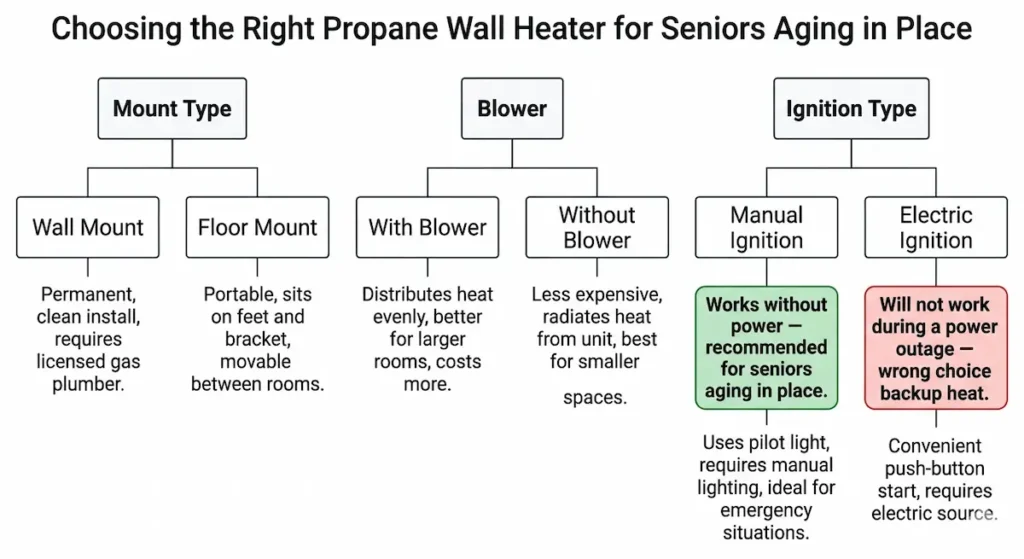
This is what I install most often as secondary heat sources for seniors in the winter. A propane wall heater mounts directly to the wall — two screws into studs and it’s hung. From there you’re running your fuel line, and I’ll get to that in a minute.
Within wall heaters there are options worth understanding before you buy:
Blower vs. no blower.
Some wall heaters have a built-in blower that circulates the heat through the room. They work better, they heat more evenly, and they cost more. The ones without a blower are less expensive and still do the job — the heat radiates out rather than being pushed into the room. For a smaller space the difference matters less. For a larger room the blower is worth the money.
Wall mount vs. floor mount.
Most of these units can either be cut into the wall as a permanent installation or sit on the floor on the feet and bracket they come with. Wall mount is cleaner and permanent. Floor mount is less expensive and movable — you’re leaving the wall intact and the unit can be repositioned. Depends on the situation and what makes sense for the home.
Electric ignition vs. manual ignition.
This one matters more than most people think about when they’re standing in the store. Electric ignition is convenient — push a button and it lights. But if you’re using this heater because the power is out, an electric ignition has just failed you. The whole point of a backup heat source for elderly adults aging in place is that it works when the power doesn’t. Manual ignition — pilot light, manual lighting — works regardless of whether the power is on. Like a grill ignitor on a propane grill, works the same. Some carry batteries, some don’t, regardless they work when the power doesn’t. I wouldn’t go electric ignition on a unit that’s meant to serve as backup heat during outages. That’s not a preference. That’s a basic logic problem.
Ventless Propane Fireplaces
The other propane option worth knowing about is a ventless gas fireplace. These come in two basic versions no matter how many models you look at.
The first is a built-in ventless firebox with gas logs — this goes into an existing fireplace opening or a framed-in space and looks like a standard fireplace in the home. If you already have a fireplace this conversion is usually straightforward. It’s not complicated work as long as whoever is doing it understands basic gas plumbing — good flares, proper cutoff valves, and the log sets usually come with an emergency cutoff that detects leaks. Test it. Make sure it works.
The second is a package unit — a complete ventless fireplace you buy as a unit and set into whatever room you need it in. No framing, no construction, no permanent installation. You just place it.
Here’s the practical decision between them: if you don’t have an existing fireplace, do the math before you commit to building one in. By the time you pay someone to frame a firebox, finish it out, and do the installation, you may have spent more than the package unit costs sitting right there on the floor. If you already have a fireplace the conversion usually makes more sense. Run the numbers for your specific situation before you decide. If you’re running a propane wall heater to cut down on the Kentucky Power bill, it’s worth knowing that switching your hot water heater to propane is another meaningful way to reduce that bill — and for most Eastern Kentucky households on a fixed income it’s worth the conversation. The Hot Water Heater for Seniors guide covers the full comparison.
The Tank Situation on Secondary Heat Sources for Seniors
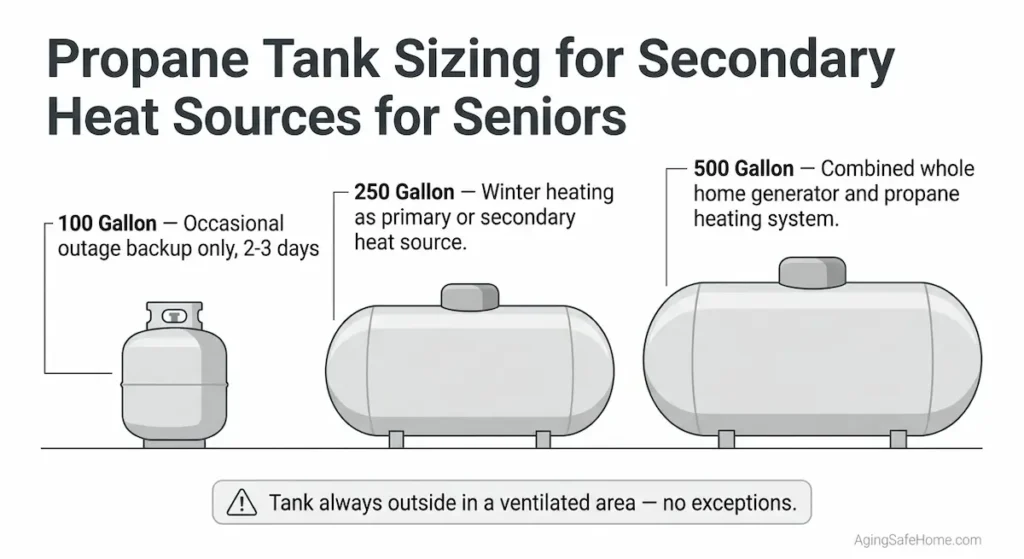
The generator article covers propane tank sizing in detail for whole home standby generators — the short version is that a 100-gallon tank won’t cut it for extended use and a 500-gallon tank is the standard recommendation for serious whole-home backup power.
Secondary heat sources for seniors follow similar logic depending on how you’re using them.
If you’re only running a propane wall heater during power outages — a few days here and there through the winter — a 100-gallon tank can get you through. It’s not a long-term solution but for occasional outage backup it’ll hold.
If you’re running propane heat as your primary or significant secondary heat source through the winter because Kentucky Power bills are unsustainable on a fixed income, you need a bigger tank. How much bigger depends on the size of the home and how hard the heater is running, but plan on 250 gallons minimum and have the conversation with your propane supplier before you commit to anything.
If you’re combining a whole home standby generator with a propane heating system — the setup that takes the most off the table in terms of what can go wrong in winter for an elderly person aging in place — you’re looking at 500 gallons and a conversation with both your propane supplier and your electrician about how the systems interact. That’s covered in the generator article.
One thing that cannot be said clearly enough: the tank lives outside. Always. No exceptions.
A propane heater hooked to a grill tank sitting in the middle of a living room is one of the most dangerous things I see people do. I’ve never personally watched a house burn down from it but I’ve seen it happen on the news and I’ve seen people doing it and told them to stop. Leaks, fires, explosions — a propane tank indoors in a living space is not a calculated risk. It is a bad idea with bad outcomes. Tank outside, in a ventilated area, always. If the line has to run through the wall to get there, that’s how it runs.
Carbon Monoxide Detector: Not Optional
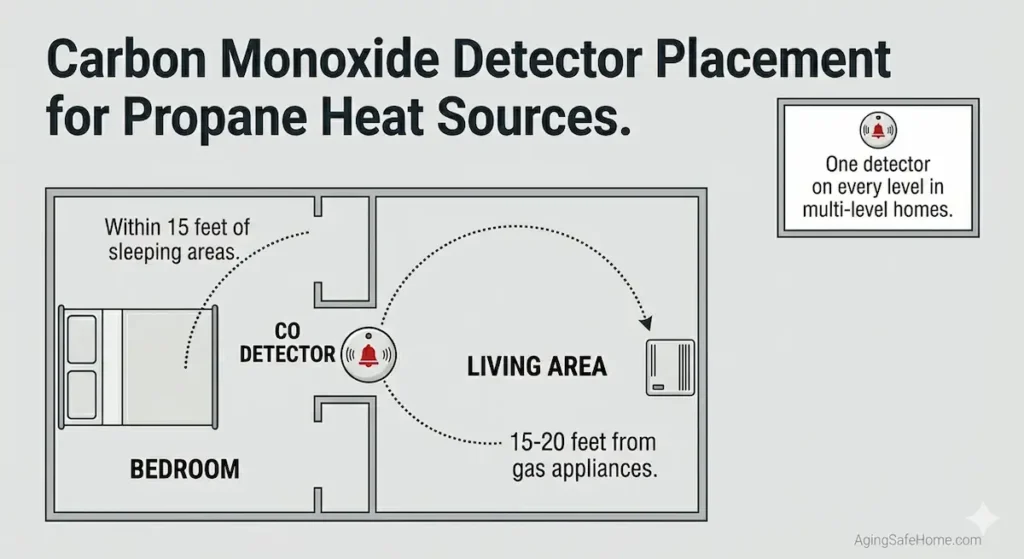
Any time you are running a gas appliance in your home a carbon monoxide detector is mandatory. Not a recommendation. Mandatory.
Carbon monoxide is colorless and odorless. You will not smell it. You will not see it. For an elderly person aging in place and living alone the margin for error is zero — there is no one else in the house to notice something is wrong.
Placement matters:
- Within 15 feet of sleeping areas
- 15 to 20 feet away from the gas appliances themselves — close enough to detect a problem, far enough to avoid false alarms from normal operation
- On every level of a multi-level home
Get one. Put it in the right place. Check the battery.
Installation and Maintenance: What to Know
On installation: Hanging the wall heater itself is simple — two screws into studs, it’s up. The gas line work is where it gets more nuanced. You’re typically running 1/2 inch flex copper, flaring both ends, fitting flare nuts, making sure your cutoff valve is right and your regulator is set correctly.
If you’re a plumber or you have real experience with gas line work and you understand flaring, cutoffs, and regulators — you can probably handle this. My papaw did his own installation years ago. It’s not impossible for the right person.
If you don’t know what a flare is or you’ve never worked with gas line, this is not the project to learn on. Get someone who knows what they’re doing. A mistake with a gas line is not a mistake you get to fix after the fact. And before anyone shows up at your door for any aging in place work, read The Last Guy — it covers exactly what to look for before you hand anyone your money.
On maintenance: These units need to be cleaned regularly. Dust and debris build up inside the burner tube and cause problems. If your pilot light comes on but goes out as soon as you turn the gas on, check the burner tube first — that’s usually what it is. If you hear a whistling noise, same thing.
If the pilot light won’t stay lit and the burner tube is clean, check your flame detector. A dirty flame detector is the other common culprit and it’s usually an easy fix.
Regulators go bad eventually. It takes years — my papaw’s lasted decades — but when it goes you’ll know because the unit stops performing the way it should. Worth having it checked if the heater is old and starting to act up.
Talking to an Elderly Parent About Their Heat
If you’re an adult child calling because you’re worried about how your elderly parent is heating their home in a Leslie County holler or anywhere else across Eastern Kentucky, here’s how I’d approach that conversation.
First — what kind of heat are they using now and what’s getting harder? Wood or coal that’s becoming physically unmanageable is a different conversation than someone who just needs a propane wall heater added to an existing setup.
Second — what’s the budget? It always factors in whether people want to talk about it or not. The range between a floor-mount propane heater and a full ventless fireplace installation is significant. Know what you’re working with. If money is tight, there are programs that can help — more on that below.
Third — what’s the size of the space? A wall heater sized for a bedroom isn’t going to heat an open living and kitchen area. Make sure what you’re buying matches what you’re trying to heat.
Fourth — what’s the current propane situation? Do they have a tank already? What size? Is it shared with other appliances? The propane conversation needs to happen before the installation conversation, same as it does with generators.
Help Paying for Secondary Heat Sources for Seniors
For seniors and elderly adults on fixed incomes in Eastern Kentucky, the cost of adding a secondary heat source — or even covering the propane bill through a hard winter — can feel out of reach. It doesn’t have to be.
LIHEAP, the Low Income Home Energy Assistance Program, provides heating assistance specifically for low-income households and seniors are prioritized. It covers heating bills, heating system repairs, and in some cases equipment. It’s federally funded and administered locally — contact your Area Agency on Aging or your county’s community action council to find out what’s currently available and how to apply.
Beyond LIHEAP, the broader grant and funding programs available in Eastern Kentucky — USDA Rural Development, Area Agency on Aging programs, Kentucky Medicaid waiver programs — can cover home modifications that make staying warm and safe possible for elderly adults aging in place. The Senior Home Repair Grants in Eastern Kentucky guide covers every program available in this region, who qualifies, and what the process actually looks like. If the cost of a proper heating setup feels impossible on a fixed income, look at what’s available before you decide it can’t be done.
FAQ: Secondary Heat Sources for Seniors in Eastern Kentucky
What is the best secondary heat source for an elderly person living alone?
For most seniors aging in place in Eastern Kentucky, a propane wall heater with manual ignition is the most practical option. It doesn’t require physical labor to operate, it works when the power is out, it’s less expensive to run than electric heat on a fixed income, and it heats a room reliably. The manual ignition piece matters — if the power is out an electric ignition won’t work, which defeats the purpose for backup heat.
Can an elderly person safely use a propane heater?
Yes, with the right setup. The heater should be properly installed, the tank should be outside in a ventilated area, and a carbon monoxide detector should be within 15 feet of sleeping areas. For a senior aging in place who can no longer manage the physical demands of wood or coal heat, a properly installed propane heater is a safer option, not a more dangerous one.
Is a ventless propane fireplace safe for seniors aging in place?
A properly installed ventless propane fireplace with a working carbon monoxide detector is safe. The emergency cutoff that comes with most log sets adds another layer of protection. The key words are properly installed — flares correct, cutoff valve in place, no leaks, tested before the unit is left running. Don’t skip the carbon monoxide detector.
What size propane tank do I need for a secondary heat source?
It depends on how you’re using it. For outage backup only, a 100-gallon tank will get you through a few days. For heating your home through the winter as a primary or significant secondary heat source on a fixed income, plan on at least 250 gallons. If you’re combining propane heat with a whole home standby generator, you’re looking at 500 gallons — the generator article covers the full tank sizing conversation.
Should I get a propane wall heater with a blower?
For a larger room, yes — the blower circulates heat more evenly and the unit performs better. For a smaller space the difference is less significant. The blower models cost more. Decide based on the size of the space you’re heating and whether the even heat distribution is worth the additional cost for your situation.
Can an elderly person with black lung use a wood stove?
For most retired coal miners dealing with black lung, wood smoke is not just uncomfortable — it makes breathing genuinely difficult. For a senior aging in place with black lung, wood heat should come off the table entirely and the conversation should go straight to propane or another smokeless option.
Why are pellet stoves a bad backup heat source for seniors?
Pellet stoves require electricity to run the auger that feeds pellets into the burn chamber. If the power is out, the stove doesn’t run. For elderly adults aging in place who need heat specifically during power outages, that’s a fundamental problem. Pellet stoves work fine as a supplemental heat source when power is reliable — they’re the wrong tool for outage backup.
Is propane wall heater installation a DIY project?
It depends on who you are. Hanging the unit is simple. The gas line work — flaring, cutoff valves, regulators — requires real knowledge and experience with gas plumbing. If you have that background, you can probably handle it. If you don’t, get someone who does. A gas line mistake is not recoverable the way a drywall mistake is.
Where should I put a carbon monoxide detector if I have a propane heater?
Within 15 feet of sleeping areas and 15 to 20 feet away from the gas appliances themselves. Far enough from the heater to avoid false alarms, close enough to detect a real problem. If you have a multi-level home, one on every level.
Are there programs that help pay for heating assistance for elderly adults in Eastern Kentucky?
Yes. LIHEAP — the Low-Income Home Energy Assistance Program — provides heating assistance for low-income households and prioritizes seniors. Contact your local Area Agency on Aging or community action council to find out what’s currently available in your county. The Senior Home Repair Grants in Eastern Kentucky guide also covers the broader funding programs that can help cover the cost of heating modifications for elderly adults aging in place.
The Bottom Line
Secondary heat sources for seniors aging in place in Eastern Kentucky aren’t complicated but they have to be done right. Wood and coal are real options that get harder to manage as the body ages — and for retired miners with black lung they’re not options at all. Pellet stoves need power to run, which makes them the wrong answer for outage backup. Propane is the practical choice for most situations out here: no physical labor to operate, works when the power is out, and cheaper to run than electric heat when Kentucky Power is making it impossible to stay warm on a fixed income.
If you’re setting up a propane wall heater — manual ignition, tank outside, carbon monoxide detector in place, gas line done by someone who knows what they’re doing. That’s the short version.
For the power outage side of this conversation — what keeps the lights on, the refrigerator running, and the medical equipment powered when the lines go down — see the generator article. And if the Kentucky Power bill is the bigger problem, that conversation is here. There’s a lot a contractor can tell you about closing up the holes that are letting your heat walk right out of your house every winter.
Stay warm. Do it safely.
For more on aging in place in this region — modifications, funding, terrain, and the full picture of what staying home actually requires in Eastern Kentucky — see the Eastern Kentucky Aging in Place Guide.