Keeping It Level
Most aging in place work happens inside the house. The grab bars, the comfort height toilet, the curbless shower. All of it matters. But the stretch of ground between the car and the front door — the last fifty feet — is where a lot of elderly adults actually get hurt, and most families never think about it until something goes wrong. This page covers outdoor safety for seniors: the lighting, the handrails, the ramps, and when a ramp isn’t the right answer at all.
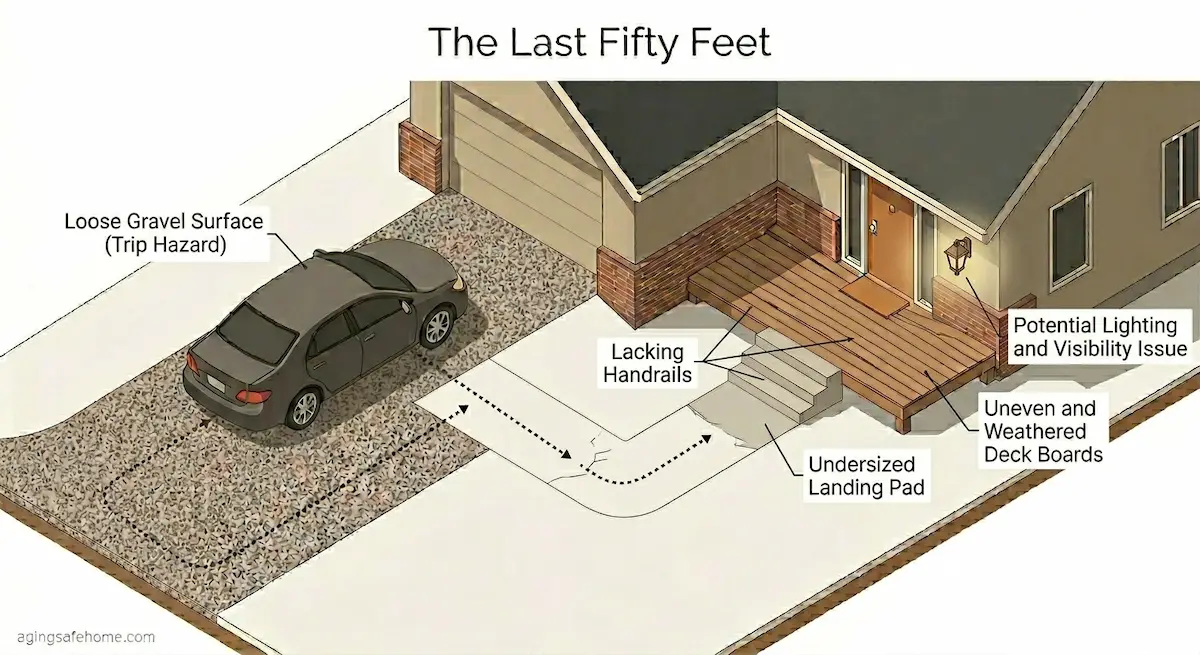
My mamaw broke her leg on an uneven deck board. Not on the steps. Not on a steep ramp. On a board that had shifted just enough to catch her foot at the wrong angle on a walk she’d made a thousand times before. That’s how it usually goes. Not a dramatic fall from height. Just a surface that changed slightly and a body that didn’t have enough margin left to compensate.
I know a woman who tripped in a hole in her yard — one of those spots where the ground had settled and nobody had filled it in — and broke her hip. Another who was navigating a gravel driveway and went down because loose stone doesn’t give you anything solid to push off of. I’ve seen ramps so steep they were more dangerous than the steps they replaced. And I’ve written an entire article about outdoor lighting for aging in place because you cannot navigate what you cannot see, and most people have no idea how inadequate their porch light actually is for an aging eye.
None of those are inside-the-house problems. All of them happen in that stretch of ground between the car and the front door.
That’s the last fifty feet. And it doesn’t get nearly the attention it deserves.
- What "The Last Fifty Feet" Actually Means
- The Hazards People Walk Past Every Day
- Outdoor Fall Hazards for Seniors
- Outdoor Lighting
- Door Hardware for Seniors
- Handrails
- Exterior Steps
- Wheelchair Ramps
- Lifts vs. Ramps: When the Terrain Decides
- Deck and Porch Safety
- Anti-Slip Deck Coatings
- Driveway and Walkway Materials
- Porch Awnings and Roof Extensions
- Outdoor Seating for Seniors
- FAQs: The Last Fifty Feet
- What does "aging in place" mean for the outside of a home?
- What is the most dangerous part of a senior's outdoor environment?
- How do I know if my elderly parent's outdoor setup is safe?
- Do I need a contractor for outdoor aging in place modifications?
- What if my elderly parent rents and can't make permanent modifications?
- Is outdoor aging in place modification expensive?
- The Bottom Line
What “The Last Fifty Feet” Actually Means
When families start thinking about aging in place, the conversation almost always starts inside. The bathroom. The bedroom. The kitchen. Those are real concerns and they deserve real attention — we cover all of it on this site. But there’s a sequence problem. If your elderly parent can’t safely get from the car to the front door, nothing inside the house matters yet. The last fifty feet is the entry point to everything else. It’s also the part of the property that gets the least systematic attention.
Part of that is because the outside of a home feels less urgent. It’s not where you sleep or cook or bathe. It doesn’t have the concentrated risk profile that bathroom safety does. But that thinking underestimates how much is actually happening in that stretch — the surface transitions, the elevation changes, the lighting gaps, the handholds that aren’t there — and how unforgiving the outside of a home can be for an aging body that’s already working harder than it used to just to move through space.
The last fifty feet isn’t one problem. It’s a series of smaller problems that stack on top of each other. Bad lighting makes an uneven walkway invisible. An uneven walkway makes a ramp more dangerous to approach. A ramp without proper handrails is just a slope. All of it connects, and all of it has to be right.
The Hazards People Walk Past Every Day
Here’s what I look at when I walk a property for a senior safety assessment outside the house. These are the things that are already there, already dangerous, and almost never on anyone’s radar until after something goes wrong.
Uneven surfaces.
Deck boards shift. Concrete heaves. Pavement seams open up. Yard ground settles into low spots nobody fills in. Any of these can catch a foot at the wrong angle and that’s all it takes. For a younger person with full reaction time and muscle strength, an uneven surface is a minor annoyance. For an elderly adult whose margin for error is already smaller, it’s a fall waiting to happen.
Gravel and loose stone.
Gravel driveways are common out here and they’re genuinely problematic for elderly adults. Loose stone doesn’t give you a stable surface to push off of, shifts underfoot in a way that’s hard to predict, and offers nothing solid for a cane or walker tip to grip. It’s not insurmountable — there are ways to address it — but it has to be recognized as a hazard first.
Elevation changes without handholds.
Steps without rails. A ramp without rails on both sides. A porch edge with nothing to grab. Any place where the ground level changes and there’s nothing solid within reach is a hazard. The handrail article covers this in depth, but the short version is: if the elevation changes and there’s nothing to hold, that’s a problem.
Steep or poorly built ramps.
A ramp that doesn’t meet slope requirements — 1:12 is the standard, meaning one inch of rise for every twelve inches of run — isn’t a solution. It’s a different shape of the same problem. A ramp that’s too steep, built without proper handrails, with decking that gets slick when wet, or without adequate landings is more dangerous than the steps it replaced. I’ve seen them. I’ve had to tell families that what they paid someone to build was going to hurt the person it was built for.
Lighting gaps.
This one is invisible until dark, which is exactly when it matters. Most homes have a porch light. Most porch lights are inadequate for aging eyes that need significantly more illumination than younger eyes to see the same level of detail. A single fixture over the door doesn’t light the walkway, doesn’t light the step edges, doesn’t light the driveway, and doesn’t light the path to the car. You cannot navigate what you cannot see, and most outdoor lighting setups for residential homes weren’t designed with that in mind.
Outdoor Fall Hazards for Seniors
A hole nobody filled in. A hose left in the grass. A dog that doesn’t know its own size. Outdoor fall hazards for seniors don’t look dangerous — they look like a normal backyard on a normal afternoon, which is exactly why they get missed until something goes wrong. This guide covers what’s actually hiding in the yard, why outdoor falls are uniquely dangerous when nobody’s close enough to hear you, and a free-to-paid spectrum of ways to make sure help finds you fast if it does.
Outdoor Lighting
You can fix every other problem on this list and still have a dangerous property after dark if the lighting isn’t right. And the lighting almost never is — not because people don’t care, but because most people don’t realize how differently an aging eye processes light, or how much a single poorly placed fixture can actually make things worse instead of better.
The short version: aging eyes need significantly more light than younger eyes to achieve the same level of visibility. A porch light that works fine for you can genuinely look dim to your elderly parent navigating the same steps. On top of that, aging eyes are more sensitive to glare and struggle more with the transition between bright and dark spaces — which is exactly the transition that happens when someone steps out of a lit house onto a dark porch. And a single bright floodlight pointed at a walkway doesn’t solve the problem. What it creates is a hot spot surrounded by darkness, which for an aging eye is a visual trap that makes everything outside that cone invisible.
Even, consistent coverage across the entire path — from the door to the car — is what you’re after. Multiple fixtures spread along the walkway, step lighting that casts light down onto the tread nosings rather than up into the eyes, and fixtures that work reliably every night without anyone having to remember to turn them on.
Door Hardware for Seniors
The last fifty feet gets someone safely to the door. This is what happens once they’re standing in front of it. A round knob that’s hard to grasp, a lock installed backwards, a stiff deadbolt, or a lever that takes too much force to push down can turn the final few seconds of the journey into the hardest part. This guide covers door handing, graspable hardware, ADA operating force standards, strike plate anchoring that can take a real impact, and where smart locks genuinely help seniors and elderly homeowners aging in place.
Handrails
Most homes have a guardrail on their porch steps. Most homes do not have a proper handrail for seniors. Those are two different things with two different jobs, and confusing them is one of the most common and most dangerous oversights I see on exterior safety assessments.
A guardrail keeps you from going over the edge — it’s a barrier, same as a highway guardrail. A handrail is the rounded, graspable bar you actually hold onto for support going up and down the steps. You need both. What most older homes have is one of them.
Beyond just having a handrail, the details matter more than most people realize. The height has to be right. The profile has to be graspable — a 2×4 cap rail is not a handrail, no matter how solid it looks. It has to be anchored correctly into something that will actually hold. It has to run all the way to the nose of the last step. And the ends have to be returned so there’s nothing sticking out to catch a sleeve or a walker bag at exactly the wrong moment.
→ Read the full guide: Exterior Handrails for Seniors: What You Actually Need
Exterior Steps
Handrails are only as good as the staircase they’re bolted to. Riser height, tread depth, how the stringers are attached, whether the risers are open or closed, all of it either supports a safe descent or works against it before anyone’s hand ever touches the rail.
The details most homeowners never think to ask about are exactly the ones that matter most. A single riser off by a fraction of an inch creates what’s called a trip step, and it’s one of the most common causes of a fall on an otherwise “fine looking” staircase. Open risers let a cane tip or walker leg slip straight through. Stringers that were never mechanically attached to the deck at the top can pull loose over time, long before the wood itself ever shows a sign of wear.
→ Read the full guide: Exterior Steps for Seniors
Wheelchair Ramps
When steps become unmanageable — whether because of a wheelchair, a walker, or just the reality of what aging knees and hips can handle — a ramp is usually the right answer. But a ramp that doesn’t meet slope requirements is just as dangerous as the steps it replaced. You haven’t solved the problem. You’ve changed the shape of it.
The standard is 1:12 — one inch of rise for every twelve inches of run. On a flat lot that math is straightforward. In Eastern Kentucky, on a mountain lot where the door threshold might be thirty inches off the ground and the lot drops away in three directions, that same math gets complicated fast. The route matters. The footings matter. The decking material matters — a treated board that’s perfectly fine in dry conditions can become a skating rink on a damp morning. The handrails matter. The landings matter.
A ramp built right will outlast almost everything around it and give an elderly person years of safe, independent access to their home. A ramp built wrong is a liability that looks like a solution.
→ Read the full guide: Wheelchair Ramp in Eastern Kentucky: Build It Right or Don’t Build It
Lifts vs. Ramps: When the Terrain Decides
Most of the time a ramp is the right answer. It’s passive, it requires no power, and when it’s built correctly it requires almost no maintenance. But the terrain doesn’t always cooperate, and sometimes the honest answer is that a ramp isn’t the right tool for the situation.
When a lot won’t fit a proper 1:12 ramp — when the switchback math puts the project in the same cost range as a lift anyway, or when existing steps are already solid and a stair lift is the simpler solution — the conversation changes. A vertical platform lift runs $9,000 to $20,000. An outdoor stair lift runs $7,500 to $10,500. A complicated switchback ramp on a difficult lot can land in the same neighborhood. The right answer depends on the specific property, the specific person, and an honest accounting of what each option actually requires to live with long term — including what happens when the power goes out.
→ Read the full guide: A Contractor’s Perspective: When the Ramp Guy Recommends Lifts
If you’re working on a mountain lot in Appalachia, the regional picture is different enough to deserve its own conversation. The Eastern Kentucky Aging in Place guide covers the terrain, the housing stock, and the funding programs specific to this region.
Deck and Porch Safety
Not everything in this series is about building something new. A lot of what actually causes falls is sitting on a deck or porch that’s already there. An old threshold drop nobody’s thought twice about, fasteners rusting out where nobody can see them, or a railing nobody’s ever actually tested.
→ Read the full guide: Deck and Porch Safety for Seniors
Anti-Slip Deck Coatings
A deck or porch can be structurally sound and still be dangerous if the surface itself doesn’t hold traction. Wood, composite, and concrete all behave differently once they’re wet, worn, or covered in algae — and the fix isn’t the same for all three. Paint, stain, DIY grit additives, commercial epoxy coatings, grip tape, screw-down mats — there’s no shortage of options and picking the wrong one for the surface you have is one of the more common mistakes I see. What works on wood can peel right off composite. What holds up on concrete without a non-slip additive can end up slicker than what you started with.
Driveway and Walkway Materials
A driveway can look fine on day one and still crack, heave, or wash out five years later — and the material you pick matters less than whether the base underneath it was built right. This guide breaks down how gravel, asphalt, concrete, and pavers actually hold up over time for someone using a cane, walker, or wheelchair, the installation mistakes that cause most cracking and upheaval, and how to get a safer surface without necessarily redoing the whole driveway.
Porch Awnings and Roof Extensions
Steps, surface, handrails, lighting — get those right first. But even a walkway that’s built and lit correctly still has to deal with rain, snow, and sun beating down on it every day, and that takes a toll over time. A fixed awning or a properly tied-in roof extension keeps the weather off the steps and landing, protects whatever anti-slip coating you’ve already put down, and adds one more layer of protection on top of everything else you’ve done right. It’s not the first thing I’d fix, but once the essentials are handled, it’s one of the upgrades that quietly protects everything else you’ve invested in.
Outdoor Seating for Seniors
Not every fix in this series is about getting someone from point A to point B safely. Sometimes it’s about giving them somewhere to stop along the way. A bench that looks fine in the yard can still be the wrong height, sitting on ground that shifts underfoot, or positioned somewhere a walker can’t turn around. The details that make a rest area actually usable — seat depth, armrest grip, what’s underneath it, whether it can even be seen at dusk — are easy to miss and important to get right.
FAQs: The Last Fifty Feet
What does “aging in place” mean for the outside of a home?
Most aging in place conversation focuses on the interior — bathrooms, kitchens, bedrooms. But the exterior of a home is where a lot of elderly adults actually get hurt. Aging in place outdoors means making sure every part of the path a senior use regularly — from the car to the front door and everywhere in between — is safe, well-lit, and navigable regardless of mobility level.
What is the most dangerous part of a senior’s outdoor environment?
It depends on the property, but the highest-risk areas I see consistently are unlit step edges, the transition from the bottom step to the ground, uneven walkway surfaces, and ramp approaches without proper handrails. Any place where the ground level changes and there’s nothing solid to hold onto is a high-risk zone.
How do I know if my elderly parent’s outdoor setup is safe?
Walk it yourself at dusk or after dark. That single exercise will show you more than any checklist. Notice where you instinctively reach for something to hold onto. Where your eyes struggle to find the edge of a step or the lip of a surface. Notice where the light drops off. What you find is what your elderly parent is navigating every time they leave the house.
Do I need a contractor for outdoor aging in place modifications?
Some of it you can handle yourself — quality solar pathway lights can be staked along a walkway in twenty minutes with no tools. A low-voltage landscape lighting system is a reasonable weekend project for someone comfortable with basic outdoor work. But anything involving structural changes — a ramp, new hardwired fixtures, handrail installation into masonry — should be done by someone who knows what they’re doing and will anchor it like they mean it. False security is worse than no security.
What if my elderly parent rents and can’t make permanent modifications?
Solar pathway lights require no wiring, no mounting, and no landlord permission. They can go in tonight and move if your person moves. It’s not a forever solution but it can meaningfully reduce fall risk immediately, and sometimes that’s exactly what the situation calls for.
Is outdoor aging in place modification expensive?
It ranges enormously. Quality solar pathway lights run $50 to $150 for a full walkway setup. A low-voltage landscape lighting system might run $200 to $500 installed yourself. A properly built wheelchair ramp can run several thousand dollars depending on the site. The right approach is to address the highest-risk areas first and work through the rest systematically. You don’t have to solve everything at once.
The Bottom Line
The last fifty feet doesn’t get the attention it deserves. Families spend real money on bathroom modifications and never look at the walkway their elderly parent navigates in the dark every time they come home after sunset. They build a ramp and skip the handrails. They assume the porch light is enough because it’s always been enough — for them.
It’s not about perfection. It’s about walking the property with honest eyes and fixing what you find. The lighting. The surfaces. The handholds. The ramp, if there is one, and whether it was built right. All of it connects, and all of it matters.
My mamaw broke her leg on a deck board. A board that had been shifting for years while everyone walked past it. That’s the thing about the last fifty feet — the hazards are already there. Most of the time you just have to look.
Want to walk through the full picture? Download the free Aging Safe Home Safety Checklist and see where the last fifty feet fits into everything else.