Keeping It Level: A Kentucky Power bill in Eastern Kentucky isn’t just high — for seniors and elderly adults on fixed incomes across Leslie, Perry, Knott, Letcher, and Breathitt counties, it can be genuinely dangerous to the budget. This guide covers how to lower your Kentucky Power bill from a contractor’s perspective: starting with the free walk-around every homeowner should do, moving through cheap DIY fixes, insulation, windows and doors, and HVAC — in the order that makes the most sense for your home and your wallet. If you’re aging in place in Eastern Kentucky and you’re tired of saying a little prayer every time that bill shows up in the mailbox, this is where to start.
- The Bill Nobody Wants to Open
- Think of Your House Like a Cooler
- Start With a Walk-Around
- The Cheap Fixes That Actually Move the Needle
- Insulation: Be Like Oprah
- Windows and Doors: The Honest Conversation
- HVAC: When You Need It, You Need It
- The Ladder: What to Fix First
- Help Paying for Your Kentucky Power Bill
- FAQ: How to Lower Your Kentucky Power Bill in Eastern Kentucky
- What is the single most impactful thing I can do to lower my Kentucky Power bill?
- What can I do today for little or no money?
- Does running a propane heater actually help lower my Kentucky Power bill?
- My windows are old. Do I have to replace them all at once?
- Are there programs that help pay for energy efficiency improvements for seniors in Eastern Kentucky?
- Is it worth replacing an old HVAC system just for efficiency?
- The Bottom Line
The Bill Nobody Wants to Open
You know that feeling when you walk to the mailbox in January and see the Kentucky Power bill sitting there? That little prayer you say before you open it? That moment where you’re doing math in your head before you’ve even pulled the envelope open — groceries, or heat, but maybe not both?
That’s not an exaggeration. I’ve seen bills over $800 out here. Eight hundred dollars. For people who spent their whole lives working hard, now on a fixed income, and this is what they have to look forward to? Kentucky Power asking for another rate increase when the ink on the last one is barely dry? It’s a lot. It genuinely is.
I want to be clear about something before I go any further: this is not about the linemen. Those guys are out there in conditions most people wouldn’t survive. I watched a crew ratchet a power pole across a creek after the 2025 floods because the water was too high to drive across. The men and women doing that work don’t set the rates. I have nothing but respect for them.
But the rates? Every Eastern Kentucky resident knows. So let’s talk about what you can actually do about it.
The goal of this article is simple: before you write another check to Kentucky Power, make sure your home isn’t making the bill worse than it has to be. Because I promise you, for most homes out here, it is. And learning how to lower your Kentucky Power bill starts not with a contractor or an appliance store — it starts with a walk around your own house.
Think of Your House Like a Cooler
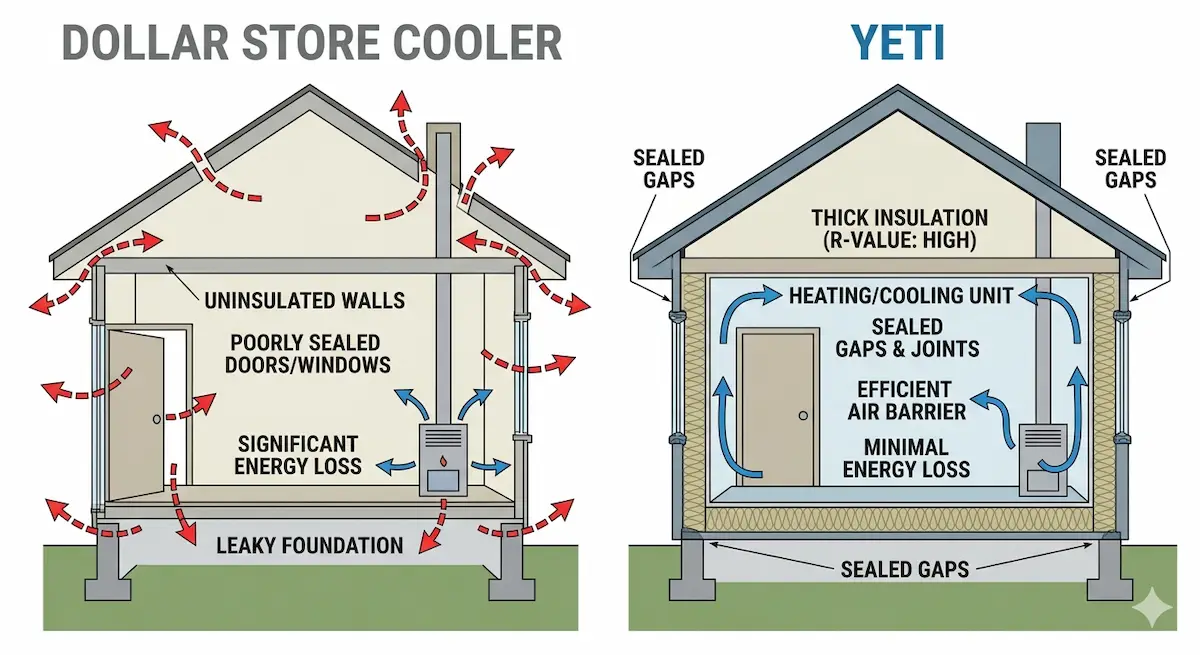
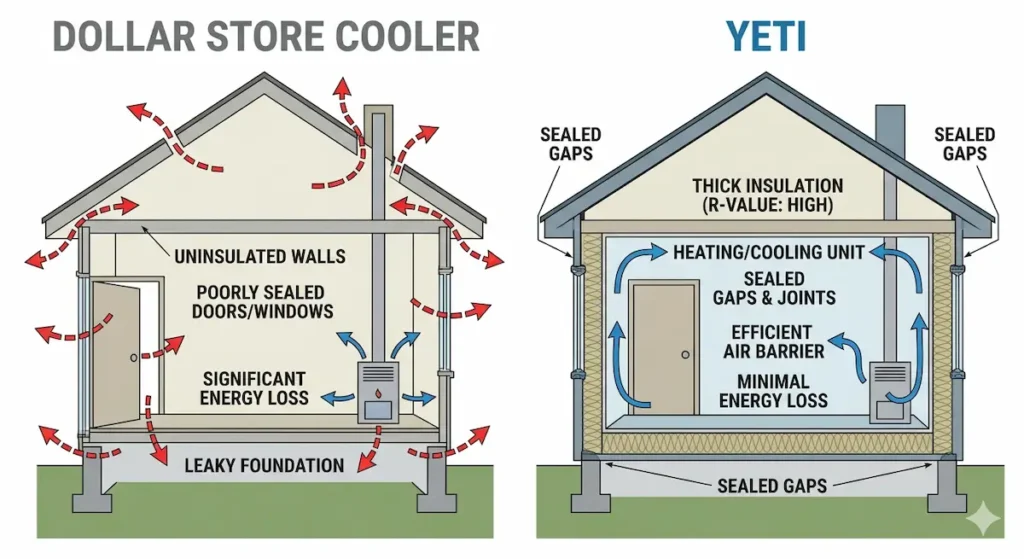
Here’s the mental model I want you to carry through this whole article: your home is a cooler. You pay real money to heat or cool that air. Every gap, every hole, every uninsulated surface is a crack in that cooler letting the air you paid for escape straight outside.
Here’s the question worth asking yourself: do you want a dollar store cooler or a Yeti? Because that’s genuinely what we’re talking about. A dollar store cooler and a Yeti both hold ice — but one of them is still holding it three days later and one of them isn’t. Your home works the same way. The tighter and better insulated it is, the less your heating and cooling system has to fight, and the less Kentucky Power gets to charge you for it.
Kentucky Power didn’t waste that conditioned air. Your house did. And that’s the part you can fix.
Everything in this article is aimed at building yourself a Yeti, starting with the things that cost the least and working toward the bigger investments. This is how to lower your Kentucky Power bill without handing that money to anyone but yourself.
Start With a Walk-Around
Before you spend a single dollar, walk around your home and look at it with fresh eyes. Not as someone who’s lived there for years and stopped noticing things — as someone trying to find every place outdoor air can get in or conditioned air can get out.
Look at the foundation. If you’re in a mobile home or a home with underpinning, are there gaps or holes in it? Sections that have come loose or been damaged? That underpinning is supposed to create a barrier between your floor and the outside. When it’s compromised, cold air in winter and heat and humidity in summer are getting right up under you with nothing in the way.
Look at where things enter the house — pipes under the sink, lines coming through the wall, anything that was cut through a floor or exterior wall at some point. Is there a gap around it? That gap is a direct opening for outdoor air and bugs both. A can of expanding foam — the window and door formula, not the high-expansion stuff that can warp frames — closes those gaps permanently for next to nothing.
Look at your doors and windows. Stand at them on a cold day. Do you feel air moving? Can you see daylight around the edges when they’re closed? That’s money leaving your house in real time.
This walk-around costs nothing. Do it first. What you find will tell you where to start.
The Cheap Fixes That Actually Move the Needle
Weatherstripping and door sweeps.
Same concept as the cooler — if air is getting around your door, you’re losing conditioned air constantly. Weatherstripping compresses and wears out over time, especially on doors that get used every day. A door sweep at the bottom seals the gap between the door and the threshold. Inexpensive, most people can handle them without a contractor, and they make a real difference.
Expanding foam around pipe penetrations.
Under every sink, behind every appliance line, anywhere a pipe or wire comes through a floor or wall — foam it. Window and door formula specifically. Cheap, permanent, and people overlook it constantly.
Outlet and switch plate gaskets on exterior walls.
Foam gaskets that sit behind the cover plate on walls facing outside. The impact is real but on the smaller end — worth doing, just don’t make them your first priority. A dollar apiece and you can do every outlet in the house in an afternoon.
LED bulbs.
Not a contractor fix — go to the store and swap them out today. Incandescent bulbs turn a significant chunk of the electricity they use into heat instead of light. LEDs use a fraction of the power and last years longer. It won’t transform your bill on its own but it’s the easiest, cheapest win on this entire list and there’s no reason to wait on it.
On appliances: if everything is working, don’t replace it for efficiency’s sake alone — the math rarely works out on a fixed income. But when something fails and it’s time to replace it anyway, buy the most energy-efficient model you can afford. That’s the right time to make that call. Your hot water heater deserves its own conversation entirely — it’s the second largest energy expense in the average home and most people have no idea. See the Hot Water Heater for Seniors guide for the full picture on what it’s costing you and what to do about it.
None of these fixes requires a contractor. None of them costs much. And together they’re a real first step toward lowering your Kentucky Power bill before you spend a dollar on anything bigger.
Insulation: Be Like Oprah
If there’s one thing I want every senior and elderly homeowner aging in place in Eastern Kentucky to take from this article, it’s this: insulate like Oprah. You get insulation, you get insulation, everybody gets insulation. Floors, attic, exterior walls — all of it. Adequate insulation is one of the single highest-impact things you can do to lower your Kentucky Power bill, and it’s one of the most overlooked in older Eastern Kentucky homes.
One thing to know before you start: don’t compress fiberglass batt insulation into a space smaller than it’s rated for. Compression kills the R-value. It needs that loft to do its job. Use the right size for the cavity you’re filling.
Here’s what adequate actually means by location:
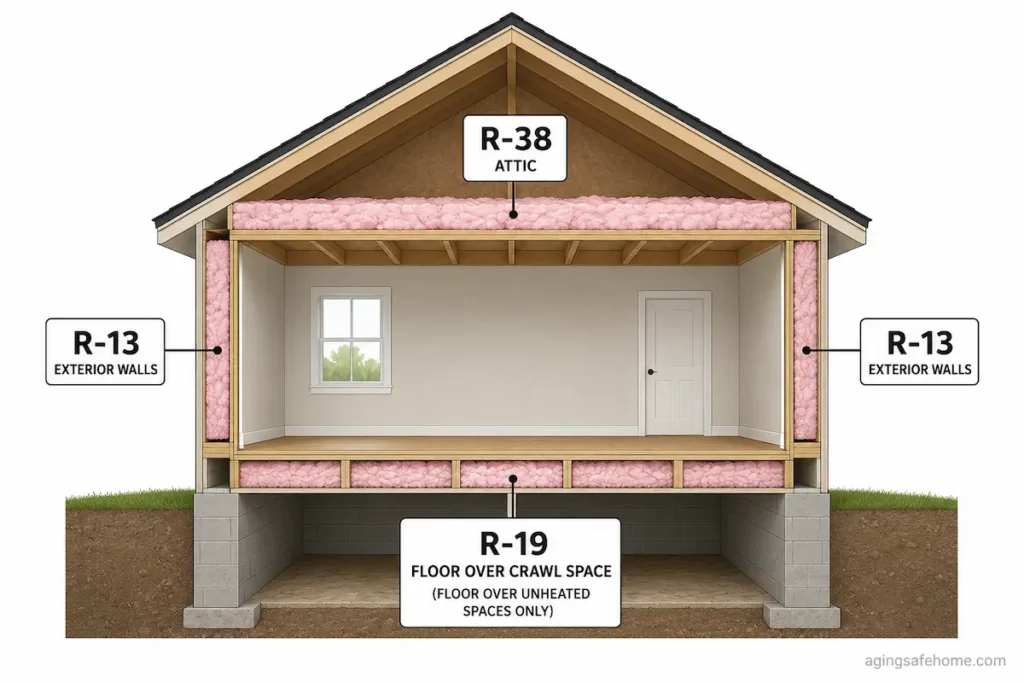
Exterior walls should have R-13 at minimum. Higher is better — R-13 is the floor, not the target.
Floors over unheated spaces — crawl space, unheated basement, anything with open unconditioned air below — should be at R-19. To be clear, this means the floor between your living space and an unheated area below, not between levels of a two-story home. What an uninsulated floor over a crawl space does in winter is allow the cold ground below to pull the heat right out of your living space — you’re essentially heating the outdoors. In summer that same open crawl space pushes humidity straight up through the floor, making your air conditioner work harder to manage both temperature and moisture. Insulating that floor stops the winter heat loss, slows the summer moisture, and takes real load off your system either way.
Attic insulation should be at R-38. Heat rises, and in summer that attic is an oven radiating down into your living space. In winter your heated air is heading straight toward it. The attic is where a lot of Eastern Kentucky homes are losing the most and don’t realize it.
If your home doesn’t have adequate insulation in these areas, that’s where the money goes before windows, before doors, before anything else that costs more. It’s the highest return investment when you’re trying to lower your Kentucky Power bill for the long haul.
Windows and Doors: The Honest Conversation
Old windows and doors are some of the biggest culprits for drafts and energy loss in Eastern Kentucky homes — but the replacement conversation is more nuanced than most people realize.
Here’s what to look for. Is the window single pane? Old wood? Those simply aren’t performing the way a modern window does. Is it cracked? A cracked double-pane window has lost the nitrogen sealed between the glass and is no longer insulating the way it should. Is there fogging or moisture between the panes? The seal has failed and the window is compromised regardless of how new it looks.
What you want is double-pane, low-e glass. Low-e is a coating that reflects heat — keeps it in during winter, reflects it out during summer. It matters.
And here’s something people miss even with newer windows: just because the window is recent doesn’t mean it was installed correctly. Pop the interior trim and look. Was the gap between the window frame and the rough opening filled with window-and-door foam? Or is there just open space communicating with the outside? A window installed without proper air sealing is still costing you money no matter how new it is.
The fixed-income reality: I’m never going to be the one to walk into an elderly person’s home and bring up replacing every window at once unprompted. That’s not my place. But a window that’s cracked, fogged, single pane, or clearly failing? It’s worth saving up for. One at a time if that’s what it takes — and I’ll come back as many times as it takes to get them done.
HVAC: When You Need It, You Need It
Most of the time when I walk into a home out here the HVAC unit is over 20 years old. I understand why — a new system is a significant expense and on a fixed income that’s not a light decision. But a 20-year-old system is working a lot harder than it needs to, and every year you run it inefficiently is money going to Kentucky Power that a modern system would keep in your pocket.
When you need a new unit, you need one. I’ve personally used an HVAC company out of Harlan that does good work at a fair price — reach out if you need a recommendation for this area.
On mini splits: they’re genuinely efficient and worth knowing about for the right situation. A mini-split conditions one zone or room rather than a whole home, which makes them a good option if there’s a specific area that’s always too hot or too cold or if you want to supplement your main system without running the whole thing. Talk to an HVAC professional about whether it makes sense for your setup.
One more thing while we’re on heat: a lot of seniors and elderly adults aging in place in Leslie, Perry, Knott, Letcher, and Breathitt counties run propane wall heaters or wood stoves alongside their main system specifically to lower their Kentucky Power bill in winter — and it’s a legitimate strategy that genuinely works. If that’s you, make sure you have a working carbon monoxide detector within 15 feet of your sleeping areas. CO is colorless and odorless, and for an elderly person living alone the margin for error is zero. The Secondary Heat Sources for Seniors article covers the full safety picture for alternative heat in Eastern Kentucky homes.
The Ladder: What to Fix First
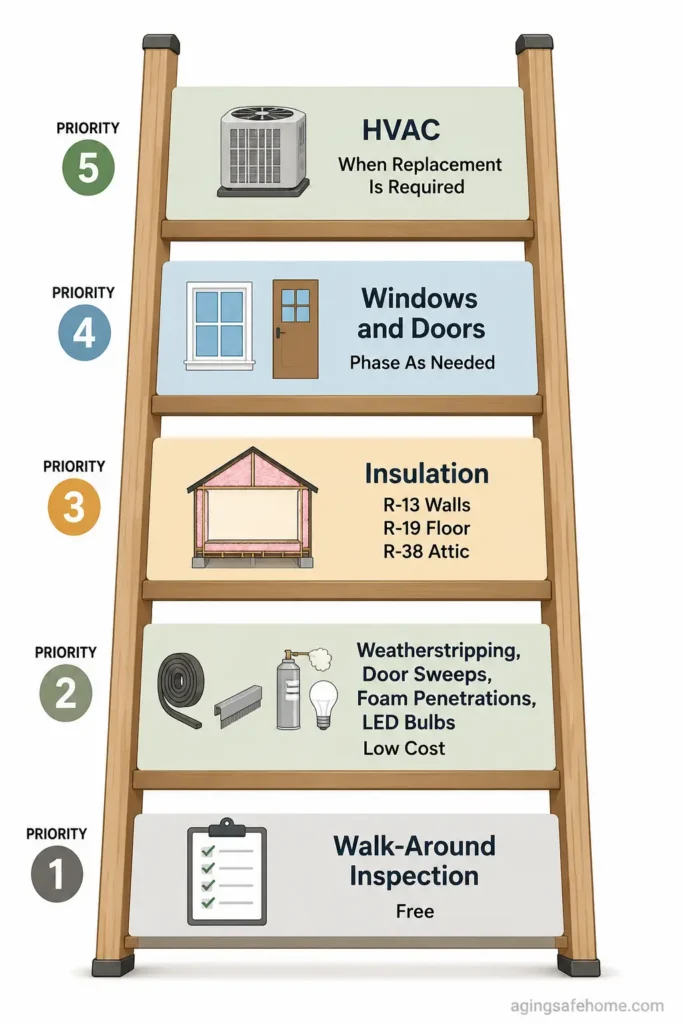
Every home is different and every budget is different. There’s no universal answer — it depends on what’s wrong with your specific house and what you have to work with. But here’s the general framework I use when I’m helping a senior or elderly homeowner in Eastern Kentucky figure out how to lower their Kentucky Power bill.
Start with the walk-around. Find the obvious problems. A clearly failing window, a gaping hole in the underpinning, a door that won’t seal — whatever is glaring, that goes first.
If there’s no single obvious problem, go to the cheap DIY fixes. Weatherstripping, door sweeps, foam around penetrations, LED bulbs. Low cost, no contractor needed, and they add up more than people expect.
From there, insulation. Highest long-term impact relative to cost in older Eastern Kentucky homes, and it makes everything else perform better. Seal the envelope before you worry about what’s inside it.
Then windows and doors as budget allows, prioritizing the ones that are clearly failing. And HVAC when the system genuinely needs replacing — but get the insulation and air sealing done first so whatever system you’re running isn’t fighting a losing battle.
This Is a Long Game, not a Quick Fix
One more thing worth saying plainly before we move on: this isn’t going to transform your Kentucky Power bill overnight. Put in one window and your next bill probably looks about the same. Replace the weatherstripping and don’t expect to save a couple hundred dollars the following month — that’s not how this works and I don’t want anyone thinking it is. What you’re doing here is compounding. Every improvement you make to your home’s energy efficiency stacks on top of the last one. The window you add this month works with the insulation you added last year and the door sweep you put on in the fall. Over time, across enough improvements, you build a genuinely efficient home — and that’s when you feel it in the bill in a way that actually matters. This is a long game and it’s worth playing.
Now here’s the part that matters for seniors and elderly adults on a fixed income: nobody has to do this all at once. The phased approach isn’t a compromise — it’s the smart way to do it. If the budget right now covers one door, we do one door. One window every couple of months, I’ll be there every couple of months. The goal is to make progress in the right order, so every dollar builds on the last one — and every dollar you put into your home is a dollar that stops going to Kentucky Power. For a full breakdown of how to plan and budget home improvements without getting overwhelmed, see the Doing It in Phases article.
Help Paying for Your Kentucky Power Bill
For seniors and elderly adults on fixed incomes in Eastern Kentucky, there are programs worth knowing about before you decide something is out of reach.
LIHEAP covers heating costs and weatherization work for low-income households and seniors are prioritized. The Kentucky Weatherization Assistance Program can cover insulation, air sealing, and window replacements at no cost to qualifying homeowners — that’s worth a phone call before you pay out of pocket for any of it.
Kentucky Power does offer a handful of their own assistance programs — HEART and THAW provide winter bill help for income-qualified customers, and they have a Targeted Energy Efficiency program for low-income residential customers. It’s there. It’s not nothing. Call them if you need it.
For the full picture of every grant and funding program available to seniors aging in place in this region — USDA Rural Development, Area Agency on Aging, Kentucky Medicaid waiver programs, and more — see the Senior Home Repair Grants in Eastern Kentucky guide.
FAQ: How to Lower Your Kentucky Power Bill in Eastern Kentucky
What is the single most impactful thing I can do to lower my Kentucky Power bill?
For most older Eastern Kentucky homes, insulation. Walls, floors over unheated spaces, and attic — if any of those are inadequate, that’s where conditioned air is escaping the most. It’s not the cheapest fix but it delivers the highest long-term return and makes everything else in the house perform better.
What can I do today for little or no money?
Start with the walk-around — look for any obvious gaps or holes where outdoor air is getting in. Then swap incandescent bulbs for LEDs, add weatherstripping and door sweeps to any door letting air through, and foam any gaps around pipes or lines coming through floors and walls. None of that requires a contractor and none of it costs much.
Does running a propane heater actually help lower my Kentucky Power bill?
Yes — it’s one of the main reasons elderly adults and seniors aging in place out here run them, and it genuinely moves the needle on the electric bill. Just make sure the setup is done safely with a working CO detector in the right place. The Secondary Heat Sources for Seniors article covers everything you need to know.
My windows are old. Do I have to replace them all at once?
No. Replace the ones that are clearly failing first — cracked, fogged between the panes, single pane, or drafty — and phase the rest in as budget allows. Also make sure whatever windows you have are properly air-sealed. A newer window installed without foam around the frame isn’t performing the way it should regardless of age.
Are there programs that help pay for energy efficiency improvements for seniors in Eastern Kentucky?
Yes. LIHEAP and the Kentucky Weatherization Assistance Program can cover heating costs and efficiency improvements including insulation and windows for qualifying households, and seniors are prioritized. Kentucky Power also has income-based assistance programs worth asking about. See the Senior Home Repair Grants in Eastern Kentucky guide for the full breakdown.
Is it worth replacing an old HVAC system just for efficiency?
If it’s still running and not failing, it depends on how old and inefficient it is and what your current bills look like. When it does need replacing, buy the most efficient system you can afford — the savings over time are real. Seal and insulate the home first so whatever system you’re running isn’t working harder than it needs to.
The Bottom Line
Kentucky Power is going to keep doing what Kentucky Power does. The rates aren’t getting more reasonable and they weren’t asking permission the last time they went up. But your home — that’s something you have control over.
Every gap you seal, every wall you insulate, every failed window you replace is money that stops walking out the door. Do the walk-around. Start cheap. Build toward the bigger fixes at whatever pace your budget allows. Phase it out if you have to. There is no wrong pace as long as you’re moving in the right direction — and every dollar you put into your home is a dollar that stops going to Kentucky Power.
For seniors aging in place in Leslie, Perry, Knott, Letcher, and Breathitt counties who want to lower their Kentucky Power bill in winter specifically by running alternative heat safely, see the Secondary Heat Sources for Seniors article. For the full picture of aging in place in Eastern Kentucky — modifications, funding, and everything else — see the Eastern Kentucky Aging in Place Guide.
Stay warm. Keep your money.