Keeping It Level
Choosing the right driveway and walkway materials for seniors isn’t about finding the prettiest option — it’s about finding the one that’s still safe to walk on five, ten, twenty years from now. Concrete, asphalt, gravel, and pavers all have a place, but they don’t all belong under the feet of someone using a cane, a walker, or a wheelchair. This article breaks down what each material actually does over time, the installation mistakes I see most often, and how to get the safest surface without redoing your entire driveway if the budget doesn’t allow it. Everything else is details.
This is the next installment in my Last Fifty Feet series on outdoor senior safety.
There I was, drinking my coffee, when my papaw calls me. Yes, this man really does get me into some stuff, I swear.
“The gravel truck is coming today,” he says. “But I won’t be home, I’m busy.”
Now, papaw has gravel. I only win certain battles with him — it’s a work in progress. So the truck shows up, starts spreading the load down the driveway, gets about halfway, and just… dumps the rest. The whole load. Right there.
Guess who spent the next three days shoveling and leveling gravel down papaw’s driveway?
If you guessed me, you’d be correct.
That story is a pretty good stand-in for this whole topic. Driveway and walkway materials for seniors aren’t complicated in theory — but they go wrong constantly in practice. Either because the material wasn’t the right call for the situation, or because whoever installed it didn’t do the prep work to make it hold up. Both of those things matter just as much as each other, and I want to walk through both.
The Materials, Honestly
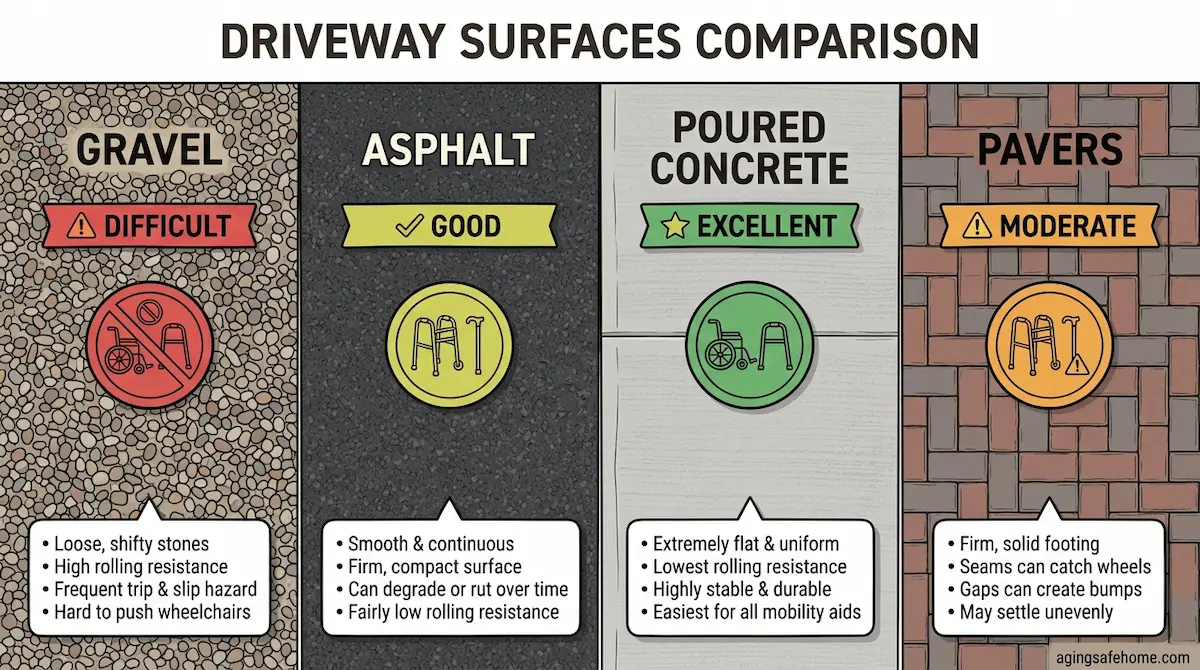
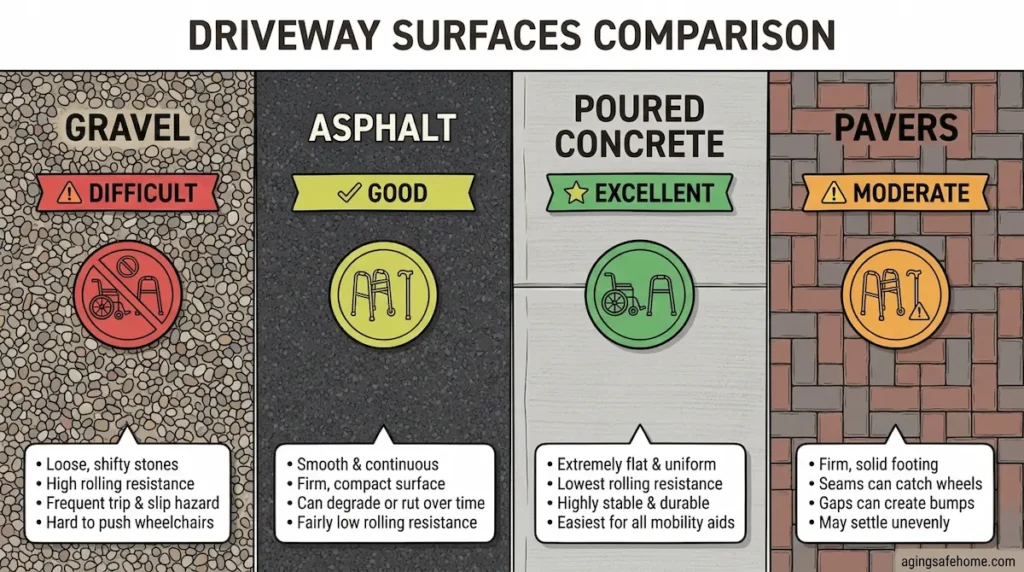
Gravel — Cheapest Option. Safest Option? No.
Gravel is, at its core, already a base material. That’s the honest answer on why it’s cheap — you’re basically skipping a step. And once again, it depends on your situation, but I’ll tell you straight: gravel is not my first recommendation for aging in place, especially not on a hill. The federal accessibility standard for outdoor surfaces backs this up — it requires walking surfaces to be firm, stable, and slip resistant, and loose gravel doesn’t meet that on its own unless it’s been properly compacted and stabilized. Gravel washes out. That’s just a fact. Put it on a slope and gravity does what gravity does.
Here’s a compromise I recommend a lot, especially out here in Eastern Kentucky where a long gravel driveway is just normal — if that’s your situation, my Senior Safety in Eastern Kentucky series covers more of what’s unique about rural properties like this. You don’t have to concrete two miles of driveway if you don’t want to. That gets expensive fast, and I get it. Instead, concrete just the actual parking area and the walkway — the parts where a person is actually walking. Leave the rest of the driveway as gravel if that’s what fits the budget. You’re solving the problem where the problem actually is.
Asphalt — The Cheapest Solid Base
If gravel is the cheapest option and concrete is my usual pick, asphalt sits in between. It’s a solid surface, which already puts it ahead of gravel for someone using a walker or a wheelchair. But asphalt comes with a maintenance requirement gravel and concrete don’t: sealing.
How often you need to reseal depends on the sealer you’re using and what the manufacturer recommends, and it also depends on how thick your driveway is. Average asphalt thickness runs around 3 inches, and heavier vehicles — RVs, that kind of thing — need more than that. The sealer itself is tar-based. And here’s the part people don’t think about until it happens: asphalt gets soft again when it heats up. Soft enough that you can actually dent it.
I’ll be straight with you — I’m not a huge asphalt guy. I know enough to speak to it, but it’s not something I generally install myself.
What I do know is what happens to the people who own an asphalt driveway long-term. My neighbor reseals his every single year, faithfully. Five years ago, that was easy for him. He’s 65 now with two bad knees, and it is not nearly as easy as it used to be. There are companies that will come out and reseal it for you, but that’s more money on top of the driveway you already paid for — just something to factor in before you choose asphalt for an aging-in-place situation. The material itself is fine. The maintenance is the part that gets harder to keep up with as the years go on.
Poured Concrete — My Usual Pick
Concrete costs more than asphalt up front. But it wins on longevity every single time, and it doesn’t come with the same yearly upkeep asphalt does. As long as it has a solid, correctly built base and is installed the right way, it’s going to last. Hit it with a pressure washer every once in a while and you’re good.
It should be finished with a standard broom finish — not just for looks. That texture is what gives it a non-slip surface, which matters a lot more once you’re talking about someone with a cane or a walker. If you want to go deeper on traction beyond just the finish, my Anti-Slip Deck Coatings article covers the same idea applied to decking.
A lot of the concrete failures I see come down to thickness. If you’ve got heavy vehicles parking on a standard 4-inch slab, that’s where problems start. I recommend 6 inches right out of the gate, just to cover your bases. Mesh together 6 inches of concrete correctly and the odds of it cracking are very slim.
Concrete failure almost always starts the same way: a little itty-bitty crack. Water gets into that crack. Winter comes, the water freezes, it swells, and the crack gets bigger. Wash, rinse, repeat, year after year, until you’ve got a driveway full of cracks or one crack that’s turned into a real problem.
Done right, a well-poured concrete driveway can last 40-plus years. A well-maintained asphalt driveway is more in the 15-to-20-year range. Both are a lot easier on someone with a walker or wheelchair than gravel — but between the two, concrete is where I’d put my money for an aging-in-place project, both for longevity and for how little maintenance it demands from someone who may not be able to keep up with yearly resealing forever.
Pavers
Pavers generally cost more than poured concrete, though how much more depends heavily on which pavers you choose and where you live. Sometimes they land around the same price as concrete; sometimes they cost a lot more. It’s also a question of whether you’re doing this yourself or hiring it out — pavers require a lot more labor and take a lot longer to reach a finished product than a concrete pour does.
I’m not ruling pavers out for driveway and walkway materials for seniors — they can be a great choice — but they lean on one thing harder than any other material on this list: the base underneath them. More on that below.
What I See Done Wrong on Driveway and Walkway Materials for Seniors
Gravel.
If it’s not leveled right, it’s a pain — see my papaw’s driveway story above. Beyond the leveling issue, gravel that isn’t contained with proper edging migrates onto walkways and hard surfaces where it acts like ball bearings underfoot, which is its own hazard for someone unsteady on their feet.
Concrete.
The two big issues I see are the slab not being thick enough and pouring a slab too large without an expansion joint. That second one is the big one — it’s the mistake I see most often. An expansion joint is exactly what it sounds like: a joint that lets the concrete expand and contract instead of fighting itself and cracking. Skip it on a large pour, and you’re going to get a crack, guaranteed.
Then there’s upheaval — those big slabs you see jutting up out of the ground. That comes from a few different causes: tree roots pushing up from underneath, or an improper foundation and groundwork. If there’s no good base and no drainage plan, winter comes, the ground underneath is already wet, it freezes, and it pushes your concrete right up out of the ground.
Mesh helps with cracking, but mesh is not a substitute for a real base. You still need a proper substrate under there — dense grade gravel, ABC stone, crushed shell, whatever your area uses.
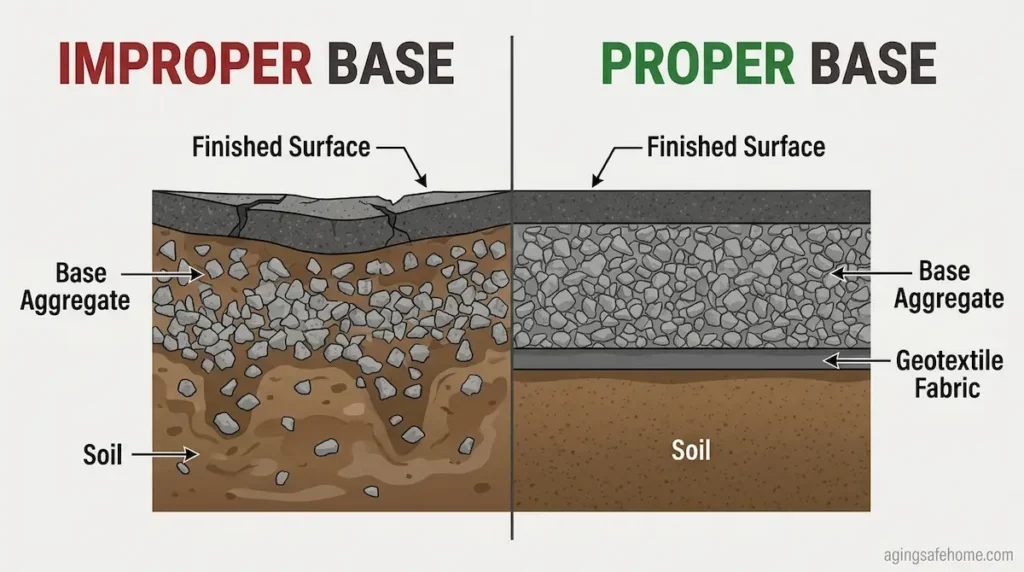
Here’s a piece I see skipped constantly, and it’s the one I’d call the single biggest culprit behind sunken, uneven driveways over time: geotextile fabric. Before that base stone ever goes down, the raw dirt underneath should get a layer of heavy-duty geotextile fabric laid over it first. Skip that step, and here’s what happens — wet clay or soft soil underneath freezes and thaws, freezes and thaws, and little by little your base stone starts sinking down into that soft dirt instead of staying put on top of it. That’s how you end up with wheel ruts, dips under pavers, and a “solid” surface that isn’t solid anymore five years later. The fabric keeps the base stone and the soil from mixing together, and it’s genuinely one of the cheapest steps in the whole job relative to how much lifespan it adds. If a contractor skips it to save a little time, that’s exactly the kind of lazy prep work that comes back to bite you.
If you do lazy prep work — skipping the base, skipping the fabric, skipping the drainage — your concrete, asphalt, or pavers are not going to last, no matter how good the finished surface looks on day one.
Pavers
These have the exact same base problem as concrete and asphalt — arguably worse. Concrete is at least one connected slab fighting to stay in place. Pavers are a whole field of individual blocks, each one capable of shifting on its own. Without a solid base and that same geotextile fabric underneath, you’re fighting a losing battle before you even start, and once it starts going wrong, you’re fixing it piece by piece.
The through-line on all of it: your base and your drainage are the whole game. You’re trying to keep the soil underneath dry, because wet soil that freezes is what moves the ground and pushes on whatever you built on top of it. Keep the soil dry, don’t stress the material, and don’t skip the prep work to save a day of labor. That’s where every one of these failures starts.
Transitions and Drainage — The Part Nobody Talks About
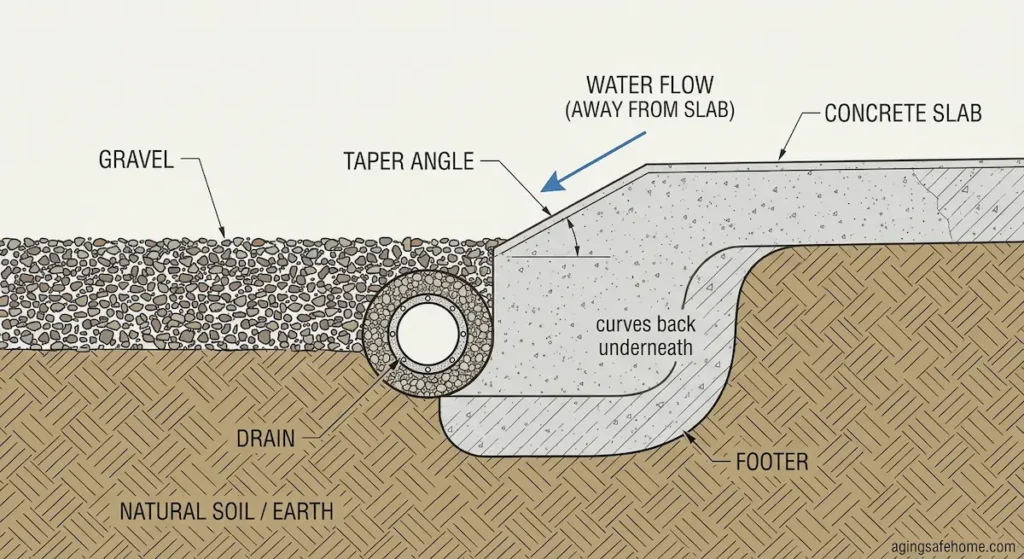
Where a gravel drive meets a concrete pad, you’ve got two options: bring the gravel up level with the top of the concrete, or taper the concrete down into the ground. If you taper it, that edge needs a footer — the same thickness as the rest of your slab — so it doesn’t end up as a thin, weak edge that breaks off. I’d also put a drain right at that tapering point to keep water from pooling there and trying to lift it. Done right, the end of that slab tapers down, angles back underneath itself a little, and forms essentially a block of concrete anchoring the edge. That’s what keeps it strong.
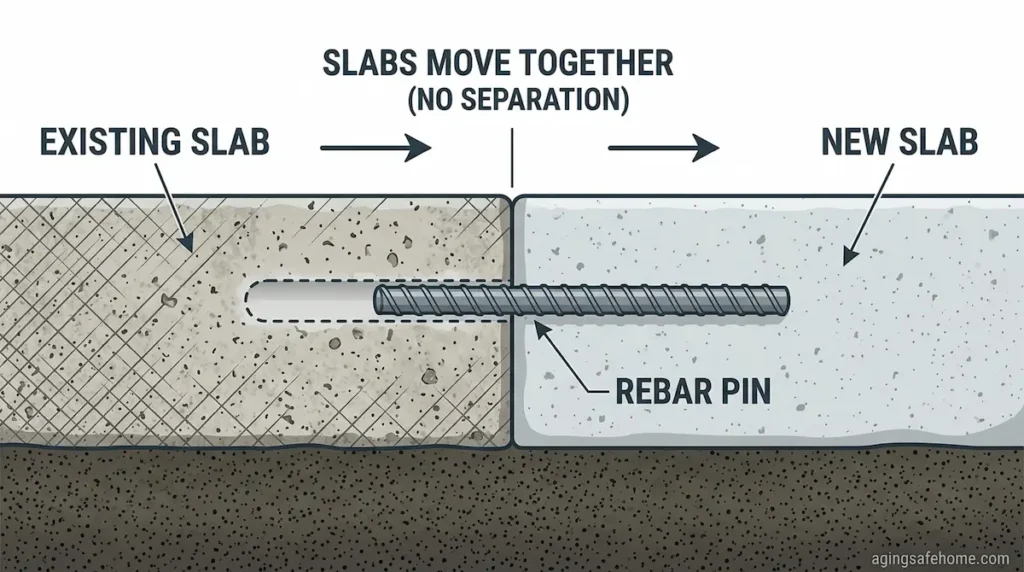
Old concrete meeting new concrete is its own transition problem, and it’s usually where you’ll see an actual trip step form — because the two slabs settle differently over time and stop being level with each other. When I tie new concrete into old, I drill at least half-inch rebar into the old, cured concrete before pouring the new section over it. That locks the two slabs together. If they do shift a little over time, they move together instead of separating and creating a step where there wasn’t one before. Same underlying idea as tying a deck extension into an existing deck — settling and separation cause the step, not the material itself.
And while we’re on the subject: standing water on a driveway or walkway is not a material problem. That’s an installation failure, full stop. There is no reason a brand-new driveway should have water sitting on it — that means it wasn’t pitched correctly. It’s a real safety issue, especially once winter turns that puddle into a sheet of ice, but don’t let anyone tell you that’s just how concrete or asphalt is. That’s the contractor’s job to get right, not something you have to live with.
Two more things worth a quick mention here, since they don’t fit neatly into “material” or “installation” but they matter for driveway and walkway materials for seniors specifically:
Where a smooth walkway transitions into a parking pad or the lawn edge, that boundary can get hard to see for someone with cataracts, macular degeneration, or just reduced depth perception — especially in bright sun or at dusk. A simple high-contrast border strip along the edge of the walkway, whether that’s stained concrete, a contrasting paver border, or a light-reflective paint line, goes a long way toward keeping someone from stepping off the edge without realizing it. Worth pairing with good exterior lighting too — my Outdoor Lighting for Aging in Place article covers that side of visibility after dark.
And on winter maintenance — rock salt and calcium chloride will eat away at new concrete (anything under about two years old) and unsealed asphalt, flaking and pitting a smooth broom finish into a rough, uneven surface over time. I’ll go into safer deicing options in more detail in my upcoming winter safety article, but the short version for now: go easy on the harsh chemical deicers on newer concrete, and lean on sand or a gentler option instead until it’s fully cured.
What About Cost?
I’m not going to hand you a ballpark number for any of this, and I’ll tell you why: it depends heavily on where you live, what your specific job looks like, how much prep work is involved, and how big the job is. Giving out a flat estimate would be doing a disservice to both my fellow contractors and to you as the reader — anyone who quotes you a number without seeing your property is guessing. Get a few local quotes once you know which material you’re leaning toward — and if you want the fuller picture on vetting whoever ends up doing the work, The Last Guy: A Contractor’s Guide to Hiring Right article covers what to ask before anyone touches your driveway.
What I can tell you is where to spend if the budget is tight. If a full driveway redo isn’t in the cards, concrete just the parking pad and the walkway — leave the rest gravel or whatever it already is. And if your layout allows for it, sometimes even that’s more than you need. If you can pull the car right up next to the house, concreting just the walkway itself may be enough. It really comes down to your specific lifestyle and situation. You don’t have to solve the whole driveway to solve the actual safety problem. If you want the fuller picture on stretching a renovation budget further, I go into that more in my Fixed-Income Home Renovations article.
Where I’d Land, If You Asked Me Straight
If you’re trying to sort through driveway and walkway materials for seniors and just want the short version:
- Concrete, poured at 6 inches, is my top pick for anyone who can make the budget work. Longest lifespan, least upkeep, broom finish gives you the traction you need for a walker or cane.
- Asphalt is a fair choice if the budget’s tighter, but go in with your eyes open about the yearly resealing — that gets harder to keep up with as the years go by, or you’ll need to pay someone else to do it.
- Gravel is better than nothing and it’s the cheapest option on the table, but know its limits. It’s not great on a hill, and it washes out over time.
- Pavers can look great and hold up well, but the prep work underneath them is the least forgiving of any material here. If the base isn’t right, pavers will show it faster than concrete will.
None of these are wrong choices in every situation. They’re just different tools depending on your budget, your layout, and how much upkeep you or your family realistically want to take on for the next twenty years.
FAQs: Driveway and Walkway Materials for Seniors
What is the safest driveway material for elderly homeowners?
Poured concrete, at a minimum of 6 inches thick with a broom finish, is generally the safest and longest-lasting option for elderly homeowners and anyone using a walker, cane, or wheelchair. It offers a solid, non-slip surface and requires far less ongoing upkeep than asphalt or gravel.
Is gravel safe for seniors or wheelchair users?
Standard loose gravel is not a good surface for a walker, cane, or wheelchair — it shifts underfoot and doesn’t provide stable footing. If gravel is what your budget or driveway length calls for, the safest approach is to concrete just the parking area and walkway where actual walking happens, and leave the rest of the driveway as gravel.
How long does a concrete driveway last compared to asphalt?
A properly installed concrete driveway can last 40 years or more with minimal maintenance beyond occasional pressure washing. A well-maintained asphalt driveway typically lasts 15 to 20 years and requires regular resealing to get there — upkeep that can become genuinely difficult for an aging homeowner to keep up with on their own.
Why did my concrete driveway crack or heave?
The two most common causes are a slab that’s too thin for the vehicle load it’s carrying, and a large pour without expansion joints. Upheaval — where sections push up out of the ground — usually comes from poor drainage, a missing geotextile fabric layer, or an inadequate base underneath, letting water sit, freeze, and push the slab upward.
Do I need to redo my entire driveway for aging in place?
Not necessarily. If the full driveway isn’t in the budget, concreting just the parking area and walkway solves the actual safety problem in the areas where someone is walking. In some layouts, concreting just the walkway itself — if the car can pull up close to the house — is enough.
What causes standing water on a new driveway, and is that normal?
No, it’s not normal, and it’s not a material problem — it’s an installation failure. A properly pitched driveway or walkway shouldn’t hold standing water. Left unaddressed, that water becomes an ice hazard in the winter, so this is worth pushing back on with your contractor before the job is considered finished.
The Bottom Line
Every one of these materials can be the right choice for the right situation, and every one of them can turn into a hazard if the prep work gets skipped. That’s the real thread running through this whole article — the material you pick matters less than whether it was installed the right way, on the right base, with the right drainage.
Walk your driveway and walkway the same way I’d tell you to walk your yard in my Outdoor Fall Hazards for Seniors article — slow, with honest eyes. Look for the crack that’s just getting started, the low spot where water sits, the seam where old meets new. Deal with the small stuff before it becomes the big stuff.
And if a gravel truck ever shows up while you’re not home — just know how that story usually ends.