Keeping It Level
Outdoor seating for seniors isn’t about picking a pretty bench and setting it in the yard. Safety comes first, aesthetics second — though with the right approach, you don’t have to choose between them. This guide covers matching seating to mobility level. It explains why the ground underneath matters as much as the bench itself, seat geometry and armrest specs, clearance for mobility aids, visibility, lighting, and material choices that actually hold up outdoors. Plus, where, and how many, rest areas belong on a property built for aging in place.
This one’s part of my Last Fifty Feet series — the stretch of ground between the driveway and the front door where many falls happen. I’ve covered lighting, steps, handrails, ramps, coatings, and covering the entryway itself. But outdoor seating for seniors is a piece that gets overlooked entirely, and it matters just as much as anything else on this list. Whether it’s a bench by the front porch or a spot to catch your breath halfway up a hill, rest areas are part of what makes aging in place actually work on a real property, not just on paper.
Safety First, Aesthetics Second
Rest areas can be custom-built, beautiful pieces — benches, seats, whatever shape they take. But that’s really just the aesthetics talking. For outdoor seating for seniors, safety comes first and aesthetics come second. The good news is you rarely have to choose between them. Giving someone a safe environment that still feels comfortable and beautiful is one of my favorite parts of this job.
Built to Your Lifestyle
Like most things I write about, this needs to be built to your lifestyle — or the lifestyle of the elderly person you’re building it for. If someone can get up and down on their own without much trouble, a simple flat bench can do the job. But if they need something to push against to stand, a flat rectangular bench isn’t going to cut it. They need armrests, or some kind of structure they can use for support.
Swings and hammocks are an easy trap to fall into, because they look charming in a catalog — but for obvious reasons, they’re a bad choice for outdoor seating for seniors. Nothing that moves should be involved when balance is a concern. If you want a little sway without full instability, a gliding bench is a reasonable middle ground. If mobility is a real issue, you want zero movement. Sturdy is safe.
Height, Depth, and Getting Back Up
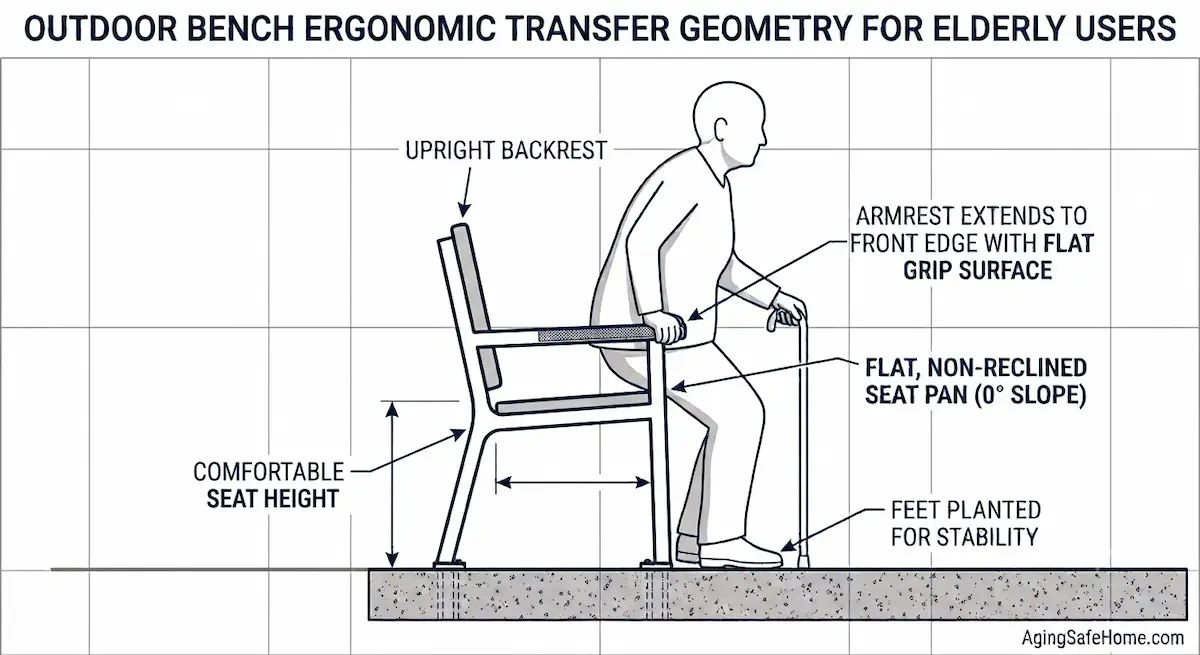
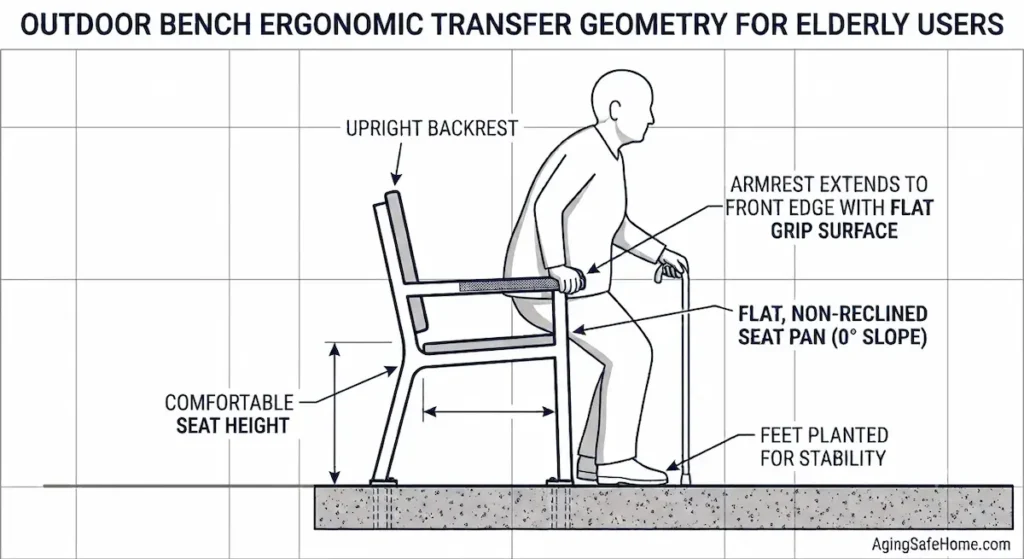
Height gets most of the attention, but it’s only half of what makes a bench safe to get out of. Depth and armrest position matter just as much, especially for anyone dealing with arthritis or lower muscle strength.
A lot of standard park benches are deeper than they need to be. A deep seat forces someone to scoot forward before they can even plant their feet, which costs them momentum and puts real strain on the knees right when they need stability most. For outdoor seating for seniors, a shallower seat depth works better, letting feet stay planted and stable without having to slide forward first.
Armrests need to actually be usable, not just decorative. They should reach out close to the front edge of the seat so someone can push straight down over their feet on the way up, not partway back where they’re pushing at an angle. And the top of the armrest needs a flat, grippable surface — a curved decorative rail looks nice, but hands slide right off it exactly when you need them not to. I cover this same graspability principle in my handrails guide. Avoid a deep backward pitch on the seat pan too. A flat or even slightly forward-leaning seat makes standing back up meaningfully easier than a bucketed one.
Now, when it comes to height, think of it the same way I talk about shower bench height: sit down and have someone measure what’s actually comfortable, give or take an inch for the fact that you’re wearing shoes outside — unlike, hopefully, in the shower. My mother-in-law is barely five feet tall. I’m over six. Our “comfortable” isn’t the same number, and there’s no reason it should be.
If you’re having a bench custom built, this parts easy. If you’re buying one, pay attention to actual seat dimensions instead of just how it looks in the photo — and check the reviews. I ask my own mother this all the time: did you check the reviews? Not the vague five-star ones — the ones where someone describes letting their sons practice WWE off of it and its still standing strong. Those are the reviews that tell you something.
Level Is Law
Here’s the part everyone skips: not the bench, but what’s underneath it. Remember this phrase — level is law.
Can you put a bench over mulch or gravel? Sure, as long as the ground was properly leveled first. The one caveat: if the person relies on a walker or other assistive device, mulch and gravel will fight them the whole way there, even on level ground. For real stability, concrete is king. If you’re pouring a concrete pad specifically for seating, a standard 4-inch depth is plenty — same as a sidewalk. You’re not parking a car on it. Just make sure you finish it with a broom finish for traction, same as I talked about in my anti-slip deck coatings article — a smooth-troweled pad gets slick fast when it’s wet. I go into base prep, thickness, and material tradeoffs in a lot more depth in my Driveway and Walkway Materials guide, if you want the full breakdown before you pour anything.
Pavers are a great option too, as long as they’re installed correctly. And that’s the catch with pavers — most people skip the groundwork. You can’t just set pavers on the ground and call it finished. Nope. Stop. Do not pass go. Do not collect $200. Done right, it’s leveled and tamped ground first, then a layer of crushed stone tamped down, then a layer of sand to bring everything level, and only then do the pavers go in, tamped tight into the sand. There are a few more steps I’ll get into in a future article but think of it like an onion — like that Shrek movie, it’s got layers. Installed right, pavers are fantastic. Installed wrong, you’ll get upheaval and create the exact tripping hazard you were trying to avoid in the first place.
If someone just wants a bench in the yard, level and solid ground is the bar — and keep in mind, weather can shift ground that started out perfectly flat. What’s level today isn’t guaranteed to stay that way.
Room to Maneuver
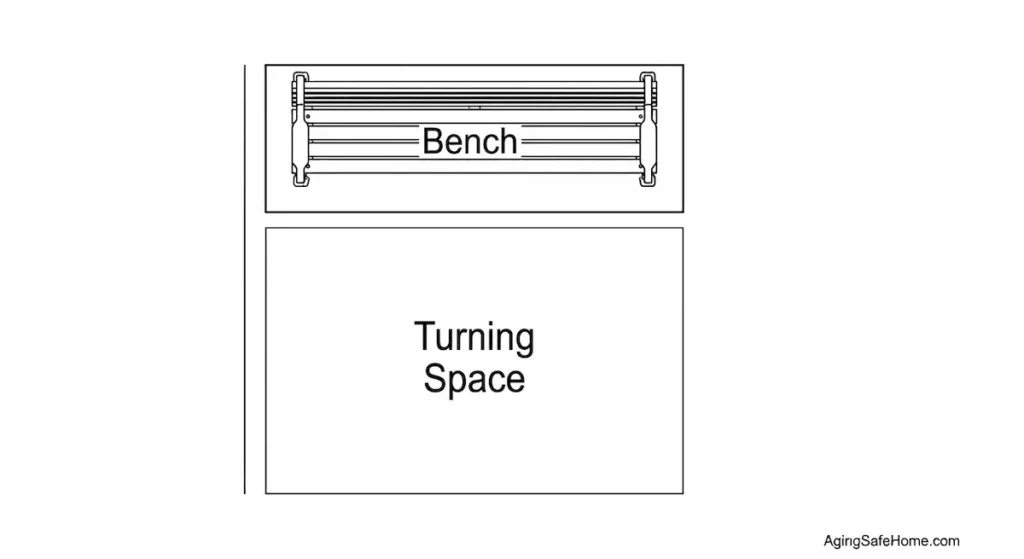
A bench sitting alone on a small pad isn’t always usable, especially if the person relies on a walker, rollator, or wheelchair. There needs to be real room to turn around and park a mobility device safely, not just enough room to stand.
It’s also worth planning for a companion — a clear, level space next to the bench where a family member, caregiver, or another wheelchair user can park alongside the person sitting, without blocking the main path. This is easy to forget when you’re just thinking about the bench itself, but it’s often the difference between a rest area someone can actually use with help and one that quietly excludes the people helping them.
Whether to tie a seating area into an existing walkway really depends on the person and their situation, and honestly, this is what I love about residential work. Commercial jobs have to appeal to the masses, which I get — but building something specifically for one person is what does it for me. If you already have a concrete walkway and want a spot to sit over by the garden, we’ll just branch a new path off the original to get you there. But if someone’s still getting around well and just wants a place to rest after working outside, or catching their breath on the way in from the garage, they can often get by without a dedicated path to it at all. There are also commercial options like weighted furniture if you’d rather buy than build — just don’t lose sight of the sturdy-is-safe rule either way.
Seeing It Before You Reach It
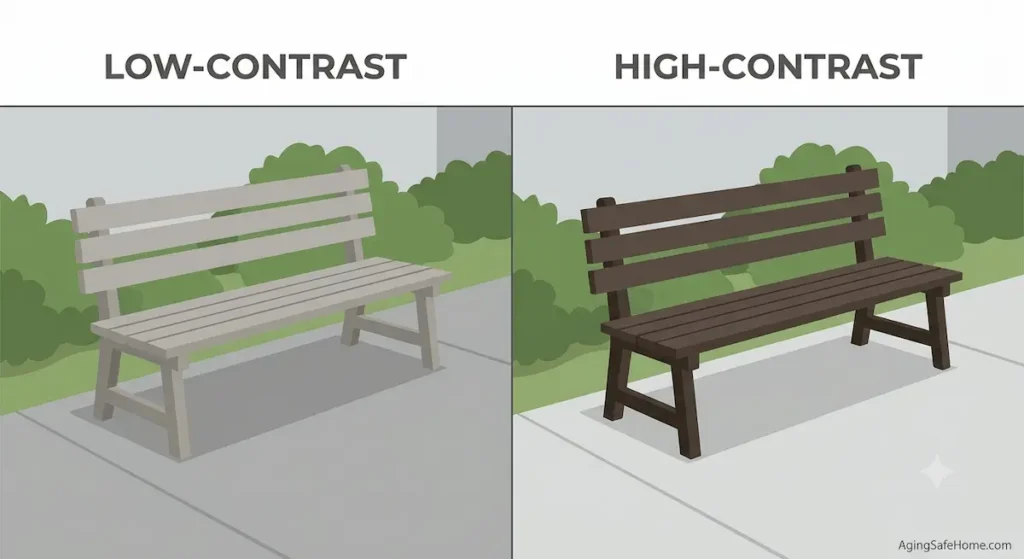
Eyesight changes with age — macular degeneration, cataracts, depth perception loss — and something that’s obvious to you might not be obvious to the person actually using it. A gray composite bench sitting on a gray concrete pad can genuinely disappear in bright sunlight or at dusk.
Pick a bench color that actually contrasts with what’s around it — a dark wood bench against light concrete, or a lighter bench against dark brick or foliage. And if there’s any kind of step or edge transition getting to the bench, mark it. A strip of contrasting stain, paint, or texture on that edge goes a long way toward keeping someone from catching a toe on a transition they didn’t see coming.
I touched on lighting in my Outdoor Lighting for Seniors Guide, but seating areas have their own specific lighting problem. An unshaded light directly overhead shines straight into a seated person’s eyes, which causes glare and can trigger headaches instead of helping anyone see. For a rest area, low, downward lighting works better than overhead — think pathway-level fixtures aimed down at the walking surface, or lighting mounted off to the side rather than straight above the seat.
Materials
I’m a wood guy myself, so take my preference with a grain of salt. A treated wood bench, sealed regularly the way you’d seal a deck, can hold up for years. Sealing it and keeping it out of direct sun both stretch its life further. Cedar is the upgrade version: it doesn’t naturally rot, it’s bug-resistant, and a cedar bench can last decades. It costs more, but it’s a better long-term choice than treated lumber if the budget allows.
Composite, like Trex, won’t rot and will outlast a traditional wood bench, though darker colors run noticeably hotter in direct sun. The only real thing to watch on composite is the fasteners — stainless steel hardware, and it’ll last a lifetime with basic care.
Wrought iron is tried and true — heavy, stable, with support built into the design. I wouldn’t choose it myself, but that’s preference, not a knock against it. The maintenance is mostly just repainting it over time.
Heat is worth taking seriously here, more seriously than most people realize. Dark composite and bare metal sitting in direct sun can get hot enough to genuinely hurt someone, especially anyone with thinner skin or reduced sensation from something like neuropathy — the kind of thing where they may not even feel it happening until there’s real damage done. The same metal works against you in winter too, pulling heat out of bare hands fast and getting slick and uncomfortable to grip in the cold. If that’s a concern, lighter-colored wood like cedar or redwood, or a dense synthetic lumber (HDPE), stays far more tolerable in both directions than dark composite or exposed metal. And regardless of material, if heat’s a real issue, build some shade over the seating area or place it somewhere naturally shaded to begin with.
Clearance and Placement
If you’re putting a bench near a porch, garage, or entryway, don’t let it interfere with the walkway. Keep at least 36 inches of clear path at all times, untouched by furniture.
Beyond that, placement is genuinely site by site — and how many rest areas a property needs, or how far apart they should sit, doesn’t follow a universal rule either. I built my papaw a bench on top of the hill behind his house, because that’s where he wants to be tending his flowers, watching the birds. He’s 76, and he’ll tell you himself he’ll let us know when he can’t do something anymore, and until then, he’s just fine. You know how papaws are. Eastern Kentucky hills aren’t gentle, even for those of us decades younger, so he needed somewhere to rest once he made it up there.
Do I love that my papaw’s still climbing what feels like Mount Everest just to look at the birds, insisting “I can still make it, so we only need a bench at the top”? Not particularly. But that’s his call to make, and it’s my job to deliver for a man who spent his whole life delivering for our family. If he calls me tomorrow and says he needs one halfway up the hill too, I’ll build him one. I’ll build him one every ten feet if that’s what it takes to keep him getting up there as long as he wants to go. That’s the job — figuring out how to keep someone doing what they love, safely, for as long as they want to keep doing it.
Where I wouldn’t put a bench: anywhere that turns into a small pond when it rains hard. Past that, it’s your yard and your call, as long as it’s not compromising actual safety. That’s really what I’m here for — helping you keep your routine the way you want it, for as long as you want it.
Retrofitting Existing Structures
Sometimes you don’t need to build anything new. A low wall, a planter ledge, an existing porch step — any of these can potentially become a real rest point instead of starting from scratch. It’s hard to give a one-size-fits-all answer here, since retrofitting is always job-specific, but here are a few questions worth asking first. Is the existing structure the right height, or does it need real modification to get there? Is there a way to add arm or back support to it? And realistically, what’s the mobility level of the person who’ll be using it? Miss any of those, and you can end up creating more problems than you solved.
FAQ: Outdoor Seating for Seniors
What’s the ideal bench height and depth for elderly seating?
It depends on the individual’s height and mobility, so there’s no single number worth chasing. Start by sitting down and having someone measure what’s comfortable for that specific person, the same way you’d size a shower bench. In general, a shallower seat depth makes standing back up easier than a deep one.
Are swings or hammocks ever okay for seniors?
Generally, no. Anything with sway or movement works against someone with balance concerns. A gliding bench with minimal, controlled movement can work for someone with fewer mobility issues, but a completely stationary bench is the safer call for anyone with real mobility concerns.
Can I put a bench on gravel or mulch?
Yes, as long as the ground underneath is properly leveled first. Just know gravel and mulch are harder to navigate for someone using a walker or other assistive device, even on level ground.
How far apart should seating areas be spaced in a yard?
There’s no fixed rule. It depends on the person’s mobility, the terrain, and how far they’re realistically walking between rest points. Some properties need one bench. Others need several — however many it takes.
What’s the best material for an outdoor bench for aging in place?
Depends on your priorities. Cedar resists rot and insects and can last decades. Treated wood, sealed regularly, holds up well for years. Composite/Trex won’t rot and needs less upkeep, but check for stainless hardware and be aware dark colors run hot. Wrought iron is heavy and stable but needs repainting over time, and bare metal gets uncomfortably hot or cold with the seasons.
Bottom Line
Outdoor seating for seniors isn’t about buying a nice-looking bench and setting it wherever it fits. It’s about matching the seat to the person, building a stable, level surface underneath it, making sure it can actually be seen and reached safely, and putting it exactly where it needs to be for the way that person actually moves through their property. Get that right, and you get something that’s both safe and comfortable — which is really the whole point behind this entire cluster on aging in place.
If you’re just getting started, my free Home Safety Checklist is a good next step for walking your own property with a contractor’s eye.