Keeping It Level
Outdoor fall hazards for seniors don’t announce themselves. They hide in tall grass, in a hole you didn’t know was there, in a dog that doesn’t know its own size, and in the simple fact that when something goes wrong outside, nobody can hear you. This article is about using common sense, knowing what to look for, and making sure that if something does happen, someone finds out about it in minutes — not an hour later when the neighbor lets the dog out. Everything else is details.
My neighbor broke her hip in a hole.
Not a big hole. Not a construction site, not a ditch, not anything dramatic. Just a hole in the yard that she didn’t see when she got up from her chair to go inside. She tripped. She fell. And then she laid there — not knowing how long — until I happened to walk over to check on her because my dogs were barking at the edge of the property and I had a hunch.
The ambulance came. She had surgery. She’s recovering. And I have thoroughly checked that yard for holes since.
A hole. Broke. Her. Hip.
Then there’s the story my dad told me. He lives on a cul-de-sac — about twelve houses total, middle of the day, people around. He was outside and thought he heard something faint but wasn’t sure. Stood there a minute, didn’t hear anything else, figured he’d imagined it. A little while later he let his dog out and heard it again — something that sounded like “help.” He started looking around and found his elderly neighbor laying in her backyard. She’d been there for almost an hour.
Her dogs had jumped on her. Two of them — a golden doodle and a big mutt, both untrained, both wild — jumped up and her knee gave out. She couldn’t get back up. She’d been trying to roll herself toward the porch so she could pull herself up and get inside to call her husband, who wasn’t home. My dad went over, helped her up, got her inside.
Twelve houses on a cul-de-sac. Middle of the day. Nobody heard her for almost an hour.
That’s what outdoor fall hazards for seniors actually look like. Not dramatic. Just a regular yard, a regular afternoon, and nobody close enough or paying enough attention to know something had gone wrong. This is the newest installment in my Last Fifty Feet series that focuses on senior outdoor safety.
What’s Actually Hiding in the Yard
Here’s the thing about outdoor fall hazards for seniors — you don’t need a contractor to find them. You need a slow walk and a set of honest eyes. This isn’t a job site assessment. It’s common sense applied to a space you’ve probably stopped really looking at because you see it every day.
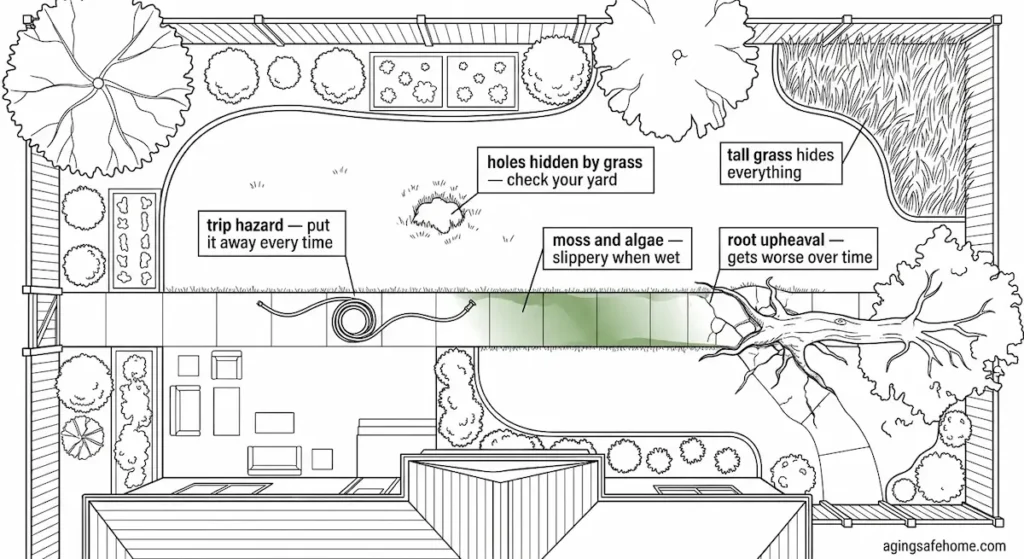
Tall grass hides everything. Hoses, cords, holes, uneven ground, sprinkler heads — all of it disappears once the grass gets long enough. Keep the yard mowed and you can actually see what you’re walking on. That’s not a landscaping tip, that’s a safety tip.
Trip hazards left on the ground are the easiest fix and the most ignored problem. Garden hoses, extension cords, tools left where they were last used — these are things that have no business being in a walking path and yet they end up there constantly. Put them away. Every time. It takes thirty seconds and it’s one of the most effective things you can do.
Walkways need to be kept clear. Leaves, pine needles, moss, algae — all of it gets slippery when wet, and wet is a condition that happens regularly whether you plan for it or not. If your walkway has a green tint to it, that’s not character, that’s a slip hazard. In winter, wet turns into ice, and I cover how to deal with that in outdoor winter safety for seniors.
Decorative gravel in flower beds is generally fine as long as it’s staying in the flower beds. The issue is when it migrates onto walkways and hard surfaces where it acts like ball bearings underfoot. Keep the edging intact and keep the gravel where it belongs.
Tree roots that have lifted or cracked a walkway are a real problem and they don’t fix themselves over time — they get worse. I’m not a tree guy and I’ll be straight with you about that. I’ve taken down a couple small ones on my own property and run the stump grinder, but tree work is its own specialty. What I will say is that if a root has pushed up a section of concrete or pavers on a path a senior walks regularly, that’s worth dealing with. Whether that means calling a tree service, having the walk re-leveled, or rerouting the path — do something about it. Don’t just learn to step over it and assume your elderly parent will too.
Slopes are what they are. Unless you’re planning significant landscaping work, your yard’s grade isn’t going to change. What I’m not here to do is tell seniors to stop going outside. Go outside. Just be aware of where the grade changes, where it gets steep, and where wet grass on a slope becomes a completely different surface than dry grass on flat ground. Know your yard.
If you want to make sure your yard is still safe after dark, go read my Outdoor Lighting for Seniors article that explains what lights to use and why its so important.
Let’s Talk About Dogs
I love dogs. I currently own three of them and every day I hold my breath a little wondering if my wife is going to come home with another one. I love them — but this isn’t a kennel.
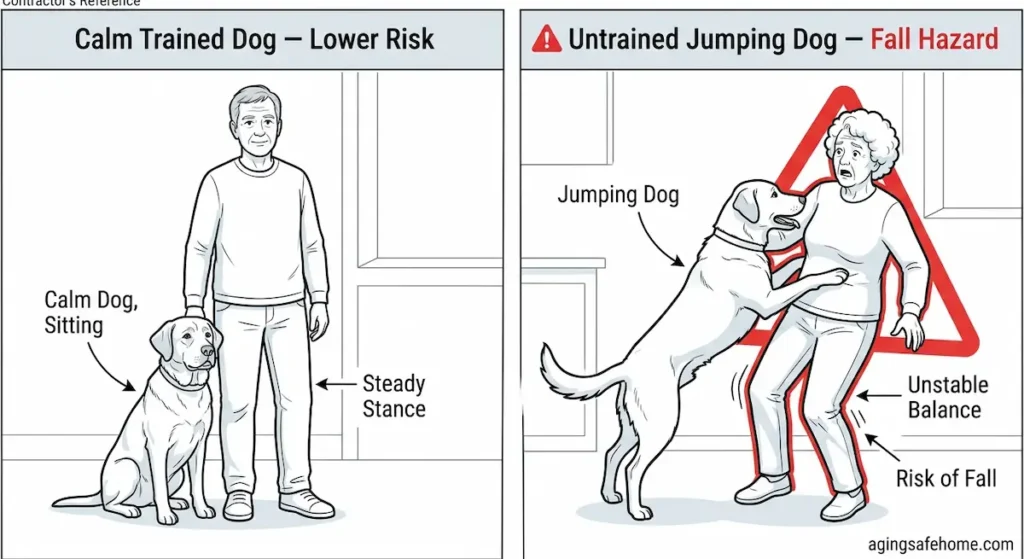
So with that said: dogs and seniors are not automatically a problem. An older, calm, well-trained dog? Probably fine. A puppy that hasn’t been trained, jumps on everyone, doesn’t listen, and has no idea what its own body weight does to a person who doesn’t have great balance? That is an outdoor fall hazard for seniors that nobody talks about enough.
I include myself in that. Until my dad called me about his neighbor, I had never given much thought to what happens when an enthusiastic dog hits an elderly person at the wrong angle. Now I think about it. A medium to large dog jumping up on someone whose knees aren’t what they used to be isn’t an affectionate greeting — it’s a knockdown waiting to happen.
If you’re a senior who has a young, untrained dog and can’t manage the training yourself, get a trainer or have a family member take the dog for that period and work with them. This isn’t about getting rid of the dog. It’s about making the dog safe to be around. Those are two different things.
And if you’re visiting an elderly parent or neighbor who has a dog like that — pay attention to it. The dog doesn’t mean any harm. It just doesn’t know any better yet.
The Isolation Problem
Here’s what makes outdoor fall hazards for seniors uniquely dangerous.
If you fall inside and other people live in the home, odds are someone hears it and help is seconds away. If you fall inside and live alone it’s a different situation — but depending on how bad the fall is you might be able to crawl to the phone or pull yourself up on something. Inside falls are serious and plenty of people have been hurt badly in them. But you have options that outside doesn’t always give you.
Outside the problem is that your voice is competing with everything — open air, distance, closed windows, TVs on inside, neighbors who are at work, lawnmowers running two streets over. You can call for help as loud as you can and it just gets absorbed by all of it. And if you can’t get up you can’t get to a phone. That combination — exposed, unable to move, and harder to hear — is what makes outdoor falls so dangerous for seniors who are alone.
My neighbor was rural. My dad’s neighbor was on a cul-de-sac with eleven other houses. Both were outside in the middle of the day. Neither was heard for almost an hour. The common thread wasn’t geography — it was that nobody had a reason to look until they happened to.
That’s the problem you’re solving with a plan.
The Solution Spectrum on Outdoor Fall Hazards for Seniors
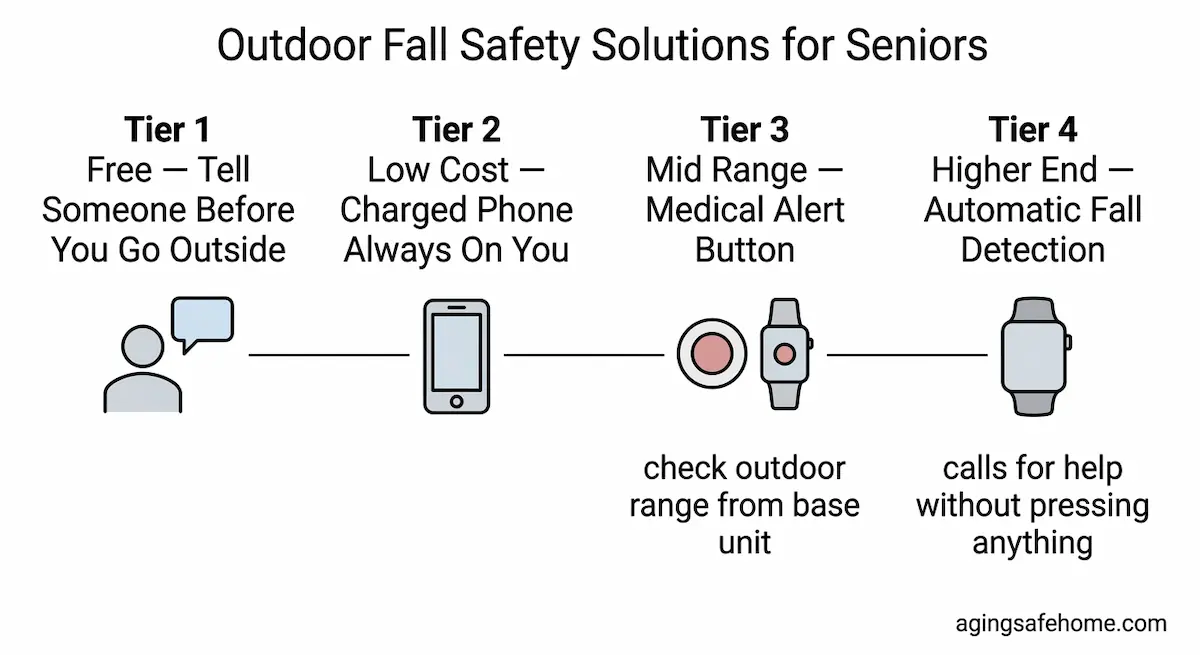
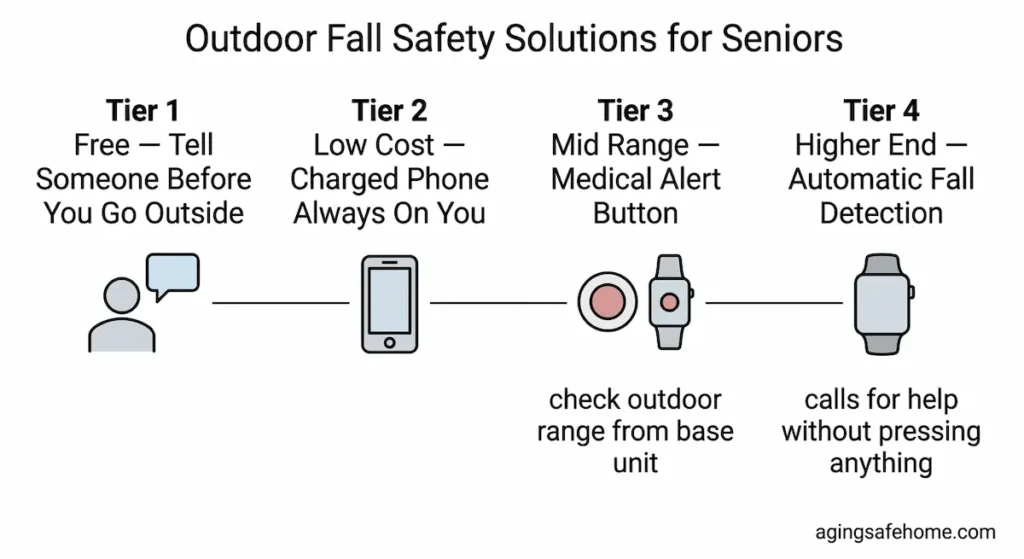
The goal here isn’t to sell you something. The goal is to make sure there’s a plan. And a plan doesn’t have to be expensive or complicated to be better than nothing.
Free, Right Now, Today
Tell someone when you’re going outside. That’s it. “I’m going out to check on the garden, I’ll be back in twenty minutes.” That single habit changes everything about the scenario my neighbor was in. It means someone notices when you don’t come back.
Never go outside alone for yard work without someone knowing. This isn’t about independence — it’s about having a system.
The Cordless Phone Method
My papaw is outside constantly. That man is only still when he’s sleeping. He’s all over his property, every day, doing whatever he feels like doing. And he clips his cordless landline to his shirt or his pants every single time he goes out.
Is it a perfect solution? Probably not. Is it better than nothing? Absolutely.
My mom and aunt have made certain he understands that this is non-negotiable, with the kinds of threats that only mothers and aunts can make effectively. So far it’s working. The key is that it’s always charged and always on him — not sitting on the kitchen counter, not left in the truck. On him.
Now — my papaw said something about medical alert devices that I think deserves to be in this article because I suspect he’s not the only one who feels this way. His exact words were: “If I wanted someone to know my every move I’d live in Lexington.”
Papaws are like toddlers. You never know what’s going to come out of their mouths.
But I do understand it. He’s a proud, independent man and we’re not looking to take that from him. He gets around well, he’s sharp, and he lives right across from me. The cordless phone is a compromise that works for where he is right now. If that changes, we’ll have a different conversation. That’s what you do — you find the balance that works for your family at this point in time, and you revisit it when things change.
If you’re in an area with reliable cell service, your cell phone does the same job as the cordless landline. Charged, on you, every time. In a lot of rural areas cell service isn’t reliable enough to count on. Know which situation you’re in before you decide which tool makes sense.
If you live in a rural area like I do over here in Eastern Kentucky, my Senior Safety in Eastern Kentucky series probably applies to you. Check it out to see problems and solutions folks in the city don’t have to worry about.
Dedicated Medical Alert Devices
Life Alert is the name everyone knows — it’s been around long enough that “I’ve fallen and I can’t get up” is basically part of the cultural vocabulary at this point. A friend of mine uses it for her elderly mother who wants to stay home independently. You designate two contacts it connects to in addition to emergency services, and when the button gets pressed, help is on the way.
What most people don’t realize is that Life Alert and several similar systems work from a base unit in the home — which means outdoor range matters and isn’t always advertised clearly. Before you set up any medical alert system, ask specifically how far the wearable works from the base unit and test it in the actual areas the person spends time. The backyard, the garden, the detached garage — make sure the device works there, not just in the living room.
There are newer options worth knowing about. Medical Guardian, Bay Alarm Medical, and similar services offer dedicated fall detection devices with varying levels of coverage and price points. Some have GPS built in for seniors who are more mobile and active outside the home. Monthly monitoring contracts vary — shop them and read the fine print before you commit.
Automatic Fall Detection
This is the layer that matters most for the scenario we’re talking about — because it doesn’t require the person to press anything. If they fall and can’t reach the button, or they’re disoriented, or they fall hard enough that pressing a button isn’t the first thing on their mind — automatic fall detection calls for help anyway.
The Apple Watch has fall detection built in, and it works. It’s not a perfect system and it does generate occasional false alarms, but for a senior whose family has already bought them a smartwatch it’s worth making sure that feature is turned on. Dedicated medical alert wearables with automatic fall detection are also available at various price points for families who want a purpose-built device without the smartwatch price tag.
The monthly monitoring cost on dedicated devices is the barrier for a lot of families on a fixed income. If that’s the situation, the cordless phone method with a solid “tell someone before you go outside” habit is a real plan — not a consolation prize. Build the free layer first, and add paid layers as the situation and budget allow.
FAQs Outdoor Fall Hazards for Seniors
What outdoor fall hazards for seniors should I look for when walking my yard?
Walk it slowly and look at it like you’re seeing it for the first time. Check for holes, uneven ground, tree roots that have lifted pavement, moss or algae on hard surfaces, and anything left on the ground that shouldn’t be there — hoses, cords, tools. Pay attention to where the grade changes and where water tends to sit after rain. Do it seasonally at minimum because yards change and what was fine last fall may not be fine this spring.
My elderly parent won’t let me make any changes to their yard. What do I do?
Start with the no-cost stuff — put away hoses and cords, clear the walkways, mow regularly. Those things don’t require a conversation about independence because they’re just basic yard maintenance. The device conversation is harder but framing it as a compromise rather than a takeover helps. Find the version they’ll actually use rather than the version you think they should use. A cordless phone clipped to a shirt that they actually carry beats a medical alert device sitting on the nightstand every time.
At what point should a senior stop doing their own yard work?
That’s a personal and family decision that depends on the individual. The signals worth paying attention to are a recent fall or near miss during yard work, significant balance or mobility changes, working alone in an isolated area with no communication plan, or yard work that requires ladders, slopes, or equipment that demands physical stability they no longer have. The goal isn’t to take the yard away — it’s to match the activity to the current ability honestly.
Does Life Alert work outside in the yard?
Life Alert and most base unit systems have a range limit from the home unit — typically around 400-600 feet but that varies by system and by what’s between you and the base. Before you rely on any base unit system for outdoor use, take the wearable to the actual spots the person spends time — the garden, the back corner of the yard, the detached garage — and test it there. Don’t assume it works everywhere just because it works in the living room.
What’s the difference between a medical alert button and automatic fall detection?
A medical alert button requires the person to press it to call for help. Automatic fall detection calls for help on its own if it senses a fall — no button press required. For outdoor situations where someone might fall hard, be disoriented, or land in a position where they can’t reach the button, automatic detection is the more reliable layer of protection. It’s worth paying extra for if the budget allows.
Is the Apple Watch a good option for senior fall detection?
It can be — it has automatic fall detection built in and it works reasonably well. The barrier is cost and comfort. Not every senior wants to wear a smartwatch or knows how to use one. If a family member has already bought their parent an Apple Watch, make sure fall detection is actually turned on because it isn’t always enabled by default. For seniors who won’t wear a watch or can’t afford one, dedicated medical alert devices are purpose built for this and generally easier to use.
What happens if cell service is unreliable in my area?
Some medical alert systems run on landline rather than cellular which makes them more reliable in rural areas with spotty coverage. Life Alert for example has a landline option. GPS enabled mobile devices require cellular signal to call for help so they’re less reliable in low coverage areas. If you’re rural, ask specifically about landline based options and check coverage maps for any cellular based device before you buy.
How much do medical alert systems cost?
It varies widely. Basic landline-based systems start around $20-30 per month. GPS enabled mobile systems with fall detection run $35-50 per month on average. Equipment fees and activation costs vary by company so read the full contract before committing. For families on a fixed income the free and low-cost options — charged phone always on the person, tell someone before going outside — are real starting points that cost nothing while you figure out the budget for a monitored system.
The Bottom Line
A hole broke my neighbor’s hip. An untrained dog put another woman on the ground for an hour on a cul-de-sac with twelve houses. Neither of those situations was unusual. Neither yard was particularly dangerous looking. It was just a regular afternoon and something went wrong.
Outdoor fall hazards for seniors are real, they’re common, and they’re hiding in places that look completely normal until someone is on the ground looking up at them.
You don’t need a contractor for this. You need to walk the yard with honest eyes, deal with the obvious stuff, think about what your dog actually weighs when it’s excited, and make sure there is a plan — some version of a plan, any version — for what happens if something goes wrong outside and nobody is right there to see it.
Be proactive. Not reactive. Every step you put in place before something happens is one less thing you’re wishing you had done after.
My neighbor is recovering. My dad’s neighbor is okay. They both got lucky because someone happened to walk outside.
Don’t count on luck.