Keeping It Level
Outdoor winter safety for seniors comes down to a handful of things done right before the first freeze: something adequate to hold onto, water that drains away from where people walk, the right deicer for the surface you actually have, traction that stays put, a covered entry that can hold the weight of snow, light that comes on when the days get short, and a plan for when something goes wrong or the power goes out. This guide covers all of it, from ramp railings and downspouts to deicers, heated mats, snow load, and who should be holding the shovel. Ice is going to do what ice does. Your job is to make it as hard as possible for it to hurt somebody. Everything else is details.
- Something Adequate to Hold Onto
- Why Ice Forms Where It Does: Drainage, Shade, and Downspouts
- Deicers: What Helps, What Hurts
- Traction: Sand, Kitty Litter, and What Not to Pour Out of the Kitchen
- Pre-Treatment: The Parchment Paper Trick
- Shovels, Brooms, and Your Surfaces
- Heated Mats and Cables for Outdoor Winter Safety for Seniors
- Covered Entries and Snow Load
- Lighting for Shorter Days
- Check the Yard Before the Snow Covers It
- Power Outages
- Who Should Be Shoveling?
- FAQs: Outdoor Winter Safety for Seniors
- The Bottom Line on Outdoor Winter Safety for Seniors
This is the final piece in my Last Fifty Feet series on outdoor senior safety. If you’re just joining, start with the pillar page, Outdoor Safety for Seniors. Everything before this got someone safely from the car to the door. This one is about keeping that path usable when the weather is doing its best to ruin it.
Something Adequate to Hold Onto
My papaw’s ramp used to look like you were scaling the side of a mountain. Every winter he’d come down that thing like he was going skiing, and it drove me nuts.
You might be thinking, why didn’t he just grab the railing? Well, because there wasn’t one. OK, that’s a lie. There was one. It just wasn’t an adequate one.
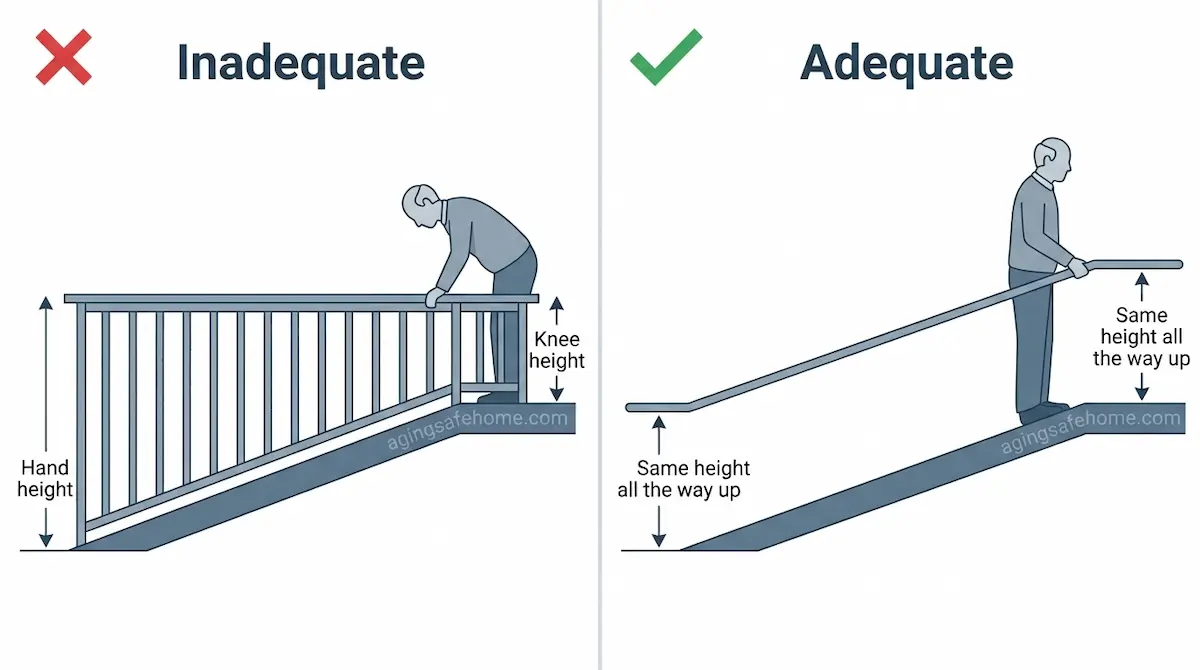
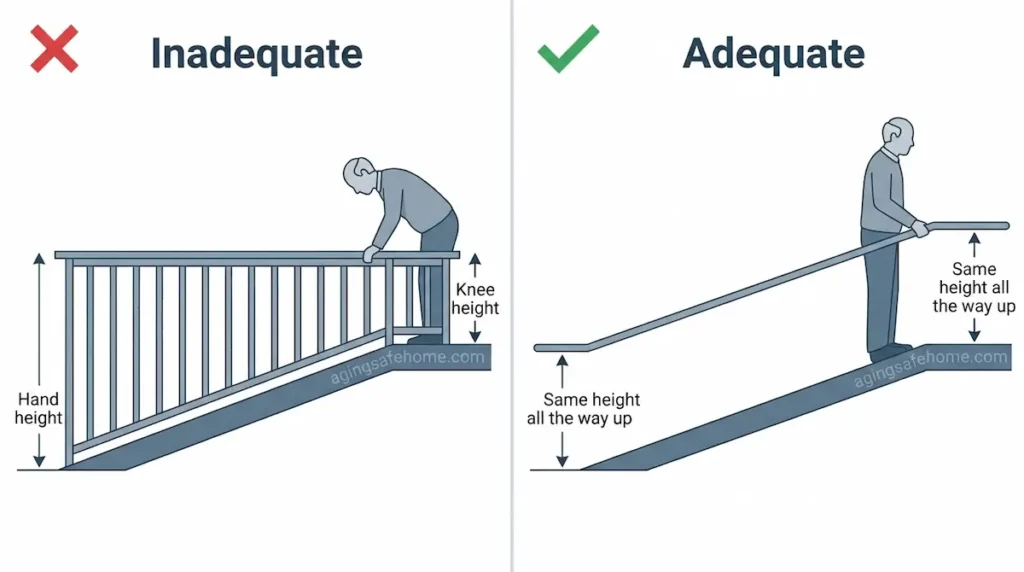
His railing ran straight across like a deck railing. Now what does a ramp do? It slopes. It goes up, or down depending on which way you’re walking. So by the time he got halfway up, that “railing” was sitting at his knees. And folks, if you have to bend over to try and grab your railing, you might as well just tuck and roll the rest of the way down.
That’s what I mean by adequate. The rail has to follow the ramp, or the steps, or whatever you’re walking on, and stay the same height all the way up, and the ADA agrees. It’s the single most important thing I’ll say in this whole article, because everything else I’m about to cover is about reducing ice. But ice is going to win sometimes. When it does, a solid, continuous rail at the right height is what keeps a slip from turning into a fall.
If you want the full breakdown on getting a rail right, my Exterior Handrails for Seniors article covers it, and Wheelchair Ramps covers the ramp itself.
Winter adds one more wrinkle. In freezing rain, your handrails ice over. Metal gets cold faster, but wood will do the same thing. A rail coated in ice is a lot harder to grasp than a dry one, and I’ve made the point before that grip is everything for an elderly person. A rail they can’t hold onto isn’t doing them any good. So, clear your rails the same way you clear your steps, and don’t assume they’re fine because they’re bolted down.
Want a vetted aging-in-place contractor in your area?
I’m building a short list of contractors I’d trust with my own family, one city at a time. Tell me where you need one.
Why Ice Forms Where It Does: Drainage, Shade, and Downspouts
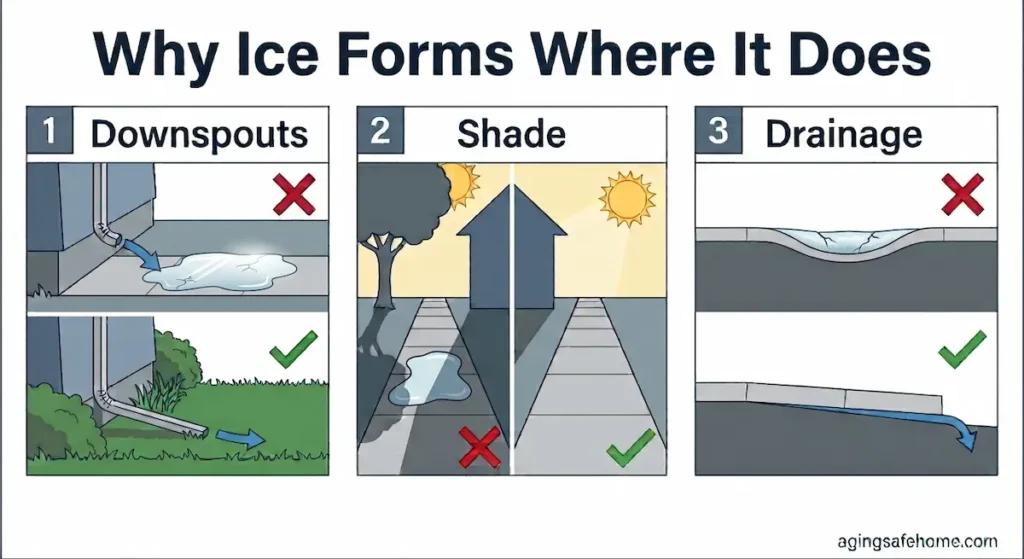
If you want to prevent ice, start by figuring out why it forms in the same spots every year. Nine times out of ten it’s one of three things.
Downspouts. A downspout should never be directed toward a walkway. I don’t care how convenient it was when it was installed. In winter, that water runs across the path, freezes overnight, and you’ve built yourself an ice rink on the one stretch someone has to walk every day. Redirect it away from where anybody walks.
Shade. This one is obvious, but people forget it. A spot that never sees the sun doesn’t thaw. The north side of the house, the area under a tree, the corner behind the porch. Those places hold ice days longer than the rest of the yard, so those are the spots to treat first and check most often.
Inadequate drainage. Water that can’t disperse has nowhere to go but to freeze. And it does double damage: it creates ice, and it keeps the ice that’s already formed from thawing out, because there’s nowhere for the melt to go. If you’ve got a low spot or a section that stays wet, it’s going to stay icy. As I said in my driveway article, standing water on a walkway isn’t a material problem, it’s an installation problem. Winter is just when it shows up. See Driveway and Walkway Materials for Seniors for what proper pitch and drainage look like.
Deicers: What Helps, What Hurts
I told you in my driveway article I’d get into deicers, so here we are.
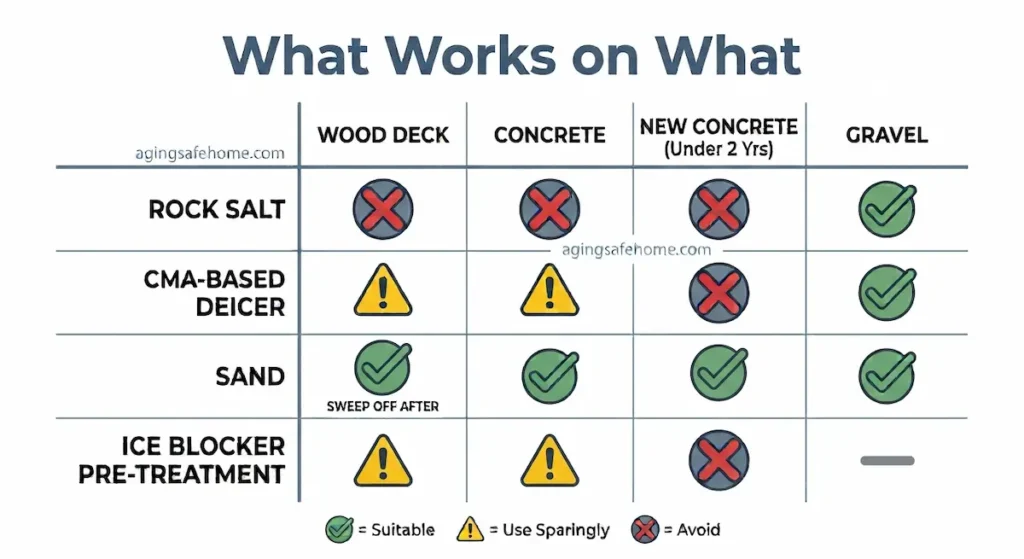
Rock salt. It tears up wood and concrete, especially concrete. It dries the surface out and makes it brittle, and on concrete it causes scaling, which is when the surface chips and flakes off. That broom finish I told you to insist on for traction? Rock salt will eat it.
And you should not put a deicer of any kind on new concrete. I’d say stay off it for at least two years. The absolute bare minimum is a year. New concrete is still curing and gaining strength, and chemicals can damage it before it’s ready.
Now, before everybody comes for me saying “I’ve used rock salt and my stuff is fine.” That’s probably true. This is something that happens over time. I’m not saying you throw rock salt on your deck and a board falls out. I’m saying you’re weakening the structure a little at a time. And on wood, it’s abrasive too. Walking on rock salt over a wood surface can gouge it, the same way a metal shovel can.
If you’re going to use a product anyway, use a CMA-based deicer. CMA is calcium magnesium acetate, a chemical compound that’s gentler on concrete and wood than rock salt. I want to be honest here. None of this stuff is great for your surfaces. But if you’re absolutely going to use something, CMA is the better option. Check the label on whatever you buy to make sure it says it’s safe for the surface you’re putting it on.
Gravel is the exception. If you have a gravel driveway, you CAN use rock salt on it. There’s no surface to scale or pit. Gravel also tends to melt out a little faster than concrete. I’m usually not cheering gravel on for aging in place, but it gets a point from me here.
Traction: Sand, Kitty Litter, and What Not to Pour Out of the Kitchen
Sand is one of the best answers for traction, and probably the one I’d recommend first. It doesn’t melt anything. It just gives your feet something to bite into. One caution: if you leave it on a wood deck, it can put fine scratches in the surface. Not nearly as bad as rock salt, but sweep it off when the ice is gone.
And here’s a free test. If you put sand down on your ramp and it immediately slides off, that slope is too steep to start with. Sand can’t fix a ramp that was built wrong. That’s a conversation about the ramp, not the sand.
Kitty litter works for the same reason sand does. It provides traction. My daughter has a cat, though, and the price of kitty litter would make me second guess it for a whole driveway. But for a small area like a set of steps, it’ll do the job.
Table salt. Papaw called me up one day and asked if I had any “extra salt.” I told him sure, figuring he’d run out of the regular stuff. Next thing I know, I’m watching him pour out my whole Morton’s container right on his ramp.
Will it work in a pinch? Sure. But his house is six feet off the ground, and his ramp and porch are longer than a country song. The absurd amount of table salt you’d need to cover that might change your mind. Leave it on the table where it belongs.
Pre-Treatment: The Parchment Paper Trick
Here’s one most people haven’t heard of. There are pre-treatments, often sold as an ice blocker, that you put in a pump sprayer and coat your driveway, walkway, steps, whatever it is. You do it before the weather hits.
What it does is build a barrier between the ice and the surface so the ice can’t bond to it. Think of it like parchment paper between the baking pan and the cookies. The cookies don’t stick, so they come right off. Same idea. Ice that can’t grip the surface is a whole lot easier to clear.
A lot of these are labeled as safe for wood, concrete, and pets. As with CMA, I’d still use it sparingly and read the label to confirm it’s rated for your specific surface. And just like any other product, keep it off new concrete until it’s fully cured. It won’t stop a storm, but it makes the cleanup easier, and for a senior who can’t be out there chipping ice, that matters.
Shovels, Brooms, and Your Surfaces
A metal shovel on concrete is usually fine. The exception is if you have an anti-slip coating on it. Metal shovels can wear that coating down with repeated use, and then you’ve lost the traction you paid for. If you’ve got a coated surface, see my Anti-Slip Deck Coatings article for what holds up, and use a plastic shovel or a push broom on it.
On a wood deck, use a broom. The decking is usually the most expensive part of your deck, so let’s not gouge it. Obviously, if you’ve got a foot of snow sitting on there, go ahead and use a shovel to take the weight off. But once you get down close to the actual surface, switch to the broom.
One more thing I’ve seen people try. They throw a tarp down over the walkway before the storm. Great in theory, as long as your tarp doesn’t freeze to the surface. Then you’re battling a whole new problem.
Heated Mats and Cables for Outdoor Winter Safety for Seniors
I’ll be straight with you. I’ve never personally used heated mats. I’ve been strongly considering getting a set for papaw’s walkway, and if I do, I’ll come back and write an article with a real review.
There are also permanent heated cables you can install in driveways and walkways. You can pave over them or build over them, and they do what they’re supposed to do. The downside is the cost. Especially if you’re on a fixed income, where sometimes it’s all you can do to heat your house. Heating the entire driveway is out of the question. That’s OK. I get it. I’m out here with a shovel and a broom just like the rest of you.
If you do go this route, I’d look at a small, targeted area like the steps or the landing rather than the whole path. That’s where it counts most. For ideas on stretching a budget, see Fixed-Income Home Renovations.
Covered Entries and Snow Load
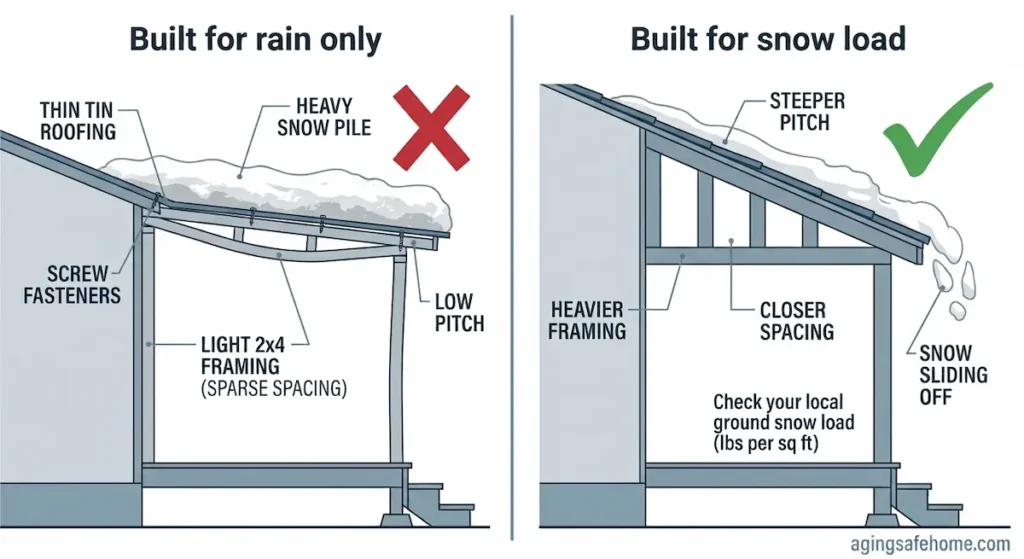
A covered landing keeps the weather off your steps, and that’s one of the most effective things you can do for winter safety. But the question is whether the cover can hold the weight of the snow.
Think about roofs up north. The pitches are steeper because they’re built to shed multiple feet of snow. Roofs down south don’t have to worry about that, so they aren’t as steep. A lot of porch covers, especially ones built after the house, were built with only rain in mind. It’s some tin screwed down to 2x4s. Sure, it keeps you dry. But if there’s ever a bad snowstorm, that thing is folding like a lawn chair.
Papaw learned that the hard way with his porch, but that was before my time, and we don’t talk about it.
It comes down to pounds per square foot, which is how your main roof is built to begin with. The porch roof shouldn’t be any different. Pay attention to your climate. Your local building department can tell you the ground snow load for your area, and a contractor can tell you whether your cover was built to handle it. I break down the awning versus roof extension question in my Porch Awnings for Seniors article.
Lighting for Shorter Days
If it’s dark, you want light. That doesn’t change in winter, but the timing does. As the days get shorter, remember to adjust your timers and sensors so the lights come on when it’s getting dark, not an hour after. Winter dusk shows up fast, and a walk to the mailbox that was fine at 6 p.m. in July is a different story at 5 p.m. in December. My Outdoor Lighting for Seniors article covers what to use and where to put it.
Check the Yard Before the Snow Covers It
Snow fills in holes and low spots, and if you get enough of it, the whole yard looks flat. That’s a problem, because you can’t see what you’re stepping on.
If you remember my neighbor who broke her hip in a hole, you know how little it takes. Before the first big snow, fill in those holes and low spots. At the very least, know where they are so you can steer around them. My Outdoor Fall Hazards for Seniors article has the full walkthrough.
Power Outages
Power outages happen a lot around here, and I’m sure they do in other areas too. When the power goes out in winter, it’s not just an inconvenience. It’s a safety issue, especially for someone who lives alone.
I cannot stress enough how important I think a secondary heat source is. I’ve got a full article on that: Secondary Heat Sources. And if you can swing it, a whole-home generator is worth a serious look: Whole Home Generator. If you’re rural like I am, my Senior Safety in Eastern Kentucky series covers more of what we deal with out here.
One safety note while we’re on it. Whatever backup heat or power you use, never run a generator indoors or in an attached garage, and keep it well away from windows and doors. Carbon monoxide doesn’t announce itself. Make sure you have working carbon monoxide detectors, too.
Who Should Be Shoveling?
That’s not my place to tell a random person what they can and can’t do. I do all the shoveling and cleaning around here for my house and papaw’s. But if I weren’t here? He’d just do it himself whether it was a good idea or not.
If you have someone who can do it for you, that’s great. If you can afford to hire someone, that’s great too. I’m not going to sit here and pretend to know everyone’s family dynamics and finances.
Here’s what I will say. If you’re a younger, able-bodied person and you have an elderly person in your family who lives near you, check on them and ask. Even if you’re just a neighbor, it doesn’t hurt to ask. As much as I joke about my papaw, there’s serious risk to him and every other senior when conditions are slippery. Falls are dangerous, and they’re even more common in winter.
And remember the isolation problem from my fall hazards article. Outside, nobody hears you. In winter, you’re also at risk of the cold on top of the fall. If you’re heading out, tell someone, and keep a charged phone on you.
FAQs: Outdoor Winter Safety for Seniors
What is the safest way for seniors to walk on icy surfaces?
The safest way is to avoid ice, but if you have to be out, make sure there’s a continuous rail at the right height to hold onto, wear footwear with real traction, take short steps, and tell someone you’re going out. The surface matters just as much as the person, so clear and treat the path before anyone has to use it.
What is the best deicer for concrete walkways?
None of them are great for concrete. If you’re going to use one, a CMA-based product is gentler than rock salt. Sand adds traction without damaging the surface. Don’t put any deicer on new concrete, ideally for the first two years, and at the absolute minimum the first year.
Is rock salt bad for wood decks and concrete?
Yes, over time. It dries out and weakens concrete and causes scaling, and on wood it’s abrasive and can gouge the surface. It won’t ruin your surface overnight, but it weakens it a little at a time. Rock salt is fine on gravel.
Does sand work on ice?
Yes. It doesn’t melt the ice, but it gives your feet traction. If sand slides right off your ramp, the slope is too steep. Sweep it off wood decks when the ice is gone, since it can scratch the surface.
Are heated walkway mats worth it for outdoor winter safety for seniors?
I haven’t used them myself, so I’ll update this when I do. They can work well in a small area like steps or a landing. The main drawback is cost, especially on a fixed income, and permanent heated cables cost more still.
What does an ice blocker or pre-treatment do?
It’s sprayed on a surface before the weather hits and creates a barrier so ice can’t bond to it. That makes the ice much easier to clear. Check the label to make sure it’s safe for your surface.
How do I stop ice from forming on my walkway?
Check your drainage, shade, and downspouts first. Never point a downspout at a walkway, make sure water can run off instead of pooling, and treat shaded areas first because they stay icy the longest.
Can a porch roof collapse from snow?
Yes. Many porch covers, especially ones added after the house was built, were designed only for rain. Ask your local building department for the ground snow load in your area and have a contractor confirm the cover can handle it.
Who should shovel snow for an elderly parent?
That depends on the person and the family. If you can help or hire someone, great. If you live nearby, check on them and ask, especially after a storm.
The Bottom Line on Outdoor Winter Safety for Seniors
My papaw used to come down his ramp like he was going skiing, and he did it for years before I was finally allowed to fix the railing. It wasn’t the ice that was the only problem. It was that there was nothing adequate to hold onto when the ice showed up.
That’s really what this whole series has been about. Ice is going to do what ice does. You can’t stop the weather. But you can make sure there’s a rail that follows the slope, water that drains away from the path, the right deicer on the right surface, traction that stays put, a roof that can hold the snow, light that comes on in time, and someone who knows when you’re heading out. Clear the ice and snow as it comes, if you can. If you can’t, do what you can ahead of time.
Be proactive. Not reactive.
If you’re working through a full aging in place plan for your home, grab our free Home Safety Checklist and walk through it room by room, inside and out.