Keeping It Level
A deck or porch that’s been standing for years can look perfectly fine and still be hiding real problems underneath. This isn’t a build guide, it’s a walkthrough. We’ll cover how to spot deteriorating boards and rusted fasteners before a foot goes through one, how to actually test a railing instead of just eyeballing it, the hidden trip hazard at your own back door, where an outdoor grab bar makes sense, why covered porches aren’t automatically safer, and what a realistic maintenance routine looks like. Deck and porch safety for seniors comes down to catching the small stuff before it becomes the big stuff.
- Deck and Porch Safety for Seniors: The Threshold Drop Nobody Notices
- Board Condition, Deterioration, and Rusted Fasteners
- Railings: The Shake Test and the Baluster Gap
- Resting Areas and Seating
- An Outdoor Grab Bar?
- Debris, Algae, and Slip-Resistant Surfaces
- Deck Maintenance for Seniors: Re-Sealing on a Realistic Schedule
- Covered and Screened Decks: What Changes
- Lighting: The Blind Transition
- Furniture and Obstacles
- The 5-Minute Deck and Porch Safety for Seniors Audit
- FAQ: Deck and Porch Safety for Seniors
- Bottom Line
Many decks and porches I get called out to aren’t new (although I do build new custom decks, that’s a different call though). They’re 10, 15, 20 years old, and they’ve held up fine for that long, which is exactly the problem. “It’s been like that forever” is not a safety inspection. It’s just something bad that hasn’t happened yet.
If a deck is newer, built by someone reputable for an elderly homeowner, I’ll still take a look at the structure, but nine times out of ten it’s solid. The older the deck, the more the walkthrough matters, because that’s where the structural stuff needs a real assessment, not a glance.
This is another piece in our Last Fifty Feet series covering deck and porch safety for seniors, and it’s a little different from the others. We’ve covered building ramps, handrails, and steps the right way. This one’s not about building anything. It’s about what I actually look for when I walk an existing deck or porch for aging in place.
Deck and Porch Safety for Seniors: The Threshold Drop Nobody Notices
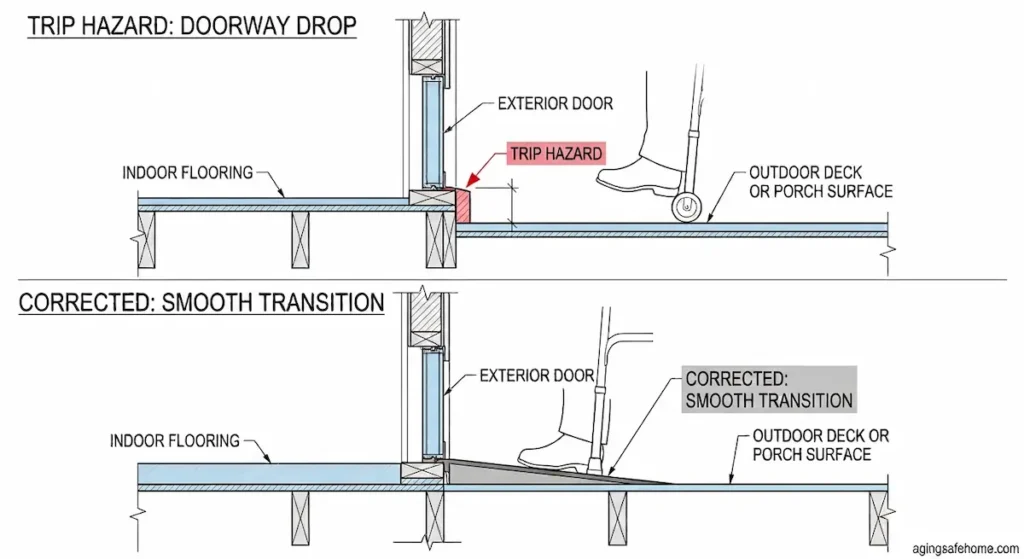
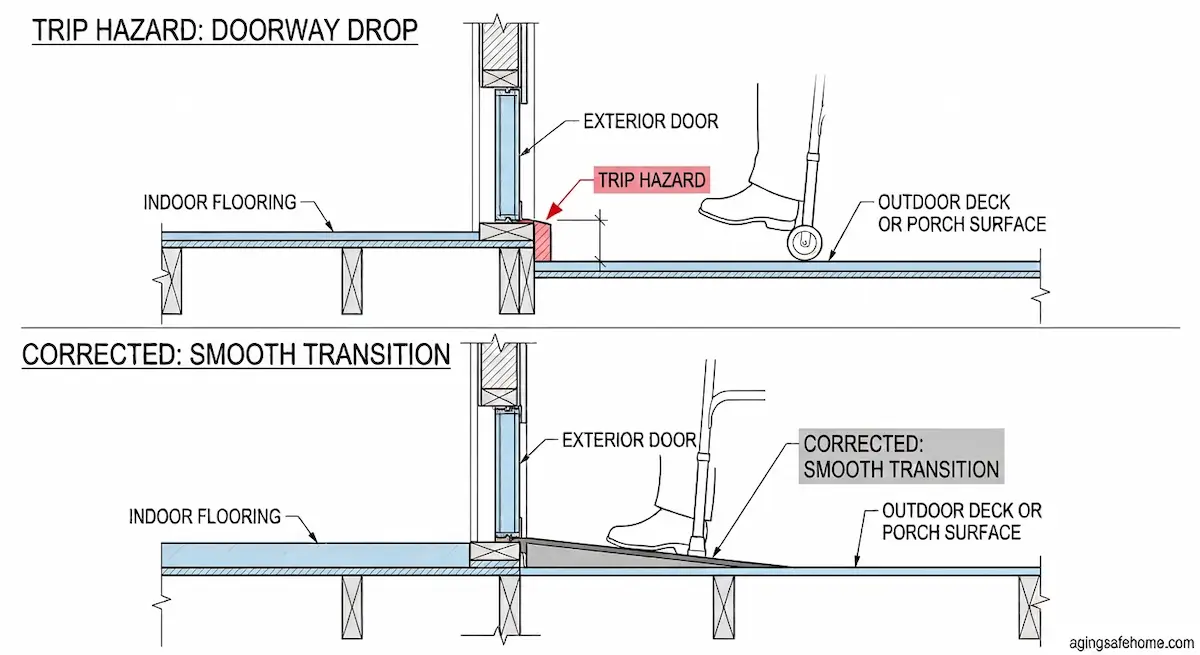
Before we even get to the deck itself, check your own door. Most builders intentionally set the deck or porch surface a few inches below the indoor floor level. That’s not a mistake; it’s done on purpose to keep driving rain from working its way under the door.
For most people, that small drop is invisible, a non-issue they’ve stepped over a thousand times without thinking about it. For a senior, especially someone using a walker or someone who shuffles their feet instead of lifting them fully, that invisible drop is a real trip hazard sitting right at the doorway. If you find that on your property, a modular rubber threshold ramp or a low-profile transition wedge on the exterior side is a simple, weather-tolerant fix that smooths that drop out without messing with the door itself.
Board Condition, Deterioration, and Rusted Fasteners
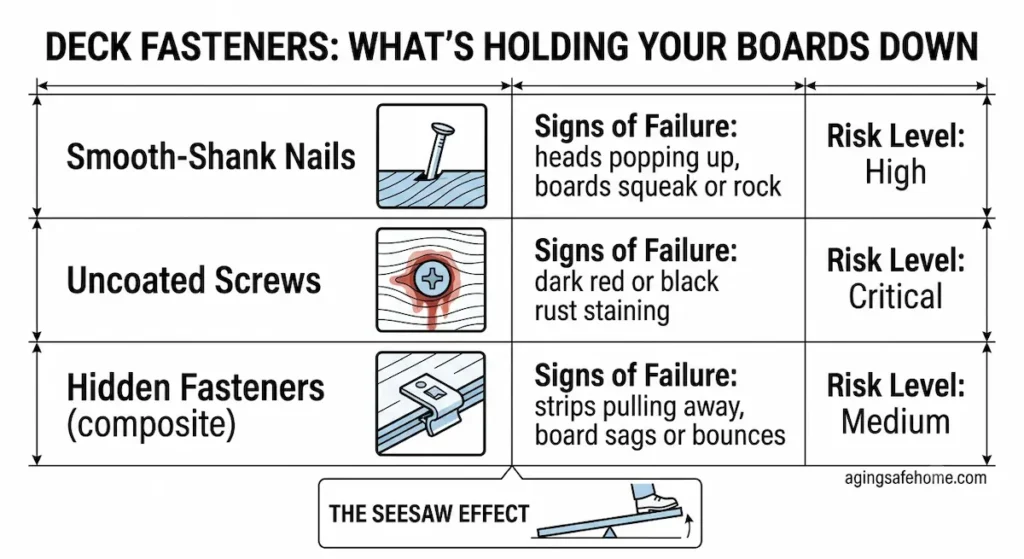
Soft spots are the obvious one, but they’re not the first sign of trouble, they’re usually one of the last. Before a board ever gets soft enough to flex under your foot, you’ll see it. Visible rot, discoloration, dark staining along the grain. You’ll also see nails starting to pop up as the board moves over time. And you’ll see cupping, where the board starts to bow up on the edges, which is a sign moisture’s gotten into the wood and it’s warping.
Here’s why those nails are popping in the first place, and it’s worth understanding. On decks built 15-plus years ago, a lot of builders used standard nails or cheap screws that weren’t rated for treated lumber. The chemical treatment in pressure-treated wood eats away at raw steel over time, corroding those fasteners until they snap clean through underneath the board, out of sight. A board can look completely flat and fine right up until someone steps on the edge of it, and it flips up like a seesaw because there’s nothing but rusted-out metal holding it down anymore. If you see rust staining bleeding out around a fastener head, that’s your warning sign, and the fix is retrofitting with 3-inch stainless or coated structural deck screws, that’s what I use.
I’ve had customers put a foot straight through a rotted board because they’d looked at it, knew it needed attention, and figured they’d get to it one day. That mindset is exactly what turns uneven decking into an emergency room visit instead of a weekend repair.
Board spacing matters too, and here’s something a lot of homeowners don’t know. Store-bought treated lumber is still wet when you buy it. As it dries out over the following months, it shrinks, and that shrinkage creates gaps on its own. I don’t space my boards at all when I’m using treated wood, because if you run a gap up front and then the wood dries and shrinks further, that gap ends up too wide, and now you’ve got something a cane tip, a walker leg, or a small wheel can catch in or drop through. That gap exists for a reason though, wood expands in heat and humidity and contracts in the cold, so it needs room to move, and it helps with drainage too. Composite decking is a different animal; it usually comes with a hidden fastener or biscuit system that handles this for you.
Underneath all of it, the joists holding those boards up matter just as much as the boards themselves. I frame at 16 inches on center for wood decking and tighten that up to 8 to 12 inches for composite, since composite needs more support to stay stiff under weight. If a deck feels bouncy even though the surface boards look brand new, that’s usually your answer. Either the joists underneath are rotting from the top down where moisture’s been sitting between the deck boards and the frame, or whoever built it originally spaced the joists too far apart to begin with.
Railings: The Shake Test and the Baluster Gap
Wood and lumber flex a little no matter what, that’s normal. What you’re actually checking is the anchor points. Walk up to the railing and lean on it, don’t swing on it like a monkey bar, just lean the way someone would naturally grab it for support. If it takes real effort to get it to move even a quarter inch, it’s probably fine. If a light lean gets it swaying, that’s one of the loose railings I run into constantly on older decks, and it needs attention before anyone leans on it for real support.
Material matters here too. Wrought iron railings tend to have more natural give than a wooden railing does, so know what you’re working with before you decide something’s loose. If it does need work, sometimes bracing or tightening the existing connection is enough. Other times, especially if you’re looking at more repair than the railing’s worth, it’s time to talk about tearing it out and starting over. I go into the full guardrail versus handrail distinction, height, and load requirements over in the handrails article, worth a read if you’re rebuilding one anyway. If cost is what’s holding that decision up, check out if you qualify for assistance programs before ruling a proper rebuild out.
While you’re at the railing, look down at the balusters, the vertical spindles running between the top and bottom rail. Older decks were often built with wider spacing than you’d get away with today. Current standard is a 4-inch sphere test, nothing bigger than 4 inches in diameter should be able to pass through that gap. That’s not just a small-child safety rule. A wide gap can trap a cane tip or a foot if someone loses their balance and stumbles into the railing, turning a minor slip into a real injury.
Resting Areas and Seating
Having somewhere stable to sit down partway through a task, checking the mail, watering plants, whatever it is, matters more than people think. I’ve built beautiful custom benches into a deck, and I’ve had customers just buy a nice chair and set it up instead. Either one works. What matters is that it’s there, and that it’s stable enough to trust. I get into what actually makes a seating area work — not just look nice — in my full guide to outdoor seating for seniors.
An Outdoor Grab Bar?
Here’s the thing about grab bars I love telling people: in your own home, you’re the king or queen of the castle. Commercial work means building for the masses. Residential work means building around you. So if you want a grab bar somewhere, as long as it’s anchored into something solid, a stud, a doorframe, I’ll build it wherever makes sense for your life.
Stainless steel grab bars hold up outdoors just fine, they’re made to be waterproof and they won’t rot. The one thing I’d caution you on is sun exposure. If you’re putting one on an uncovered porch, especially near a west-facing entry that bakes all afternoon, that stainless steel is going to get hot, like genuinely too hot to grab comfortably. Most of the time I see them installed just inside a doorway, out of direct sun, but I’ve also put them in random spots based on what the person actually needed. I had one customer who wanted theirs installed in the garage, since that was the door they actually used to come and go every day, and because it was covered and out of the sun, it worked perfectly there. It’s specific to you and your situation, not a one-size answer.
Debris, Algae, and Slip-Resistant Surfaces
The two worst culprits are leaves and algae. Algae’s always slick. Leaves are slick when wet, and if you leave them sitting on a wood deck long enough, they’ll rot the boards out underneath them. Composite won’t rot from leaf litter, but it’ll get slippery and can stain. With that being said though, just remember most composite decking is generally built over a treated wood frame. Which means that even though your decking might not be able to rot, the framing absolutely will. This can lead to a false sense of security because your deck looks fine from the top but is slowly rotting away underneath, worth keeping in mind.
The fix for leaves isn’t complicated. A broom or a hose will do it, this isn’t rocket science, you just have to actually do it instead of letting it pile up. For algae, an outdoor cleaner works for light buildup, but if it’s bad, it’s time for a pressure washer. That’s on my papaw’s schedule every year too, right alongside his re-sealing. If you don’t own one, somebody in your family probably does or knows somebody who does. Keeping up with both is really what keeps a slip-resistant deck surface slip-resistant, the material itself only does half the job. If you’re looking at putting down a new anti-slip coating instead of just keeping up with cleaning, I break down the products and what works on which surface in my anti-slip deck coatings guide.
Deck Maintenance for Seniors: Re-Sealing on a Realistic Schedule
Maintenance frequency really depends on how much traffic the space actually gets, not just its size. A big wraparound porch that doesn’t see a whole lot of daily use can usually go longer between resealing than your stairs need. But a small deck or porch that leads straight into the house is probably seeing just as much foot traffic as your steps every single day, and if it’s the same material, it needs to be treated on that same schedule, not stretched out just because it’s technically “a porch.” I went through the full sealing schedule and product recommendations in the steps article, the same rules for wood, composite, and masonry apply here. Whatever product you use will have their own specifications and timeline for you to go by. I would never recommend going past the allotted time but if your space sees more foot traffic than usual you might have to do it more frequently. Always more frequently, never less.
Covered and Screened Decks: What Changes
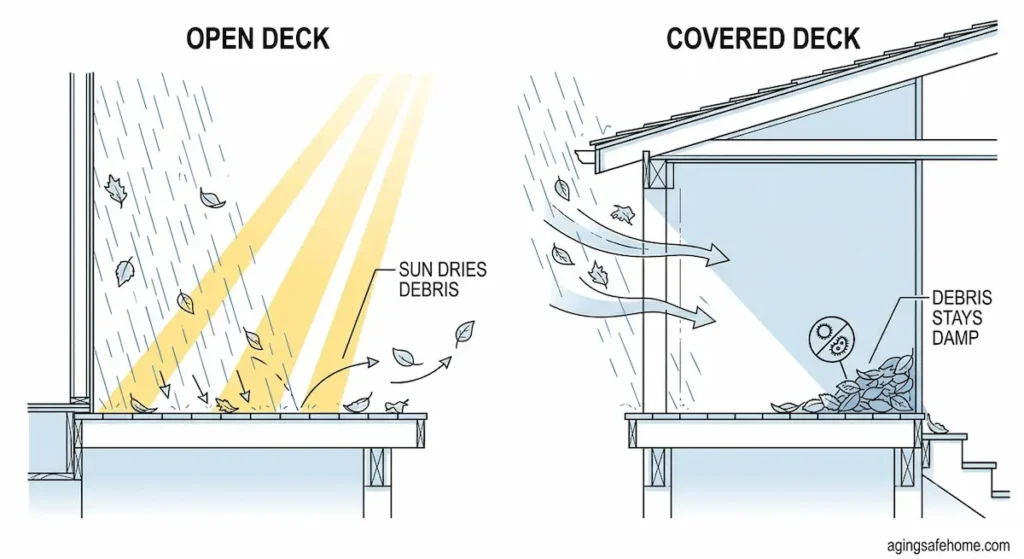
I love a covered porch, but I’ve seen plenty of people assume that because it’s covered, it’s automatically safer. Leaves and debris don’t travel in a straight line, they blow sideways, backwards, in circles, before they land, and a hard rain does the same thing. Odds are your covered porch is still getting debris and moisture underneath it.
Here’s the catch, though. That cover protecting you from the sun is also protecting whatever’s wet under there from drying out. So debris that would dry out and blow off an open deck can sit damp for days under a covered one, which is worse for rot, not better. Bottom line, get your broom out regardless of whether it’s covered or not.
Screens are a separate decision from cover. You can have a covered porch that isn’t screened in at all. If you’re considering a screen door, think about grip strength. A standard hinged screen door doesn’t add an extra threshold, but a sliding screen door usually does, unless it’s recessed into the frame. If a family member’s grip strength is a concern, that’s worth discussing with your contractor before you commit to a style. Sometimes screening in just a section of the porch or the back deck is a better call than the whole thing.
If you’re thinking about adding cover where you don’t have it, not just working with what’s already there, I go through the real options, fixed awnings, roof extensions, what holds up to snow and wind, and the mistakes that cause leaks, in my porch awnings and roof extensions guide.
Lighting: The Blind Transition
I talked in my outdoor lighting guide about how a light behind someone can cast a shadow over the exact steps they’re trying to see. Porches have their own version of that same problem, and it’s about contrast, not shadow.
When someone steps out of a bright, well-lit living room onto a dim porch at night, their eyes need a few seconds to adjust. During that window, they’re walking half-blind on a surface they can’t fully see. The fix is keeping the light level right outside the door closer to the brightness they just left, rather than a sharp drop from bright to dark the second they cross the threshold. A good high-CRI LED fixture right at the door helps close that gap and cuts down on harsh shadows at the same time. Lighting is its own beast, generally the best rule of thumb is to have multiple lights that create an overlap so there aren’t any shadows. It’s covered more in depth in my lighting article.
Furniture and Obstacles
The mistakes I see repeat themselves. Furniture that’s light and unstable, the kind that tips over if the wind picks up. Furniture placed directly in a walking path instead of off to the side. And just plain too much clutter crowding the space. As a rule of thumb, I try to keep at least 36 inches of clear walking path open at all times, that’s enough room for a walker or a wheelchair to move through without squeezing past anything.
The 5-Minute Deck and Porch Safety for Seniors Audit
If you want to check your own property before calling anyone, here’s the walkthrough I’d do, in order:
- Check the door threshold. Open your main exterior door and look at the drop from indoor flooring to the porch or deck surface. Anything more than about a half inch is worth addressing.
- Do the heel-drop test. Walk the center of the deck and drop your weight onto your heels every few feet. Springy, bouncy, or hollow-sounding spots point to joist problems underneath.
- Look for rust staining. Check fastener heads across the surface for dark red or black staining bleeding into the wood. That’s corrosion working on the fastener underneath.
- Shake test the railing. Lean on it the way you naturally would. Real sway from a light lean means the anchor points need attention.
- Check the balusters. Nothing wider than 4 inches should be able to pass between the spindles.
- Clear the 36-inch path. Measure the walkway from your door to the steps or seating area and move anything, plants, doormats, furniture, that’s crowding it.
That covers the deck and porch specifically. If you haven’t already, it’s worth running the same kind of eye over the rest of the property too, I put together a free home safety checklist that walks through the same room-by-room approach I use on a full assessment.
FAQ: Deck and Porch Safety for Seniors
What are the most common hazards for deck and porch safety for seniors?
Uneven decking, loose railings, rusted or failing fasteners, an unmarked threshold drop, and clutter or furniture blocking the walking path are the most common issues I find on an existing deck or porch.
How often should I check my deck for safety issues?
A visual inspection once or twice a year is a good baseline, but high-traffic areas like a deck that connects directly to the house should get the same attention as your front steps.
Why does my deck feel bouncy even though the boards look fine?
Usually, the joists underneath are the problem, either they’re rotting from the top down where moisture sits between the boards and the frame, or they were spaced too far apart when the deck was originally built. Another reason could be that the span of the joist itself is too long.
Are covered porches safer than open ones?
Not automatically. Covered porches still collect debris and moisture, and because they’re shaded, that moisture doesn’t dry out as fast, which can actually mean more rot risk in certain spots if it’s not cleaned regularly.
Can I install an outdoor grab bar on my porch?
Yes, as long as it’s anchored into something solid like a stud or doorframe. Stainless steel bars hold up well outdoors, just be mindful of direct sun exposure, which can make the metal too hot to comfortably grab.
How do I know if my deck railing is actually loose or just normal flex?
Lean on it the way you naturally would for support. A small amount of give is normal. If it sways noticeably from a light lean, the anchor points likely need attention.
What’s the safest way to fix a threshold drop at my porch door?
A modular rubber threshold ramp or a low-profile transition wedge installed on the exterior side smooths out the drop without altering the door itself.
Bottom Line
A deck or porch doesn’t have to be new to be safe, but it does have to be checked. Most of what causes a fall out there isn’t dramatic, it’s a board that’s been soft for months, fasteners rusting out where nobody can see them, a threshold drop nobody ever noticed, or a railing nobody’s tested. Familiar and safe are not the same thing. You’ve walked that porch a thousand times without a problem, right up until the one time it is one. Walk it with fresh eyes, fix the small stuff before it becomes the big stuff, and it’ll hold up for your family for years to come.